Welcome Guest – Erin Johnson

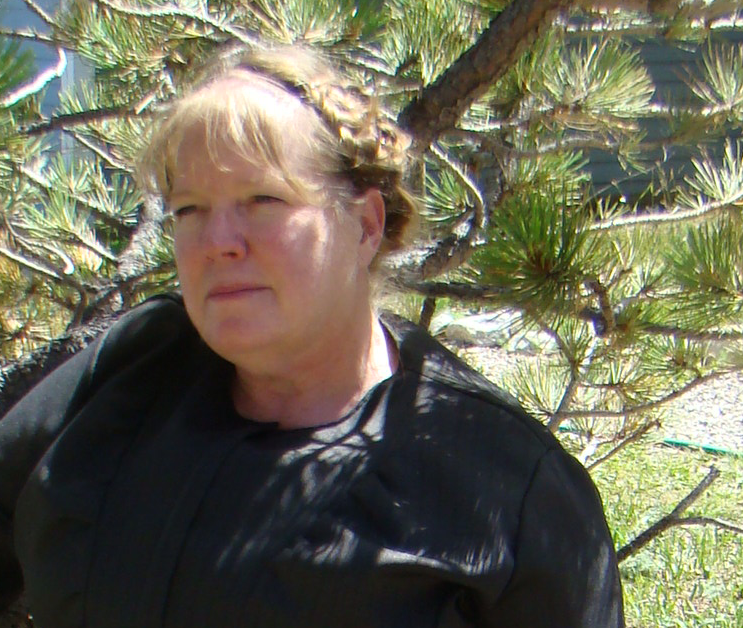
Rachel photo web

I’ve always been interested in history and did a lot of research on the West while I was writing the Encyclopedia of Native American Tribes (Cengage, 2012). I also spent time in Arizona after my father moved to a ghost town near the Mexican border, and I was fascinated by the area around Tombstone, where much of the WANTED series is set.

encyclopedias

Wanted_GraceBk1

In the first book in the series, Grace and the Guiltless, Grace is the lone survivor after outlaws massacre her family. She risks her reputation by entering the notorious Bird Cage Theater to report the crime to the sheriff:

Clouds of smoke enveloped Grace. Like the black, acrid smoke from the burning cabin that still clung to her pores and clothes, the sweetish cigar smoke and the sharper scent of burning tobacco from hand-rolled cigarettes suffocated her. Raucous laughter, the tinkle of a piano, and the clink of glasses pulsed through the room. The infamous alcoves, or bird cages, some with their red velvet curtains drawn, perched overhead like rows of fancy packages.

Her eyes stinging from the haze, Grace squinted to find the sheriff. So many black frock coats blurred into an indistinguishable mass…

WantedGraceandtheGuiltless_smDisentangling herself from pawing hands as she crosses the room, Grace irritates the sheriff by separating him from the painted lady keeping him company.

The heavyset man frowned at her. “So, what can I do for you, Miss —”

“Grace Milton, sir. Yesterday my parents . . . my whole family . . .” Grace’s tongue tripped over the words. If she said them aloud, it would make it real. But if she didn’t, those killers would get away with what they had done. “Elijah Hale and his gang . . . they shot my pa, and-and…”

The sheriff’s face paled at the mention of Hale’s name, but he leaned back in his chair and steepled his fingers, though his hands shook slightly. “Mr. Hale is well known in these parts as a respectable man.”

Respectable man? A picture imprinted itself on Grace’s mind – Hale smiling, his gun pointed straight at her father’s heart.

The sheriff pulled a cigar from his vest pocket and rolled it between his fingers, avoiding her eyes.

Her Cold Revenge 9781630790073 web“Did you hear me? Hale killed my pa. And my ma, and my—”

The sheriff chomped down on the cigar, twisted, and then spat the end into the nearby spittoon. The wad hit the brass with a wet ringing sound. “Any witnesses?”

“Me,” Grace choked out.

Sheriff Behan lit his cigar and blew a puff of smoke in Grace’s direction. “Not sure your word,” he said, his gaze raking her disheveled appearance, “would stand up against Hale’s.” He waved his cigar in a dismissive circle. “You bring me some proof, and I’ll consider looking into it.”

A white-hot volcano of rage erupted in Grace’s stomach. Did that badge glinting at her from across the table mean anything at all?

“My family’s dead in the ground.” She sucked in air to control the tremor in her voice. “I dug their graves myself.” She held out her blistered and bloodied hands. “Is that proof enough for you?”

Something flickered in the sheriff’s eyes. Pity maybe? But he quickly shuttered it. “That’s a sad story Miss Milton, but people die every day.” His voice loaded with fake sympathy, he continued, “Lots of Injuns ’round here. Renegade soldiers. Hermits. Even coyotes. Understandable you’d be a mite mixed up following such a tragedy. You being hysterical and all.”

Wanted_GraceBk2“I. Am. Not. Hysterical.” Grace spat out each word. Furious, yes. Hysterical, no. Although he was rapidly pushing her in that direction. She’d get no help from this snake.

As Grace suspects, the sheriff is in cahoots with the gang, so she trains as a bounty hunter to singlehandedly track down the criminals. One reviewer calls her the “Katniss of the Wild West.” But when Grace falls for Joe, a?rugged range rider, can she give up her independence to take on a partner?

In book 2, Her Cold Revenge, Grace must prove her skills and stop a train robbery masterminded by the outlaws who slaughtered her family. And as she slowly opens her heart to both Joe and the Ndeh tribe, who take her in, her heartache begins to heal. Yet she’s still torn between revenge and love.

“Every second had me on the edge of my seat…”

“I’ve never been so moved by a book. You honesty made me cry…”

The books in the WANTED series came out in the UK first, and then in the U.S., with different covers.

Scuppernong readingFeast on Fiction

 Erin Johnson grew up watching classic western movies with her father, which fueled her lifelong love of horseback riding. She’s always dreamed of being a fierce-talking cowgirl, but writing about one seemed like the next best thing. She loves traveling, painting, and teaching, and she writes under several pseudonyms for both children and adults.

Blog: http://lje1.wordpress.com/erin-johnson/

Wattpad: http://www.wattpad.com/story/16791791-grace-and-the-guiltless

http://www.wattpad.com/story/38198225-her-cold-revenge

Buy links: G&G http://www.amazon.com/Grace-Guiltless-Wanted-Erin-Johnson/dp/163079001X/?tag=pettpist-20

HCR: http://www.amazon.com/Cold-Revenge-Wanted-Erin-Johnson/dp/1630790079/?tag=pettpist-20

Giveaway! : Erin has a great giveaway with two separate winners!  For a chance to win, leave a comment for Erin and you’ll be entered.  One winner will receive a copy of Grace & the Guiltless and the second winner will receive a copy of the recipe book, Feast on Fiction!

Jane Porter: One Room School Houses

A former teacher, I come from a long line of passionate educators. My father was a history and political science professor. My brother Thom is a business professor at UNC Wilmington, and my great grandfather was a professor of refrigeration engineering at Purdue University.

With teaching in my blood, it’s a given that I’ll write a story or two about teachers (Kit Brennan in The Good Daughter teaches English at a Catholic High School in Oakland, California and Jesslyn from The Sheikh’s Chosen Queen teaches at an international school in the UAE), I’ve never written about a teacher in a one room school house…until now.

My new story, The Lost Sheenan’s Bride, which releases on Friday, July 8th, is about a young teacher taking a long-term substitute job at one-room schoolhouse in Montana. The story wasn’t about the one-room school, but you wouldn’t know it from my research. I’m fascinated by Montana history, and in particular the intrepid women who first settled there.

Some facts from http://montanawomenshistory.org:

  • It’s estimated that up to 18 percent of homesteaders in Montana were unmarried women.
  • Passage of the Homestead Act of 1862 allowed any twenty-one-year-old head of household the right to homestead federal land. Single, widowed, and divorced women fit this description, and they crossed the country to file homestead claims of 160 acres.

Many of the homesteading women in Montana also became the state’s first teachers. Because of the Homestead Act of 1862, one-room schoolhouses were built all over the state.   Historians estimate that there were once 2,600 rural schools in Montana, and those rural schools served a multitude of purposes for each community, from education to social gatherings. In America today, there are still 200 operational one-room schoolhouses, with 62 of them located in Montana.

Screen Shot 2016-07-02 at 9.55.06 AM
The one room school house in Paradise Valley that inspired my story (photo courtesy Megan Crane )

Last month in early June I returned to Montana for eight days, and on my flight from Seattle to Kalispell I sat next to a woman who worked for the Swan Valley school district which still has an operational one-room school in the town of Salmon Prairie. The woman, a school clerk, loves the one-room school in Salmon Prairie and told me about the exceptional quality of education the children receive, the time teacher is able to devote with his students, the ability to individualize lessons and even better, the opportunity for a teacher to truly teach Montana—morning nature walks, visits to local parks (Glacier National Forest, Yellowstone, etc). The teacher doesn’t just teach math and reading, but hunts and fishes with his students and embraces what it means to be a Montanan. (Here is a story on the school in Salmon Prairie! Photographers document Montana’s disappearing one-room schools)

I was able to work a little of that fascinating conversation into my story, but its impossible to convey the history for Montana’s one-room schools in a 50,000 word contemporary romance, but I’ll try to share a bit more here with you since I know you’re all history and western buffs, too.

In 2013, The National Trust for Historic Preservation added Montana’s one-room schoolhouses to their list of the Nation’s 11 Most Endangered Historical Places.

Today at Montana’s Divide School, built in 1870, teacher Judy Boyle functions as teacher, principal, and guidance counselor. Grades K-8 are taught in the same room to as many as eight students. This year she had 3 students, and as there are no janitors, it is part of the kids’ responsibility to help clean the school daily.

As an American Studies major at UCLA, I focused on Frontier literature with my senior thesis on Mark Twain, and you can’t immerse yourself in Frontier lit without understanding the significance of the one-room schoolhouse scattered across vast prairies and in the snug valleys nestled between the Rockies. The schools represented hope and opportunity, and education was a big part of that opportunity. Homesteaders and miners, ranchers and railroad workers wanted their children to succeed, and the best way to succeed was by getting an education, and the sheer number of the schools still standing today are a reminder of the commitment Montanans made to their children.

IMG_0156
Another historic school house in Paradise Valley, this one still in operation.

Many of us grew up with Little House on the Prairie, or are fans of Hallmark’s popular series, When Calls the Heart, so we can picture the one room school. There was very little variation from one school to another:

  • Teachers were typically male. If the teacher was a woman, she had to be single. Married teachers were not allowed.
  • Frequently, families in the rural towns would take turns boarding the teacher, with every family contributing towards the teacher’s salary.
  • Schoolhouses had only a few windows and one door. Bigger schools might have two doors for separate entrances for the boys and girls.
  • The teacher’s desk was located at the front of the room and the teacher wrote the lessons on a large slate board, much like chalkboards or white boards in classrooms today.
  • There was no bathroom or running water. Students used an outhouse.
  • The children sat at narrow wooden desks and/or on long wooden benches, with boys sat on one side and the girls on the other.
  • Schoolhouses were heated by one stove with the older students responsible for keeping the fire going.

One of my favorite books I bought in Montana several years ago, that probably also helped inspire my new story was Visions and Voices: Montana’s One-Room Schoolhouses. The pictures are worth the price of the book alone, but there are also wonderful quotes and stories from former students who were educated in these schools.

Visions and Voices: Montana’s One-Room Schoolhouses
by Charlotte Caldwell
Link: http://amzn.com/0985497106

cover

Three other favorites books from my shelves on Montana and women homesteaders:

Nothing to Tell: Extraordinary Stories of Montana Ranch Women
by Donna Gray
Link: http://amzn.com/0762779098

Montana Women Homesteaders: A Field of One’s Own
by Sarah Carter
Link: http://amzn.com/1560374497

Staking Her Claim: Women Homesteading the West
by Marcia Meredith Hensley
Link: http://amzn.com/0931271908

To celebrate the release of my new book, The Lost Sheenan’s Bride, featuring Jet Diekerhof, the teacher of a one-room schoolhouse in Paradise Valley, Montana, I’m giving away a signed print copy of the book, plus lots of fun reader swag. Interested? Tell me if you think you would have enjoyed attending school at a one-room school. One comment will be drawn and the winner will be announced on Wednesday, July 13th so do check back and see if that was you!

Look for The Sheenans’s Lost Bride at these online retailers:
Amazon | iBooks | Amazon UK

TheLostSheenanBride-MEDIUM

Doc Susie: The truth of Colorado Women Physicians & Giveaway

close up hhj spcPlease welcome guest blogger:

Doris McCraw/Angela Raines

Doris is giving away four eBooks,

so be sure to leave a comment!

In January 1991, “Doc Susie, The true story of a country physician in the Colorado Rockies” was given to the world. This biography of Dr. Susan Anderson began the legend of the lone woman doctor who gave up so much to follow her dreams. This legend became a myth when “Dr. Quinn, Medicine Woman” hit the airwaves in 1993, two years after the release of the book. Both were full of drama and pathos.

But was Dr. Anderson the norm for women doctors, or is there more to the story? Susan Anderson , born January 31, 1870, received her license to practice medicine in Colorado in 1897 and the bulk of her story takes place in Frasier, Colorado after 1907, where she was the lone doctor, and never married. To put this in perspective, Colorado had women physicians as early as 1873. Dr. Alida Avery came to Denver, Colorado in 1874 from Vassar, where she taught and was their physician for nine years. Like Doc Susie she also remained single.

9-6-2015 209In 1876, according to relatives, Dr. Harriet Leonard arrived in Manitou Springs, Colorado, with husband and children. By 1878 she was joined by Dr. Julia E. Loomis, Dr. Esther B. Holmes and shortly after Dr. Clarabel Rowe in Colorado Springs. All four of these women were married and practiced their chosen career, along with the sixteen other doctors in the area in the late 1870’s. Dr. Loomis went to medical school in her 50’s. None of these women, who appear to have been married prior to going for their medical degree, could have achieved their goal without a least some support from their husbands.

In 1881 when Colorado started licensing physicians, women were licensed the same as men. Dr. Edith Root of Denver, Colorado may have been the first to receive her license. Her license number was 82.2-19-2013 020

Between 1870 and 1880 Colorado saw the arrival of many physicians, which included a number of women. This may have in part been due to Colorado being touted for a climate known for helping those who suffered from consumption. Note, consumption was not just TB, but any wasting disease. There was another spurt from 1890-1900. Yes, many of these women congregated in the larger towns, to include the boom towns of Leadville, Cripple Creek and Victor. Once the floodgates were opened, women physicians made their way to Colorado. Many became involved in the suffrage movement, while others worked to better the conditions of others. Dr. Caroline Spencer of Colorado Springs and Dr. Alida Avery worked for the rights of women. Dr. Mary Helen Barker Bates helped start a hospital in Leadville. Dr. Kate Yont worked in the Italian community with the naturalization process in Denver. Some carried guns, others didn’t have to, but all have stories waiting to be told.

So you see, while the story of Dr. Susan ‘Doc Susie’ Anderson is a wonderful story, it is by far not the norm for women doctors in the state of Colorado. There were many before her who also followed the dream of helping people in need.

Doris McCraw has been researching the women doctors in Colorado prior to 1900 for some time. Finding the stories of these pioneering and determined women is a passion. Doris also writes fiction under the pen name Angela Raines where she tells the stories of strong women and men who find the strength to love, much like the women doctors who followed their dreams.

 Author Page: http://amzn.to/1I0YoeL

What do you think was the biggest challenge for those early female doctors?


Angel of Salvation ValleyA Cowboy CelebrationOne Christmas Knight     Home For His Heart


Four lucky readers will win one of these delightful e-books. The rest of us can order by clicking on the covers.

Sweepstakes Rules Apply


Taming the West One Meal at a Time

MargaretBrownley-header

Nothing changed America as much as the iron horse. People were finally able to travel across country in relative comfort and not have to worry about the weather, Indians, or some of the other mishaps that plagued early travelers. A train passenger’s greatest fear was food poisoning. That’s how bad meals were along the rails.

It took one efrednterprising Englishman to change the way travelers ate. His name was Fred Harvey and his Harvey House restaurants eventually stretched along the Santa Fe railroad tracks from Chicago all the way to Los Angeles and San Francisco—one every hundred miles.

Hear That Whistle Blow

Fred Harvey invented the “fast-food” concept long before Ray Kroc. Passengers were allowed only thirty minutes to get off the train, eat and board again, so time was of the essence. He devised a system in which train conductors would telegraph passenger food orders to the restaurant in advance. This allowed the restaurant staff to prepare the food before the train pulled into the station.

From Dishwasher to Household Name

Harvey learned the business the hard way. After traveling to America at the age of seventeen, he landed a job as a dishwasher at a famed New York restaurant, working his way through the ranks from dishwasher to line-cook. He eventually landed in St. Louis where he took over the Merchants Dining Room Saloon. His success lasted only a short time. The winds of war could not be ignored and after his partner joined the secessionist army, taking all the money the two men had saved, Harvey’s restaurant was doomed.

After a series of jobs and personal losses, he eventually took over an eating house at the Santa Fe depot in Topeka. He arranged for fresh fruit and meat to be railed in from Chicago and other states. His food was so good that railroad officials worried that no one would want to travel past Topeka.

First Female Workforce

As the number of his depot restaurants increased, so did his troubles. Black men were hired as waiters, but this often created conflict with cowboys. After one unpleasant midnight brawl at the Raton Harvey eating house, Harvey’s friend Tom Gables suggested a radical idea; why not replace black male waiters with women? Harvey decided to give Tom’s idea a try.

Harvey ran ads in newspapers for “young women of good character, attractive and intelligent, 18 to 30, to work in the Harvey Eating Houses.” He offered a salary of $17.50 a month, a tidy sum for a young woman. Soon he had all the help he needed.

300px-Harveyhouse3
This Harvey House is in Barstow, CA. It’s now a museum. I used it as a model for my story.

The women lived in dormitories above the restaurants under the watchful eye of a house mother. Their uniforms consisted of a black dress, black shoes and stockings, and a crisp white apron. The women had to adhere to strict rules and were not allowed to marry for six months.

His new female staff was a great success and helped ease racial tensions. Even the roughest of cowboys and railroad workers were willing to don the required (and dreaded) dinner jacket just for the pleasure of being served a good steak by a pretty girl.

He Kept the West in Food—and Wives

That quote from Will Rogers says it all; Among his other talents, Fred Harvey not only “civilized the west” he was indirectly responsible for more than 5000 marriages. That’s enough to make you want to forgive him for inventing fast-food. Almost….  

What’s the best or worse meal you had while traveling?


Calico SpySomeone is killing off the Harvey Girls. Undercover Pinkerton detective Katie Madison hopes to find the killer before the killer finds her—or before she burns down the restaurant trying.


Amazon

iTunes


Taking a Chance—a Big Chance—on Love & Book Giveaway

MargaretBrownley-header

“Did you ever wonder why we use the word engagement
to describe both a promise of marriage and a war battle?”-Undercover Bride

My June release Undercover Bride is a mail order bride story with a twist. Maggie Michaels is a Pinkerton detective working undercover to nab the Whistle-Stop Bandit. To do this she is posing as his mail order bride. The clock is ticking; if she doesn’t find the proof she needs to put him in jail, she could end up as his wife!

My heroine has a good reason for doing what she’s doing, but what about the thousands of other women during the 1800s who left family and friends to travel west and into the arms of strangers?

Shortage of Men

mailThe original mail order bride business grew out of necessity. The lack of marriageable women in the west was partly responsible, but so was the Civil War. The war created thousands of widows and a shortage of men.

As a result, marriage brokers and “Heart and Hand” catalogues popped up all around the country. Ads averaged five to fifteen cents and letters were exchanged along with photographs. It took ten days for a letter to travel by Pony Express and often the wax seals would melt in the desert heat, causing letters to be thrown away before reaching their destinations.

According to an article in the Toledo Blade a lonely men even wrote to the Sears catalogue company asking for brides (the latest such letter received was from a lonely Marine during the Vietnam War).

                                      Cultural Attitudes

wife

Marriage was thought to be the only path to female respectability. Anyone not conforming to society’s expectations was often subjected to public scorn. Women who had reached the “age” of spinsterhood with no promising prospects were more likely to take a chance on answering a mail order bride ad than younger women.

Not Always Love at First Sight

For some mail-order couples, it was love (or lust) at first sight. In 1886, one man and his mail order bride were so enamored with each other they scandalized fellow passengers on the Union Pacific Railroad during their honeymoon.

Not every bride was so lucky. In her book Hearts West, Christ Enss tells the story of mail order bride Eleanor Berry. En route to her wedding her stage was held up at gunpoint by four masked men. Shortly after saying “I do,” and while signing the marriage license, she suddenly realized that her husband was one of the outlaws who had robbed her. The marriage lasted less than an hour.

Men: Do Not Be Deceivedmail2

Women weren’t the only ones who could be duped. Ads popped up warning men not to be seduced by artificial bosoms, bolstered hips, padded limbs, cosmetic paints and false hair.

Despite occasional pitfalls, historians say that most matches were successful. That’s because the ads were generally honest, painfully so in some cases. If a woman was fat and ugly she often said so. If not, photographs didn’t lie (at least not before Photoshop came along).

There may have been another reason for so much married bliss. A groom often signed a paper in front of three upstanding citizens promising not to abuse or mistreat his bride. She in turn promised not to nag or try to change him.

No one seems to know how many mail order brides there were during the 1800s, but the most successful matchmaker of all appears to be Fred Harvey who, by the turn of the century, had married off 5000 Harvey girls.

Okay, since it’s almost June and I’ve got brides on my mind how about sharing a wedding memory, either your own or someone else’s?  It can be funny, sweet, nightmarish or just plain special.  Fair warning: anything you say could be used in a book!  If all else fails just stop by and say hello and I’ll put your name in the old Stetson.

undercovertiny

Wild West Guns and Grins or How the West Was Fun

 Another Pinkerton Lady Detective is on the case. This time the female operative masquerades as a mail-order bride. Pretty funny overall plot to begin with, so expect some fun reading while the detective team attempts to unmask a pair of train robbers and murderers. That’s how Margaret Brownley writes. Western mystery with humor rolling throughout, like tumbleweeds on Main Street.

                                                           -Harold Wolf on Amazon

Amazon

B&N


First Petticoats & Pistols Giveaway of Now and Forever

Now and Forever
Click to Buy Now and Forever 


Now and Forever Book #2 of the Wild at Heart Series is now shipping from Amazon!

To celebrate it’s release I’m posting an excerpt and giving away a signed copy to one lucky commentor. (please try and think of yourself as lucky!)

Matt Tucker could take people for only so long and then he had to get up in the mountains, all the way up where he was more likely to run into a golden eagle than a man. He’d wander in the thin pure air for a week or two, to clear his thoughts. Forget the smell and behavior of men.

This time it wasn’t men driving him to the high-up peaks. This time it was a certain head full of dark curls and a pair of shining blue eyes. Not a man—though no one would admit it—which was so odd he almost turned around.

In fact he wanted to turn around so bad he walked faster.

            He scooted past a boulder—and stomped on the toe of a bear cub.

A squall drew his eyes down. A roar dragged them up. He looked into the gaping maw of an angry mama grizzly. He hadn’t heard her or smelled her. Honestly, that was so careless and stupid he almost deserved to die.

            She swung a massive paw and he had no time to dodge. She knocked him over the side of that mountain. Not a cliff, but the next thing to it. He slammed into an aspen.

He bounced off and plummeted.

The next Aspen hit so hard his ribs howled in pain. He snagged. His arms, legs and back whipped forward but his haversack held. It saved him.

That’s when he heard a roar. It brought his head around.

The mama wasn’t satisfied with knocking him off a mountain. She was coming, and coming fast, finding a way down somehow.

Finally he slammed into level ground and stopped, sprawled flat on his back. He flickered his eyes open, knowing he had to get up and run. The bear was coming.

            His blurred vision filled with a cap of dark curls and the prettiest blue eyes he’d ever seen.

            Well, no. Not ever.

            Because he’d seen them before on the roof of Aaron and Kylie Masterson’s cabin. He wanted to just lay there and look forever.

            And then that dratted bear roared and those blue eyes, looking at him all worried, turned uphill and changed from concern to horror.

            The pretty little gal reached down, grabbed Tucker by the front of his shirt, and hauled him upright. What was she going to do, throw him over her shoulder and run? He didn’t think that was going to work. He was about six inches taller and outweighed her by a hundred pounds.

            But Mama Grizz was coming, so someone was going to have to do something. They couldn’t stay here, and Tucker wasn’t sure he was up to moving. Of course he’d only had about two second to think about it. He hadn’t really tried.

            “Hang on!” She shoved him backward, clinging so tight it was like he’d gotten a second pack hooked on.

            She screamed.

            They flew. There was no more rolling. No more aspens. No more rocks. They soared.

            Tucker saw the walls of the cliff rushing past and knew where they were. Worse yet, he knew where they were going to land. “Are you crazy?”

             They were falling to almost certain death. He’d just been killed by a woman as crazy as he was. Well, he wasn’t killed yet. But it was only a few minutes ahead of them.

            The bear roared overhead.

            The dark curled madwoman shouted, “I hope Bailey’s not too stubborn to tend my sheep.”

            “I hate sheep.”

            They hit the water so hard it was like slamming into granite.


Mary Connealy
Mary Connealy

Except over….Mary again.

Well, things only get worse for poor Tucker and Shannon right along with him. They’re a long while saving themselves and as a reward for doing it??? It turns out they spent five days alone together, day and night. Only a wedding will do.

It’s a lot of fun this adventure with Shannon and Tucker. Give it a chance.


NOW AND FOREVER

Saddle up for romance and adventure with the Wilde sisters!

Shannon Wilde is the middle sister–and the one who loves animals. She’s established her own homestead and is raising sheep for their wool. Things are going fine…until Shannon gets swept over a cliff by Matthew Tucker!

Tucker seizes every opportunity to get away from civilization, but one particular walk in the woods ends with him sprinting away from an angry grizzly and plunging into a raging river, accidentally taking Shannon Wilde with him. Their adventure in the wilderness results in the solitary mountain man finding himself hitched to a young woman with a passel of relatives, a homestead, and a flock of sheep to care for.

As Tucker and Shannon learn to live with each other, strange things begin to happen on Shannon’s land. Someone clearly wants to drive her off, but whoever it is apparently didn’t count on Tucker. Trying to scare Matthew Tucker just makes him mad–and trying to hurt the woman he’s falling in love with sets off something even he never expected.


Women Make History Daily, Not Just Once a Year

Men of sense in all ages abhor those customs which treat us only as the vassals of [their] sex. —Abigail Adams (1744-1818), second First Lady of the U.S.
“Men of sense in all ages abhor those customs which treat us only as the vassals of [their] sex.”
—Abigail Adams (1744-1818), second First Lady of the U.S.
I hope everyone will forgive me for not writing about western history this month — at least not specifically. Every so often, though, even those of us devoted to the history of the Old West must take a look even farther into the past, and sometimes much closer to the present, in order to develop a broader perspective about the era in which our imagination spends so much time. This is one of those occasions.

I do not wish women to have power over men, but over themselves. —Mary Wollstonecraft (1759-1797), writer and advocate for women’s rights
I do not wish women to have power over men, but over themselves.
—Mary Wollstonecraft (1759-1797), author and advocate for women’s rights

March is Women’s History Month. While I appreciate the increased emphasis on remembering women’s contributions to science, art, philosophy, and society in general, I’ve always considered it a bit odd that we need reminding women have contributed. Designating a specific month during which to focus on women’s history implies that for the rest of the year, everyone thinks of women as secondary characters in their own life stories.

Old-fashioned ways which no longer apply to changed conditions are a snare in which the feet of women have always become readily entangled. —Jane Addams (1860-1935) social reformer, women’s rights activist, first American woman to win the Nobel Peace Prize
“Old-fashioned ways which no longer apply to changed conditions are a snare in which the feet of women have always become readily entangled.”
—Jane Addams (1860-1935), social reformer, women’s rights activist, first American woman to win the Nobel Peace Prize

Women don’t sit around waiting for men to make all the great discoveries, think all the great thoughts, and fight all the dragons. They never have. Throughout history, as many women as men have explored the unexplored, cured the previously incurable, and given voices to those unable to speak for themselves. And, as has been famously stated, they did it all dancing backward in high heels.

If women could go into your Congress, I think justice would soon be done to the Indians. —Thoc-me-tony (aka Sara Winnemucca, 1844-1891), Pauite educator, interpreter, writer, activist
“If women could go into your Congress, I think justice would soon be done to the Indians.”
—Thoc-me-tony (aka Sara Winnemucca, 1844-1891), Pauite educator, interpreter, writer, activist

“It would be ridiculous to talk of male and female atmospheres, male and female springs or rains, male and female sunshine…,” women’s rights pioneers Susan B. Anthony and Elizabeth Cady Stanton wrote in one of their suffrage pamphlets. “[H]ow much more ridiculous is it in relation to mind, to soul, to thought…?”

Anthony and Stanton often railed against inequality between the genders and the resulting injustices visited upon the distaff side of humanity — lack of access to education and discriminatory civil laws, for example. Today, the philosophy they espoused is, or should be, de rigueur, but until the mid-20th Century, speaking such thoughts in public in many societies carried significant risk to life and liberty. In some societies, it still does.

The best protection any woman can have … is courage. —Elizabeth Cady Stanton (1815-1902), social activist, abolitionist, women’s rights crusader
The best protection any woman can have … is courage.
—Elizabeth Cady Stanton (1815-1902), social activist, abolitionist, women’s rights crusader

For precisely that reason, historical romance novels can be important beyond the obvious entertainment. Unlike much literature written in previous ages, primarily by men, romance novels written during the past twenty to thirty years, primarily by women, portray heroines and female villains with courage, determination, and strength equal to the hero’s. Call me a man-bashing feminist if you must, but I believe it is crucial for readers, particularly younger ones, to be presented with female characters who are much more than decorative pedestal dwellers.

The day will come when men will recognize woman as his peer, not only at the fireside, but in councils of the nation. Then, and not until then, will there be the perfect comradeship, the ideal union between the sexes that shall result in the highest development of the race. —Susan B. Anthony (1820-1906), social reformer, women’s suffrage leader
“The day will come when men will recognize woman as his peer, not only at the fireside, but in councils of the nation. Then, and not until then, will there be the perfect comradeship, the ideal union between the sexes that shall result in the highest development of the race.”
—Susan B. Anthony (1820-1906), social reformer, women’s suffrage leader

In fact, when one studies history, it becomes impossible to consider the romantic notion of heroes on white chargers rescuing damsels in distress anything more than exactly that: a romantic notion. On any frontier in any age, toughness and capability are essential for survival, regardless of gender. Today’s well-researched historical fiction makes that abundantly clear — and like it or not, fiction resonates in contemporary culture, subtly but undeniably influencing attitudes on both sides of the gender divide. Art always has been both reactive and proactive in that way.

So, readers and writers of romance, don’t let anyone tell you you’re wasting your time with ludicrous, lowbrow “trash.” You’re not. You’re buttressing ramparts our foremothers built long ago. Could there be a more pleasant, if stealthy, way to celebrate Women’s History Month?
 

Kitty LeRoy: Beloved Tramp

Main Street, Deadwood, SD, 1876

Some real-life episodes in the Old West read like fictional adventures. Some read like tragedies. Some read like romances.

The life stories of a few non-fictional characters—like Kitty LeRoy—combine all three.

“…Kitty LeRoy was what a real man would call a starry beauty,” one of her contemporaries noted in a book with a ridiculously long title*. “Her brow was low and her brown hair thick and curling; she had five husbands, seven revolvers, a dozen bowie-knives and always went armed to the teeth, which latter were like pearls set in coral.”

From all reports, LeRoy was a stunning beauty with a sparkling personality that had men—including both notorious outlaws and iconic officers of the law—throwing themselves at her feet. She was proficient in the arts of flirtation and seduction, and she didn’t hesitate to employ her feminine wiles to get what she wanted.

Often, what she wanted was the pot in a game of chance. One of the most accomplished poker players of her time, LeRoy spent much of her short life in gambling establishments. Eventually, she opened her own in one of the most notorious dens of iniquity the West has ever known: Deadwood, South Dakota. With spectacular diamonds at ears, neck, wrists, and fingers glittering bright enough to blind her customers every night, it’s no wonder LeRoy’s Mint Gambling Saloon prospered.

With her reputation as an expert markswoman, there was very little trouble…at least at the tables.

LeRoy was born in 1850, although no one is sure where. Some say Texas; others, Michigan. One thing is certain: By the age of ten, she was performing on the stage. Working in dancehalls and saloons, she either picked up or augmented an innate ability to manipulate, along with gambling and weaponry skills that would serve her well for most of her life. According to local lore, at fifteen she married her first husband because he was the only man in Bay City, Michigan, who would let her shoot apples off his head while she galloped past on horseback.

Lower Main Street, Deadwood, SD, 1877

A long attention span apparently was not among the skills LeRoy cultivated. Shortly after her marriage, she left her husband and infant son behind and headed for Texas. By the age of twenty, she had reached the pinnacle of popularity at Johnny Thompson’s Variety Theatre in Dallas, only to leave entertaining behind, too.

Instead, she tried her hand as a faro dealer. Ah, now there was a career that suited. Excitement, money, men…and extravagant costumes. Players never knew what character they would face until she appeared. A man? A sophisticate? A gypsy?

Texas soon bored LeRoy, but no matter. With a new saloonkeeper husband in tow, she headed for San Francisco—only to discover the streets were not paved with gold, as she had heard. While muddling through that conundrum, she somehow misplaced husband number two, which undoubtedly made it easier for her to engage in the sorts of promiscuous shenanigans for which she rapidly gained a reputation.

Although the reputation didn’t hurt her at the gaming tables, it did create a certain amount of unwanted attention. One too-ardent admirer persisted to such an extent that LeRoy challenged him to a duel. The man demurred, reportedly not wishing to take advantage of a woman. Never one to let a little thing like gender stand in her way, LeRoy changed into men’s clothes, returned, and challenged her suitor again. When he refused to draw a second time, she shot him anyway. Then, reportedly overcome with guilt, she called a minister and married husband number three as he breathed his last.

Now a widow, LeRoy hopped a wagon train with Wild Bill Hickock and Calamity Jane and headed for the thriving boomtown of Deadwood. They arrived in July 1876, and LeRoy became an instant success by entertaining adoring prospectors nightly at Al Swearengen’s notorious Gem Theatre. Within a few months, she had earned enough money to open her own establishment: the Mint. There, she met and married husband number four, a German who had struck it rich in Black Hills gold. When the prospector’s fortune ran out, so did LeRoy’s interest. She hit him over the head with a bottle and kicked him to the curb—literally.

Gem Theatre, Deadwood, SD, 1878

Meanwhile, thanks to LeRoy’s mystique—and allegedly no little fooling around with the customers—the Mint became a thriving operation. LeRoy reportedly “entertained” legendary characters as diverse as Hickock and Sam Bass. But it was 35-year-old card shark Samuel R. Curley who finally claimed her heart. Curley, besotted himself, became husband number five on June 11, 1877.

Shortly thereafter, Curley learned LeRoy hadn’t divorced her first husband. The bigamy realization, combined with rumors about LeRoy’s continued promiscuity, proved too much for the usually peaceful gambler. He stormed out of the Mint and didn’t stop until he reached Denver, Colorado.

Folks who knew LeRoy said she changed after Curley’s departure. Despite nights during which she raked in as much as $8,000 with a single turn of the cards, she grew cold and suspicious.

Her grief seemed to dissipate a bit when an old lover showed up in Deadwood. LeRoy rented rooms above the Lone Star Saloon, and the two moved in together.

By then, Curley was dealing faro in a posh Cheyenne, Wyoming, saloon. When word of LeRoy’s new relationship reached him, he flew into a jealous rage. Determined to confront his wife and her lover, he returned to Deadwood December 6, 1877. When the lover refused to see him, Curley told a Lone Star employee he’d kill them both.

LeRoy, reportedly still pining for her husband, agreed to meet Curley in her rooms at the Lone Star. Not long after she ascended the stairs, patrons below reported hearing a scream and two gunshots.

Deadwood, SD, 1878
Deadwood, SD, 1878

The following day, the Black Hills Daily Times reported the gruesome scene: LeRoy lay on her back, her eyes closed. Except for the bullet hole in her chest, the 27-year-old looked as though she were asleep. Curley lay face down, his skull destroyed by a bullet from the Smith & Wesson still gripped in his right hand.

“Suspended upon the wall, a pretty picture of Kitty, taken when the bloom and vigor of youth gazed down upon the tenements of clay, as if to enable the visitor to contrast a happy past with a most wretched present,” the newspaper report stated. “The pool of blood rested upon the floor; blood stains were upon the door and walls…”

An understated funeral took place in the room where Curley killed his wife and then took his own life. Their caskets were buried in the same grave in the city’s Ingleside Cemetery and later moved to an unmarked plot in the more noteworthy Mount Moriah.

The happiness the couple could not find together in life, apparently they did in death. Within a month of the funeral, Lone Star patrons began to report seeing apparitions “recline in a loving embrace and finally melt away in the shadows of the night.” The sightings became so frequent, the editor of the Black Hills Daily Times investigated the matter himself. His report appeared in the paper February 28, 1878:

…[W]e simply give the following, as it appeared to us, and leave the reader to draw their own conclusions as to the phenomena witnessed by ourselves and many others. It is an oft repeated tale, but one which in this case is lent more than ordinary interest by the tragic events surrounding the actors.

To tell our tale briefly and simply, is to repeat a story old and well known — the reappearance, in spirit form, of departed humanity. In this case it is the shadow of a woman, comely, if not beautiful, and always following her footsteps, the tread and form of the man who was the cause of their double death. In the still watches of the night, the double phantoms are seen to tread the stairs where once they reclined in the flesh and linger o’er places where once they reclined in loving embrace, and finally to melt away in the shadows of the night as peacefully as their bodies’ souls seem to have done when the fatal bullets brought death and the grave to each.

Whatever may have been the vices and virtues of the ill-starred and ill-mated couple, we trust their spirits may find a happier camping ground than the hills and gulches of the Black Hills, and that tho’ infelicity reigned with them here, happiness may blossom in a fairer climate.


Sources:

* Life and Adventures of SAM BASS, the Notorious Union Pacific and Texas Train Robber, Together with a Graphic Account of His Capture and Death, Sketch of the Members of his Band, with Thrilling Pen Pictures of their Many Bold and Desperate Deeds, and the Capture and Death of Collins, Berry, Barnes, and Arkansas Johnson (W.L. Hall & Company, 1878)

The Lady Was a Gambler: True Stories of Notorious Women of the Old West by Chris Enss (TwoDot, October 2007)

Women of the Western Frontier in Fact, Fiction and Film by Ronald W. Lackmann (McFarland & Company Inc., January 1997)


Nuns on the Frontier

threesisters
An early re-enactment of the 1869 journey from Galveston to San Antonio undertaken by three Sisters of Charity of the Incarnate Word. The journey resulted in the formation of what is today the largest congregation of women religious in Texas.

When the sun rose on Sept. 9, 1900, the island city of Galveston, Texas, lay in ruins. What would come to be called The Great Storm, a hurricane of massive proportions, had roared ashore from the Gulf of Mexico overnight, sweeping “the Wall Street of the Southwest” from the face of the Earth.

Over the following weeks, rescuers pulled more than 6,000 bodies from the rubble, piled the remains on the beach, and burned them to prevent an outbreak of disease. Among the departed, discovered amid the wreckage of St. Mary’s Orphan Asylum, were the bodies of ninety children ages 2 to 13 and all ten Sisters of Charity of the Incarnate Word. In a valiant, yet ultimately futile, attempt to save the children from floodwaters that rose to twenty feet above sea level, each sister bound six to eight orphans to her waist with a length of clothesline. The lines tangled in debris as the water destroyed the only home some of the children had ever known.

Sister Vincent Cottier and two of her young charges at the orphanage in Galveston. All three perished during The Great Storm of 1900.

All that survived of the orphanage were the three oldest boys and an old French seafaring hymn, “Queen of the Waves.” To this day, every Sept. 8 the Sisters of Charity of the Incarnate Word worldwide sing the hymn in honor of the sisters and orphans who died in what remains the deadliest natural disaster ever to strike U.S. soil.

Established in Galveston in 1866 by three Catholic sisters from France, the Sisters of Charity of the Incarnate Word is a congregation of women religious. Not technically nuns because they take perpetual simple vows instead of perpetual solemn vows and work among secular society instead of living in seclusion behind cloistered walls, they nevertheless wear habits and bear the title Sister. Today the original congregation is based in Houston, but back then Galveston seemed an ideal spot for the women to build a convent, an orphanage, and a hospital. On January 7, 1867, they opened Nazareth Academy in Victoria, Texas. In 1883, the federal Bureau of Education praised the academy as one of six Texas schools providing “superior instruction of women.” By 1869, the sisters had founded a second congregation in San Antonio. From there, they expanded to other cities in Texas, including Amarillo, and even farther west, all the way to California. In 2014, the sisters operated missions in Ireland, Guatemala, El Salvador, and Kenya in addition to the United States. They continue to operate Nazareth Academy, but as a coeducational school serving children in pre-kindergarten through eighth grade.

Two postulants from the Congregation of the Incarnate Word in San Antonio, Texas, ca. 1890.

Armed with faith instead of guns, the sisters did their part to civilize Texas’s notoriously wild frontier. They did not do so without significant hardship. Catholics often were not well-tolerated in 19th Century America, although in Galveston the sisters were admired and even loved for their industry and benevolence. That benevolence led to the deaths of two of the original three Sisters of Charity of the Incarnate Word, who perished during Galveston’s yellow fever epidemic of 1867.

As a Galvestonian, the history of the island city and its diverse people fascinates me. I continue to hope for inspiration that will grow into a story set here, where the past overflows with tales of adventure dating back well before the pirate Jean Lafitte built the fortified mansion Maison Rouge on Galveston in 1815. In the meantime, the Sisters of Charity of the Incarnate Word provided the inspiration for the heroine in a quick read, The Second-Best Ranger in Texas, which is available at Amazon, Barnes & Noble, and .

TheSecond-BestRangerInTexas_200x300


A washed-up Texas Ranger. A failed nun with a violent past. A love that will redeem them both.

Thanks so much for stopping by. As a token of my appreciation, I’ll give a copy of The Second-Best Ranger in Texas, in the winner’s choice of e-fomats, to one of today’s commenters.

Sometimes Only a Cowboy Will Do

 quotescover-JPG-98 cowboy 2

If you’re like me, you love to watch historical shows and movies, but really crave anything with a western flair.  There have too little of them lately, too few and far between.  My latest fan crush is OUTLANDER (Scottish–not western but wonderful) and my biggest gripe is that there were only 7 made for Showtime and the next full season doesn’t start until April 2015!  That’s a long time for an avid fan!  

Here’s a list of IMDb’s (Internet Movie Database) Highest Rated Western Television Shows.  I think you’d be surprised with some of them.  

1.    Deadwood   2004

deadwood


2.    The Adventures of Brisco County   1993

3.    Trigun  1998 Animated

4.    Have Gun Will Travel  1957

5.     Saber Rider and The Star Sheriffs  1987 Animated 

6.      Hell on Wheels   2011

7.      Zorro  1957

8.    The Rifleman   1958

9.    Maverick    1959

10.   The Wild Wild West  1965

11.   Rawhide   1959

12.   Longmire   2012

13.   Gunsmoke  1955

14.   The Big Valley   1965

15.   King Fu   1972

Hell on Wheels


I was surprised Bonanza wasn’t in the top 15.  It came in at  #17, while Little House of the Prairie was #19 and Dr. Quinn, Medicine Woman, was 20th. Looks like westerns rocked the television screens in the 1950’s.   Now, occasionally a good western will come our way, but not often enough if you ask me.

Is your favorite on this list?  What are your top 5 westerns, movies or television series?  

I have a great two-in-one Desire to give away to one blogger today!  (Suddenly Expecting and The Texas Renegade Returns)


LOOK FOR MY NEW HARLEQUIN ONLINE READ coming in January to kick off my Moonlight Beach Bachelors series! TITLE TBA

HER FORBIDDEN COWBOY coming in February!


Petticoats & Pistols