
I’ve lived in the same house in a rather affluent part of my city for 35 years. In that time, I’ve seen the area grow and thrive. We have lots of restaurants and shopping, banks and office buildings. Good schools and churches. Neighborhoods are well-kept and safe.
Safe, most of all.
Until recently, that is.
Several weeks ago, less than a mile away from my home, one of the banks I frequent was robbed. The two thieves pistol-whipped a bank employee, roughed up and dragged a pregnant employee by the hair, and injured a bank customer. They got away with $350,000. Luckily, the police found them early the next morning. One of the robbers had red dye staining his face, pretty strong evidence of his guilt.
Last week, unbelievably, a young, heavily-armed man walked into my Target store a mere block from the same bank. 250 people were in that store. Once he started shooting, people fled into bathrooms, fitting rooms, and out the back door. By the grace of God, he didn’t kill anyone. Dozens of police cars from all over the city and surrounding towns raced to the store. Six minutes after the first 911 call, one brave police officer took care of the situation, saving those 250 lives.
Sure makes you want to lock up your house and never come out, doesn’t it?
But of course, we can’t live that way, and in the time since, I wondered about the men and women who lived in the far reaches of our country when it was yet new and unsettled. No 911 calls. No speeding policemen. No high-tech databases. No cell phones to keep frantic families informed.
 Sure, they had sheriff posses and organized groups like the Texas Rangers. The men were dedicated and tough, but they were helped along only by their horse, word-of-mouth, and possibly the occasional telegram from neighboring county law enforcement that might have news about an outlaw’s whereabouts.
The Pinkerton Agency’s detectives were a little more sophisticated in their sleuthing. Record-keeping was perfected, criminals and their methods were studied, and even the cleverness of working undercover produced positive results in preventing crime and catching criminals. But speed wasn’t their strong suit.
And then there were the citizens themselves who often took matters in their own hands when law enforcement was nowhere to be found or too far away to help. Vigilantes, too, who enacted justice with the help of a rope and a long-branched tree.
Thank goodness those days are gone. Justice was hard and slow. Sometimes it didn’t happen at all.
Unfortunately, crime still thrives, the acts far more sophisticated and deadly than ever before. I’m afraid the outlaws of yesteryear would never have thought of the crimes being committed today.
I’m grateful to say I’ve never been a victim of one. I’ve never had a car broken into, or my house robbed, or my purse stolen. My neighborhood–knock on wood–remains very safe, and hopefully will for a very long time to come.
Have you ever been a victim of a crime? Did the modern-day outlaw fall to justice?


 The most interesting tidbit I learned was that most 19th century Rangers did not wear badges. The state did not provide them, so a Ranger would have to purchase his own. Instead, a Ranger carried his credentials in paper form – A Warrant of Authority and Descriptive List. It provided proof of his authority along with a physical description. I couldn’t help but wonder what could have happened if a Ranger’s credentials were stolen. Especially if he were killed and unable to report it. Could make for an interesting plot twist in a book someday.


 When I started The Lawmen of Texas series, I had no idea it would even be a series, but while I was working on the first book, my cousin Erick Reed passed away after twenty years of battling a kidney disease. He was only 42. Since we were kids, he dreamed of serving his country as a fighter pilot. He would have been a doting husband and a fun dad, but the disease kept him from those things and ultimately took him from us. After he was gone, my heart needed to rewrite his story for him, to give him the adventure and happy ending he should have had. Once I got the idea, book two practically wrote itself. I don’t write about pilots, but, I think, making him a Texas Ranger is just about as cool! The Ranger’s Purpose is my gift to Erick.


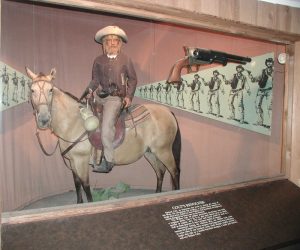


 In April, I’m attending an arts workshop, including authors, in Canadian, in the Texas Panhandle. You can’t think about this part of Texas without giving a great deal of thought to one of our pioneers, Captain George Washington Arrington, who was also one of the first Texas Rangers. His ranch is now an historical site with a Bed and Breakfast. I’m hoping to take a tour while we’re there.
 enlisted in the Confederate Army. But, in 1867 he murdered a businessman in his hometown; and after a while, he moved to Texas and changed his name to Arrington to escape his troubled past. He did many things during his lifetime; worked on the railroad, at a commission house, and farmed in Collin County, Texas, which led him to get hired on to be a drover in cattle drives. That seemingly changed his life.
 After breaking up a major rustling ring, he left the Rangers and became the sheriff of “the mother city of the Panhandle”, Mobeetie, a wild and woolly town with a reputation for fast gunplay, sporting women and quick-dealing gamblers.
 The Arrington Ranch Headquarters, which still stands today, is located south of Canadian adjacent to the Washita River. The house was ordered from the Van Tein catalog, delivered by railroad, moved pieces at a time by wagon for the first ten miles, and set up on the prairie in 1919. The building site was well chosen; sweeping vistas offer unobstructed sunsets and sunrises across the grassland.
 baths. In 1923, on one of these trips, he had a heart attack. He returned to his beloved Canadian where he died on March 31, 1923. He and his wife are both buried in the Old Mobeetie cemetery.
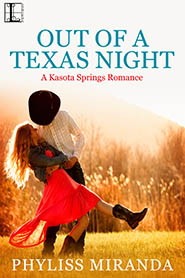 To one reader who leaves me a comment, I will give them an autographed copy of my latest Kasota Spring Romance Out of a Texas Night.
 Those early Rangers were called various names including mounted gunmen, mounted volunteers, minutemen, spies, scouts and mounted rifle companies. The term Texas Rangers didn’t come into use until the1870s.

