 It’s not always possible to step into the shoes of a pioneer. I value a good history book that walks me through the social, political, and geographic changes of the nineteenth century. But my favorite way to research is hands on. Don’t make me read about the various ways to hitch a team of horses to a wagon. Take me out and let me hitch them myself. Don’t tell me how to make butter. Sit me down at a churn and let me make it myself. (And if I get to put it on freshly baked bread warm from the oven with raspberry preserves afterward, even better!)
So, I am blessed to have two living history museums within a short drive of my home. One is a re-creation of Fort Nisqually, the Hudson’s Bay Company outpost on Puget Sound. Though it was originally situated closer to the Nisqually Delta, in present day Dupont, some of the original buildings were moved to a wooded area in Tacoma’s Point Defiance Park, and other facsimiles were added to represent what the fort would have been like in the 1840s.

The other is Pioneer Farm Museum above the Ohop Valley, on the way to Mount Rainier. The clearing surrounded by forest re-creates an 1887 homestead, and two of the cabins date from that era. With live animals and a smithy, you can really get the feel of living on a pioneer farm. You can grind grain, scrub laundry, card wool, and even curl your hair with a curling iron heated down the chimney of an oil lamp.

Here’s a few of the things I’ve learned:
Make your space count. When you have to cut and prepare the logs, lift them into place, put in a chimney, and add a sturdy roof, you don’t build a 2,500-square-foot California split! The inside of some of these cabins is no more than about ten feet square, and the length often depended on the length of the logs available. You might have a loft or a second story, but the main room needs to do duty as parlor, dining room, kitchen, sewing room, and even bedroom.
Learn to scrape. Sugar came in cones rather than sacks. Cinnamon came in sticks. Even laundry only got clean by scrubbing it over something. Those pioneer ladies must have had strong hands, wrists, and arms!
Follow fashion judiciously. One of the first questions I asked one of the reenactors at Fort Nisqually, who was wearing a large-skirted gown from the 1850s, was about whether they employed the big hoop skirts so popular back East. She confided that petticoats were more the thing out West, and I’m not surprised. How would a pioneer lady have navigated those narrow ladders leading up to the sleeping loft or even squeezed through a door in one of those things?
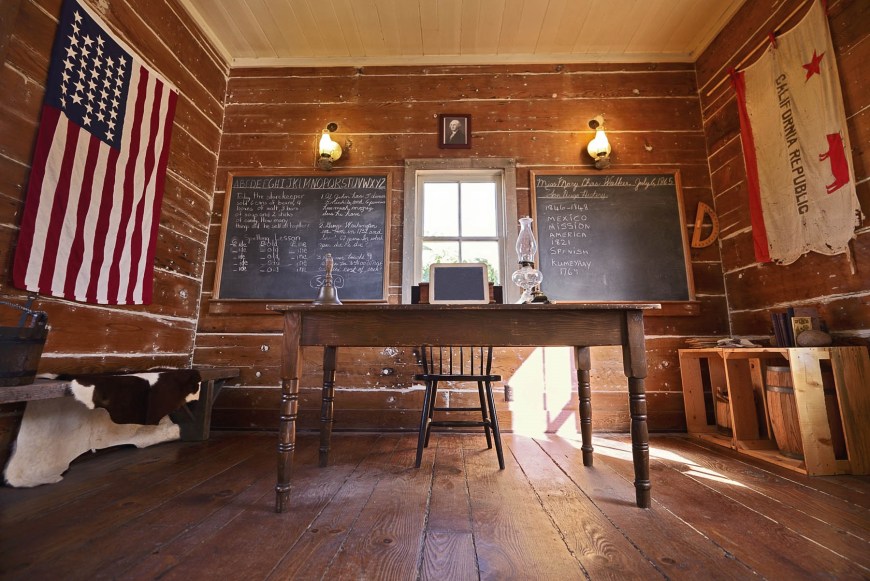
Whatever I learn, I always factor into my books, and The Schoolmarm’s Convenient Marriage, out November 6, is no exception. My heroine’s schoolroom bears a close resemblance to this one from Pioneer Farm.

Alice Dennison travelled across country to start life over as a schoolteacher in Wallin Landing, north of Seattle. No one there knows the humiliation and hurt hidden in her heart. Then a storm forces her to seek shelter with a handsome logger for the night, and suddenly she’s facing marriage or scandal! Again! Jesse Willets had always hoped for a love match like his parents. But he steps up to save Alice’s reputation through a marriage of convenience. When Alice’s past intrudes, they must work together to discover that true love may not be so distant after all.

In celebration of the new release, I’m giving away a copy of Her Frontier Sweethearts (print in the U.S., ebook internationally), which introduces many of the characters in the new book. When feisty Ciara O’Rourke starts a frontier restaurant, someone thrusts a baby at her and disappears. Logger Kit Weatherly will do anything to protect the niece he never knew he had. Can he convince Ciara to take a chance on them both?


To be entered in the drawing, answer this question: How do you prefer to learn about history?
Bio
 Regina Scott started writing novels in the third grade. Thankfully for literature as we know it, she didn’t sell her first novel until she learned a bit more about writing. Since her first book was published, her stories have traveled the globe, with translations in many languages including Dutch, German, Italian, and Portuguese. She now has more than sixty-five published works of warm, witty romance, and more than 1 million copies of her books are in reader hands. She currently lives forty-five minutes from the gates of Mount Rainier with her husband of thirty years. Regina Scott has dressed as a Regency dandy, driven four-in-hand, learned to fence, and sailed on a tall ship, all in the name of research, of course. Learn more about her at her website at http://www.reginascott.com


 The winter of 1888 was brutal for its blizzards, and the one on January 12, 1888, was no different. The relatively warm morning showed no hint of snow, and Minnie Freeman was teaching school like any other day in her small sod schoolhouse in Mira Valley, Nebraska. Mid-afternoon, sudden 45 mph winds came up and blew the door in. As Minnie helped her thirteen pupils bundle up in their coats and hats, raging winds blew the windows in and ripped off the roof. Snow dumped from dark, dense clouds and whirled over the Nebraska and South Dakota prairie, quickly obliterating nearby landmarks.




 what decision was made at that time. What we do know through other sources is that one member supported keeping the teacher, another supported firing her, and the third was a man named Ephraim Morse. We also know that one month later, Mary was no longer teaching at the schoolhouse, but had taken a position as a tutor for a local family. We also know that shortly thereafter, Ephraim Morse courted and subsequently married Mary.

 *Must have a U.S. Mailing address to win. Void where prohibited.


 When we think of the western frontier, few of us picture a young woman seated at her desk,
  studying English grammar, yet many would argue that the West was shaped as much by education as by anything else. Thus, when I learned of the pioneering institution known at its inception as the Young Ladies’ Seminary in Benicia, California, I was immediately intrigued. Established in 1852, it was the first school of higher learning created for women west of the Rockies and continues today as Mills College.
 California’s capital. According to the school’s early catalogues, its aim was “to train healthy, companionable, self-reliant women—those prepared to be useful and acceptable in the school, in the family, and in society.” To that end, the teachers deemed it important for their students to “be able to spell correctly, to read naturally, to write legibly, and to converse intelligently.” The young ladies of the school performed regular recitations at which family and select members of the public were often invited to attend. In addition to an English course of study, the school offered what they called “ornamental branches” of study which included “instrumental music (pianoforte and guitar), drawing, crayoning, painting (in water colors and oils) and ornamental needle work.” (Keep, 1931)
 Initially many of the school’s students came from the nearby cities such as San Francisco, Marysville, Sacramento, and Stockton, but most came from Mother Lode camps such as Hangtown, Park’s Bar, Rough and Ready, Angels Camp, and more. A few students also came from the southern part of the Golden State, which is where my heroine, Clarinda Humphrey, hails from in my novel, Sing in the Sunlight. Keeping in mind the incredible fluctuation of fortunes and social status going on in California during this time period, the idea of young women from such varied backgrounds coming to Benicia to learn and live beneath the same roof is fascinating. What I wouldn’t give to have been a fly on the wall of the Young Ladies’ Seminary in those early days.

 s celebrate reading, and particularly, Dr. Seuss. The program is encouraging supporters to take a selfie with their favorite childhood book and post it to social media. I decided to take it one step further and write this month’s blog about my choice.
 e I start talking about that, I must issue a quick apology, because my favorite childhood book, The Secret Garden by Frances Hodgson Burnett, isn’t western related. For those who don’t know the story, it’s about a selfish, spoiled girl raised in India whose life is overturned when her parents die, forcing her to move to England to live with an uncle she’s never met.
 repeatedly.
 d me dreaming about writing my own stories.


