 I love words. I’m sure every writer does. I am a word freak, a language maven, a…a vocabularist, if you will. Okay, so maybe vocabularist isn’t actually a real word, but it should be because it describes me to a T. I am fascinated with language and how we use it, especially regional or quirky terms.
As a writer and an editor, I have a passion for learning new words and using them. I got it from my mom, who also loved language and insisted we choose our words well. She spent serious time increasing our vocabularies with word games like Scrabble, Boggle, and Probe and crossword puzzles. To this day, family gatherings always include word games. I adore discovering new words and finding ways to use them in my writing.
One of the things I am learning as I make the switch from small-town romance that happens in the Midwest to Montana cowboy romance is how language is different from one area of our country to another.
I’ve lived in the Midwest my whole life and there are things that we say that have unquestionably shown up in my River’s Edge books. “You betcha,” comes to mind. So does, “For cryin’ out loud” and “Slow as molasses in January” and talking about corn being “knee high by the Fourth of July.” (It’s always way higher by then, btw.) I remember my grandpa saying something moved “like a bat out of hell,” which always conjured the picture of a flock of bats darkening the sky and sometimes gave me nightmares. When Mom tucked us in at night, we were “snug as a bug in a rug,” and I recall my grandmother saying, “If I had my druthers” when she wanted us to know what she wanted to happen in any given circumstance.

But, the lingo out West comes from a different history and has lingered in the vernacular in Montana, Texas, Wyoming, and other ranch and cowboy states just like words have stayed in the Midwest. “Skedaddle” and “Ornery” and “Hold your horses” are all words/phrases that come from life on the cattle trail or ranch life. “Howdy” instead of “Hello” and someone who looks like a cowboy, but has no experience is “all hat and no cattle” are terms you don’t hear much in the Midwest.
Some of the terms around horses I already knew because we had horses for sixteen years, and I think barn slang is pretty universal in the US. “Barn sour” is when a horse is too eager to return home and a term I learned when I was first riding. But calling horses “critters” isn’t part of the cowboy vernacular according to my editor, when she queried the use in my first book, Forever Cowboy. (See what I did there? A link to the book is what I call ninja promo—my own term.) “Hightailin’ it” and “Tinhorn” are terms that might show up in Western romance. My hero in Forever Cowboy was originally from Boston, so he got a little pass when it came to cowboy speak.
 Another difference between my Montana cowboys and my Indiana winemakers, government analysts, firefighters, and attorneys is how much they talk. One of my critique partners has always told me that my heroes talk too much. Maybe they do, but I live with and raised men who ruminate and discuss and share their feelings, so my heroes probably do talk too much–just like the men in my real life. Not so much my cowboys, though. They keep it short and simple with Yup and Nope and dropping the g from the end of their verbs. They’re goin’ and ridin’ and fixin’ and of course always lovin’.
You can show exactly who a character is simply with the words they use… so authors choose their characters’ words carefully as they build their arcs and tell their stories. Remaining as true as possible to where your character hails from helps readers stay in the story.
 Where do you come from? Are there words or phrases that are especially peculiar to your neck of the woods. Share with me, won’t you? There are a couple of e-book copies of my newest cowboy romance, Help Wanted, Cowboy (ninja!) up for grabs for two lucky commenters.
Stay well and Keep Readin’!


 I always knew trucks meant a lot to their owners, but after listening to these songs, it will change my writing because they’re more.


 To be entered in my random drawing for an ebook version of my Pink Pistol Sisterhood novel, Aiming for His Heart, leave a comment about quilting, superstitions, or whatever’s on your mind.


 First, being aggressive makes me think of a bully. When I think of a cowboy, I think of John Wayne in movies where his character stood up for those who needed a champion. Big Jake and The Cowboys come to mind as examples. He stands up for what’s right, does what needs to be done no matter what the personal cost, and he certainly isn’t a reckless driver. See me shaking my head over this one yet again. He may take a risk, but he’s not reckless or as Webster says, “acting without thinking or caring about the consequences of an action.”
 A cowboy possesses what some today call old-fashioned manners and values. They’re willing to work hard and can be counted on to finish the job. The words “yes, ma’am” are part of their vocabulary, and more importantly, used. No matter what their age, they call their parents’ friends Mr. and Mrs. to show respect. When I wrote my first novel with a cowboy hero Big City Cowboy, (which happened to be the only idea of that type I had at the time), the inciting incident forced my hero to go to New York to model. However, I wanted a reason other than to save his ranch. I asked myself what a cowboy loved more than his ranch or his horse. The answer his mom popped into my head. For me, that’s the kind of values a cowboy possesses. He values hard work, family, his heritage, and respects women.


 GIVEAWAY:

 The if not now, then when question has been on my mind as I grow older and played into why I’m writing this while waiting for the remaining passengers to load on my flight to Los Angeles. More about how this unexpected trip came about later. Great teaser, huh? ?

 Which brings me back to flying to LA. My youngest received a week’s notice he’d been selected as a contestant for a game show taping in LA. Even before we learned neither his boyfriend or best friend could attend, my hubby and I wanted to go. But it wasn’t a good time. Flights would be expensive. My bff, Lori, was to arrive two days before we’d leave for LA. After a long phone conversation, she decided not to go with us to LA, but insisted I go. Her exact words were, “This is a once in a lifetime thing. You are going.” (Thankfully, Southwest would issue a voucher to reschedule if she cancelled her flight.)
 While Nathan was in college, Tony award winning actress Kristin Chenoweth sang at Rowan University and needed backup singers. When no baritone students auditioned, the professor charged of selecting the singers contacted Nathan . Between the super short notice—maybe two days—and it being December, tickets prices were insane. (More than double the LA tickets.) We didn’t go, and I’ve always regretted not being there.


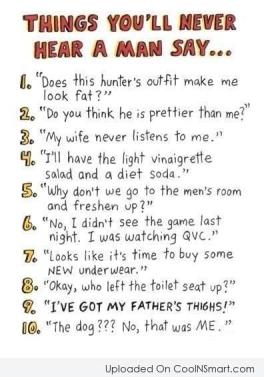

 This leads into my next point. Women use around 20,000 words as day versus the paltry 7,000 men use. Guys are like Sergeant Joe Friday in Dragnet. They keep it to just the facts. They don’t embellish or add emotion to the story. (When I taught fourth grade writing, that was the hardest thing for boys to learn—to add their feelings to their writing.) Nor do men notice the same details women do. Women notice what people wear, jewelry, outfits, shoes, and hair. My heroine might think a friend’s dress is aqua, but then qualify if as turquoise, but not the blue kind, the type that has a green hue. Guys? They’ll say it’s blue if they notice the color. But a car? Men will often know the make, model, color, how much horsepower it has, and Lord only knows what else. Me? I’m lucky if I know how many doors the car had. This can be fun, though, giving a character an unusual trait such as the heroine being a car expert or a sharpshooter as in The Andy Griffith Show when his date, Karen beats him in shooting competition. Or I might have a hero who has two or more sisters notice details other heroes wo


 The winery’s name comes from the Kiepersol farm where Pierre grew up. Legend has it soldiers running from a lion toward a lone tree, shouted, “Kiepersol! Kiepersol” as they sought safety in the tree. (Later it was learned the soldiers yelled, “We hope this tree will keep us all!” Pierre named his winery after that Kiepersol tree, hoping everyone who visited the winery would find that same comfort.


 Today I’m giving away this horseshoe decoration and a signed copy of To Tame a Texas Cowboy. To be entered in my random drawing, leave a comment to this question. What is the best story you’ve heard or best/most interesting fact you’ve learned on a trip? Or, if you don’t have a story to share, just stop by to say hello or tell me about a real life hero in your life.


