Back to School

letterhead-header 2


Here in Texas, our children have returned to the classroom. My three kids were up early Monday morning, making lunches, packing backpacks, and rushing off to the first day of school. My oldest is starting her senior year of high school. Gasp! Not sure mom is quite ready for what that means. But whether mom is ready or not, it has begun.

In the American West, teachers were often little more than former students who had completed the 8th grade and gone on to pass a teacher’s examination. My youngest is starting 8th grade this year, and I can’t even imagine him having enough knowledge to turn around and teach.

As more settlers headed west and communities grew, so did the demand for teachers with a higher education. In the early 1800s, schoolmasters were men. They ruled their classrooms with discipline and authority. Yet in the 1830s when tax-supported common schools made education more widely available, the result was a teacher shortage that left the door open for women.

“God seems to have made woman peculiarly suited to guide and develop the infant mind, and it seems…very poor policy to pay a man 20 or 22 dollars a month, for teaching children the ABCs, when a female could do the work more successfully at one third of the price.” — Littleton School Committee, Littleton, Massachusetts, 1849

By the time of the Civil War, women dominated the teaching field. However, if a woman wanted to set herself apart, to establish herself as a professional, she required training that went beyond the rudimentary grammar schooling of her peers. She needed a diploma from a reputable Normal School.

Normal Schools were two-year academies designed to grant teachers a mastery of the subjects taught in the common schools as well as giving them a practical knowledge of teaching methodology. Normal Schools prided themselves on their thorough, cohesive, and “scientific” curriculum. They would provide a norm for all teachers (hence the term Normal School) that would assure a level of quality generally unavailable previously.

The Boston Normal School, for example, was established in 1872. According to a regulation manual published in 1888, a teacher studying there would have taken courses in the following areas:

  • Mental and Moral Science and Logic
  • Physiology and Hygiene
  • Natural Science
  • Study of Language
  • Elementary Studies
  • Principles of Education, School Economy, and Methods of Instruction
  • Vocal Music, Drawing, and Blackboard Illustration
  • Observation and Practice in the Training School
  • Observation and Practice in other public schools

Not so very different from our current teacher education programs, is it?

Click Cover to Order

The heroine in my latest release is a teacher of exceptional youths, or what we would call today – gifted children or child prodigies.

In honor of teachers across the country who are getting back into their classrooms, I’ll be giving away an autographed copy of A Worthy Pursuit to one reader who leaves a comment.

Tell me about you favorite first-day-of-school memory. What made you excited, what you dreaded. How long it took you to pick out the perfect outfit. Anything related to the first day – kindergarten through college. Or maybe your first day as a teacher, if that is your profession. Anything is fair game.

Have fun! 🙂


THE SPIRIT OF THE WOLF, an excerpt

bannerHowdy!

Well, I am going to be on the road all day, Tuesday, and believe it or not, I don’t have one of those fancy i-phones.  So I’ll be off email pretty much the whole day.

However, I do plan on giving away a free e-book (your choice).  But bear with me — I’ll be on the road for a few days and so I won’t be able to send it until I finally am able to get back on the computer and do a drawing.

Lately I’ve been blogging about the awesome ability of the American Indian scout — there’s more…so much more.  But today, I thought I’d post an excerpt from the book, THE SPIRIT OF THE WOLF, which is just out (end of July) in Tradepaper.

So here we go:

SpiritoftheWolf-The-R -- first draftTHE SPIRIT OF THE WOLF, Excerpt

By Karen Kay


At last, they reached the top of the little mesa, and as soon as they did so, Marietta was no longer left in doubt as to what was in Grey Coyote’s mind. It wasn’t from necessity that they were here. Indeed not. Grey Coyote had come here by choice.

Standing quite still, he gazed at the sunset laid out before them. As though only now remembering her, he looked behind him, and Grey Coyote motioned, indicating that she should slip down from the pony.

Wasn’t he going to help her down? Disappointment washed over her. It was too bad, for she had begun to think of Grey Coyote as a savage sort of gentleman.

“Sir,” she said, “do you mean not to aid me in getting to the ground?”

Grey Coyote spun back toward her, and she at once wished she had remained silent. It was one thing to ride next to the man with scant inches of clothing between them; it was another to bear witness to the wide expanse of the man’s muscular and naked chest. Perhaps she would do well to hand him back his shirt.

She gulped instead.

Frowning up at her, he asked, “Help you to the ground? Do you have an affliction that does not allow you to jump off the pony on your own?”

She bit her lip. “No, I can jump.”

His frown deepened.

“It is only,” she continued, “that in my society, a gentleman helps a lady down from her mount. It is considered good manners.”

Grey Coyote nodded. “And so you think I am ill-mannered?”

“Well…”

“This is not a custom in my country. Here, most women would be offended if I offered help. Here, a woman might wonder why I was assisting her instead of attending to my duty to guard her.”

“Really?”

“Hau, hau, it is so. She might even be angered if I tried to aid her, for in her mind, for me to do this, would be as to say that she was not worthy of defending.”

“Truly?” Marietta gazed off at the panorama of beauty. “It’s strange, isn’t it?”

“Strange?”

“How different are some of our customs.” Bringing her attention back to the matter at hand, she started to vault down from the pony. But she had only begun when he was there in front of her.

He tossed her a lighthearted grin. “Let me help you.”

She laughed.

Looking up at her, he stopped cold, staring at her as though she had sent a poisoned arrow to his heart. His smile faded, and time seemed to have developed a warp, for she could have sworn it stood still.

He recovered swiftly enough, and without further hesitation, his hands came around her waist, and he lifted her easily from the pony. On the descent, she rubbed against him, the action sending a jolt of energy surging through her body.

Briefly, he held her closely, and then with a chuckle and a shake of his head, he said, “I never realized how clever is the white man.”

“Oh?”

“Hau, hau, it is so.”

“And what makes you say that?”

He grinned. “A red man would need a very big reason to hold a woman such. But the white man excuses himself with manners. Hau, hau. I think the white man is very clever, indeed.”

Marietta, too, grinned. “Indeed.” Gazing up at him, she stepped out of his arms.

For a fleeting moment, their eyes met, held. Then, unexpectedly, he turned away.

To her surprise, she felt suddenly bereft. “Mr. Coyote,” she said, stepping up to him. “Did I say something to offend you?”

“Hiya, you did not. In truth, I am uncertain that you could do something which would offend me. But I came here to see this.” He gestured toward the western side of the prairie, where the sun was announcing its departure by means of a glorious, golden sunset.

Marietta looked the way he indicated, and saw that the sun, which had been hidden from them most of the day, was practically screaming at them now. As they gazed outward, the sun sent streaks of light upward through clouds, clouds that were awash in various shades of golds, reds, pinks, blues and greys. Moreover, the sky itself was painting the once brown-drab prairie, transforming it into shades of amber and scarlet, the land appearing as though it were a gigantic mirror, set afire in color.

Then the strangest thing happened. Coming down onto his knees and lifting his hands to the sky, Grey Coyote began to sing.

Watching, Marietta stood aghast. The moment was unusual, yes, for Marietta was not accustomed to men opening their arms and breaking out into song. But unaccountably, the event was also stunning, and she hardly dared breathe, afraid she would disturb its remarkable charm.

In due time, she allowed herself to take a breath as she looked out toward the west. From here one might very well be able to see forever. In truth, so much space was there, she felt as though her soul expanded.

It was then that it came to her. Grey Coyote was praying. He had climbed all this way to do no more than communicate with his Creator. Was he even now thanking the Lord for the beauty set here before them?

Looking on, Marietta was aware that her throat felt tight, and worse, there was a tear forming in her eye. Not because of him. No, more likely it was because of the enchantment of the prairie, or maybe even the crisp feel of the pure air. Or perhaps it was no more than the incessant wind, which was now blowing directly in her face.

How curious to discover such artistry here, here where there was nothing but the earth, the sky, the winds. Unforeseen, unexpected, the beauty seemed to take hold of her.

“It reminds me of you,” said Grey Coyote, and Marietta was awakened to the knowledge that it had been several moments since he had stopped singing.

“What was that?” she asked. “What did you say?”

“The sunset.” He pointed outward toward the west. “It is golden like your hair, red like your cheeks, pink like your lips. You should be called Little Sunset, I think. Even now, your hair reflects the colors, looking as though it is set afire.”

The praise was simply said, yet it was one of the most excellent compliments she had ever received. Certain she was blushing, Marietta turned away.


THE SPIRIT OF THE WOLF

By Karen Kay

Well, there you have it.  Do leave a message, and although it might be a few days before I will be able to access the internet, I will eventually do that drawing and pick a winner for a free e-book.  Picture below taken close to Chief Mountain (a main figure in the book SOARING EAGLE’S EMBRACE) in Montana.

PHOT0043

We Have a Winner!

Congratulations to Catslady!

I drew your name from my Stetson (I really do have one, I promise!) for the free copy of The Gunslinger and the Heiress/Playing the Rakes Game. It’s a “two-in-one” book. I will contact you! If you don’t hear from me, please email me at kathryn @ kathrynalbright.com and let me know what address to send it to.

                                                                                                 Kathryn 

Women Schoolteachers in the Old West

Webheader 2009 2


The Three R’s: Ridin’, Ropin’, and Romance (of course!)

The leading lady of my first book, The Angel and the Outlaw, was a schoolteacher in the “wild, wild, West” of 1873 and so I thought I’d give a small glimpse into the life of a teacher in that day and age. I am also working on a new story in which the heroine is a teacher in Southern California’s back country.

Prior to tThe Angel and the Outlawhe Civil War, schoolteachers were mostly men because the prevailing belief was that women could not maintain discipline in the classroom. When the men left for the war, women moved in and filled positions at 60% less salary. When the men returned, they refused to work at the reduced wages (even though they did make more than the women teachers) and most left the profession.

Women teachers were required to be single. They could “sit” for their teaching certificate as long as they had graduated. Some were as young as fifteen. If they married, they had to give up their job. They were not allowed to attend public performances or dances. Male teachers were permitted to date one night a week or two if they attended church regularly. Because women were so few in number compared to men in the West, the turn-over rate for teachers was fairly high as women married and started their own families.

Children from the age of five would go to school daily through the week and then on weekends, would be expected to come back and help clean the schoolhouse. A teacher might have anywhere from three to forty-five students in the first through eighth grade. Discipline could be difficult at times, especially when some of the older boys towered over the teacher.

                                  Wisconsin Schoolhouse
Wisconsin One-Room Schoolhouse

The typical school house was a one-room building. A male teacher and his family often lived in a home next door or attached to the school house—a teacherage. Women teachers would be housed with one of the families whose children attended the school so that they could be supervised. (Now that would make it hard to “leave your day job” at the end of the day!)

Teachers had to be creative and work with whatever supplies they had. They used memorizing, reciting, and oral testing to teach reading, spelling, arithmetic and history. For many years, the main textbook was the McGuffey Reader. A staggering amount, approximately 120 million copies of McGuffey Readers were sold between 1836 and 1960. Many parents could not afford textbooks and so they sent their children to school with any book from home—usually the Bible—for instruction in reading. Eliza Mott was a teacher who taught the alphabet using the inscriptions on tombstones!

McGuffey Reader
McGuffey Reader

In doing research about the school in La Playa where The Angel and the Outlaw is set, I learned that the main difficulty for the teacher there was a horse track in Old Town San Diego that enticed the children to play hooky and also let them wager on the horses. When the school in La Playa had a teacher vacancy, the children rowed boats to the school in Old Town and attended there.

Some very important and influential people have “graduated” from one-room schools. To name a few ~ Abraham Lincoln (President), Herbert Hoover (President), Joyce Carol Oates (Pulitzer Prize), Laura Ingalls Wilder (author), and my father.

My father and his brothers attended a one-room school house that was built on land his father donated for the school. It still stands (and is now a private home), down a winding country road in central Illinois. It feels like stepping back in time a hundred years when I go back for a visit. My grandparents farmhouse is just around the corner ~ a country mile…


Iron flourish med

One of my memories is that my Junior High School was situated right up against the back of the San Diego Zoo next to the wallaby and kangaroo enclosures. When the tour bus would drive by loaded with people, the bus driver would often comment on the “animals” on the other side of the fence– meaning the children on the gym field. It was all in good-natured fun (I think…)

What about you?

Do you have any unusual or fond memories of school?

Comment for a chance to win a copy of my newest release ~ The Gunslinger and the Heiress ~ (which does not have a schoolteacher in it!) along with Playing the Rake’s Game by Bronwyn Scott. (Continental U.S. only)

Kathryn


Michael K Reynolds Has a Winner!

painting- New York Harbor about 1855 Fitz Henry Lane,American American, 1804–1865

Tipping my hat to Michael. What an interesting take on the American West!

After putting all the names in a random drawing….

The Winner of the print book is…………

LOIS IMEL

Woo-Hoo! Get ready to do some great reading. Someone will contact you for your mailing particulars.

Guest Michael K. Reynolds: Romancing the West!

There is tremendous irony in how popular the Western genre of Historical Romance is with today’s readers.

After all, life in the Western United States in the late 19th century was hardly the stuff romantic dreams were made of.

Sweaty saddles, dusty bedrolls, boll weevils in the breakfast bowl, horse flies feasting on your neck and only the most rudimentary levels of sanitation. Not exactly Harry Met Sally.

painting- New York Harbor about 1855 Fitz Henry Lane,American American, 1804–1865And during the Gold Rush era, romance was barely mathematically possible as there was a severe shortage of ladies in the bustling, burgeoning Barbary Coast area. The fairer sex were even scarcer in the desolate hills of the Gold Country and the few women who did reside in the region were…uh um…mostly of the working variety.

So why is it that historical novelists such as myself and well informed readers…like you…cling so tightly to the notion there is romance in the air of those Western Skies?

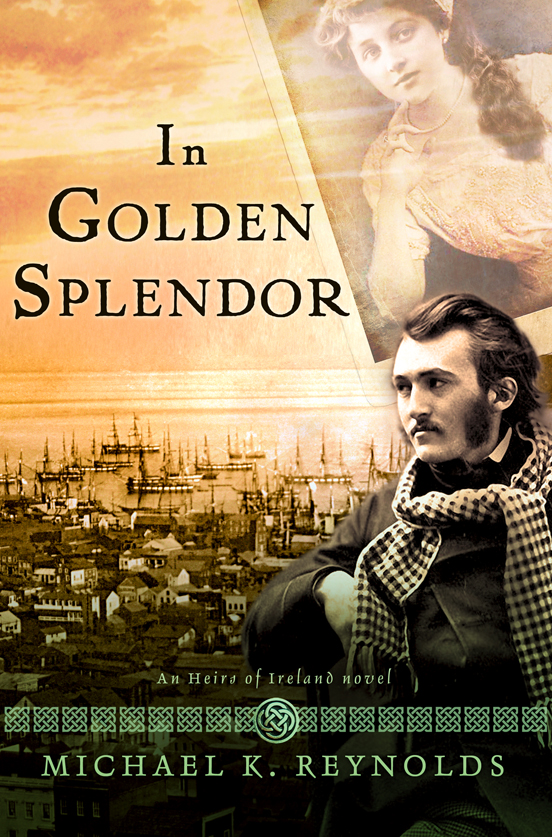
For me, there always was something undeniably, absolutely captivating about the wide open spaces of the West. In fact, in writing In Golden Splendor, the second novel of my Heirs of Ireland series, I discovered the landscapes themselves became a central character in the book.

They became inseparably entwined in the courtship of the story. Here are some examples:

The Emptiness

Any good romance starts with our leading lady or man with a yearning in their heart, a sense of aloneness. The great expanses of the unexplored wilderness of the West naturally provoke emotions of deep yearning, always a key to a great romance.

Even at a distance, the ribs of the great beast showed through its patchy and scarred chestnut fur. Through the barrel’s eye, Seamus tracked the young bull as it limped its way over to an aspen tree. The elk raised its head, crowned in mockery by horns uneven and fractured.

Did it catch his scent?

Then the animal relaxed, bared its teeth, and tugged on a low-lying branch, releasing a powdery mist of fresh snowfall and uncovering autumnal leaves of maroon, amber and burnt orange. Brilliant watercolor splashes on a white canvas.

In the deadly stillness of a finger pointed on a trigger, Seamus shared a kinship of loneliness and futility with his prey, whose ear flapped and jaw bulged as it chewed.

The Grandeur

FlightOfTheEarlsWhat is romance without beauty, whether it is expressed through a perfectly sculpted face or experienced in the depths of a pure heart? When it comes to landscapes of the American West there are few areas on our planet that offer as seductive a setting for an epic journey of the soul.

Can you imagine being the first to capture sights of Yosemite? Long before there were roads and campgrounds?

There spinning beneath them, breathlessly and seemingly miles below, was a valley finely tailored in a stunning cloak of white and generously covered with snow-flocked forestry. It lay at the base of a symphony of granite that reached like grateful hands up to the heavens. Tears of adoration poured freely from great waterfalls that descended with fullness, despite the lateness of the season. Behind this all, the sun lowered its head beneath the distant edge of the crucible, pouring into the sky cottony plumes of pink, rose, and rusted orange.

The Struggle

Just as the thorn to the rose, the territory of the West can prove to be the perfect villain in the story, an antagonist who challenges our heroes to the core of their being:

Now also coming into clarity was the gruesome evidence of the trail’s savagery. Lining either side of the pathway were the tragic debris of failed crossings. Sun-blanched rib cages and scattered bones of oxen, horses, mules, as well as broken wagon frames and wheels with missing spokes. Even more haunting were the discarded dolls and toys and even cribs, a reminder of how death dealt no better hands to the young.

The Ephemeral Moods

This scenery of the West as well can prove to be a treasured palette for authors, allowing us to shift emotion and moods of a story.

The harbor fog drifted in as they weaved between the ghost ships, amidst the lofting smells of dead fish, rotting wood, and mildew. The waves splashing against the hulls and moans of bending timber and strained ropes added to the eeriness of the evening. The farther they were from the shoreline, the more desolate and forbidden became this naval graveyard.

Characters of Strength

SongsOfTheShenandoahBut the rich scenery is far from the only tool of the Western-themed novelist. Also in romancing the West a writer can tap into the deep complexity and intrigue of those who would respond to such a Manifest Destiny in their lives.

What great romance awaits such complex characters!

Which is why in the blending of all of this mostly male humanity, the woman who approached appeared so extraordinary and so out of place. She was dark enough in skin color to be Mexican, but her facial features were European, with high cheeks and taut skin. Her hair flowed freely, brown and straight and nearly all the way to her glistening silver belt buckle. She glanced at Seamus with playful and alluring eyes.

Yet rather than being dressed in the bright, ornamental dresses off the painted ladies in town, she was dressed more as a man, with leather leggings, a red plaid shirt, spurred boots, and a black flat-brimmed hat. Most notably, she swayed with confidence and strength.

The Pen is Yours

What about you? What do you think makes the American West such a perfect accompaniment for romance?

One of the commenters who answers Michael’s question will win an autographed copy of his or her choice from the Heirs of Ireland series: Flight of the Earls, In Golden Splendor, or Songs of the Shenandoah. Click on the book covers above to find out more about each book. The winner will be announced Sunday evening (Aug. 23).


MichaelKReynolds_GoldABOUT THE AUTHOR

Michael K. Reynolds’s debut novel, Flight of the Earls, about the Great Irish Potato Famine was a finalist for RT Book Reviews 2013 novel of the year award in the category of Inspirational Romance. In Golden Splendor, set during the San Francisco Gold Rush, earned fourth place as Forewords Best Historical Novel of 2013 and Songs of the Shenandoah, the Civil War-era conclusion to the trilogy was a Top Pick in RT Book Reviews, as well as a finalist for RT’s Book Reviews Book of the Year and was the Gold Award Winner as Forewords Best Historical Novel of 2014.

You can learn more about Michael at MichaelKReynolds.com. Find all of his books on his Amazon author page.


If Life Hadn’t Happened…….

LindaThis is probably no surprise. I always wanted to be writer and I’m so grateful for the chance to fulfill my dream. Telling stories and creating story people is the most rewarding thing I’ve ever done.


My path started back in school. English (of course) was my favorite subject with history a close second. I loved when an assignment included writing a short story. I remember clearly one I wrote called The Sugar Bowl. It was about a colony of ants who decided to play a game of football in a family’s sugar bowl.


Then there was one about a squirrel who teased a dog to death until the dog finally had enough and taught the squirrel a lesson that he almost lived to regret.


stack_of_booksBut, my favorite things to write are western romances. These stories and the characters are so deeply embedded inside me. I feel I reach out and touch them. With them living in my head, talking and laughing and keeping me awake, it’s no wonder they become like family. I celebrate their joys and cry when they’re heartbroken.


I think sometimes about what I might’ve done if the writing bug hadn’t bit me. I know it would have something to do with books. I’d have been a librarian or bookstore owner. Libraries are magical places. As a child, I wanted to live in one. And I almost did because of the time I spent at the local library. I wanted to read every book and discover all the worlds and the people on each page. Books opened up new schools of thought and I learned about what true love was from stories I read. Books are everything to me, no doubt about it. If I haven’t convinced you, you should see my bookshelves!


So are you satisfied with the way things turned out for you? And what would you have been if life hadn’t happened?

Michael K Reynolds Arrives Friday!

Songs of the ShenandoahMr. Michael K Reynolds is riding this way and will arrive Friday, August 21!

Writer of Historical Fiction, Michael has an exciting new series called Heirs of Ireland. RT Book Review gave his latest a top pick rating in their magazine. The series covers the journey of Irish immigrants to the American frontier.

Come and help us welcome him.

You might find out lots of things you didn’t know! 

Black Jack Ketchum: An Outlaw Meets a Gruesome End

Kathleen Rice Adams header

“Can’t you hurry this up a bit? I hear they eat dinner in Hades at twelve sharp, and I don’t aim to be late.” —Black Jack Ketchum

"Black Jack" Ketchum as a young man. (Image: University of New Mexico)
Black Jack Ketchum as a young man. (Image: University of New Mexico)

Whether or not he aimed to be late, Thomas Edward “Black Jack” Ketchum missed the dinner bell by more than an hour on April 26, 1901. In fact, his original 9 a.m. appointment on the gallows was delayed by more than four hours while authorities tried to ensure Ketchum’s execution was both humane and permanent.

They got the permanent part right.

Ketchum, the youngest of five children, was born in San Saba County, Texas, on Halloween 1863. His father, a prosperous farmer, died when Black Jack was five years old; his mother when he was ten. Because the family’s property went to the eldest son, Black Jack and his other brother, Sam, made their living cowboying in Texas. The work never suited either of them. By 1890, both had left the state.

By 1892, they were robbing trains.

Together with a gang of other young men—all of whom were described as well-mannered and well-dressed, riding good horses, and flashing plenty of money—between 1892 and 1899 the Ketchum gang liberated payrolls and other large sums of cash from trains passing through the Four Corners area of the Southwest. In 1895 and 1896, the gang included Kid Curry and his brother Lonnie Curry, who reportedly departed after a dispute over the division of proceeds from a holdup.

(Image: Herzstein Memorial Museum, Union County, New Mexico)
(Image: Herzstein Memorial Museum,
Union County, New Mexico)

In 1897 alone, the Ketchums heisted more than $100,000: $42,000 from a Wells Fargo safe outside Langtry, Texas, in May and another $60,000 in gold and silver near Twin Mountain, New Mexico Territory, in September.

Two years later, in July 1899, Sam Ketchum partnered with Wild Bunch members Will Carver and William Ellsworth “Elzy” Lay to rob the Twin Mountain train a second time. A posse chased the outlaws into Turkey Creek Canyon near Cimarron, New Mexico, where Sam was wounded in a shootout. He died of his wounds in Santa Fe Territorial Prison a few weeks later.

In August 1899, unaware of his elder brother’s fate, Black Jack lost his right arm to a shotgun blast fired by the conductor of a train he attempted to rob alone. “The handsome train robber” didn’t resist when either a posse or a railroad crew (there’s a dispute) found him near the tracks the following morning.

At trial, Ketchum was sentenced to hang, but the date of execution was delayed several times by arguments about where final justice should take place, since several towns wanted the honor. Finally, reacting to a rumor that the old gang planned to break Black Jack out of jail, the hanging became the center of a carnival in Clayton, Union County, New Mexico. Despite an extended debate about the length and strength of the rope necessary for the deed, something went horribly wrong.

"Black Jack" Ketchum, center. (Image: National Archives)
Black Jack Ketchum, center. (Image: National Archives)

Shortly after 1 p.m., the scaffold’s trapdoor opened and Ketchum, 37, plunged through. He died instantly, decapitated by the fall.

Black Jack Ketchum bears the dubious distinction of being the only man sentenced to die in New Mexico for “felonious assault upon a railway train.” Apparently his botched execution set the residents of Union County back a mite, because Black Jack also was the only man ever hanged in Union County. Until serial murderer Eva Dugan suffered the same fate at the Pinal County, Arizona, prison in 1930, Black Jack Ketchum was the only person in the U.S. who literally lost his head to a hangman’s noose ordered by a court.

****

No train robberies or grisly executions take place in the Civil War-era duet The Dumont Brand, although the hanging of a cattle rustler in her past plays a role in one heroine’s present. The book, which contains two stories about two brothers, debuted July 24. It’s the first in a trilogy about a Southeast Texas ranching dynasty with more skeletons than you can shake a stick at in its closets. Links and excerpts are on my website.

Here’s the blurb, and below that is a video trailer.

The Dumont BrandThe Civil War burned Texas…and fanned the flames of love.

On the eve of the Civil War, family secrets threaten everything a ranching dynasty has built…until one son finds salvation in the wrong woman’s love. In the aftermath of battle, a woman destroyed by betrayal brings peace to his brother’s wounded soul.

The Big Uneasy: To escape the unthinkable with a man about whom she knows too much, New Orleans belle Josephine LaPierre agrees to marry a Texan about whom she knows nothing. Falling in love with his brother was not part of her plan.

Making Peace: After four long years in hell, Confederate cavalry officer Bennett Collier just wants to go home—assuming home still exists. Widowed Jayhawker Maggie Fannin will hold onto her home at any cost…even if she must face down the imposing Rebel soldier who accuses her of squatting.

These Boots Were Made For Walking


LLBroday
In historical westerns four things are always in everyone of my stories – Hats (Stetsons usually,) Guns, Horses and Boots. Not necessarily in that order.


But who were the boot makers?


New BootsThe first boots, and for sure the forerunner of the western kind, were reportedly worn by Genghis Kahn way back in the Mongol Empire. He wore a pair of red boots with wooden heels. But definitely the Wellington boots worn in 17th and 18th centuries of England were a precursor of the boots cowboys wear. They rode high on the leg, had a low heel and were made of the same four part construction as cowboy boots.  Soldiers in the Civil War preferred them and when they went home from the war, they took their boots with them.


Old BootsOne on the earliest known cowboy boot makers was Charles Hyer in Olathe, Kansas in 1872. He and his brother Edward founded the Hyer Brothers Boot Company and outfitted many a trail driver.


Down here in Texas as the cattle drives accelerated, bootmakers popped up in the towns along the trails. The Justin Boot Company and the Nocona Boot Company in Texas are among two of the earliest makers of western footwear. I’m sure there were many others. Justin Boots is world famous. It was founded in 1879 and George Strait still wears them today.


Justin Ropers
Worn Justin Ropers

Nocona boots were long made by H. L. Justin before he ever formed the company. He was a maker of fine boots in Spanish Fort, Texas which was on the Chisolm Trail. Cowboys would stop on their way north and let him measure their feet and pick up their boots on the way back.


In 1911, Italian immigrant Tony Lama, who learned the trade at age 11, set up shop in El Paso, Texas and began that lucrative business. Today there are many, many brands.


Boots are worn by rich man and poor, presidents, country singers and the cowboys of today who work the ranches, herding cows and riding the rangeland.


I have three pair of western boots– an old pair I bought in Reno, Nevada in 2002, my Justin Ropers and a new pair I bought last month to wear to NYC to a writers’ conference. The new pair is made by the Abilene Boot Company and they’re as comfortable as my Justins. I’ve always had trouble finding shoes that don’t hurt my feet. I never have to worry about my boots.


So what about you? Have you tried cowboy boots?


I love talking to readers. You can reach me at these links:

WEBSITE      FACEBOOK AUTHOR PAGE     PERSONAL FACEBOOK    TWITTER