Hair Styles of Yesterday and Today!

I’m out in the wine country of California preparing for our first grand’s wedding on Friday.  We’re busy getting all of the last minute things in order and one of the big problems is hair-do’s.  It got me to thinking that the styles of today’s bride and bridal party really aren’t that much different than those of bygone years.  Hairstyles I used to describe women in my western historical romances.

Since I write both western historicals and contemporary romances typically set in the Texas Panhandle women’s day-to-day hairstyles have never been a problem to describe.  Especially since woman on the ranches of today wear their hair very much like they did when this part of the West was settled in the mid-1800’s … either long, over the shoulder styles, sometimes curled, sometime straight, or in braids of some sort.

Chignon Pix 2I thought it’d be fun to look at the different hairstyles of the American women during the 1800’s.

Short Hair with ringlets

For the first fifteen years after the turn of the century, women wore short curls waved on the forehead with their back hair in a simple knot. Some wore top knots; and they used combs, tiaras and coronets for ornaments.  To be honest with you, I had to look up a coronet to see what they look like and found they are a small crown consisting of ornaments fixed on a metal ring. They differ from a crown in that they will never have arches. They are unlike a tiera because they  completely encircle the head, while a tiara does not. Simply said, a crown is worn by an emperor, empress, king or queen; a coronet by a nobleman or lady.

Cornet Hair AccessoryBetween 1815 and 1840 a woman frequently parted her hair in the middle, smoothed it, and wore ringlets, puffs or loops at the sides.  From the early 1820’s to the early 1830’s they piled their hair progressively higher in the back, culminating in a style dubbed a la giraffe.  Masses of sausage curls (tubelike curls) and ringlets were also popular during this period.

Topknots became smaller and moved to the back of the head beginning in the 1840’s and continued for another fifteen years.  Large coils of hair at the nape of the neck and sometimes held by black or colored silk nets were popular from the 1850’s on.  This chignon is a knot or roll of hair worn at the back of the head and sometimes ornamented with lace, ribbons, jeweled bands, combs, foliage, flowers and strings of pearls; and was very popular in the 1860’s, but worn throughout the century.  As you can see by the picture, they are still popular today.

Between 1865 and 1890, the bun and chigon were moved up on the head with the frontChignon Hair Do hair carried back without any parts.  As it is today, in the 1870’s women’s hair was allowed to cascade down long and full in the back, sometimes in ringlets or hugh loops.  Pompadous were worn, as were hair ornaments. Of interest, the pompadous was popular in the 1950’s by people such as James Dean and Elvis and was known as the Rockabilly Hairdo.  And, of course, today many movie stars and singers wear the style.

Elizabeth Frenchie McCormick 1852-1941From then until the end of the century the most prominent style was the psyche knot, which has the hair pulled back from the forehead and knotted on top.  Small coiffures, pompadours and French twists were worn, as were ornaments.

The more research I did on hairstyles of the 1800’s the more I realized that as I heard all of my life everything sooner or later comes back into style; and hairdos are no exception. 

Since I come from “Big Hair Country” and grew up with it, I have to admit that I still like the style.  Now, what is your favorite hairstyle?

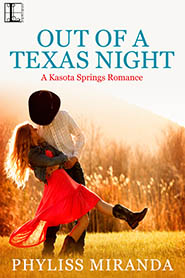
To one lucky commenter, I’d love to send you an autographed copy of your choice of any one of our six anthologies.  To a second reader who leaves a comment, I will send you an eBook of my latest Kasota Spring Contemporary romance Out of a Texas Night.  Thanks to all you all for stopping by and reading my blog.
 

All Good Things…

We’ve all heard the saying, “All good things must come to an end.” While I don’t necessarily believe that’s always true, it’s doubly true today. This is my last post as a regular blogger at Petticoats & Pistols. It’s been great hanging out with these wonderful, talented ladies and getting to know a lot of the enthusiastic readers. It’s been fun talking about our shared love of western stories.

This month also marks the release of my final book in my Blue Falls, Texas, series for Harlequin. Since the Western Romance (formerly American Romance) line folded last summer, this one book has been awaiting its day on shelves. Harlequin is releasing Texas Cowboy, Be Mine under their Home on the Ranch program, and I must say it’s a very pretty cover.

Here’s a bit more about the story, which concludes the five stories about the adopted Hartley siblings:

Single mother Angel Hartley has her priorities straight—building her career as a photographer and making sure her young daughter, Julia, will never suffer the pain of being abandoned, a pain Angel herself knows too well. Dating can wait, even though she suddenly can’t stop thinking about Hunter Millbrook, who happens to be the handsomest rancher in Blue Falls, Texas.

Hunter also has a full plate. How can he juggle a relationship with running his family’s ranch and looking after his mother as her memory slips away? He’s just too busy for love…no matter how long he’s had a crush on Angel. But as Hunter begins to suspect, hearts don’t wait for the perfect moment!

What’s not in that blurb is the fact that Angel is Native American, but since she doesn’t know who her birth parents are part of her story is her search for her heritage. I think that’s a basic human instinct, the need to know our origins.

Since this is my last blog, I also would like to mention that the third book in my Once Upon a Western series for Tule Publishing is coming out next month. This is Wes McQueen’s story, the third of the three McQueen brothers, and like the two stories before it it’s loosely inspired by a classic fairy tale–this time Beauty and the Beast with a twist.

Wes McQueen has always been a casual dater, not in any hurry to settle down with one woman. But that begins to change when he meets his new neighbor, Claire Moon. But all Claire wants is to be left alone to make and sell her jewelry, to live away from the eyes of others following a fire that left her scarred. But her resolve to live a solitary existence is shaken every time Wes looks at her and doesn’t seem to even see her scars.

To go out with a bang, I’ll give away three signed copies of Texas Cowboy, Be Mine today. In the story, Angel Hartley undertakes the big task of trying to find her birth parents and her heritage. To be eligible to win, just tell me something big you plan to undertake this year. Me? Because I’ve recently developed a love for Korean dramas and pop music, I’m going to try to start learning Korean. It’s evidently one of the hardest languages for native English speakers to learn, so it’s going to be a challenge.

Finally, thanks for all the support since I’ve been  P&P blogger. Hope to see you all out on the range (in person, on social media, etc.). Here’s to a happy, healthy, productive and fun 2019!

Tanya Hanson Has a Winner!

Thank you for coming back to the Junction, Miss Tanya! Miss you something awful!

Now for the drawing……………..

All the names are in the Stetson all nice and cozy………..

I’m reaching in for one and I pull it out………….

Winner of the ebook Love, Sweet Love is…………

QUILT LADY

Woo-Hoo! I’m doing the happy dance for you, Quilt Lady! 

Miss Tanya will drop you a note so be watching your email!


Mary Sullivan Has a Winner!

Thank you for visiting and talking about ranches, Miz Mary! Enjoyed it.

Now for the drawing………….

I’ve given the wheel a whirl to see who gets Montana Rodeo Star…..

It landed on………………..

ELLIE

Congratulations, Ellie! I’m dancing up a storm for you.

Miz Mary will drop you an email so be watching for it.


* * * * * *

Check Out This Interview

I was interviewed by the Lone Star Literary Life ezine last week and it went live today. The article is under the Lone Star Listens column.

http://www.lonestarliterary.com/

Here’s the direct permalink: http://www.lonestarliterary.com/content/author-linda-broday


Also….I’m giving away 5 copies of my new book that releases Tuesday!

Click HERE for the Rafflecopter!


Special Sale Through January 31

Just a quick note to let you know that the first book in my Archer Brothers series is on sale until the end of the month for only $1.99.

Four brothers. Four straws. One bride. Now’s the time to see why Short-Straw Bride has garnered over 4,500 five-star ratings on Goodreads! Fall in love with the Archer brothers for only $1.99 for the e-book at all online retailers.

Amazon | Barnes & Noble | Christian Book

The Rugged Rock and Guest Author Mary Sullivan!


Please give a big Petticoats and Pistols welcome to our
Friday guest author ~ Mary Sullivan!
Miss Mary hails from Toronto, Canada and today is giving away a
copy of her newest release, MONTANA RODEO STAR 
to one lucky person who responds to her questions at the end of this post.


Petticoats and Pistols, thank you so much for having me here today!

I write about cowboys, ranchers, sheriffs, and small towns. Often, I have wondered why I’m fascinated with ranching and farming life when I have never lived that life. I grew up in a large city.

The source of this interest, I believe, was my parents who grew up in rural Newfoundland on the eastern edge of Canada. I grew up listening to my mother’s stories of her childhood, her experience light years from my own urban childhood. Her family lived a life of self-sufficiency ruled by ‘island’ mentality. She was a small child during the Great Depression. Anything they needed or that had to be done or fixed had to be handled on their own. They were hardy and resourceful.

Newfoundland’s nickname of The Rock is justified. It’s rugged, to say the least.

Despite this, the family grew all of their own vegetables—potatoes, carrots, parsnips, turnips, cabbages, and onions—and stored them winter-long in root cellars. Even the children had their daily chores. They were not idle.

They fished for cod and laid it out to dry on ‘fish flakes’ set up on a hillside in the sun. They also salted the fish.

They owned cows and chickens.

Every spring, they bought a pig that they fattened throughout the summer for butchering, curing and preserving in the fall. My mother, a great animal lover, doted on the pig every summer and would steal buttermilk after the cows were milked to rub over the pig’s back to make it soft!

Then, one day in the autumn, her family would send her off to visit friends or family so she wouldn’t be around when they killed the animal she had nurtured for months. It saddened her immensely. I asked her once how she felt about all of this and whether she could bring herself to enjoy the bacon and ham the pig produced. Her pragmatic response was, “Of course. I had to eat.”

Winters were harsh, with frigid temperatures for months on end and deep snow nearly covering ground floor windows. Winter started early and ended late.

The buckets and buckets of wild blueberries my mother picked and sold every summer bought her a new pair of shoes for the start of another school year in September.

I don’t romanticize how difficult her life was, but even given such a bare-bones existence, my mother had a happy and healthy childhood with loving parents. She had a wicked sense of humor, loved to play pranks and was adored by her one older and six younger siblings.

My brothers and sisters and I love to visit. The island and my extended family there hold captive a huge portion of my heart. Here’s a photo of me with my sisters wearing our tourist t-shirts during a recent visit!


I imagine large ranches as being much like islands, with life lived so close to the land and the harsh reality of nature and death a hairs-breadth away. I imagine self-sufficiency and pragmatism. I imagine tough, hard-working people.


My latest book, HOME ON THE RANCH: MONTANA RODEO STAR is the final, sixth book of my Rodeo, Montana, series. I have loved writing about the six women who labored to keep their small town afloat by reviving the local fair and rodeo.

Cocky but likable Dusty Lincoln meets his match in stubborn Maxine Porter. 
If ever two opposite should not attract, it is these two, but attract they do!


You can find it here: http://bit.ly/MontanaRodeoStar


I’m giving away a copy of MONTANA RODEO STAR to one of today’s blog visitors.
Please respond to the questions below for a chance to win.


Have you ever visited a ranch or wanted to?

Or did you grow up on one?

Or are you a die-hard city person?


Multi-published author, Mary Sullivan, finds fulfillment in writing heart-warming, small town romance.
Her first book, No Ordinary Cowboy, was a finalist in Romance Writers of America’s Golden Heart contest.
Her books have since won awards and glowing reviews. For Mary, writing a book is very much like putting
together a jigsaw puzzle without the final image. She indulges her passion for puzzles—particularly getting
her daily cryptic crossword fix and putting together real jigsaw puzzles without the box—in her hometown
of Toronto.  

Mary’s Website:  MarySullivanBooks.com   

Follow Mary on Facebook at Facebook.com/MarySullivanAuthor


Before There Was a Texas, There Were Texas Rangers

I’m on the last draft of the third book in my Haywire Brides series (at least I hope it’s the last draft). My male protagonist is a Texas Ranger and, as some of you might have guessed from my earlier books, that’s my favorite type of hero to write about.

The Texas Rangers have a long and checkered history, starting in 1823. When Stephan F. Austin hired ten men to protect the frontier, he probably never imagined that nearly two hundred years later, the force would still be going strong.  

Those early Rangers were called various names including mounted gunmen, mounted volunteers, minutemen, spies, scouts and mounted rifle companies.  The term Texas Rangers didn’t come into use until the1870s.

Maintaining law and order on the frontier wasn’t easy, but those mounted gunmen still managed to move with quick speed over long distances, and settle trouble on the spot. Those early rangers were called upon to serve as infantrymen, border guards, and investigators.  They tracked down cattle rustlers and helped settle labor disputes.  They both fought and protected the Indians.

The job didn’t come cheap.  A man was expected to provide his own horse and it had to be equipped with saddle, blanket and bridle.  A man also had to supply his own weaponry, which included rifle, pistol and knife. 

As for clothing, a Texas Ranger wore what he had.  It wasn’t until the Rangers became full-time professional lawmen in the 1890s that many started wearing suits.  (Today, Rangers are expected to wear conservative western attire, including western boots and hat, dress shirt and appropriate pants.)

He would also have carried a blanket, and cloth wallet for salt and ammunition.  To alleviate thirst, a ranger would suck on sweetened or spiced parched corn.  Dried meat, tobacco and rope were also considered necessities. What he didn’t carry with him was provided by the land. It was a tough life and it’s not hard to guess why a man seldom lasted more than six months on the job.

Those early professional Rangers received twenty-five dollars a month in pay and worked hard for it. An officer’s pay was seventy-five dollars.

Texas Ranger Hall of Fame

Today, the Texas Rangers enjoy a stellar reputation, but that wasn’t always the case. Frontier justice could sometimes be harsh and cruel, and some Rangers fought according to their own rules. This led to excesses of brutality and injustice, including the massacre of unarmed citizens.  The Rangers were reformed by a Legislature resolution in 1919, which instituted a citizen complaint system.

The Texas Rangers have undergone many changes and transformations through the years. But the biggest change of all probably has such legendary Rangers as John B. Jones and Big Foot Wallace a-whirling in their graves; The Texas Rangers recently allowed women to join the ranks.  (Hmm.  I feel a story coming on.)

I told you the kind of heroes I like to write.  What kind of heroes do you like to read about?

“This book charms.”  Publishers Weekly

Amazon

B & N

iTunes

Back in the Corral ~ by Tanya Hanson

No doubt about it. I am a California beach girl. Somehow, though, the heroes in my books always seem to end up cowboys. For that “wild west” reason, the fillies here in Wildflower Junction let me be a member of the corral for almost nine years.

However, in June 2017, family matters demanded I put writing and blogging on hold. Some good stuff, like a baby granddaughter. Others, not so good, like a still-ailing mother-in-law. But the fillies assured me I’d always be welcomed back. And after twelve months of catching my breath, four amazing inspirational authors invited me last summer to participate in a Valentine anthology. It released January 11, so—here I am!

Thank you, fillies!

AMAZON

Timing was perfect. Jumping back into the writing saddle with “Heart of Hope” was a great ride. Since the keystone of each of our novellas was a recipe, nothing else would do but the directions for my late Aunt Grace’s historic banana bread. And well, that itself led to the hero having an Aunt Grace…

Of course, nowhere else would do for my setting but my beloved California. I decided to return to a place I’d used before, fictional Rancho Lorena inspired by the real-life Central Coast town of Santa Ynez, established in 1882.

It’s a favorite place to visit, and rich in history. In 1858, the Overland Coast Line stagecoach ran from San Francisco to Los Angeles with the Santa Ynez Valley area just about smack dab in the center. Sometimes travelers stayed on or came back, and civilization grew into a true microcosm of the American West with saloons, mercentilers, blacksmiths, and tillers of the soil. By 1887, the Pacific Coast Railroad roared through.

The valley and town likely took the name Santa Ynez from the nearby Mission of Santa Ynes, established by the Franciscans in 1804 and named for Saint Agnes of Rome.

Then and now, the near-perfect climate is ideal for raising cattle, olives, and fruit. These days, 20% of the valley’s land is cultivated for wine grapes.


This photo I took is the tree that lends its name to my hero, Akron McCrory’s, ranch, the Leanin’ Tree. I have no idea why it’s bent, but I liked the idea it somehow could have been a trail marker left by the native tribe.

The Thyme Arbor Inn, where Akron and Bree run into her sneaky ex Marshall, is inspired by this restaurant:

The California coastal oaks are one of the area’s hallmarks. I think you’ll see some in my story.

As well as these horses on Akron’s ranch.

If you want to get into the Valentine spirit early with some sweet reads filled with love and romance, food and family sprinkled with faith, please check out our anthology.

~*~*~*~*~*~*~

From today’s commenters, I will be pulling one name out of the Stetson to receive a digital copy of Love, Sweet Love, so don’t be a stranger. Please and thank you.

So to get you in the sweetheart mood, what do you prefer giving/getting—flowers, a mushy card, or CHOCOLATE?

~*~*~*~*~*~*~

And before I ride off into the sunset, I need to publicly thank Mary, Dora, Delia, and Zoe for all their hand-holding. Thank you, Mary Manners (head of the project), Dora Hiers (aka my rock), Delia Latham (who designed all our covers) and Zoe McCarthy (made this old lady want to go skiing again.)

Here’s a bit about HEART OF HOPE.

He gave Bree her first kiss, but can he give her a future? She’s back in Rancho Lorena but not to stay—until Akron steals her heart. For good this time. But his ranch is in financial trouble, and she’s a rich developer. A recipe for disaster. Until they find the missing ingredients of love, happiness, and hope when they help out together at a home for young women in need.

LIKE A DANCE by Delia Latham
A former celebrity dancer with a child she adores. A successful but burnt-out therapist to Hollywood’s rich and famous. When they show up in Hummingbird Hollow at the same time, sparks fly… but can they fan the flames?

LANDING IN LOVE by Mary Manners
Erin Mulvaney is comfortable in front of both crowds and cameras. It’s the tango of one-on-one relationships, especially when it comes to men, that ties up her tongue. When handsome Kyle arrives to renovate her family’s restaurant, can she conquer her fears to cover the project alongside him?

HER VALENTINE VET by Dora Hiers
Veterinarian Murphy Denton doesn’t trust people. Heiress Micaela Stanford would donate her fortune to care for abandoned animals. Her generous spirit crushes his defenses. Will his dysfunctional past prevent them from a happily-ever-after?

GOOD BREAKS by Zoe M. McCarthy
Life has dealt a mammography tech and an entrepreneur bad breaks and led them to a small North Carolina ski town. A new bad break introduces them. Can they share more than a love of skiing? Or is she intent only on fixing his flaws?