From Hero to Character

One of the questions, as authors, we get asked a lot is how do we find our characters? Do they come from real people? Are we people watchers? Do we just make them up? Are there research books with characters to help develop yours? Do they come from the headlines?

The answer is simple … all of the above. I use a combination, as most writers do. I probably shouldn’t tell you, but sometimes I’ll use the name for a character of someone I really don’t care about who have similar traits. However, most of the time, it comes from someone I like.

In the first book of the Kasota Springs Contemporary Romance series, “The Troubled Texan”, I knew I wanted a strong lawman, with a heroic past. A friend of mine came to mind. In our bowling and coaching days, I knew his mother, father and sister. Although I’d only met him a few times, he was definitely one of those people you’d always want for a friend.

Billy Hobbs was from my hometown and graduated from the same high school as my husband and both of our daughters. He was a two-time All-American linebacker for the Texas A&M Aggies, and an NFL linebacker for six seasons. Cotton Bowl MVP, Panhandle Sports Hall of Famer and National Defense Player of the Year, only begins to name some of his honors. He was selected in the second-round draft by the Philadelphia Eagles and went on to become captain for New England and New Orleans Saints.

After his football career, of 25 years, he surrendered to full-time Christian ministry to preach, work with youth, do mission work in Africa, working with orphans and the many needed fellowships in prisons, even creating a vitamin supplement for the disadvantaged. He started the Mercy Foundation; and, where I knew him best, he ran the Faith City Mission here in Amarillo. His foundation and Faith City Mission are family shelters for those in need of a space to go whether it’s single moms and their children or families who need help getting back on their feet. After many years of doing such wonderful, selfless work, he was killed in a motorcycle-car accident in 2004 at the tender age of 57.

At his funeral one of his closest friends, said Billy applied what he had learned in football to his work in the ministry. “Hobbs took the same competitive spirit to help people.”

What a perfect model for my character, the Sheriff of Kasota Springs and his friend, who is also a deputy sheriff working with the Joint Task Force. They were raised in the same town and went to college together, but in my story it was at the University of Texas, not Texas A&M. Deuce went on to play for the Steelers, while Brody went into law enforcement, later encouraging Deuce to do the same.

Now you can see why I selected Billy, a real person who I admire greatly, as my role model for Deuce Cowan. Although, Deuce had to quit his football career due to an injury and became a defensive line coach, his true love, like Billy’s, was people. To help Deuce, law enforcement became his true love; particularly, since his father was a lawman.

Of interest, I took a headliner news story and used it as the reason Deuce’s love interest in the first book came to Kasota Springs to hide out in a small town; not knowing that her once BFF Deuce Cowan was sheriff.

Names sometimes come easy, other times very hard. For instance, one of my characters in both books came from a family in our anthology “Give Me a Cowboy”. Mesa LeDoux, who like most of my characters are founding family members from our anthologies, is a Johnson, my mother’s family name. Lola Ruth is her BFF. Ruth is my mama’s name and Lola is my mother-in-law. Clara at Pumpkin’s Café is named from my deceased sister, Clara, who was nicknamed Pumpkin. In “Out of a Texas Night”, I even use the first name of one of our P&P faithful readers. Now you’ll have to read the book to see if you can recognize who it is.

So now you have a little insight on how we come about in developing our characters, not just their name but their personalities and traits.

I’m working on the next book in the series, tentatively titled “Deep in a Texan’s Heart” and it’s Sylvie Dewey’s story. You might remember her Aunt from one of our anthologies, so she also comes from one of the founding families; and has a fantastic backstory. In this book, there’s a cooking club made up of retired teachers, and they are real educators I know who taught either my daughters, grandkids or are close friends, so get ready for some great first names only and fantastic holiday recipes in the back of the book. And, a teaser—the story is ripped from the headlines!

Have you ever had a career or hobby that changed you for the better?

To one reader who leaves a comment, I’ll send you an eBook of either “The Troubled Texan” or “Out of a Texas Night” from Amazon.

Bustles & Prairie Fires & Why We Wear Pants

Is this really only a hundred and twenty-five years???? We’ve come a long way, baby! 


The whole idea of puffy dresses and prairie life became a GREAT part of my intro to “Second Chance Christmas“, the second novella of “The Sewing Sisters’ Society” collection, and part of the overall Prairie Brides series…

Because claim shacks were small.

Folks didn’t always allow enough safe room around wood stoves and/or fireplaces.

Bustles made skirts wider.

In a world governed by mathematics and physics, A + B = C.

And C = skirts catching fire!

For practicality’s sake women in the west had to adjust their longing for European and Eastern fashion and slim down their skirts.

Tapered, not bustled….

Slim, not voluminous….

And then… shortened….

And then shortened some more….

And then…

Wait for it:

Skirts and pants…..

By the mid 20th Century a World War changed so much… Men went off to war.

So did women.

Women couldn’t wear skirts in all areas…. so they were issued trousers….

Women at home went to work manning the manufacturing processes…. and wore pants.


Today’s school teachers don’t look like this, do they? And yet… there’s something absolutely fetching about this look!

And a new shape was born from necessity, from self-reliance, from role reversal. And it’s never gone back, has it?

Here’s a great article about women and pants and how Calamity Jane set the Western tone for horse-ridin’ women:

“Women in Pants…”

When we look back and see how for millennia women wore dresses… That it would have been considered out-of-this-world in-your-face to dress down… 

Even into the 20th century…

Suffragists didn’t just fight for our long-awaited right to vote. They set a bar for an equality that we can never take lightly… but not at the expense of our respect, right?

I love getting dressed up. I love pretty dresses. But the other side of me is so totally down with blue-jean-casual… when I’m writing a story or running a power saw or cleaning a donkey pen or painting a house or room… or making jam to sell at our roadside stand.

So tell me, what’s your fashion fave and why? Is it how it makes you feel? Or how you like to be seen by others?  Or would you just love to go back, back, back and dress in those ladylike fashions once more?

No right or wrong answers here, and there’s a Kindle copy of my new full-length historical

“A Most Inconvenient Love“ for one lucky person today. Leave a comment below… 


The Bustle: A Pain in The Behind

A bustle was a pad or frame worn under a skirt to support the fullness and drapery at the back of a woman’s skirt. Though the bustle had long occupied a place in a well-dressed woman’s wardrobe, it was clearly the article of clothing that was most vilified, especially by men.

The bustle was also blamed for many women’s health problems, including squeezed or misplaced organs.

Shopkeepers considered bustles a nuisance.  Shops tended to be small and crowded and bustles were thought to take up too much space.

Shopkeepers weren’t the only ones complaining about the size of bustles. An editorial in a Boston newspaper asked why there was no city ordinance prohibiting bustles from protruding more than a foot in length beyond the sidewalk.  

Bustles also confounded soldiers during the Civil War. Enterprising women used bustles as a safe-deposit box to hide jewelry and other valuables from marauders.  Bustles would be ripped apart and stuffed with treasures.  It worked for a while.  But then some soldiers noticed a marked increase in the size and proportions of women’s behinds and grew suspicious. The discovery resulted in the theft of many bustles.

Bustles also caused an uproar with freight agents. Since it was cheaper to ship wire goods than dry goods, merchants listed bustles as wire goods.  Freight agents argued that bustles were made from feathers and wool and had no wire.  Merchants said that bustles superseded hoop skirts, which gave them every right to be billed as wire goods.  This view eventually prevailed, but freight agents weren’t willing to give up so easily; they simply raised the cost of shipping wire goods.   

Bustles came in many shapes and styles. As one Victorian merchant said, “There were more styles of bustles than herrings in a box.” The Washboard bustle was ribbed like a washboard.  The bustle was considered a good deal for the merchant.  For it was almost impossible to sit down without smashing the washboard, thus necessitating another trip to the store to replace it.

There was also the Brooklyn Bridge bustle, also known as the suspension Bridge or Two-Story bustle. As the name suggested, this was a series of bustles that extended down to the knees.

Another type of bustle was the Wind bustle, made of rubber.  This included a rubber hose so that it could be inflated.  This bustle was especially handy should a woman suddenly find herself in water, as it served double-duty as a life preserver.  

Some practical women would wear only bustles they made themselves out of newspapers.

-Wisconsin Historical Society

Mrs. Grover Cleveland is credited for unwittingly causing the demise of the bustle.   The story goes that two Washington newspaper reporters had nothing to report during a hot July. So, they made up a story that President Cleveland’s wife had abandoned the bustle. According to newspaper reports, Mrs. Cleveland later visited a department store and asked to see their bustles.  Supposedly, the merchant told her that since news broke that she had given up bustles, none had sold and had been moved to the basement.

Mrs. Cleveland then turned to her companion and said, “Well, if they say I’ve quit wearing the bustle, then I guess that’s what I need to do.”


Meet the Brides of Haywire, Texas!

Amazon

B&N

iTunes

Coming in May

Amazon

B&N

iTunes

Hustle and Bustles–and a giveaway!

When I look at women’s fashions from history there are few styles that make less sense to me than the bustle.

Hoops have them beat. 

And corsets.

And honestly, elephant bells and hot rollers and make up, and pierced ears and miniskirts are all pretty darned strange. I’m lucky I never got sucked into an escalator with those crazy wide bell bottoms. And forget bowling in a miniskirt, it’s just wrong…the kind of thing that scars a woman. The kind of thing that, well, I couldn’t bowl anyway so it’s not like it harmed my score all that much, but now, years later, I think of that ridiculously short dress and that whole freaking bowling alley behind me and I almost…ahem…excuse me. I mean this all happened to a FRIEND OF MINE.

Back to Bustles and Spurs Week!

So maybe bustles are just par for the course in the woman’s fashion sense.

But when I look at clothes, what I always wonder is HOW.

How did they climb in a carriage wearing a hoop?

How do you bend over and pick something up in a miniskirt?

How do you breathe in a tightly laced corset?

And how in the world to you sit down in a bustle?

Sometimes fashions have, at their very most basic root, some modicum of sense. I’ve heard hoopskirts helped keep a woman cool when she was wearing up the thirty pounds of clothing in the southern United States in the summer.

Sort of like internal air conditioning maybe? And the swaying hoop is a ‘ceiling fan’ of sorts? That’s the kidn of think that starts out maybe having some sense behind it and then the fashion takes hold, the skirts get wider, the hoops get bigger and bigger and before you know it, you’re wearing a wedding cake on the bottom half of your body as if you just popped out of it at a drunken bachelor party.

And a corset. Well, I think they used to believe corsets had some health value. Like to … (I’m struggling here) to keep your back supported? Maybe? But then they put in the boning. And they went all Scarlett O’Hara and laced tighter her tighter and bragged about a man spanning their waist with his hands and garbage like that.

But bustles? What? Was sitting down forbidden? 

Did they like…invent chairs just so women COULD sit down? And what would that chair look like?

Getting a hoop into a carriage was tricky but a bustle? No, you would have to walk everywhere, unless maybe they modified the insides of carriage so you could have plenty of room on a deep seat…or maybe lay face down. Or…………….

Oh forget it.

I suppose the same geniuses came up with all those styles.

And stiletto heels, too.

And perms.

And skinny jeans.

Just stop it.

My tribute to bustles today is actually a tribute to woman everywhere for surviving.

I will end with this thought. 

Ginger Rogers did every dance that Fred Astaire did. Only she had to do it backing up, in high heels, wearing a dress.

Women are tough and it’s a pleasure to write about tough women. And none tougher than my current heroine, Penny McCall. And she wasn’t one to mess around with a skirt when she had outlaws to hunt down.

Leave a comment about the worst possible woman’s fashion in history. Or tell me about a ‘bowling in a mini-skirt’ disaster you’ve heard of…from a friend. Get your name in the drawing for a signed copy of Mary Connealy’s Series Guide.

And come follow me on Facebook for my Spring Parade of Baby Calves

Gratuitous picture of utter (udder?) cuteness.


Where Bustles and Spurs Meet

The thought of bustles and spurs and how at odds the two things can be just makes me smile.

I love (LOVE) writing about cowboys and anytime I can work in the jingling of spurs, even better! 

I also love writing about unlikely couples. You know the type… it might be city versus country or uptight versus laid-back. 

One book in particular, Crumpets and Cowpies, was such fun for me to write because the couple was about as opposite as they could be. She was an English Lady. He was a rough rancher from Eastern Oregon. How in the world could these two find common ground let alone fall in love? 

Well, that’s part of the joy of writing for me. 

In this story, Lady Jemma despises the rough cowboy who’s shown up on her doorstep. She’s as proper as they come and refuses to put up with what she views as his insufferable ideas and overbearing disposition. 

Thane Jordan is called to England to settle his brother’s estate only to discover he’s inherited much more than he expected. To claim his inheritance, he has to put up with the fussy, tightly-laced Lady Jemma. 

Here’s a fun little scene that illustrates how well the two of them get along:

“There’s one more thing we need to discuss.” Thane smirked in the familiar way that both aggravated and excited her as she looked at him again.

“What might that be?”

“This…” Thane reached behind her, grabbing her bustle and giving it a gentle tug. She sucked in a gulp of air at his outlandish behavior. “Has got to go.”

At her abhorrent glare, he let go of the bustle and took a step back, although his grin broadened. “You can’t work on a ranch with that thing flopping around behind you. You can dress however you like when we go into town, but for life on the ranch, you need to put it away. While I’m on that subject, you can’t go around with your corset laced so tight it makes you faint.”

She glared at him. “I did not faint.”

“You came darn close and I won’t have you putting your health in danger just to make an already tiny waist smaller. You can wear it, if you insist, just don’t lace it so tight. Since you’re going to be getting new clothes, make sure you get them to fit with the corset loosened.”

Jemma trembled with fury as she stood in front of him, about to combust with anger. She couldn’t believe he would dare converse about such personal, sensitive topics as her bustle and corset.  “You, sir, are a…”

“Save it, Jem. Unless you can invent some new words to call me, I’ve heard it before.”

Thane gave her bustle another tug as he walked by, returning outside to where he’d been hammering horseshoes at the forge.

You can find Crumpets and Cowpies along with the other Baker City Brides stories on Amazon here: http://tinyurl.com/yxer7bca

To enter for a chance to win a digital copy of the prelude to the Baker City Brides series along with the first three books, just post your answer to this question: 

If you were Lady Jemma, what would you do?

Set aside your bustle or continue to wear it?

The Music of Spurs by Linda Broday

I’m happy to kick off this Bustles and Spurs week. I just love writing everything about cowboys but especially the little visual details that can add so much to a story. The smooth way they walk. The way they talk—from the hard edge they add to their voice when they have to—to the quiet, gentle words reserved for their lady, kids, and animals. Then there are the sounds—the slap of leather chaps against their legs, their boot heels striking a wooden boardwalk.

Most of all, the clink of their spurs. Oh man! I love that music.

I began thinking about spurs and here are some facts that you might find interesting.

* The earliest spurs found go back to Julius Caesar and his Roman soldiers. Who knew?

* The type of metal used in those early spurs once indicated rank. Gold or gilded spurs were reserved for knights or royalty. Hence the expression, “earn your spurs.”

* The part of the spur that makes noise is the rowel that spins when the cowboy walks. The rowel is also the part he uses to make the horse do what he wants.

* The ornate Spanish influence is still evident today.

* Spurs from the second to about the fifteenth century were buried with their owners which is why few remain today.

* Any knight who failed to remove his spurs inside a church had them confiscated and had to pay a fine to get them back.

* The U.S. Cavalry uniform required boots and spurs and they were also worn during the Civil War. These were made of brass, slightly curved, with a small rowel, black straps, and a brass buckle.

* Today, artisan spurs are big business and depending on what they’re decorated with can be quite expensive. I recently saw a pair online selling for $925. Can you imagine?

* Sometimes cowboys attach jinglebobs to their spurs for even more noise.

I have a new book coming April 30 – SAVING THE MAIL ORDER BRIDE – #2 of Outlaw Mail Order Brides series. Jack Bowdre has been arrested and on his way to jail in a stagecoach the marshal flags down. The only other passenger is Lenora Kane who’s on her way to marry a man sight unseen. When the coach wrecks, Jack finds himself handcuffed to Lenora and they’re running for their lives, afoot, with nothing but the clothes on their backs and five days to safety. This has danger, suspense, humor, and romance and available for preorder.

AMAZON  |  B&N  |  iTUNES

Leave a comment mentioning some detail about a cowboy that really adds to what you love about him. Maybe it’s a bead of sweat trickling down his neck or the way he tips his hat to the ladies. Something small that gives you that tingle. You know the one. I’m giving away a western movie called Forsaken starring Kiefer and Donald Sutherland. It’s really good. I’m also giving a $10 Amazon gift card to another winner. Drawing will be Saturday.


Amanda Cabot Has a Winner!

Thank you so much for coming to visit, Miss Amanda! Texas Rangers make great heroes.

Now for the drawing……………

A print copy of A Tender Hope goes to…………….

ROSIE

Woo-Hoo! I’m excited for you, Rosie. You’ll love this.

Watch for Miss Amanda’s email.


Don’t Forget the Bustles and Spurs Party!


YOU’RE INVITED!

A BUSTLES AND SPURS PARTY!

When: Monday, March 25 to Friday, March 29, 2019

Where: Right Here at P&P

IT’LL BE FUN!

YOU MIGHT WIN SOMETHING!

OR YOU MIGHT LEARN SOMETHING NEW!

OR A COWBOY MIGHT WANT TO DO-SI-DO!


Texas Rangers: What You May Not Know ~ Amanda Cabot

If the very words “Texas Rangers” make you think of heroes, you’re not alone.  For many of us, those men who wear the star are legendary, their stories larger than life.  That’s one of the reasons I made Jackson Guthrie, the hero of A Tender Hope, a Ranger.  But as I researched the Rangers, I discovered a number of things that surprised me.

It started with the stars.  Did you know that the early Rangers did not necessarily wear badges, and if they did, they were ones they’d either created or purchased?  It’s true.  The state did not issue badges to Rangers until 1935.  Prior to that, the only official proof that they were Rangers was the documentation the state provided, a description of their physical appearance that served to identify them.  The early badges were often

The Texas Ranger Hall of Fame and Museum in Waco celebrates this man, who – like many Rangers of his era – had a number of careers besides Ranger.

made from Mexican silver eight-real coins or simply tin.

Then we come to the uniforms.  There were none in the early days.  While Rangers are often shown wearing slouch hats, those were not mandatory.  Instead, those particular hats were chosen for their practicality, keeping the sun and rain out of the Ranger’s face.

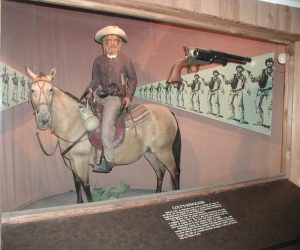
Do you picture the Ranger carrying his Colt revolver?  While it’s true that many of them had Colts after Jack Hays, who was famous for his one-man stand against a band of Comanche near Enchanted Rock, introduced them to the Rangers, they weren’t something the state provided.  The first time the state issued firearms to Rangers was in 1870 when they provided breech-loading cavalry carbines.  But – and this is a big but – the cost was deducted from the Rangers’ pay.

Ever wonder what a hobble for a horse looks like? Here’s one from The Texas Ranger Hall of Fame and Museum

So, what did the state provide to its famed peacekeepers?  Food, forage for their mounts, ammunition, and medical assistance.  The Rangers were responsible for their horses, their weapons, and their clothing.

Until 1874, the Rangers were citizen-soldiers, meaning that they were called when needed and disbanded when the need was over.  While the 1866 legislature established three battalions of Rangers, the bill to finance them failed.  In 1870, the legislature authorized the creation of twenty companies of Rangers, but only fourteen were actually established.

The creation of the Frontier Battalion in 1874 marked a significant

This exhibit within the Texas Ranger Hall of Fame and Museum shows not only a Ranger and his horse but also the famous Colt Revolver.

change for the Rangers, creating a professional law enforcement agency with civil police powers.  The Frontier Battalion consisted of six companies, each with a captain, two lieutenants, and 72 men who enlisted for twelve months.

How much were these men paid?  In 1835, the daily pay was $1.25.  You might have thought that by 1874, the pay would have increased, but a private’s monthly pay was only $30 and a corporal’s was $40.  Sergeants made $50, lieutenants $75, and captains $100.  Since pay day was once a quarter, I suspect that the state-provided meals were critical to a Ranger’s survival.

Does all this make you want to enlist?  I didn’t think so.  The men who joined the Rangers were men who believed in justice, men who wanted to keep their home safe, men who sought adventure rather than comfort.  Men like Jackson Guthrie.

(Note: These are all photos I took at the Ranger Museum in Waco.  We won’t talk about the challenge of getting these pictures from a machine running Windows 95 to one with Windows 10.  Such fun!)

As far as Thea Michener is concerned, it’s time for a change. With her husband murdered and her much-anticipated baby stillborn, there is nothing left for her in Ladreville. Having accepted a position as Cimarron Creek’s midwife, she has no intention of remarrying. So when a handsome Texas Ranger appears on her doorstep with an abandoned baby, Thea isn’t sure her heart can take it.

Ranger Jackson Guthrie isn’t concerned only with the baby’s welfare. He’s been looking for Thea, convinced that her late husband was part of the gang that killed his brother. But it soon becomes clear that the situation is far more complicated than he anticipated—and he’ll need Thea’s help if he’s ever to find the justice he seeks.

Amazon

Barnes & Noble

Christian Book Distributors

I’m giving away a print copy of A Tender Hope to a US winner.

Just leave a comment to be eligible to win!


Amanda Cabot’s dream of selling a book before her thirtieth birthday came true, and she’s now the author of more than thirty-five novels as well as eight novellas, four non-fiction books, and what she describes as enough technical articles to cure insomnia in a medium-sized city.  Her inspirational romances have appeared on the CBA and ECPA bestseller lists, have garnered a starred review from Publishers Weekly, and have been nominated for the ACFW Carol, the HOLT Medallion, and the Booksellers Best awards.  A popular workshop presenter, Amanda takes pleasure in helping other writers achieve their dreams of publication.

Social Media Links

http://www.amandacabot.com

http://www.facebook.com/amanda.j.cabot

http://twitter.com/AmandaJoyCabot/

http://amandajoycabot.blogspot.com/


A Bustles and Spurs Party!


YOU’RE INVITED!

A BUSTLES AND SPURS PARTY!

When: Monday, March 25 to Friday, March 29, 2019

Where: Right Here at P&P

IT’LL BE FUN!

YOU MIGHT WIN SOMETHING!

OR YOU MIGHT LEARN SOMETHING NEW!

OR A COWBOY MIGHT WANT TO DO-SI-DO!