
If the very words “Texas Rangers” make you think of heroes, you’re not alone. For many of us, those men who wear the star are legendary, their stories larger than life. That’s one of the reasons I made Jackson Guthrie, the hero of A Tender Hope, a Ranger. But as I researched the Rangers, I discovered a number of things that surprised me.
It started with the stars. Did you know that the early Rangers did not necessarily wear badges, and if they did, they were ones they’d either created or purchased? It’s true. The state did not issue badges to Rangers until 1935. Prior to that, the only official proof that they were Rangers was the documentation the state provided, a description of their physical appearance that served to identify them. The early badges were often

made from Mexican silver eight-real coins or simply tin.
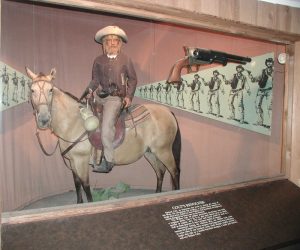
Then we come to the uniforms. There were none in the early days. While Rangers are often shown wearing slouch hats, those were not mandatory. Instead, those particular hats were chosen for their practicality, keeping the sun and rain out of the Ranger’s face.
Do you picture the Ranger carrying his Colt revolver? While it’s true that many of them had Colts after Jack Hays, who was famous for his one-man stand against a band of Comanche near Enchanted Rock, introduced them to the Rangers, they weren’t something the state provided. The first time the state issued firearms to Rangers was in 1870 when they provided breech-loading cavalry carbines. But – and this is a big but – the cost was deducted from the Rangers’ pay.

So, what did the state provide to its famed peacekeepers? Food, forage for their mounts, ammunition, and medical assistance. The Rangers were responsible for their horses, their weapons, and their clothing.
Until 1874, the Rangers were citizen-soldiers, meaning that they were called when needed and disbanded when the need was over. While the 1866 legislature established three battalions of Rangers, the bill to finance them failed. In 1870, the legislature authorized the creation of twenty companies of Rangers, but only fourteen were actually established.
The creation of the Frontier Battalion in 1874 marked a significant
change for the Rangers, creating a professional law enforcement agency with civil police powers. The Frontier Battalion consisted of six companies, each with a captain, two lieutenants, and 72 men who enlisted for twelve months.
How much were these men paid? In 1835, the daily pay was $1.25. You might have thought that by 1874, the pay would have increased, but a private’s monthly pay was only $30 and a corporal’s was $40. Sergeants made $50, lieutenants $75, and captains $100. Since pay day was once a quarter, I suspect that the state-provided meals were critical to a Ranger’s survival.
Does all this make you want to enlist? I didn’t think so. The men who joined the Rangers were men who believed in justice, men who wanted to keep their home safe, men who sought adventure rather than comfort. Men like Jackson Guthrie.
(Note: These are all photos I took at the Ranger Museum in Waco. We won’t talk about the challenge of getting these pictures from a machine running Windows 95 to one with Windows 10. Such fun!)

As far as Thea Michener is concerned, it’s time for a change. With her husband murdered and her much-anticipated baby stillborn, there is nothing left for her in Ladreville. Having accepted a position as Cimarron Creek’s midwife, she has no intention of remarrying. So when a handsome Texas Ranger appears on her doorstep with an abandoned baby, Thea isn’t sure her heart can take it.
Ranger Jackson Guthrie isn’t concerned only with the baby’s welfare. He’s been looking for Thea, convinced that her late husband was part of the gang that killed his brother. But it soon becomes clear that the situation is far more complicated than he anticipated—and he’ll need Thea’s help if he’s ever to find the justice he seeks.
I’m giving away a print copy of A Tender Hope to a US winner.
Just leave a comment to be eligible to win!

Amanda Cabot’s dream of selling a book before her thirtieth birthday came true, and she’s now the author of more than thirty-five novels as well as eight novellas, four non-fiction books, and what she describes as enough technical articles to cure insomnia in a medium-sized city. Her inspirational romances have appeared on the CBA and ECPA bestseller lists, have garnered a starred review from Publishers Weekly, and have been nominated for the ACFW Carol, the HOLT Medallion, and the Booksellers Best awards. A popular workshop presenter, Amanda takes pleasure in helping other writers achieve their dreams of publication.
Social Media Links
http://www.facebook.com/amanda.j.cabot
http://twitter.com/AmandaJoyCabot/
http://amandajoycabot.blogspot.com/
 Let’s talk about series books today. Do you prefer your favorite cowboy books to be part of a series? As you start the book, do you begin to imagine the secondary characters having stories of their own? Have you ever written to an author to ask for a secondary character to have their own book?

 Her Last Chance Cowboy


 While I was writing
 One thing I’ve always enjoyed while writing was the research and it’s easy to get lost in it. So for all you historical writers of the West, when a random or crazy plot line you think couldn’t possibly work for your story, dig deeper into your research. Hopefully, you’ll be wildly surprised as I was and can add that to your novel.

 As my story ideas came together, I especially wanted to write my heroes as strong Christians and show how they dealt with the horrors of Andersonville Prison for Union soldiers. Perhaps a 21st century veteran’s spouse, mother, sister, or girlfriend will read PATRIOT HEART, FAITHFUL HEART, AND HOPEFUL HEART and see there is hope for their loved one. Hope for the future in God, the Father, and salvation through Jesus Christ, His son.
 HOPEFUL HEART is the last story in my 3-book Journey Home Series. The series is about three Civil War POWs who met in the infamous Andersonville Prison for Union soldiers and survive because of their friendship and Christian faith. Each book features one of the memorable heroes and a unique heroine that’s perfect for him.
 Missouri. November 1866 – Nat Renshaw’s boyish good looks disguise his intense personality.


