 Out where the handclasp’s a little stronger,
Out where the smile dwells a little longer,
That’s where the West begins…
Arthur Chapman 1912
 Last week was National Cowboy Poetry week and I usually spend it at the Santa Clarita Cowboy Festival signing books. The festival, was canceled this year, along with everything else. But I sure did miss it.
I especially missed rubbing shoulders with people like Cheryl Rogers Barnet (daughter of Roy Rogers and Dale Evans), Jon Chandler (chosen Best Living Western Musician by True West Magazine) and cowboy poet, Waddie Mitchell.

It was at this festival that I first learned to appreciate cowboy poetry. I was never particularly fond of poetry, but this was different. This was storytelling like I’d never heard, and it really brought the west alive for me.
Cowboy poetry flourished after the Civil War. War songs were mixed with traditional ballads to create a unique style that painted vivid pictures of loneliness, loss of a horse, camaraderie and annoying coyotes.
Cowboys recited these poems for each other around the campfire. No free form verse for these hard-driven men. Old time cowboy poetry always rhymed and was often put to song.
Much of it was done orally, which helped with memorization. Because the poetry was not written down, much was lost but not all. Fortunately, some of these gems were printed in newspapers and have since been published in books.
Legend has it that the reason poems were recited from memory was because cowboys were illiterate.
Not true, says writer David Stanley. In his book Cowboy Poetry Then and Now,” he argues that cowboys were anything but illiterate. “Many cowboys of both the nineteenth and twentieth centuries have been well read, sometimes astonishingly so.” He goes on to say that “Cowboy poetry has been primarily the province of literate people since the first publication of poems in western newspapers in the 1870s.”
To prove his point, Stanley tells us that “It wasn’t just original poetry that was enjoyed around the campfires. Cowboys also enjoyed “a mass of popular poetry from Shakespeare to Rudyard Kipling.”
There’s a famous saying that any poem a cowboy likes is a cowboy poem. That may be true of Shakespeare, but for me, personally, nothing beats a poet in a cowboy hat.
What’s your favorite western storytelling medium: movie, TV, books, music or poetry?


 I could not “think out” a dinner my husband could eat without a cookery book, nor could I apportion out the righteous need of rations to each individual member of my household without having some indisputable precedent to go by, and this latter I found in Mrs. Beeton’s admirable ‘Book of Household Management.’ Or so says Mrs. Pender Cudlip, writing in the 1880s magazine, The Modern Housewife.
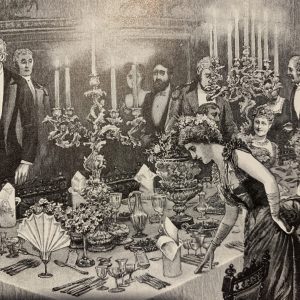 cooks what to do. They knew the correct food to have, the sauces that went with them, and how everything should taste. It wasn’t until after WW1 and the subsequent shortage of servants that they had to put their money where their mouths were and actually start cooking themselves. If they were really lucky, their daughters would have had a few cooking lessons at school.
 In smaller houses that did have a cook, the mistress came down to the kitchen to see her. The cook, therefore, had to make sure that the kitchen was spotless, with a white cloth placed at the end of the table and a slate or a menu book and pencil placed on the cloth. if you were a kitchenmaid, you were banished from the kitchen during these meetings.


