Even though the term “snake oil” evokes images of charlatan salesmen making outlandish claims about the benefits of their elixirs, therapeutic snake oil had actual health benefits.
Originally snake oil was made from the oil of the Chinese water snake, which contains omega-3 acids, which works as an anti-inflammatory agent. In the 1800s, thousands of Chinese immigrants arrived in the United States to work on the Transcontinental Railroad. With them they brought snake oil, which they rubbed into their joints to treat swelling, arthritis and bursitis after long workdays. The word of snake oil’s effectiveness spread, and people began to wonder how they could produce their own snake oil. Enter the rattlesnake.
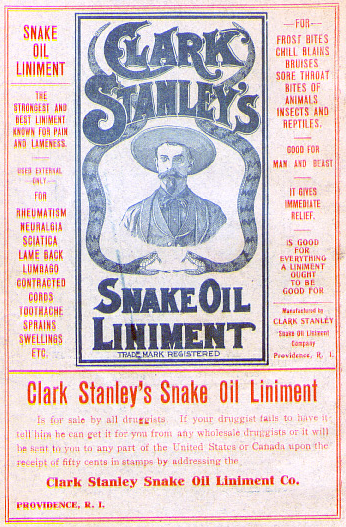
Clark Stanley, a former Texas cowboy, became The Rattlesnake King. He claimed that he studied with a Hopi medicine man in Arizona for two years and learned the secret of snake oil. He attended the 1893 World’s Fair in Chicago, where he would take a live snake, slice it open, drop it in boiling water and then skim the fat off the top to create Stanley’s Snake Oil, a topical liniment. People snapped up the product after the demonstrations.
The problem with rattlesnake oil is that is doesn’t have high levels of omega-3 acids, so it does not help with inflammation, so it would never have been effective against joint pain. But that wasn’t the biggest problem with Clark Stanley’s snake oil. When Pure Food and Drug Act was passed in 1906, Stanley’s Snake Oil was tested and found to have no snake oil at all. It was mainly mineral oil which has zero effect on joint inflammation, combined with chili peppers and turpentine. Clark Stanley was a fraud and the term “snake oil” has become synonymous with fake cures and medicines.
Clark Stanley was fined $20 for misleading the public and violating the Pure Food and Drug Act.
For my latest release, A Match Made in Heaven, I had to do a bit of research about gold mining. I know a couple of amateur gold miners who get very excited when they talk about their hobby. They do things the old fashioned way and pan for gold, and have great fun doing it.
People have always been fascinated with gold. Wars have been fought over it, nations rise and fall chasing after it and why not? This precious metal represents wealth and prosperity.
Did you know that veins of gold are created when hot lava makes it’s way to the surface? The lava cools and releases large amounts of gases and liquids. These follow cracks in the lava, depositing minerals along the way. This is what forms a vein. Who knew? And to think some of these veins can run for miles! Wowzers! The other interesting thing I found during my research, was when veins reach the surface, wind, water, weather, all break down the gold and carry it off.
But where can you find gold? My characters live in Cripple Creek Colorado where one of the biggest gold strikes in the 1800’s was found. Other characters are from Denver, and have never panned or mined for gold, but thought it would be fun to try. Much like modern day gold seekers willing to give panning for gold a try.
You could find gold on your own property. The stuff is everywhere! But to do it properly, one wants to follow a few steps. After all, you don’t want to fill your back yard full of holes. Instead, one of the best places to look is within quartz crystal formations. Unfortunately, it’s expensive for beginners to get to the gold that way, so there’s a better option. Locating alluvial deposits, an accumulation of the precious stuff that has separated from a source rock during sedimentary processes. This is what miners call “placer mining” and was the main form of gold mining in the early years.
It’s also wise to look for gold in a place where it’s been found before. Research local area museums, natural history or historical societies. Some towns might have their own school of mines. You’ll learn all about precious metals this way and have a better idea of what you’re doing. Unlike my characters, who dove into their mining adventure with very little prep. Well, that’s not entirely true. They did “read up on it” the night before setting out on their gold mining adventure.
This fun hobby is gaining popularity and getting started doesn’t have to break the bank. Modern day gold pans are made of lightweight plastic and are fairly cheap. Steel pans are heavier, harder to use, and can rust. So start with the plastic. My characters didn’t have such a luxury, they had a difficult time of it. But in the end, my hero and heroine found something more precious than the gold they were trying to mine.
What other activities from the past do people do as hobbies and for fun? I’ll pick one person from the comments to receive a free e-copy of my new release, A Match Made in Heaven! I can think of a few. These activities were necessary back in the day, but fun to do now. Knitting, bread baking, weaving. What other activities can you think of?
Fill in the puzzle and then post your number of correct answers in the comments. One lucky winner will receive a $15 Amazon gift card. Everyone is eligible, even if you didn’t get all the answers. Have Fun!
Whenever I write a blog to introduce a new book, I like to talk about some of the things I learned through my research for that story. Carrianne’s research centered mostly on the Union Pacific Railway and, in particular, the Pullman cars that Carrianne and her husband enjoyed in my story for their trip from Denver to San Francisco, where they fought to bring down the worst criminal on the Barbary Coast at the time.
The Barbary Coast also required fascinating research, but that deserves its own blog.
I think all of us would have enjoyed a train ride in an elegant, plush Pullman car. I was shocked to learn just how fabulous they were.
According to legend, a highly uncomfortable overnight train ride from Buffalo to Westfield, New York, prompted George Pullman to find a better way to provide comfortable, clean, efficient passenger service.
Traveling over early, hastily constructed rail beds, trains inevitably swayed, rattled, and clacked. Most passenger cars ran on two four-wheel trucks. Pullman used eight-wheel trucks supplied with an improved suspension for a smoother ride. He even added lighter wheels with pressed-paper cores to minimize jolts. He installed double-glazed windows and doors for quiet. The ventilators in a Pullman car brought in fresh air but filtered out dust and cinders.
The true glory of the Pullman car was in the decor. Victorian taste ran toward the baroque, and Pullman offered the utmost in ornamentation: carved walnut paneling, polished brass fittings, beveled French mirrors, Brussels carpets, brocade, tassels, and fringe. At night, porters made up the berths with pristine white sheets.
Thanks to the low $2 extra fee a passenger paid to ride in a Pullman car, such luxury was affordable even for the upper-middle class.
1872: Passengers bedding down onboard a luxurious Pullman sleeping car of the Pacific Railroad. (Photo by Three Lions/Getty Images)
Before George Pullman introduced his first diner, the Delmonico, trains stopped briefly at stations to allow passengers a hurried meal, and I mean hurried. Dining cars ended this inconvenience. There were also parlor cars, where a passenger could relax in an upholstered armchair, which swiveled to allow a view of the scenery. Wide windows and elegant furnishings added to the sense of privilege. An organ provided entertainment.
Illustration shows a crowded Pullman dining car on a train as waiters serve the passengers, late nineteenth century. (Photo by Interim Archives/Getty Images)
An important Pullman innovation was the vestibule train. Early cars had platforms front and back so that passengers had to step outside to move from one car to another. The vestibule was a spring-driven accordion covering that allowed cars to be joined seamlessly. It made moving from car to car more easily and helped to stabilize the train at high speeds.
The ultimate in Pullman extravagance was the private car, known in the business as a “private varnish.” These cars allowed the ultra-wealthy to travel comfortably without rubbing elbows with fellow passengers. A typical car might have an open fireplace and a marble bath. Italian artists supplied paintings of fuchsias and hummingbirds for the ceiling. Lamps and fitting were gold plated. The car contained several bedrooms, a central parlor/dining room, and a kitchen. Such cars sold for $50,000, equal to 1.3 million today.
I’d love to provide more details on how everything worked, but I believe I’d better quit before I wear out my welcome. I’ll provide photographs instead to show you what you missed by not having been born much, much sooner.
What would you pay today to enjoy such luxury as the Pullman cars offered?
Please comment to enter the give away. One winner will receive a copy of my current book, Carrianne’s Debacle, and a second winner will receive a book of their choice from my backlist.
Charlene Raddon is a multi-published, award-winning author of Victorian/Western romance. Originally published by Kensington Books in the 1990s, she now self-publishes. She also creates book covers, specializing in western historical designs.
I’m just now finished with a fun but kinda strange writing experience.
I wrote three geniuses. Brilliant sisters. They’re not only naturally intelligence but they are highly educated by a mother and father who know these girls are all the
children they’ll ever have. And the father has a lumber dynasty. He owns a mountain, but he is also invested in a whole lot of fast-growing companies in boom-town San Francisco in 1870.
Women could go to college then, but it wasn’t common and it wasn’t easy. And beside these parents want more for their daughters then a genteel lady’s education. They want to raise up women to lead, to manage men, to hold their own in a hard world that can be cut-throat on occasion.
So they’ve hired vacationing college professors, paid for the best tutors, and their father has taken them along with him to spend time with his lumberjacks and truly learn the business.
This was all, as I said, a lot of fun. Here’s the strange part.
I realized very early on, these women were all a whole lot smarter than I am.
So how to you write geniuses? I think I’m pretty book smart. But these women know math, science, surveying, chemicals, engines, force. They’ve learned to build, they understand the strength of steel and the strength needed to brake a train car, loaded with logs, hurling down a steep mountain train track. And also the power needed by the engine to pull that train back up loaded with passengers and supplies.
Me? I got a C in Algebra 1, and like a freakin’ coward, never took a math class again.
But I got great grades in English, especially the semester we did literature.
So I had to write really smart women. Heaven knows if I succeeded but I had fun making my characters just a little out of step with the rest of the world. I had them know how to blow up a mountain—and I mean make the calculations so the mountain ends up with a tunnel through it going just the right direction, not just blasting rocks to bits. But the women don’t know how to wash clothes or turn a haunch of venison into a meal for ten people.
And they need to do it because I start the book with them running for their lives. And then they have to hide from their cruel stepfather. They disguise themselves as servants. And realize they might not be as smart as they thought they were because they don’t know how to be servants and pretty soon no one is buying their act.
The series starts with a bang as they make their escape. Book #1 is The Element of Love, coming March 2022. Soon!
We’ll see if I outsmarted myself.
Books #1 and #2 are available to pre-order now.
Book #3 A Model of Devotion should be up soon.
The Element of Love
After learning their stepfather plans to marry them off, Laura Stiles and her sisters escape to find better matches and claim their father’s lumber dynasty.
Laura sees potential in the local minister of the poor town they settle in, but when secrets buried in his past surface, it will take all they have to keep trouble at bay.
 Even though the term “snake oil” evokes images of charlatan salesmen making outlandish claims about the benefits of their elixirs, therapeutic snake oil had actual health benefits.
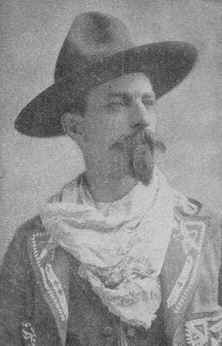 Clark Stanley, a former Texas cowboy, became The Rattlesnake King. He claimed that he studied with a Hopi medicine man in Arizona for two years and learned the secret of snake oil. He attended the 1893 World’s Fair in Chicago, where he would take a live snake, slice it open, drop it in boiling water and then skim the fat off the top to create Stanley’s Snake Oil, a topical liniment. People snapped up the product after the demonstrations.
 omega-3 acids, so it does not help with inflammation, so it would never have been effective against joint pain. But that wasn’t the biggest problem with Clark Stanley’s snake oil. When Pure Food and Drug Act was passed in 1906, Stanley’s Snake Oil was tested and found to have no snake oil at all. It was mainly mineral oil which has zero effect on joint inflammation, combined with chili peppers and turpentine. Clark Stanley was a fraud and the term “snake oil” has become synonymous with fake cures and medicines.

 For my latest release, A Match Made in Heaven, I had to do a bit of research about gold mining. I know a couple of amateur gold miners who get very excited when they talk about their hobby. They do things the old fashioned way and pan for gold, and have great fun doing it.
 But where can you find gold? My characters live in Cripple Creek Colorado where one of the biggest gold strikes in the 1800’s was found. Other characters are from Denver, and have never panned or mined for gold, but thought it would be fun to try. Much like modern day gold seekers willing to give panning for gold a try.
 It’s also wise to look for gold in a place where it’s been found before. Research local area museums, natural history or historical societies. Some towns might have their own school of mines. You’ll learn all about precious metals this way and have a better idea of what you’re doing. Unlike my characters, who dove into their mining adventure with very little prep. Well, that’s not entirely true. They did “read up on it” the night before setting out on their gold mining adventure.

 Whenever I write a blog to introduce a new book, I like to talk about some of the things I learned through my research for that story. Carrianne’s research centered mostly on the Union Pacific Railway and, in particular, the Pullman cars that Carrianne and her husband enjoyed in my story for their trip from Denver to San Francisco, where they fought to bring down the worst criminal on the Barbary Coast at the time.


 Charlene Raddon is a multi-published, award-winning author of Victorian/Western romance. Originally published by Kensington Books in the 1990s, she now self-publishes. She also creates book covers, specializing in western historical designs.
 I’m just now finished with a fun but kinda strange writing experience.


