Encouragement from an unexpected source set Barbara Ankrum’s romance-author’s feet on a new path. Help us welcome Barbara to Wildflower Junction.
By Barbara Ankrum
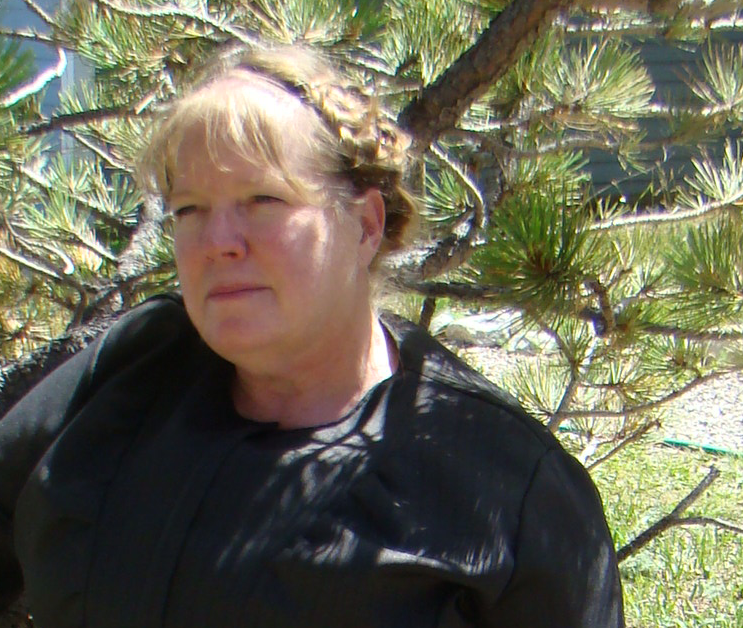
Barbara Ankrum
For years, I resisted the temptation to write a romance with a Native American protagonist. Frankly, I was scared to do it. I might get it wrong. Or, worse, insult someone! So I avoided it even though I longed to write one.
Then my daughter moved to Kansas.
On a visit, I took the grandkids to a cool little farmstead called Deanna Rose, and was surprised to find there a reproduction of a Kanza (tribe) mound lodge. From the outside, the mound looked like a tall, grass-covered hill with two tunnel-like doorways. Inside, it was a circular wood-braced lodge, 14’ high at the center with cottonwood tree trunk poles supporting the arched roof. Beds lined the walls all the way around the forty feet in diameter perimeter. In the center, a fire pit and a hole in the ceiling for smoke to escape.
The earthen walls were fourteen inches thick insulating the interior from the harsh Kansas summer sun. Outside, it was 3,000 degrees, (I jest—but it was Kansas in July!) But inside that mound it was a cool 70-something and I lingered.
A Native American docent started to chat with me about the structure and I asked a bunch of questions. The mounds are scarce—almost non-existent now, because they were nearly all destroyed by the Army in the Indian Wars, set ablaze and collapsed.
When I admitted I write historical romance and secretly always wanted to write a Native American hero, but didn’t have the nerve, this woman looks at me and says, “Why not?” And I was like, “Well, because I’m not Native American. I might not do their story justice.” This sweet woman laughed. “But you see,” she said, “You’d be telling their story, a story that might not be heard otherwise. A story that might never have a voice. You must write it.”
I was dumbfounded but profoundly affected by her words. Maybe I just needed a new perspective. If I did my best with it and gave it my heart and told the story that was calling me, then it might be enough. After all, isn’t that what writers do?
This woman’s off-handed encouragement was the jumping off point for THE RUINATION OF ESSIE SPARKS. Set Montana, my hero is a half-breed Cheyenne (okay, so I dipped my toe in!) and my heroine is a white schoolteacher he accidentally kidnaps and drags into the wilds of the Montana Mountains. It’s set in the post-Indian War devastation of the far West tribes and the systematic removal of the Native American children to white-run boarding schools.
And it turned out Essie was brave and maybe a little inspired by that docent’s words, too. When I got a really nice review from a Native American reader thanking me for not backing off the true story of the boarding schools, I could only smile and secretly thank that woman from Deana Rose.
You never know where encouragement will come from. You never know how your words will affect someone else. And you never know what you can do until you try.
I hope you’ll give THE RUINATION OF ESSIE SPARKS a read. Maybe it will inspire you to be brave about something in your own life. I think if we just remember that we bring our own heart to the things we do, we bring something to the table that no one else possibly could. And that’s more than enough.
Find The Ruination of Essie Sparks and Barbara’s other books at Amazon.
What is it you’d love to try, but have held back doing? Tell me and I will give away one e-copy of THE RUINATION OF ESSIE SPARKS to one lucky commenter.
Life on the open range could be a discomforting experience, But you can simplify lead flow with outlaws popping out from behind the sagebrush without the slightest provocation, nesters “accidentally” mistaking a cattleman’s range for the quarter section they’d purchased, steers stampeding wherever they pleased, and wild animals running amok in settlers’ vegetable gardens—not to mention all those Indians to keep track of.
Things weren’t much easier for townies. For one thing, outlaws didn’t confine themselves to the countryside. Drunks stumbled out of saloons with reckless abandon, ladies of questionable virtue roamed the streets at will, and barbers pulled teeth or performed surgery like they knew what they were doing. Even church socials sometimes got out of hand.
At least folks in town could count on the law to keep things somewhat under control, right?
Not always.
Finding a reliable lawman was anything but easy. El Paso, Texas, discovered that when it hired Dallas Stoudenmire as city marshal. Stoudenmire, a deadly gunman with a mean temper and a fondness for strong drink, insisted on starting fights and shooting people—some of them even criminals. As a young man, famed lawman Wyatt Earp stole horses. Between gigs as a county sheriff, town marshal, and city policeman, Earp ran faro tables, owned brothels, got arrested for a number of crimes, broke out of jail, led a vigilante group, and otherwise made a nuisance of himself. Pat Garrett may have been a straight arrow legally speaking, but he was unpleasant to be around. Even his fellow officers objected to his disposition: a refreshing mixture of arrogance and surliness.
Some men found a badge to be an excellent disguise for nefarious activities. Take these guys, for example:
Henry Plummer
Henry Plummer
In 1856, at the age of 24, Plummer became the marshal of Nevada City, Calif., the third-largest settlement in the state. In 1859, the marshal killed the husband of a woman with whom he was having an affair. Sentenced to ten years in San Quentin, he received parole in six months and immediately joined a gang of stagecoach robbers.
In January 1862, Plummer formed his own gang and began hijacking wagons transporting gold out of mining camps. When that enterprise petered out in January 1863, Plummer relocated to the newest gold rush in Bannack, Montana. There, he formed the Innocents, a network of road agents that numbered more than 100 men within a few short months.
In May 1863, Plummer lost a sheriff election and subsequently threatened his rival until the man high-tailed it, fearing for his life. Plummer took over the sheriff’s job and right away appointed two of his Innocents cronies as deputies. Oddly, crime dramatically increased. In about nine months, more than 100 murders occurred and robberies, assaults, and assorted other crimes reached unprecedented levels. All the while, Plummer—under the guise of cracking down on lawlessness—hanged witnesses.
On January 10, 1864, having had enough law enforcement for a while, fifty to seventy-five vigilantes rounded up Plummer and his two deputies and hanged them in the basement of a local store.
Burt Alvord and Billy Stiles
Burt Alvord, Yuma Territorial Prison, 1904
In the 1890s, Alvord and Stiles served as deputy sheriffs in Willcox, Arizona. Unsatisfied with their salaries, the two began robbing Southern Pacific Railroad trains to supplement their income. Emboldened by pulling a number of successful jobs, they undertook their most daring escapade on September 9, 1899, in what came to be known as the Cochise Train Robbery. Instead of clinging to tradition and stopping the train on a lonely stretch of track in the middle of nowhere, Alvord and Stiles had five members of their gang blow up the safe while the train was stopped in the town of Cochise. Alvord and Stiles, maintaining their law-enforcement decorum, were part of the posse that unsuccessfully attempted to apprehend the robbers in the Chiricahua Mountains.
About five months later, on February 15, 1900, the gang struck again, in broad daylight in the tiny town of Fairbank, Arizona. While the train was stopped at the station, the Alvord-Stiles gang approached the express car, guns drawn, only to find the messenger responsible for the safe unwilling to abide such rude behavior. During the gunfight that erupted, two of the five gang members were wounded and one ran away. The messenger, also wounded, hid the safe’s key before losing consciousness. Unable to find the key and without a single stick of dynamite between them, the rest of the gang vamoosed.
Fairbank, Ariz., railroad depot circa 1900
Once again, Alvord and Stiles rode with a posse to track down the outlaws, one of whom was injured so badly he had to be left behind about six miles outside town. Despite Alvord’s and Stiles’s attempts to misdirect the pursuers, they stumbled across the wounded man. Before he died, the outlaw fingered Alvord as the ringleader. Stiles confessed and turned state’s evidence, allowing him to remain comfortably outside the bars while Alvord cooled his heels inside. A short while later, Stiles broke Alvord out of the hoosegow and the two of them lit a shuck for Mexico.
The Arizona Rangers invaded Mexico and, in 1904, engaged the two now-expatriates in a gun battle. They captured Alvord, but Stiles got away. After a brief stint in the Rangers under an assumed name, Stiles was killed a few years later while working as a lawman in Nevada, also under an assumed name. Alvord did two years in Yuma Territorial Prison and took it on the lam for Panama upon his release.
H.D. Grunnels
Steam train, 1898
In 1898, Fort Worth, Texas, Assistant Police Chief Grunnels talked a gang of Oklahoma bank robbers out of robbing a local diamond merchant and into robbing a train in Saginaw, Texas, instead. Grunnels masterminded the operation, planning to apprehend the bandits after they made off with the money, then collect the reward and keep the loot.
The Apple Dumpling Gang might have performed the train heist with more aplomb. While crawling across the top of the coal tender to reach the engine, the gang’s leader slipped and accidentally discharged his pistol. His minions mistook the misfire as their signal to hop on the train and commence whatever mischief their roles required. Chaos ensued.
Meanwhile, Grunnels and a cadre of Fort Worth police officers not in on the plan raced to the rescue of a train that had yet to be robbed. The discombobulated robbers scrammed. The Fort Worth Police Department became suspicious when it discovered Grunnels reached the scene of the crime before the crime had been reported. Grunnels was fired and indicted, but he disappeared before trial.
The heroes in the two novellas that compose Robbing Banks, Stealing Hearts could give lessons in how to fail at outlawry to all of the compromised lawdogs above. So, here’s my question for this month: If you were going to commit a crime in the Old West, what crime do you think you could pull off? Bank or train robbery? Horse or cattle rustling? Murder for hire? Spitting on the sidewalk? Something else? I’ll give an e-book of Robbing Banks, Stealing Hearts to one of y’all who’s brave enough to expose your criminal dreams.😉
Everyone should have career at which they excel. At failing to commit crimes, nobody is better than Laredo and Tombstone Hawkins. Maybe they can bumble their way into love.
The Worst Outlaw in the West
Laredo Hawkins has one ambition: to redeem his family’s honor by pulling the first successful bank robbery in the Hawkins clan’s long, disappointing history. Spinster Prudence Barrett is desperate to save her family’s bank from her brother’s reckless investments. A chance encounter between the dime-novel bandit and the old maid may set the pair on a path to infamy…if either can find a map.
Family Tradition
Haunted by his kin’s tradition of spectacular failure, bank robber Tombstone Hawkins is honor-bound to prove his family tree produced at least one bad apple. When carnival fortuneteller Pansy Gilchrist tries to help, she accidentally summons a pair of dishonest-to-goodness ghosts. Getting into the spirit of a crime is one thing…but how do you get the spirits out?
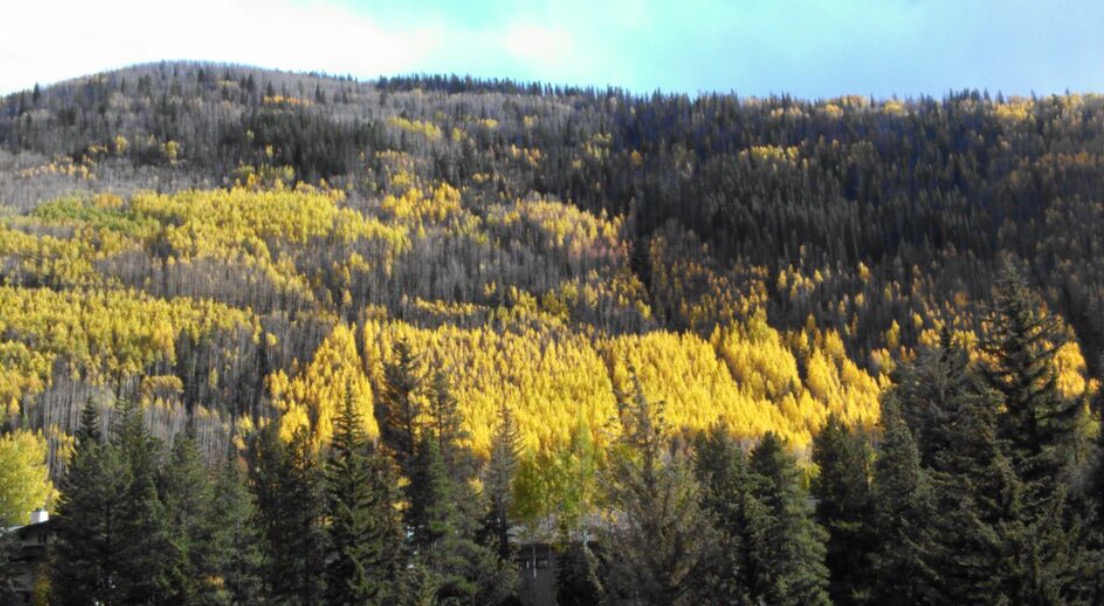
A couple of autumns ago, Hubs and I visited Colorado during peak aspen season and found ourselves in Leadville.
Well, you don’t just find yourself in a place two miles high…we went on purpose, had a great visit and lunch in a historic saloon. Finding Wild West memorabilia all over the walls of the Silver Dollar Saloon (formerly The Board of Trade) told me I had to set a story in this “Cloud City” breathing and seething with history, and somehow, Doc Holliday would play a part.
And I found out some stuff I thought I’d share. Please leave a comment today for a chance to win an e-copy. What info about Doc Holliday did you find most interesting?
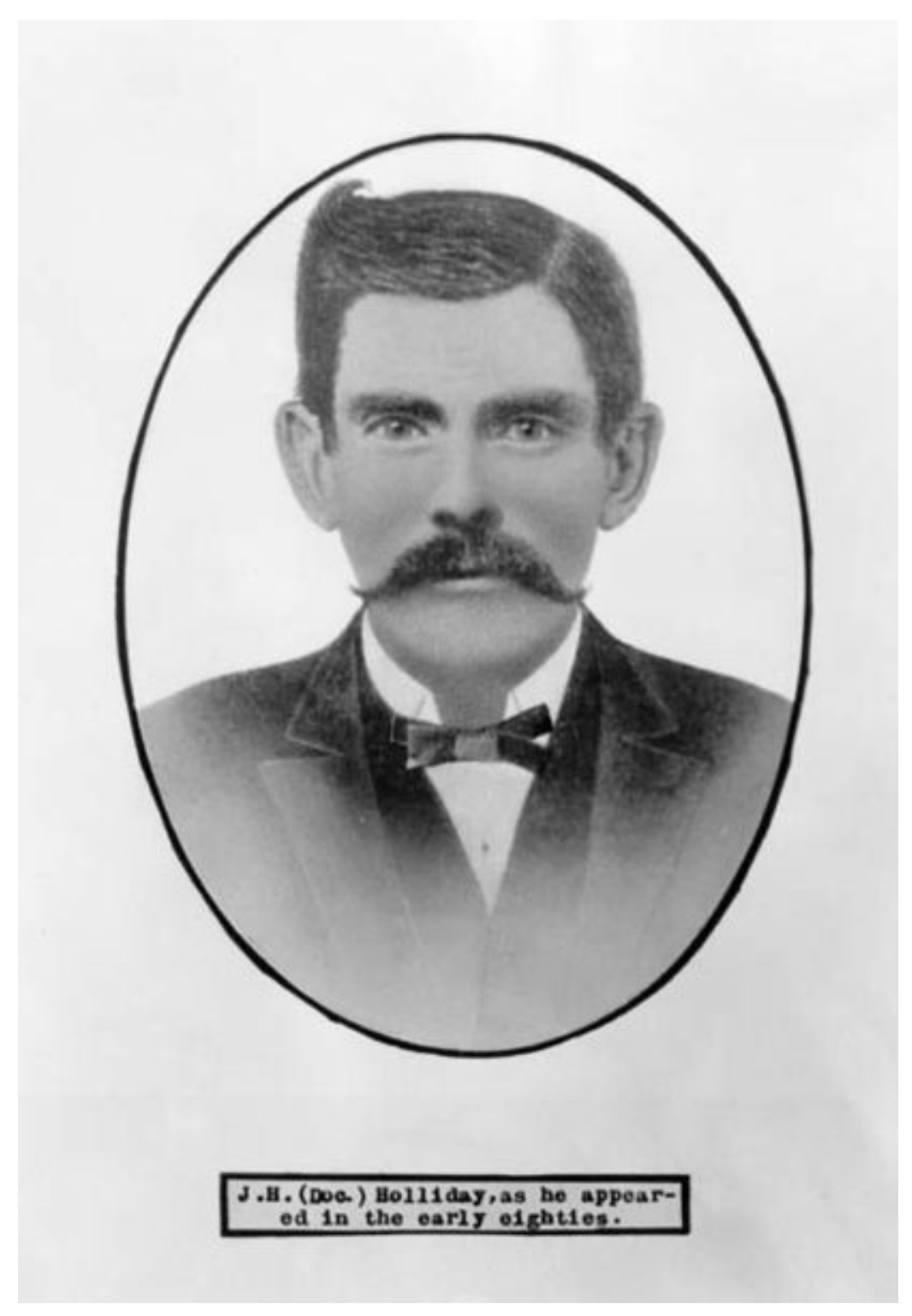
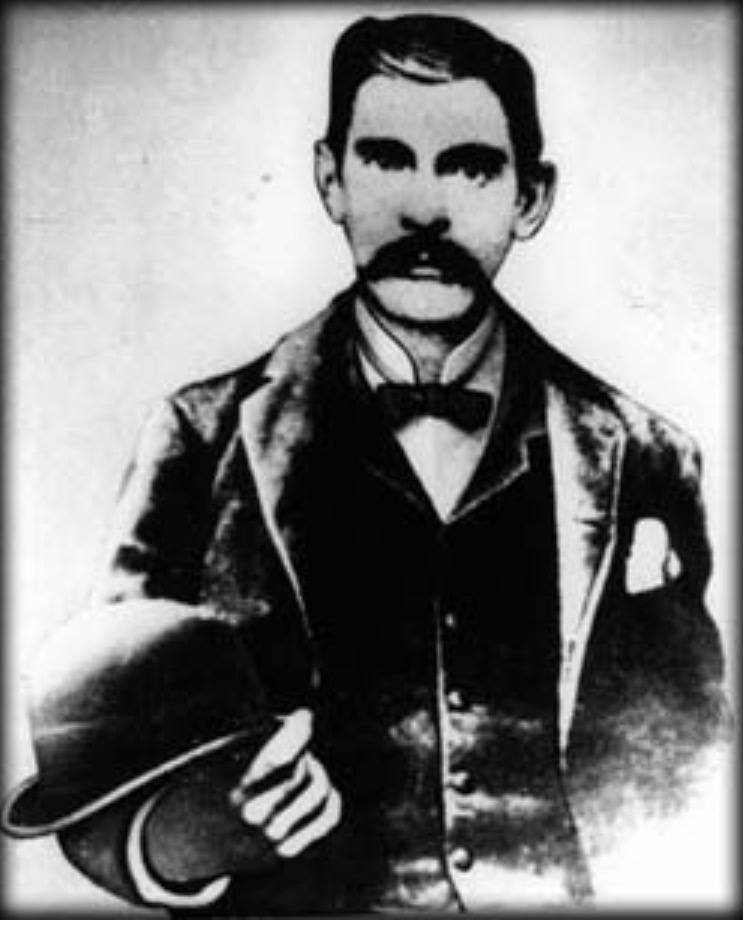
John Henry Holliday, was born in Griffin, Georgia, on August 14, 1851, with a cleft pallet. His uncle, physician John Stiles Holliday surgically repaired the newborn’s defect and possibly the baby was named for him. The doctor’s first cousin Dr. Williamson Crawford Long was the anesthesiologist. John Henry Holliday most likely had a slight life-long speech impediment.
John’s beloved mother Alice died of tuberculosis when he was 15. His father’s remarriage only three months later to a woman just a few years older than John added to his terrible loss.
His father Henry Burroughs Holliday was a planter, druggist, and a soldier who moved the family near the Florida-Georgia line when he realized their home in Griffin GA was in the warpath of U.S. General Tecumseh Sherman’s March to the Sea.
John Henry Holliday had been close friends with his first cousin Martha Anne “Mattie” Holliday since childhood, and after his father’s second, unpopular marriage, he spent even more time with her family. Romance bloomed, to both families’ displeasure. Although John eventually went west and Mattie joined a convent using the name Sister Mary Melanie, the two were in touch his whole life. Mattie is said to have burned his letters upon his death. The great granddaughter of her step-uncle named a character Melanie after her in her one and only novel. A character in love with a first cousin. The author, Margaret Mitchell. The book—Gone With the Wind.
I don’t know if the nature of John’s birth defect influenced his decision to become a dentist, but his family’s status required a respectable profession. One of 26 candidates, he graduated from Pennsylvania College of Dental Surgery during its 16th commencement ceremony in 1872. His thesis was titled “Diseases of the Teeth.”
In 1873, John H. Holliday and his partner Dr. John Seegar won dentistry awards for “best set of teeth in gold”, “best set in vulcanized rubber”, and “best set of artificial teeth and dental ware”. (From “Facts Any Doc Holliday Aficionado Should Know and Probably Doesn’t” by Susan Ballard)
Not long after graduation, John Henry Holliday set up practice in Atlanta. Shortly thereafter, he was diagnosed with tuberculosis and given the prognosis of a short life. It is highly likely he contracted the incurable disease from his mother. To improve his condition, he headed to the drier climes of the west. Eventually, wracking coughs during dental procedures and extractions helped him accept that dentistry was not for him and he needed to seek anther profession.
Leaving his dental practice behind, John Henry Holliday embarked on a new journey, one that would make him a legendary figure in the history of the American West. Despite leaving dentistry, his training as a dentist would come in handy as he gained fame as a skilled gambler and gunfighter. Holliday would become an iconic figure of the Old West, infamous for his role in the gunfight at the O.K. Corral. While his days as a dentist were behind him, his legacy lives on as one of the most well-known figures of the Wild West. Today, those in need of dental care can seek out the expertise of a dentist Jamaica Queens, who can provide a wide range of dental services to keep their patients’ smiles healthy and bright.
He discovered a natural ability for gambling. Which meant developing gun fighting and knife skills to protect himself against disgruntled opponents. His reputation spread. Tall but often pale and frail from his illness, he encouraged and maybe even embellished stories about the “deadly dentist” out of self preservation. Supposedly he aimed overhead or for the hand or arm, so as to disarm, not kill, an opponent.
9. He could handle his liquor, but the tales of him consuming three bottles a day were highly exaggerated. As are the numbers of his purported massacres. Holliday most likely killed 2 men and wounded 8 others. No legal reports or newspaper accounts support anything else. Some believed Holliday accepted his diagnosis of a short life and lived dangerously because he didn’t have much time left anyway.
Oh, not that he didn’t make enemies. And friends such as Wyatt Earp. Truth is, Holliday was very much a part of the 30-second shootout at the OK Corral in Tombstone, Arizona, and was himself wounded. Not long after, he was accused of killing Frank Stilwell, the man who murdered Wyatt’s brother Morgan in cold blood. Wild with grief and vengeance, Wyatt and Doc did pursue the man but Wyatt fired the fatal shots. Doc let loose two bullets after the fact. He willingly stuck by Wyatt on his ride for bloody retribution.
After embalming, Morgan Earp’s body was dressed in Holliday’s own blue suit before beginning the funeral cortège from Arizona to the elder Earps’ home in Colton, California.
Doc ended up in Denver by 1882. When The Territory of Arizona tried to extradite him, Colorado’s Governor Frederick Pitkin refused. Safe in Colorado, Doc spent time in Leadville at exactly the same time I set my story Outlaw Heart, 1885. This was shortly after a jury acquitted the popular Doc from shooting a man he actually did shoot. I found I simply could not tell Doc to stay silent when he asked for a speaking role in my story.
In addition to Mattie, Doc found romance with Mary Katherine Harony, but their complex 10-year on and off relationship deserves its own blog and I’ll do one on her in the near future.
Whatever his crimes, misdemeanors, and reputation, the flaxen-haired, elegant John Henry Holliday was easily likable, had many friends, inspired loyalty from just about anyone, and ever remained a gently-spoken, easy tempered charming Southern gentleman. He died of his long illness in Glenwood Springs, Colorado, on November 8, 1887, at only 36 years old.
I hope you enjoy meeting my highly, and apologetically fictionalized version of Doc Holliday in OUTLAW HEART, which releases tomorrow and is available for preorder. Please leave a comment for a chance to win an ecopy…what was the Doc fact that most surprised you?
Outlaw Bronx Sanderson, saved from the hangman five years before, trudges two-miles high to Cloud City to find absolution and forget the wrongs caused by a redheaded widow up in Canada.
Then Lila Brewster enters his new world and opens his heart to new possibilities. But this flame-haired beauty married to a memory won’t break the vow she made to a dead man. How can Bronx convince her, and himself, the time is right to take a chance? Especially when her brother-in-law blusters into Leadville with impossible demands.
Here’s a little excerpt, when Bronx first meets Doc Holliday:
Bronx ran past a laundry and four saloons before he stumbled into one called the Board of Trade.
Not many noticed him, which was a good thing, but not many men crowded the tables, either. Then again, most were likely still digging or sweating or otherwise earning their wad. Guilt shoveled through him. He ought to be finding an occupation himself instead of lollying an afternoon away with a red-headed widow, and now, taking the edge off because of it.
The place was civilized, though. Tall dark paneled walls with a long horizon of mirror behind the bar.
“Take a seat, newcomer.” A somehow familiar face invited Bronx to a faro table. The voice wore a silky drawl, the hand tapped the chair next to him. “Welcome to this fine establishment.”
Bronx nodded, polite, for sometimes the impolite invited gun fighting. “Thanks but kindly. Not a gambling man,” he said, meaning it, despite eager for masculine company.
Instead of a red-headed widow.
“Well now, sit anyway. You look like a Kentucky bourbon man, if I may be so bold. My tab is yours.”
The brown mustache and smooth-cut hair. Many a wanted poster described just this face. Oh, and Bronx had studied them all for years, since turning outlaw at fifteen. Been both proud and terrified when his own face showed up on one. Recognition niggled like fleas. Then familiarity smacked him hard as legend became life. Asa’d been right.
“John Henry Holliday. You’re John Henry Holliday.” Bronx sank to the chair, out of breath like he’d been running fast on a hot day. The deadly dentist.
“Pleased if you’d simply call me Doc. So many already do. I’m charmed to meet you, I’m sure.” Doc Holliday raised an empty hand from his belt.
Bronx half rose and shook it, found his words. “Doc, then. I’m pleased to make your acquaintance. Bronx. Bronx Sanderson.”
Pleased how easy his true name slipped off his tongue, Bronx relaxed against the hard back of the chair. Nodding at the barkeep for a second glass, Doc filled it up half.
Bronx raised it in a toast of sorts, while Doc Holliday studied him, careful, finally tapped a fingernail on his front tooth. Eyebrows clenched together over a fine-looking nose if Bronx might say so himself. But his neck twitched where his hair lay against it when Doc Holliday’s eyes narrowed.
“I’m recalling such a name from my Arizona days,” Holiday mused. “And yourself on a poster or two. Yet…I was led to believe…” He took a long drink. “…a man with your face and name died in a jail break in Prescott. Just hours before getting your neck stretched. It was a sad thing, dying just as one got free.”
For a flash, Bronx’s thoughts turned black at the momentous day. The jailer’s granny had believed in him, tucked the key in a cake. Seems like she’d spread a lie to keep him safe all the way through…
Bronx clenched his fists in disbelief. Who had she buried in his stead?
“You did not know?” Doc Holliday stared at him, thoughtful, like he was thinking many thoughts himself. “So you have been someone else. Someplace else. Four, five years now?”
Nodding, Bronx gulped a huge swallow. Shuddered as the raw brew struggled down his tight throat.
Doc burst into laughter. “So…how many know you’re back here? From whenever you came back from?”
“Uh, three. No, four including you and two ladies at the boarding house.”
“Well, if they’re proper females, they likely won’t suspect you have been a wanted man. And the improper ones, well. Likely they can be bought off.”
“I won’t be showing them my face, there.” Bronx huffed. “I need to save my coin. But truth is Doc, I didn’t kill the U.S Marshal. They were folks in Prescott out to get me.”
Doc grunted, amused, as his mouth touched his glass. “Always the same story, my friend. Never quite one’s own fault. But I won’t say a word. We’re a brotherhood of sorts, are we not?”
Give a big howdy to former Filly, Vickie Bylin! We’re so happy she came to visit. AND she brought books to give away. Three in fact, so leave a comment!
Home . . . That word is one of the most evocative in the English language. It’s also a fitting theme for today’s blog, because Petticoats & Pistols was my home for over three years. Hello, Fillies! I miss hanging out with you and the P&P readers. I thoroughly enjoyed being a Filly during my time with Harlequin Historical and Love Inspired Historical.
Westerns will always be close to my heart. So will California with its beaches, mountains, valleys, and deserts. The state may not be the first one to pop in your mind when you think “traditional western,” not like Texas or Wyoming, but the history and culture have a western flavor.
I live in Lexington, Kentucky now, but I miss the Golden State. That’s why I started writing about it. If we took a road trip with the characters in my contemporary romances, we’d walk barefoot on Pismo Beach, see endangered California condors in the wild, and camp out on Anacapa Island.
The Pismo Beach scene is in my latest release, Someone Like You (Bethany House, May 2016). The story is set at a historic resort in central California and is about what happens when college sweethearts meet after six years. Back at UC Berkeley, Zeke Monroe was a strong Christian, and Julia Dare believed in living for the moment. Fast forward six years . . . Now Zeke is struggling with his faith and Julia is a new believer and a single mom with a four-year-old son.
To add some western flavor (and because I like country music), I made the owners of the resort a retired country music duo called the Travers Twins. Ginger Travers no longer performs, but George Travers (who looks and sounds a lot like Sam Elliot) is going strong and still a heartthrob for Julia’s widowed mother.
California condors played a big role in Until I Found You. Those birds are amazing! During the 1990s, when my family and I lived in the Los Padres National Forest a.k.a. “Condor Country,” we had the pleasure of seeing condors soar over our home. With their nine-foot wingspans, the birds look like glider planes. Writing about them brought back some great memories.
Going camping again on Anacapa Island is another secret dream. Anacapa (pronounced ANN-a-cap-a) is one of the Channel Islands off the Southern California coast. In Together With You. Kentucky girl Carly Jo Mason and Los Angeles ophthalmologist Dr. Ryan Tremaine make a trip to the island with his kids.
Ryan and Carly have quite the romance, but a little girl named Penny stole even more hearts—including mine. Penny has special needs and remains one of my favorite characters.
Thank you for taking a mini-trip home with me! When it comes to romance, California is the perfect setting for strong characters, dramatic plots, and stories that touch the heart.
To celebrate my home state, I’d like to give away three books—reader choice from the titles above. Leave a comment and you’ll be entered in the drawing!
A big thank you to the Fillies for inviting me to visit. As the saying goes, “East or West, Home is Best.”
Why do so many women named Kathleen become romance authors? They’re everywhere.
Kathleen E. Woodiwiss, Kathleen Kane, Kathleen O’Brien, Kathleen Baldwin, Kathleen Eagle, Kathleen Kellow, Kathleen Maxwell, Kathleen Bittner Roth, Kathleen M. Rodgers, Kathleen Ball, Kathleen Y’Barbo, Kathleen Winsor… They’re all somewhat celebrated, and some are still writing today.
Then there’s that other Kathleen—the one who finds humor in the most inappropriate places at the worst possible times. The Kathleen whose wardrobe consists primarily of egg on her face and the taste of shoe leather on her tongue. The Kathleen who encourages fictional characters to cuss and steal and murder and commit all manner of other dastardly deeds because they can get away with it and she can’t.
The troublemaking one. The one who reveres sarcasm as high art. The one who should be rich and famous by now if for no other reason than name association.
My current hideout. Forget you saw it.
To tell you the truth, I find it more satisfying to be poor and infamous—which is a good thing, since I’m a pro at both pursuits.
Here are a few more truths:
1) I’m the eldest of four siblings: two girls and two boys. (Yes, four middle-aged hooligans with similar DNA remain at large. Be afraid.) Three of us are overachievers: My sister is a retired judge, the eldest of the boys is literally a rocket scientist, and the baby of the family is a computer systems engineer. And then there’s me.
2) My sister, brothers, and I played cowboys and Indians a lot when we were kids. I was always the outlaw. Why no one saw that as a warning remains a mystery.
3) I retired from the U.S. Air Force at the ripe old age of 22. No, I was not mustered out on a Section 8, although that would’ve surprised no one.
4) I still have my wisdom teeth, my appendix, and my tonsils. My mind, on the other hand, hasn’t been seen in years.
The Hole in the Web Gang, clockwise from top left: Dog, age 12; Underdog, 7; Little Ol’ Biddy, 15; Mr. Ed, 4.
5) As a journalist, I’ve worked the scene of a major airline disaster, covered political scandals, written columns about poltergeist-infested commodes and human kindness, won awards…and found myself staring at the wrong end of a gun—twice. Thankfully, I’ve yet to be ventilated. (A more astute individual might have realized it’s unwise to antagonize crazy people.)
6) My author bio says I come from “a long line of ranchers, preachers, and teachers on one side and horse thieves and moonshiners on the other.” I did not make any of that up. Some of my relatives still ranch, preach, and teach. The horse thieves and moonshiners found other lines of work.
7) My paternal grandmother’s mother was American Indian. Grandma never knew what tribe; consequently, neither do I. In the late 1800s, Kentucky hillbillies considered marrying an Indian shameful, so no one talked about great-grandma’s heritage. My grandmother never met her mother’s relatives. (My dad, who as a child helped his father run moonshine, was the first in his family’s history to earn a college degree. He referred to himself as a “hillwilliam.”)
8) My short story “Peaches” was based on my maternal grandparents’ courtship. Granny, a young widow who taught in a one-room Texas schoolhouse and had her hands full with three rowdy boys, took a peach pie to a church social. The man who was to become my grandfather, a bachelor rancher in his 50s, won the accidentally over-seasoned pie at auction. He nearly choked to death on the first bite. His response? “I s’pose I ought to marry that little woman ‘fore she kills somebody.”
9) My house celebrated its 100th birthday last year. Compared to some of the other homes on Galveston Island, it’s a youg’un. The Capt. H.H. Hadley House (yes, it has a name) was completed in August 1915…two weeks before a deadly Category 4 hurricane struck. More than three dozen big blows later, it’s still standing.
10)Four Chihuahuas ranging in age from four to fifteen live in this house. Whatever they’ve told you about the intractability of their servant, don’t believe them. If they didn’t want to be deviled by a spoiled-rotten delinquent, they shouldn’t have rescued me.
There. Now you know all of my deep, dark secrets. Before you decide to pursue blackmail, read “The Ransom of Red Chief.”
To compensate for the loss of financial opportunity, I’ll give away a copy of The Dumont Brand, which contains the first two stories in a series about a Texas ranching dynasty with more skeletons in its closets than there are in a graveyard. “The Trouble with Honey,” a new story in the series, will be published this summer.
To enter the drawing, leave a comment revealing something about you. Oh, c’mon. It’ll be fun! Your life can’t be any more embarrassing than mine. 😉
To the People of Texas & All Americans in the World—
Fellow Citizens & compatriots—
I am besieged, by a thousand or more of the Mexicans under Santa Anna — I have sustained a continual Bombardment & cannonade for 24 hours & have not lost a man — The enemy has demanded a surrender at discretion, otherwise, the garrison are to be put to the sword, if the fort is taken — I have answered the demand with a cannon shot, & our flag still waves proudly from the walls — I shall never surrender or retreat. Then, I call on you in the name of Liberty, of patriotism & everything dear to the American character, to come to our aid, with all dispatch — The enemy is receiving reinforcements daily & will no doubt increase to three or four thousand in four or five days. If this call is neglected, I am determined to sustain myself as long as possible & die like a soldier who never forgets what is due to his own honor & that of his country — Victory or Death.
William Barrett Travis.
Lt. Col. comdt.
The Alamo, 1854
At dawn on March 1, 1836, the only reinforcements to respond to Travis’s urgent appeal fought their way into the Alamo. The Gonzales Ranging Company of Mounted Volunteers, a hastily organized cadre of boys and men ages 16 to 54, forged through a line of 4,000 to 6,000 Mexican soldados, dodging fire from their compatriots atop the mission’s walls.
All but three of the Rangers rode into history as the Immortal 32.
The story started months earlier in Gonzales, a town in DeWitt’s Colony. Established in 1825, Gonzales became known as “the Lexington of Texas” when the first shot in the Texas Revolution was fired there Oct. 2, 1835. The Battle of Gonzales began over a cannon the Mexican government had given to the Texians in 1831 so they could protect themselves from frequent Indian attacks. In September 1835, as disputes between the Texians and the Mexican government heated up, the governor of Coahuila y Tejas sent 100 Mexican soldiers to retrieve the cannon.
This cannon, displayed at the Gonzales Memorial Museum, may be the disputed artillery. (photo by Larry D. Moore)
The men of Gonzales — all eighteen of them — refused to give up the artillery. Defiant to the core, they told the soldados “Come and take it.” The Mexicans tried, the men of Gonzales — later known as the Old Eighteen — held their ground until reinforcements arrived, and the resulting skirmish went to the Texians.
The Mexican Army did not take the defeat well.
Four months later, when Travis, already besieged, sent his final appeal, the men of Gonzales and the surrounding area felt honor-bound to go to the defense of the Alamo defenders. Twenty-five men left Gonzales on the evening of February 27. More joined the group as it traveled. When they reached San Antonio de Béxar, they spent two days trying to figure a way past the sea of Mexican troops. At 3 a.m. on March 1 — knowing their chances of survival were slim — the Rangers made a mad dash for the mission gates, braving the fire of Alamo sentries who mistook them for enemy combatants.
the crypt
The Immortal 32 fell with the Alamo on March 6. They composed about 20 percent of the Anglo casualties. Mexican troops burned the bodies of all the Alamo defenders, whom they considered traitors.
A crypt in the San Fernando Cathedral purports to hold the ashes of the Alamo defenders. Historians believe it is more likely the ashes were buried near the Alamo.
The majority of the Immortal 32 were husbands, fathers, and landowners. Five had been among the Old Eighteen, and one was the younger brother of an Old Eighteen member.
The Immortal 32:
Isaac G. Baker, 21
John Cain, 34
George Washington “Wash” Cottle, 25 (brother of an Old Eighteen)
David P. Cummins, 27
Jacob C. Darst (Old Eighteen), 42
John Davis
Squire Daymon, 28
William Dearduff , 25
Charles Despallier, 24
Almaron Dickinson (Old Eighteen)
William Fishbaugh
John Flanders, 36
Dolphin Ward Floyd, 32
Galba Fuqua, 16
John E. Garvin, about 40
John E. Gaston, 17
James George, 34
Thomas Jackson (Old Eighteen)
John Benjamin Kellogg II, 19
Andrew Kent, 44
George C. Kimble, 33
William Philip King, 16
Jonathan L. Lindley, 22
Albert Martin (Old Eighteen), 28
Jesse McCoy, 32
Thomas R. Miller (Old Eighteen), 40
Isaac Millsaps, 41
George Neggan, 28
William E. Summers, 24
George W. Tumlinson, 22
Robert White, 30
Claiborne Wright, 26
Three men who rode in with the Immortal 32 survived because they were sent out March 3 as couriers or foragers. All three were attempting to return to the Alamo when it fell.
Byrd Lockhart, 54, later served in the Texas army.
John William Smith, 44, became the first mayor of San Antonio.
Andrew Jackson Sowell, 21, became a Texas Ranger.
A monument in the Alamo Shrine commemorates the valor of the Immortal 32, as does an entire cemetery in Gonzales’s Pioneer Village.
A stone memorial on the Alamo grounds honors the Immortal 32. (photo by TheConduqtor)
The heroine in my latest book Calico Spy is a Pinkerton detective working undercover as a Harvey Girl. Last month I wrote about Fred Harvey and how he saved early train travelers from food poisoning.
This month I want to draw your attention to Mary Colter, the woman who designed many of his hotels and restaurants. At a time when traveling was expensive and people traveled only out of necessity, she helped introduce the concept of traveling just for pleasure and that’s not all she did.
Born in Pittsburgh in 1862, she attended the California School of Design at the tender age of seventeen. She planned to support her mother and sister by teaching art. While attending school, she apprenticed as an architect.
At the time, architecture was going through great changes. Instead of emulating European styles, a new type of California architecture was in the works and Mary was influenced by this new Mission-type of design. She also believed in replicating nature by utilizing natural materials in her designs.
Mary designed this to house native American craftsmen and their wares.
After graduating in 1890, she returned to St. Paul and taught art at the Mechanic Arts High School.
She was hired by the Fred Harvey company in 1902 as an interior decorator. In the early days, Fred Harvey collected Indian art and she encouraged the company to expand on this concept. She was instrumental in reaching out to Native American craftsmen and bringing their wares into the Harvey hotel shops. This was a daring venture as the Indian Wars were still ongoing in some parts of the country, but somehow she persuaded visitors to purchase tribal pottery, blankets and jewelry—quite a feat given the times.
This was an engineering feat and was lined with steel for safety.
Eventually, Mary became the chief architect of the Fred Harvey company. The idea of a woman playing such a role in a company was unthinkable, and it wasn’t easy. She clashed with family members who carried on after Fred’s death, but eventually won them over.
Never heard of her? There’s a good reason for that. Architecture was a male dominated profession, and Mary was not credited as architect on the buildings she designed. As a result, she never gained the same recognition as many her peers such as Frank Lloyd Wright. She has been called the best unknown architect of the Southwest.
Some of Mary’s work includes the Indian Watchtower at Desert View; Lookout Studio; Hopi House; Hermit’s Rest and Painted in Painted Desert. La Posada in Winslow, Arizona was her favorite.
Okay, you decide; Frank Lloyd Wright’s Park Inn Hotel is on the left and Mary’s La Posada hotel is on the right. Many think that had Mary been a man she would be better known today. What do you think?
In January 1991, “Doc Susie, The true story of a country physician in the Colorado Rockies” was given to the world. This biography of Dr. Susan Anderson began the legend of the lone woman doctor who gave up so much to follow her dreams. This legend became a myth when “Dr. Quinn, Medicine Woman” hit the airwaves in 1993, two years after the release of the book. Both were full of drama and pathos.
But was Dr. Anderson the norm for women doctors, or is there more to the story? Susan Anderson , born January 31, 1870, received her license to practice medicine in Colorado in 1897 and the bulk of her story takes place in Frasier, Colorado after 1907, where she was the lone doctor, and never married. To put this in perspective, Colorado had women physicians as early as 1873. Dr. Alida Avery came to Denver, Colorado in 1874 from Vassar, where she taught and was their physician for nine years. Like Doc Susie she also remained single.
In 1876, according to relatives, Dr. Harriet Leonard arrived in Manitou Springs, Colorado, with husband and children. By 1878 she was joined by Dr. Julia E. Loomis, Dr. Esther B. Holmes and shortly after Dr. Clarabel Rowe in Colorado Springs. All four of these women were married and practiced their chosen career, along with the sixteen other doctors in the area in the late 1870’s. Dr. Loomis went to medical school in her 50’s. None of these women, who appear to have been married prior to going for their medical degree, could have achieved their goal without a least some support from their husbands.
In 1881 when Colorado started licensing physicians, women were licensed the same as men. Dr. Edith Root of Denver, Colorado may have been the first to receive her license. Her license number was 82.
Between 1870 and 1880 Colorado saw the arrival of many physicians, which included a number of women. This may have in part been due to Colorado being touted for a climate known for helping those who suffered from consumption. Note, consumption was not just TB, but any wasting disease. There was another spurt from 1890-1900. Yes, many of these women congregated in the larger towns, to include the boom towns of Leadville, Cripple Creek and Victor. Once the floodgates were opened, women physicians made their way to Colorado. Many became involved in the suffrage movement, while others worked to better the conditions of others. Dr. Caroline Spencer of Colorado Springs and Dr. Alida Avery worked for the rights of women. Dr. Mary Helen Barker Bates helped start a hospital in Leadville. Dr. Kate Yont worked in the Italian community with the naturalization process in Denver. Some carried guns, others didn’t have to, but all have stories waiting to be told.
So you see, while the story of Dr. Susan ‘Doc Susie’ Anderson is a wonderful story, it is by far not the norm for women doctors in the state of Colorado. There were many before her who also followed the dream of helping people in need.
Doris McCraw has been researching the women doctors in Colorado prior to 1900 for some time. Finding the stories of these pioneering and determined women is a passion. Doris also writes fiction under the pen name Angela Raines where she tells the stories of strong women and men who find the strength to love, much like the women doctors who followed their dreams.
Author Page: http://amzn.to/1I0YoeL
What do you think was the biggest challenge for those early female doctors?
Four lucky readers will win one of these delightful e-books. The rest of us can order by clicking on the covers.
Many dishes that are prides of the American table today once were ways to avoid wasting food. Shipping of all but basic staples didn’t begin until the latter half of the 19th century; perishables weren’t shipped at all until refrigerated containers, or “reefers,” were invented in 1869. Even then, perishable cargo could be carried only a few miles before the ice melted.
The first successful long-distance reefer transport occurred in the early 1880s. The first grocery store, Piggly Wiggly, opened in Memphis, Tennessee, in 1916.
Consequently, settlers on the American frontier and American Indians used every part of the animals and plants they grew or gathered in order to avoid starvation. Frontier and farming families stewed poultry necks, tails, and wings because the meat and bones offered precious protein. Slaves in the American south prepared animal innards like chitterlings (intestines) and vegetable leavings like potato skins in a variety of ways because their masters considered those things offal. Anyone who has visited a restaurant in the past twenty years recognizes chicken wings and potato skins as trendy appetizers. At “soul food” eateries, chitlins are standard fare. (Yes, I have eaten them. No, I won’t do so again.)
Because carbohydrates offer a quick source of energy, bread, too, was a precious commodity. Many frontier families baked with cornmeal or corn flour. The latter was obtained by repeatedly pouring cornmeal from burlap sack to burlap sack and shaking loose the fine powder left clinging to the bags. Bread made with wheat flour was a treat…even though merchants in frontier towns often “extended” wheat flour by adding plaster dust. Frontier families might make a multi-day journey into town for supplies once or twice a year.
savory bread pudding
Since the early 11th century, “po’ folks” have turned stale bread into bread pudding in order to use every last ounce of food they could scrounge. Originally, the concoction was a savory main dish containing bread, water, and suet. Scraps of meat and vegetables might be added if the cook had those on hand.
What we think of as bread pudding today came into its own in New Orleans in the early 1800s. Creative cooks turned the dish into a dessert by combining stale bread with eggs, milk, spices, and a sweetener like molasses, honey, or sugar. Some also included bits of fruit, berries, and/or nuts.
My family and friends talk me into baking bread pudding each Christmas, and sometimes for other special occasions during the rest of the year. They don’t have to do much arm-twisting, because the rich dessert is easy to make, relatively inexpensive, and delicious.
bread pudding dessert
One thing to know about bread pudding: Making it “wrong” is darn nigh impossible. Any kind of bread can be used, including sweet breads like donuts and croissants. Likewise, spices are left to the cook’s imagination, fruits and nuts are optional, and sauces are a matter of “pour something over the top.”
Through years of trial and error, I’ve created a recipe that works for me. Have fun experimenting with the basics (bread, milk, butter, and eggs) until you come up with one that works for you. I prefer mine fairly plain, but you may want to add or top with raisins (a New Orleans classic), chocolate, bananas, cranberries, blueberries, raspberries, rum sauce, caramel sauce, powdered-sugar drizzle, or almost anything else you can imagine.
Bread Pudding with Bourbon Sauce
(can be doubled for a crowd)
Pudding
(makes 10-12 servings)
3 large eggs
1½ cups heavy (whipping) cream
1 cup granulated sugar
1 cup firmly packed brown sugar
2 tsp. ground cinnamon
Pinch nutmeg
¼ cup bourbon
1 Tbsp. vanilla extract
3 cups milk
1 16oz. loaf stale French bread, cut or torn into 1-inch cubes
Heat oven to 325.
Stir together eggs, cream, granulated and brown sugars, bourbon, cinnamon, nutmeg, and vanilla in a large bowl.
Place bread cubes into a lightly buttered 13×9-inch pan.
Heat milk and butter in a large saucepan over medium-high heat, stirring constantly until butter is melted. Do not boil.
Stir ¼ cup of hot milk mixture into egg mixture. When well-combined, slowly add remaining milk mixture, stirring constantly.
Pour egg mixture evenly over bread. For a fluffier pudding, lightly press bread into egg mixture so all bread cubes are coated with the liquid. For a dense pudding, allow the pan to sit for 20 mins. before baking.
Bake for 45-55 mins., until top is browned and no liquid is visible around the edges. (The center will look soft. Don’t bother with the toothpick test—it won’t tell you anything.)
Allow pudding to stand for 20-30 mins. Top with bourbon sauce and serve.
Bourbon Sauce
(This will knock folks across the room, so be careful how much you pour on each pudding serving. 2 tsp. vanilla or other extract may be substituted for bourbon, if desired.)
1 cup heavy cream
½ Tbsp. corn starch
1 Tbsp. water
3 Tbsp. sugar
¼ cup bourbon
In small saucepan over medium heat, bring cream to a boil.
Whisk together corn starch and water, then add the mixture to the cream, whisking constantly.
Bring the mixture to a boil.
Whisk and simmer until thickened, taking care not to scorch the cream on the bottom.
Stir in sugar and bourbon. Taste. Add more sugar and/or bourbon to taste.
Ladle sauce over each serving of warm-from-the-oven or room-temperature pudding.
Serve and enjoy!
Bread pudding wouldn’t be on the menu in the dingy cafe on the wrong side of Fort Worth where the heroine in my latest story works. The job is a big step down from her previous life as a pampered socialite. “A Long Way from St. Louis” appears with stories from seven other authors—including filly sisters Cheryl Pierson and Tanya Hanson—in Prairie Rose Publications’ new holiday anthology, A Mail-Order Christmas Bride.
A Long Way from St. Louis
Cast out by St. Louis society after her husband leaves her for another, Elizabeth Adair goes west to marry a wealthy Texas rancher. Burning with anger when she discovers the deceit of a groom who is neither wealthy nor Texan, she refuses to wed and ends up on the backstreets of Fort Worth.
Ten years after Elizabeth’s father ran him out of St. Louis, Brendan Sheppard’s memory still sizzles with the rich man’s contempt. Riffraff. Alley trash. Son of an Irish drunkard. Yet, desire for a beautiful, unattainable girl continues to blaze in his heart.
When the debutante and the back-alley brawler collide a long way from St. Louis, they’ll either douse an old flame…or forge a new love.
Here’s an excerpt:
If the lazy beast lounging on a bench beside the depot’s doors were any indication, the west was neither wooly nor wild. As a porter took her hand to assist her from the railway car, Elizabeth Adair stared. The cowboy’s worn boots crossed at the ends of denim-clad legs slung way out in front of him. Chin resting on his chest, hat covering his face, the man presented the perfect picture of indolence.
Surely her husband-to-be employed a more industrious type of Texan.
Her gaze fixed on the cowboy’s peculiar hat. A broad brim surrounded a crown with a dent carved down the center. Sweat stains decorated the buff-colored felt. Splotches of drying mud decorated the rest of him.
Lazy and slovenly.
Pellets of ice sprinkled from the gray sky, melting the instant they touched her traveling cloak. Already she shivered. Another few minutes in this horrid weather, and the garment would be soaked through.
The porter raised his voice over the din of the bustling crowd. “Miss, let’s get you inside before you take a chill. I’ll bring your trunks right away.”
Taking her by the elbow, he hastened toward doors fitted with dozens of glass panes. Ragtag children darted among the passengers hurrying for shelter. Without overcoats, the urchins must be freezing.
She glanced around the platform. Where was her groom? She had assumed a wealthy rancher would meet his fiancée upon her arrival. Perhaps he waited within the depot’s presumed warmth. Her hope for a smattering of sophistication dwindled, but a woman in her circumstances could ill afford to be picky.
A group of ragamuffins gathered around the cowboy. As the porter hustled her past, the Texan reached into his sheepskin jacket and withdrew a handful of peppermint sticks. A whiff of the candy’s scent evoked the memory of a young man she once knew—a ne’er-do-well removed from St. Louis at her father’s insistence, and none too soon.
After depositing her beside a potbellied stove, the porter disappeared into the multitude. The tang of wood smoke drifted around her, so much more pleasant than the oily stench of coal. Peering through the throng, she slipped her hands from her muff and allowed the hand-warmer to settle against her waist on its long chain. She’d best reserve the accessory for special occasions. Judging by the people milling about the room, she doubted she’d find Persian lamb in Fort Worth unless she stooped to ordering from a mail-order catalog.
Mail-order. At least the marriage contract removed her from the whispered speculation, the piteous glances.
The shame heaped upon her by the parents she’d tried so hard to please.
Elizabeth put her back to the frigid gusts that swept in every time the doors opened, extending gloved palms toward the warmth cast by the stove.
Heavy steps tromped up behind her. Peppermint tickled her nose.
“Bets?”
A gasp leapt down her throat, colliding with her heart’s upward surge. Her palm flew to the base of her collar. Bets? Deep and smooth, the voice triggered a ten-year-old memory: If ye were aulder, little girl, I’d teach ye more than how to kiss.
She whirled to find the lazy cowboy, his stained hat dangling from one hand. Her gaze rose to a face weathered by the elements, but the blue eyes, the crooked nose…
Brendan Sheppard.
What’s your favorite holiday dessert?I’ll give an ebook copy of A Mail-Order Christmas Bride to one of today’s commenters who answers that question. (All Petticoats and Pistols sweepstakes rules apply to this giveaway.)
I am a history buff with a weakness for historic buildings, and in particular, historic hotels.
My dad, a history and political science professor, passed his love of history to his kids and years after studying American Lit & History at UCLA, I went back and got a teaching credential so I could teach English and Social Studies to junior high and high school students.
Whenever I travel, I try to stay in one of the oldest hotels in a town, or one of those fascinating historic buildings that have been turned into a hotel today, preserving a bit of the past while making the building relevant for today’s generation.
Hubert Howe Bancroft’s Historical Library ( 1883) was my inspiration for Marietta’s Library
In my Taming of the Sheenan series, my hero and heroine in The Tycoon’s Kiss, are both preservationists. Troy Sheenan, a hi-tech tycoon in the Silicon Valley, never forgot his roots in Marietta, Montana and has bought the turn of the century Graff Hotel and restored it to its former glory after the hotel had been abandoned for twenty plus years. Renovating the Graff has nearly bankrupt him, but he had to do it because the hotel was too big a part of Montana history to let it be demolished. Fortunately, he meets the new Marietta librarian, Taylor, who is equally passionate about Montana history, including the town’s 19th century library and my tycoon and book girl fall in love with each other in part because they both love Montana’s rugged history.
The Grand Union Hotel in Montana which was the inspiration for my Graff
Thinking back, I could have happily written an entire story just about American Frontier buildings, except I don’t think my romance readers would have been happy with me f I’d left out people and romance completely.
I’ve used Marietta’s Graff Hotel as a setting many of my Sheenan Brothers stories, but it plays a central role in my brand new release, A Christmas Miracle for Daisy.
In A Christmas Miracle for Daisy, single dad, Cormac Sheenan, and his four-year-old daughter Daisy are living at the Graff during the holidays while their Paradise Valley log cabin style home is being remodeled to make it ‘child-safe’. Cormac isn’t big on Christmas and festivities and Marietta has become Christmas town, with the handsome old Graff featuring daily visits with Santa Claus.
Santa from 1900
My new Christmas story is a riff on Miracle on 34th Street, and so I don’t need to tell you the challenges everyone faces. Cormac is a non-Kris “Krinkles” believer, while Daisy knows without a doubt that Kris is the real thing. Santa needs to pull off a miracle but its not easy without magic and faith.
I loved using the Graff for a Christmas setting because I could fill the dark paneled lobby with a soaring fir tree, and put garland and red ribbons above doorways and add weekend holiday teas to the hotel’s restaurant menu. I also added another historic building to my Marietta, Montana collection with the addition of the turn of the century “Crookshank Department Store”, a big brick building on Marietta’s Main Street. I’m also sharing a couple Pinterest links to boards featuring Marietta decked out for Christmas, along with the great turn of the century buildings I love so much:
This interior bar from the Montana Hotel in Anaconda, MT found its way into my Graff Hotel in fictional Marietta, MT
As you can tell, when researching, I spend considerable hours pouring over histories and pictures of my favorite old hotels of the West so I thought I’d share some of my favorite recommendations with you. I’ve been able to stay at each of these places, too, and am including a link so you can visit, either in person or as an armchair traveler…which sometimes can be the best way to travel!
Five of Jane’s Favorite Historic Hotels of the West
The historic Grand Union Hotel was opened in 1882, seven years before Montana became a state. However, within a year two new railroads opened—the Northern Pacific and the Canadian Pacific Railroad to Calgary—and overnight the hotel and town declined. Just two years after it was opened, the bankrupt hotel sold at a “sheriff’s auction” for $10,000. The hotel struggled on through the 20th Century, before closing in the 1980’s and then undergoing a multi-million remodel over a period of years before reopening in 1999, making the Grand Union Montana’s oldest operating hotel.
Spokane’s 1914 Davenport Hotel is one of my favorite hotels in the West. It was built to be a destination spot where guests could escape from the noise and chaos of the outside world for the Davenport’s elegance and refinement. The hotel was nearly demolished in 2002 but saved at the last minute for an extensive renovation that has once again made the Davenport the place to go west of the Cascades.
The Oxford Hotel – Denver, CO
http://www.theoxfordhotel.com
Opened to the public in 1891, the Oxford Hotel was built by Colorado brewer
Adolph Zang with the newest technology, and stunning grandeur with oak furnishings, silver chandeliers and frescoed walls. The newest technology meant that all guest rooms had rare creature comforts: steam heating, electric and gas lighting and bathrooms with separate water closets. The hotel was updated a number of times over the next seventy-five years, but restored to its former glory in the 1980’s to the tune of $12 million.
Browns Palace Hotel is the second oldest hotel in Denver, opened just one year after the Oxford Hotel and name for its owner, Henry Brown. The hotel was designed around an atrium—one of the features I love best about this hotel—and features a gorgeous afternoon tea (my favorite thing to do when traveling…).
The historic Sacajawea dates back to 1910 and was renovated one hundred years later, after spending almost a decade boarded up. Unlike the big city sandstone and red brick hotels, this is a white painted beauty in a small, rural community thirty miles outside Bozeman. I’ve been here several times, if not to overnight, then for a fantastic steak dinner in the hotel’s handsome dining room. I could write an entire blog about Three Forks, MT as it factors hugely in the Lewis and Clark Expedition, as well as being a key stop on the Milwaukee Railroad.
(Plus one extra favorite from my childhood, The Wawona Hotel outside Yosemite, near the Mariposa Grove, a station stop in 1856 with rustic accomodations that were replaced in 1879 with the 25 room hotel. Just 90 minutes from my home in Visalia, the Wawona was a magical Victorian period two-story hotel with lots of crisp white paint and picturesque verandas overlooking the lawn. I could picture the horse drawn carriages at the turn of the century arriving with guests from San Francisco and Los Angeles. The hotel today has 104 guest rooms and has been operated by the Park Service since the 1930’s, and remains my first hotel love….with the Awahnee Hotel in Yosemite valley as a very close second! http://www.yosemitepark.com/wawona-hotel.aspx )
Do you enjoy staying in old hotels or visiting historic buildings? Leave a comment for a chance to win this fun prize and I’ll be back to pick a winner on Sunday, the 6th of December!


 The earthen walls were fourteen inches thick insulating the interior from the harsh Kansas summer sun. Outside, it was 3,000 degrees, (I jest—but it was Kansas in July!) But inside that mound it was a cool 70-something and I lingered.
 When I admitted I write historical romance and secretly always wanted to write a Native American hero, but didn’t have the nerve, this woman looks at me and says, “Why not?” And I was like, “Well, because I’m not Native American. I might not do their story justice.” This sweet woman laughed. “But you see,” she said, “You’d be telling their story, a story that might not be heard otherwise. A story that might never have a voice. You must write it.”
 This woman’s off-handed encouragement was the jumping off point for THE RUINATION OF ESSIE SPARKS. Set Montana, my hero is a half-breed Cheyenne (okay, so I dipped my toe in!) and my heroine is a white schoolteacher he accidentally kidnaps and drags into the wilds of the Montana Mountains. It’s set in the post-Indian War devastation of the far West tribes and the systematic removal of the Native American children to white-run boarding schools.
 You never know where encouragement will come from. You never know how your words will affect someone else. And you never know what you can do until you try.