My great grandmother lived in a sod house once upon a time. In the family album is a photo of her standing next to the tiny dwelling with a baby in her arms. Studying it, as I often did, I couldn’t help but wonder how she kept her house pest free. When I lived in a mobile home in Nevada desert country, there was always some kind of critter trying to get in and I did not have the disadvantage of a dirt floor and roof.
A little background: sod houses, or soddies, were built on the Great Plains during the latter part of the 19th century using blocks of sod as building materials. Some were dug into banks. The use of sod blocks for walls was a practical solution for the lack of timber on the plains. The roofs were made from a framework of branches or wood if available, covered with hay or straw, then topped with more sod. The floor was usually packed dirt. As you can imagine, the buildings were well insulated, but could be damaged by prolonged rain.
So how did the sod house dwellers keep out insects, rodents, snakes and the like? The short answer is they didn’t. Not entirely anyway. It wasn’t unusual to find the occasional snake taking refuge from the elements or mice eating through the walls. I won’t even get into the insects and spiders. That said, here are some of the steps they took to cut down on the unwelcome visitors.
 Keeping a cat kept down the rodent populations. Of course, the cat was also prey to larger creatures such as coyotes, so keeping a cat could be tricky.
Walls were plastered, white washed or covered with newspaper to both lighten the room and to keep varmints from infiltrating the space. If something did burrow through, it was easier to see the tunnel or home.
A fabric cover, of made of feed sacks, was spread under the ceiling to keep insects and spiders from falling on the occupants of the sod home.
The dirt floor was swept often, thus removing creeping insects and disturbing the nesting spots of those that stayed in the corners.
Plants and herbs were used to repel pests.
Food was kept in containers if possible to keep out weevils and other hungry invaders. If the container was fairly air tight, such as a covered tin or jar, the odor of the food would not bring in rodents.
Despite these precautions, it wasn’t unheard of for a sod home to become so infested with insects, particularly bedbugs and fleas, that the occupants had to abandon their home and build another. There was no calling in the Orkin Man.
We have it so easy now when it comes to pest control. I’m proud to say that I lived off the grid for 22 years in the desert and never had a mouse in the house. That said, I once had more than 20 starlings fly down my chimney and enter the house via the flue. You just never know. Have you ever had a pest adventure?
 I love colorful women who push boundaries and Goldie Griffith was just such a woman. Born in Illinois in 1893, she perhaps had a head start in the boundary pushing game, her father being a medicine showman and her mother an entertainer.
 comprised of women wrestlers, boxers and gymnast. Goldie performed as a boxer and a wrestler. Her next stint in the entertainment involved Buffalo Bill Cody, whose Wild West Show she joined as a lady bronc rider. Goldie didn’t know how to ride a horse when she was hired, but she quickly learned.


 When I was eleven years old, my favorite television show was Here Comes the Brides. For those who are unfamiliar, the show involved the Bolt brothers–Jason, Joshua and Jeremy (the cute one)–owners of a logging operation near Seattle. Their lumberjacks threaten to leave the area due to the lack of women, so they make a deal with the local sawmill owner. If he pays for 100 marriageable women to travel to the area, the Bolt brothers will guarantee that all will stay for one year. If the women don’t stay, then the sawmill owner will get the Bolt brother’s land and operation. The interesting thing is that this is loosely based on a true story.
 and sole instructor of the Territorial University of Washington, which would eventually become the University of Washington. He received no pay.
 Mercer made another trip in 1865, partially funded by local lumber mill owner Hiram Burnett. He procured additional funds by charging local men a $300 fee for the transport of a future wife. After he arrived on the east coast, Mercer’s activities were written about in The New York Herald, which reported that the women he recruited were destined to marry poorly. Due to the bad publicity, he only managed to recruit 100 women instead of the 500 promised. And then there were difficulties getting to Seattle. The captain of the ship transporting the women refused to go farther than San Francisco. Eventually he convinced lumber schooners to transport the women for free and he (finally) arrived in Seattle with the brides-to-be.
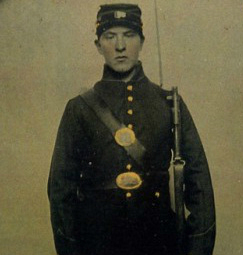 Union soldier Lyons Wakeman, who served in the 153rd New York Volunteer Infantry during the Civil War had a secret—Lyons’s real name was Sarah Rosetta Wakeman.
 Campaign in Louisiana. She saw combat on April 9, 1864 and survived the battle. After the battle, she sent her last letter home. Unfortunately, she became ill with dysentery and died on June 19m 1864. (Thousands of soldiers died of dysentery from drinking contaminated water during the war.) She was buried with full military honors at Chalmette National Cemetery in New Orleans, with a headstone that read Lyons Wakeman.
 The answer is in June 1920. After that date you could no longer have your children delivered to relatives by the US Postal Service.
 grandmother who lived 70 miles away. She was accompanied by her mother’s cousin, who worked as a mail clerk. The 53 cents postage was much cheaper than a train ticket and the stamps were affixed to her coat. When the Post Master General heard of this incident, he banned the mailing of human beings.
 My husband and I moved to Winnemucca, Nevada in 1984 as newlyweds for a one-month drilling contract at a developing gold mine. We ended up staying for 32 years…as one does. I had my kids there and taught school in the area for 29 years. I still think of it fondly, nine years after leaving.


 How wonderful it would be to have a device that cured every disease!
 the skin into the body, of course. People of the era did not understand that oxygen could only enter the body through the lungs.
 Guess what else? Dr. Sanche wasn’t really a doctor. He was a businessman who devised a field of medicine called diaduction. He believed that an undercurrent connected all natural organisms, and a disruption of that current created illness. Oxygen, he believed, could restore the disruption of the natural current, thus the Oxydonor. He moved frequently to stay one step ahead of the authorities as the complaints rolled in, but continued to market his device and to warn the general public against imitators.
 Hello and Merry Christmas!
 If you would like to read this story, please mark your calendars for December 24 and check your favorite
 online book vending site for a free digital copy of