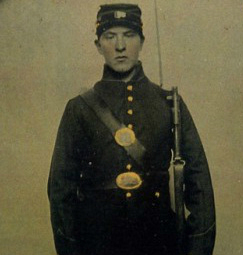
 Union soldier Lyons Wakeman, who served in the 153rd New York Volunteer Infantry during the Civil War had a secret—Lyons’s real name was Sarah Rosetta Wakeman.
Sarah was born in Afton New York on January 16, 1843 to Harvey and Emily Wakeman and was the oldest of nine children. She grew up on the family farm, which struggled financially. She worked as a domestic servant in her teens, but with no prospects for marriage, and wanting a more financially stable future, she made a gutsy decision–she moved to Chicago, dressed as a man and got work as a boatman on the Chenango Canal. It’s unclear whether her motives were purely financial. Some of her many letters allude to a family rift.
Sarah met Army recruiters while working as a boatman and enlisted on August 30, 1862, receiving a $152 bounty. She claimed to be 21 at the time, but she was only 19. Her regiment was assigned to Alexandria, Virginia. Ironically, one of her duties was to guard a prisoner who happened to be a woman arrested for impersonating a Union soldier.

Sarah wrote many letters home, often sending money, in what appears to be an attempt to heal the family rift. Sarah often signed her given name to the letters, a move which would have ended her military career if they had been intercepted. Her letters described her pride in being financially independent, being a solider and living a free life as a man. If anyone discovered Sarah’s true identity, they kept her secret. Her letters indicate that she fit in well with her fellow soldiers.
Sarah’s regiment was called to active battle duty in February 1864, and took part in the Red River Campaign in Louisiana. She saw combat on April 9, 1864 and survived the battle. After the battle, she sent her last letter home. Unfortunately, she became ill with dysentery and died on June 19m 1864. (Thousands of soldiers died of dysentery from drinking contaminated water during the war.) She was buried with full military honors at Chalmette National Cemetery in New Orleans, with a headstone that read Lyons Wakeman.
Sarah’s letters, and thus the story of her military service, were stored in a relative’s attic and went unread by those other than her family until 1976. The letters have since been complied into a book: An Uncommon Soldier by Lauren Cook Burgess