Fallen Lone Stars: Llano, Texas

Llano's Southern Hotel, built from 1880-83, also served as a stagecoach stop. Today, the building serves as office space for The Buttery Co., one of Llano's oldest businesses.
Llano’s Southern Hotel, built from 1880-83, also served as a stagecoach stop. Today, the building serves as office space for The Buttery Co., one of Llano’s oldest businesses.

Llano (pronounced LAN-oh) is located in the Texas Hill Country about an hour north of Austin, very near the geographic center of Texas. Founded in response to a legislative act creating Llano County in February 1856, the town was established June 14 of the same year. A public vote under a live oak tree on the south side of the Llano River chose the town’s location: a tract of 250 acres donated by a local rancher.

The area boomed from 1886-1893 after iron ore deposits were discovered in nearby Iron Mountain. With high hopes for the future, the Llano Improvement and Furnace Company embarked upon a mission to build an iron furnace and foundry. Land speculators from Dallas and northern states poured into the area with investment money, wanting to be part of “the Pittsburgh of the West.”

The Llano County courthouse, built in 1893 and still in use, is a Recorded Texas Historic Landmark and listed on the National Register of Historic Places. (Photo by Larry D. Moore)

The population soared to 7,000 in 1890, encouraging the Austin and Northwestern Railroad to extend its line to a terminal on the north side of what promised to be a thriving metropolis. Increased access to transportation attracted granite quarrying and finishing companies intent on profiting from the abundance of granite in the surrounding hills.

Then the bubble burst. The iron ore deposits proved insufficient for commercial exploitation, and the Llano Improvement and Furnace Company abandoned its project. The company’s withdrawal threw the town’s big plans into disarray. Although charters had been sold to construct a dam, an electric power plant, a streetcar system, and electric streetlights, only a small dam and the streetlights were completed. Speculators and local businesses lost fortunes as a result.

A wagon hauls a slab of granite through the streets of Llano in this undated postcard photo.

A series of fires in the late-1890s, probably set to collect insurance money, destroyed much of the town. Consequently, insurance companies refused to provide any coverage in the area until well into the 20th Century.

The granite processors remained. Today, Llano’s primary industries are farming, ranching, and granite quarrying and finishing. The town’s population is roughly 3,000 people except during November and December, when the undisputed “Deer Capital of Texas” overflows with hunters.


Kathleen Rice Adams header

Tuesday’s Winner for Phyliss

Winner!

Congratulations to today’s winner …

Alisa Boisclair

Alisa, I will contact you via email tomorrow

so you can tell me whether you prefer an eBook of a trade size paperback.

Again, congratulation and hope you enjoy

The Troubled Texan

Still no Pardon for Billy the Kid

Phyliss Miranda sig line for P&P BluebonnetI guess I ate too much on Easter Sunday … well, I know I did, so I decided to resurrect one of my favorite blogs (no pun intended; now if you believe it then I have the Waco Bridge for sale).  This is one of my favorite blogs.  Please remember, that Bill Richardson has been out of office in New Mexico since 2011, and Billy the Kid is still an outlaw, although there were a lot of rumors that Gov. Richardson was going to pardon him.

As I did a tad, or what I thought would be just a little, research on William Booney, I learned quite a bit that I Billy the Kidwant to share.  Billy the Kid was born in 1859 in New York City and his real name, as we all know, was William Henry McCarty, Jr.  He was also known as Henry Antim and of course the alias of William H. Booney.  It was believed that he father either died of left the family when William was very young.  His mother died when he was very young from tuberculosis; thus leaving him an orphan.  That’s when he and his brother go involved in petty theft.  There is little, if anything, known about his early years.

The “Kid” as he was known by other outlaws had a slim physique, sandy blond hair and blue eyes to kill for. He wore a “sugar-load” sombrero hat with a wide decorative band. He could be charming and polite one moment then go into an outrage without warning, a sort of an intoxicating nature he used to great advantage during his heists and robberies.

On the run, “Billy” moved to Arizona briefly before joining up with a gang of gunfighters called “The Boys” to fight in the Lincoln County War.  Known as “The Kid”, McCarty switched to the opposition to fight with John Tunsall under the name “the Regulators”.

Pat GarrettBarely escaping with his life, McCarty became an outlaw and a fugitive. He stole horses and cattle until his arrest in 1880 for the killing of Sheriff Brady during the Lincoln County War.  After being sentenced to death, he killed his two guards and escaped in 1881.  He was hunted down and shot dead by Sheriff Pat Garrett on July 14, 1881, in Fort Sumner, New Mexico.

This is what I found interesting most of all.  Shortly after the shooting, Sheriff Garrett wrote a biography of “The Kid”, the hugely sensationalized The Authentic Life of Bill, the Kid.  The book was the first of many accounts that would turn the young outlaw into a legend of the American frontier.

I sure wish I could get my hands on a copy of this book.  Wow!

In his last day in office in 2011,  New Mexico Gov. Bill Richardson announced on New Year’s Eve he would not grant a posthumous pardon to the infamous Old West bad guy, after drawing international attention by entertaining a petition on Billy the Kid’s behalf.

The pardon request had centered on whether Billy the Kid, who was shot to death in 1881 after escaping jail for the killing of County Sheriff William Brady in 1878, had been promised a pardon from New Mexico’s territorial governor, Lew Wallace, in return for testimony in killings he had witnessed.

But the descendants of Wallace and Sheriff Pat Garrett, who fatally shot the fugitive, were outraged over the proposal.  Pauline Garrett Tillinghast expressed her concern that a pardon would tarnish her grandfather’s legacy. Though the pardon might have been narrowly tailored, she said, “It’s ridiculous to pardon a murderer. Hollywood has turned him into some sort of a folk hero.”  Pat Garrett’s grandson J.P. Garrett and Wallace’s great-grandson William Wallace also publicly opposed the possibility of pardon.

According to legend, Billy the Kid killed 21 people, one for each year of his life. The New Mexico Tourism Department puts the total closer to nine. The Kid was a ranch hand and gunslinger in the bloody Lincoln County War, a feud between factions vying to dominate the dry goods business and cattle trading in southern New Mexico. Billy the Kid killed two deputies while escaping jail.

The person filing the request for pardon argued that Lew Wallace promised to pardon the Kid, also known as Gov Lew WallaceWilliam Bonney or Henry McCarty. She said the Kid kept his end of the bargain, but the territorial governor did not. But, J.P. Garrett of Albuquerque said there’s no proof Gov. Wallace offered a pardon — and may have tricked the Kid into testifying.

“The big picture is that Wallace obviously had no intention to pardon Billy — even telling a reporter that fact in an interview on April 28, 1881,” he wrote. “So there was no ‘pardon promise’ that Wallace broke. But I do think there was a pardon ‘trick,’ in that Wallace led Billy on to get his testimony.”

Garrett also said that when the Kid was awaiting trial in Brady’s killing, “he wrote four letters for aid, but never used the word ‘pardon.”‘

William Wallace of Westport, Conn., said his ancestor never promised a pardon and that pardoning the Kid “would declare Lew Wallace to have been a dishonorable liar.”

According to historians, The Kid in fact wrote Wallace in 1879, volunteering to testify if Wallace would annul pending charges against him, including a murder indictment in Brady’s death.

A tantalizing part of the question is a clandestine meeting Wallace had with the Kid in Lincoln in March 1879. The Kid’s letters leave no doubt he wanted Wallace to at least grant him immunity from prosecution.  Wallace, in arranging the meeting, responded: “I have authority to exempt you from prosecution if you will testify to what you say you know.”

But when the Las Vegas, N.M., Gazette asked Wallace shortly before he left office about prospects he would spare the Kid’s life, Wallace replied: “I can’t see how a fellow like him should expect any clemency from me.”

The historical record on the pardon is ambiguous, and there are no written documents “pertaining in any way” to a pardon in the papers of the territorial governor, who served in office from 1878 to 1881.

Of interest, Governor Richardson’s office set up a web-site so citizens could weight in on the subject of the pardon. His office received 809 e-mails and letters, with 430 favoring a pardon and 379 opposed. Comments came from all over the world.  I’d say the issue was fairly split down the middle probably along moral and political line, I suspect.

Governor Richardson said that he decided against a pardon “because of a lack of conclusiveness and the historical ambiguity as to why Gov. Wallace reneged on his promise.”  Richardson states said the Kid is part of New Mexico history and he’s been interested in the case for years. .

I’m not writing this post from a political point of view, strictly from an historical one. The interesting part is a century and nearly a half years after killing numerous people, including lawmen, and being shot to death, the life and legend of Billy the Kid still can’t be put to rest.

So tell me who is your favorite controversial historical figure?

The Troubled Texan Good


To one reader who leaves a comment, I will send your choice of a trade size copy or an iBook of The Troubled Texan, the first of the Kasota Springs Romance Series, from Kensington.  If you’d prefer an autographed copy of any one of the six anthologies that sister filly, Linda Broday, Jodi Thomas, the late DeWanna Pace, and I wrote that is an option, too.

 Update: “The Authentic Life of Billy, the Kid.” Just a few hours ago, I found the book in various conditions, hardback and paperback on Amazon.com second market. Of course, I grabbed a hardback copy that appeared in good shape. I am eager to get it and possible, if I have time to read the book between now and next month’s blog, I’ll have more Billy the Kid history to share. There are a number of copies on the second market, so if you’re interest I’d hurry and get your copy. Hugs, Phyliss

Shanna Hatfield’s Invitation to the Ball

ShannaHatfieldMy wagon is loaded full of thanks to the Fillies for inviting me over to Petticoats and Pistols today.

Rather than jingle my spurs and slap dust from my ol’ cattleman’s hat, I thought I’d veer a different direction and talk about dresses, specifically ball gowns.

Wouldn’t it be a hoot to receive an invitation to a ball and have the opportunity to choose a fancy gown, pin up your hair, and dance the night away?

Admittedly, I love the attire from the Victorian and Edwardian periods. I’m especially fond of the Gibson girl era. A new corset that bent the figure into an S shape was all the rage and shaped the fashions of that time. The resulting silhouette was undeniably feminine while the fabrics were soft and flowing.

If it wasn’t for the fact a winch, pry bar, and a healthy dose of tranquilizers would be required to get me into the corset, I’d vote for wearing those fashions all the time (at least when I could leave the home place and head into town).

LaceEvening gowns of the day often featured frilly embellishments with lace and ruffles. Ornaments of beading, spangles, rhinestones, and velvet ribbon were popular, as were skirts that flared at the hem, most with short trains.


WheatThe wheat on this dress makes me think of the women from my Pendleton Petticoats series. Pendleton, Oregon, the setting for the stories, was (and is) wheat country. It’s easy to picture one of the characters wearing this gown.
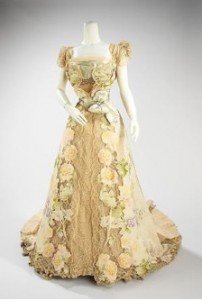
 

RosesI lose the ability to think rationally when I see the combination of roses and lace. This gown whispers quite loudly to my heart and makes me wish I could attend a ball.

Oh, wait…

I am attending a ball – and you all are invited, too!

Ball

Dust off your dancing shoes and choose your formal attire for the Petticoat Ball Party on Facebook April 9, 2015 from 10 a.m. to 2 p.m. Giveaways and games will make for a splendid event as we celebrate the release of Thimbles and Thistles and the debut of Lacy!

The talented and fabulous guest authors (including sweet Fillie Karen Witemeyer) joining in the shenanigans include:

10 a.m. – Julie Lence
10:30 – Kathleen Ball
11 – Rachel Rossano
11:30 – Christina Cole
Noon – Peggy Henderson
12:30 – Kristin Holt
1 p.m. – Karen Witemeyer
1:30 – Kayla Thomas

Invite your friends to the party, and you could win a $25 Amazon Gift card. Go to the Facebook Party Page, click on the “invite” button, invite your friends, then post how many you invited. One randomly drawn person will win, but you get additional entries for every 25 people you invite! Also, ask your friends when they join the party to share that you invited them on the party wall. Each friend who mentions your name, earns you another entry in the contest! The winner will be announced prior to the start of the party April 9! http://tinyurl.com/petticoatball

In celebration of the ball, and because I’m so doggone happy to be here today, I’m giving away an e-copy of both books in the Baker City Brides series to one lucky commenter.

To enter to win CRUMPETS AND COWPIES and THIMBLES AND THISTLES, just answer this question:

What would you rather wear… a ball gown or a pair of dusty boots?


Freebies

TThimbleshe second book in the Baker City Brides series releases Thursday, April 9!

Thimbles and Thistles takes readers back to Baker City as spring arrives and love is in the air. You can reserve your Kindle copy here: http://amzn.com/B00TCV6BFG

Maggie Dalton has no need for a man in her life. Widowed more than ten years, she’s built a successful business and managed quite well on her own in the bustling town of Baker City, Oregon. Aggravated by her inability to block thoughts of the handsome lumber mill owner from her mind, she renews her determination to resist his attempts at friendship.

Full of Scottish charm and mischief, Ian MacGregor could claim any available woman in Baker City as his own, except the enchanting dress shop owner who continues to ignore him. Not one to give up on what he wants, Ian vows to win Maggie’s heart or leave the town he’s come to love.

LacyLacy, Book 5 in the Pendleton Petticoats series, will be available for pre-orders April 9.

Be among the first to order the long-awaited story of Grant Hill. Talk about losing at love… eligible banker bachelor Grant needs to find the right girl.

Those attending the party will also get a first look at the cover!

“Will the bonds of love be stronger than the bonds of tradition…”

It just wouldn’t be a party if there wasn’t a book available for free! Aundy, Book 1 in the Pendleton Petticoats series, will be available for free Kindle download April 9. Make sure you grab your copy! If you’ve already read it, tell your friends to download it. If you haven’t met the characters from Pendleton Petticoats, here’s a brief intro:

AundyAundy (Book 1) – One stubborn mail-order bride finds the courage to carry on when she’s widowed before ever truly becoming a wife, but opening her heart to love again may be more than she can bear.

Caterina (Book 2) – Running from a man intent on marrying her, Caterina starts a new life in Pendleton, completely unprepared for the passionate feelings stirred by the town’s deputy sheriff.

Ilsa (Book 3) – Relying on others to guide and protect her, Ilsa finally finds the strength and courage to take control of her life. Unfortunately, her independence drives a wedge between her and the man she’s come to love.

Marnie (Book 4) – Giving up on her dreams for a future, Marnie finds her hope rekindled by one caring, compassionate man and the orphans who need her.

In conjunction with the Petticoat ball, you may also enter the drawing for a $50 American Express gift card, autographed books, digital books, chocolates, and original western artwork, fill out this form.


BioConvinced everyone deserves a happy ending, hopeless romantic Shanna Hatfield is out to make it happen one story at a time. Her best-selling sweet historical and contemporary romances combine humor and heart-pumping moments with realistic characters. In addition to blogging and eating too much chocolate, she is completely smitten with her husband, lovingly known as Captain Cavedweller.

Find Shanna’s books at:
Amazon | Amazon UK | Barnes & Noble | Smashwords | Apple

Shanna loves to hear from readers! Follow her online:
ShannaHatfield | Facebook | Pinterest | Goodreads | You Tube | Twitter

We Have a Winner for Karen Kay’s Tradepaper Copy of THE ANGEL AND THE WARRIOR

bannerHowdy!

We do have a winner for the Tradepaper copy of THE ANGEL AND THE WARRIOR.  Again all the names were written down and then the name of drawn.  The winner is Arlene Jones.

Arlene, please contact me personally at karenkay(dot)author(at)earthlink(dot)net.  Insert a (.) for (dot) and @ for (at).  I will need a physical address in order to get the book to you.

My hardy thanks for everyone who came to the blog yesterday and who left a message.  I enjoyed reading them all!

Shanna Hatfield Is Blazing a Trail!

Miss Shanna Hatfield is blazing a trail and will arrive on Monday, April 6. Thimbles and Thistles

This talented western historical romance author loves everything about the old West. She’s written a passel of books too and not a poor one in the bunch!

Her newest is Thimbles and Thistles.

Come Monday head over and take a seat.

You’ll be glad you did.

Cowboy Easter Fun

newsletter_headerjpg - 2As a mom, Easter is a fun time to let the kids play with their food. Dying eggs, eating the ears off chocolate bunnies, hunting plastic eggs filled with candy. I thought I’d share a few cute western-flavored ideas I discovered recently. (Disclaimer – I readily admit to stealing all of these ideas from Pinterest. None of these are my own.)

The cowboy egg:                                                                                                Root beer desperadoes:

Cowboy Easter EggRootbeer Cowboys


And for those of you who are super crafty (not me), you can make your own western-style chocolate bunnies. I even found the mold available on Amazon.

Chocolate Bunny Cowboy


Chocolate Bunny Cowboy Mold
Click image to order on Amazon


I also found these adorable horse cupcakes. The look so cute and would be easy enough that I might actually be able to pull them off. Just need some Nutterbutter cookies, some half peanuts for the ears, and some white and black icing for the face.

Horse Cupcakes And finally, a cowboy Easter basket to keep everything together.

Cowboy Easter Basket


But of course, as every good cowboy knows, the true joy of Easter is celebrating the resurrection of our Savior. May you be blessed with many reasons to smile this Easter!

Photo Credit: funtrap via Compfight cc

After the Sabbath, at dawn on the first day of the week, Mary Magdalene and the other Mary went to look at the tomb.

There was a violent earthquake, for an angel of the Lord came down from heaven and, going to the tomb, rolled back the stone and sat on it. His appearance was like lightning, and his clothes were white as snow. The guards were so afraid of him that they shook and became like dead men.

The angel said to the women, “Do not be afraid, for I know that you are looking for Jesus, who was crucified. He is not here; he has risen, just as he said. Come and see the place where he lay. Then go quickly and tell his disciples: ‘He has risen from the dead and is going ahead of you into Galilee. There you will see him.’ Now I have told you.”

So the women hurried away from the tomb, afraid yet filled with joy, and ran to tell his disciples.

~Matthew 28:1-8

The Iroquois Maple Sugar Festival

bannerHowdy & Happy Easter!

I am repeating my last give-away, which is a copy of the Tradepaper book, newly on sale, THE ANGEL AND THE WARRIOR with this post.   Briefly, I’m going to repeat my instructions from my last post, and here it is:

On April 7, 2015, Tradepaper copy of THE ANGEL AND THE WARRIOR goes on sale.  Today I will be giving away a free copy of the Tradepaper copy of THE ANGEL AND THE WARRIOR to some lucky blogger, a $16.00 value.   There is a restriction.  It is limited to the United States only.  Here is a link to to go to in order to look at the blurb of the book, as well as an excerpt.  Also, both the e-book and the Tradepaper are on sale at the moment.  Here is the link:   http://www.samhainpublishing.com/book/4964/the-angel-and-the-warrior

AngelAndTheWarrior-The-CoverAs always, in order to claim your prize, you must come back to the site tomorrow and look to see if you are the winner.  If you have won, instructions will be given on how to contact me so that the book can be sent to you.  But you must contact me in order to claim your prize.

I thought for a long time about what I might post this Easter.  Because the Iroquois weren’t traditionally Christians prior to the arrival of the French Jesuits, I thought I’d introduce you to their Maple Sugar Festival, which was the festival held about this time of year.  The Iroquois had 8 different festivals throughout the year.  It was in spring, when the nights were cold and the days were warm that the sap began to flow.   This particular festive was only a one day festival, but it was definitely perhaps one of the sweetest.  Marking this festival there were dances, singing and the making of sweet soups and other sweets as well as a tribute given to the maple tree.

It was much prized by the children (I wonder why).

Maple syrup, maple sugar, by the way is a completely American Indian product.  Interestingly, as I have become more and more educated on nutrition, I have learned that maple sugar, although definitely a sugar, reacts differently in the body than regular sugar — or any other kind of sweetener.  It has even been found of late to aid in the recovery of Diabetics (I’m no doctor so please don’t take this as medical advice — I’m just passing along information that I’ve read recently from the farm where I buy my maple sugar, and also this particular YouTube video:  http://www.youtube.com/watch?v=oH2v7MgWbkk

Unlike the Harvest Festival (our Thanksgiving Festival in the Autumn), this festival  that pays tribute to the maple tree and it’s sap, wasn’t given much publicity and so it has tended to fade into history, except in the Northeast where the tradition of gathering the sap from the maple trees still exits (thank goodness because I love real maple syrup).  But I thought it would be fun to look at it from the viewpoint again of what the American Indian has given to this country and to the world.  One of those gifts is pure maple syrup, a sugar that the body recognizes as something it can use (it contains antioxidants, by the way) and does not influence ones blood sugar (apparently) in the same way as other sugars.  Again, I’m not in the medical profession and am just passing along information that I’ve learned recently.

But it was at this time of year that this festival was much looked forward to and much loved by the American Indian of yesterday.  Since this is part of the history that makes up this land, I thought you might enjoy learning a little about it.

Happy Easter to you all!


Russian Easter Bread~Tanya Hanson

MarryingMinda Crop to Use


Thanks to my lovely filly sister Karen Kay for letting me piggy-back with her today. I couldn’t resist sharing a paska recipe. Easter blessings to all y’all out there~from me and mine, He is risen indeed!Easter logo 2015a


However, anybody who knows me longer than a day knows I am terrified of cooking with yeast. So I freely admit I’ve never made paska. Maybe this year I’ll give it a shot.

Paska, a dessert-like bread, is usually featured at Easter. With origins in Poland (called kullich) and Ukraine, paska bread is often baked in a round coffee can and topped with a braided-dough cross. Sometimes even a dyed egg.

When served as dessert, paska contains white raisins and cherries and is drizzled with a cream cheese frosting and decorative sprinkles. The cherries symbolize royal jewels in honor of Christ the King. As bread during the main meal, a plain paska is topped only with melted butter.

Although baking soda can be used as leavening, most recipes call for yeast. I’m sharing a recipe today given to me by my Aunt Grace long ago.  Her given name was Hrunya. She’s gone now. She and Uncle Ivan (Johnny) died just two weeks apart in 2001 after a marriage of more than 60 years! I wish I’d spent more time cooking with her and learning the details about my heritage and forebears.

PASKA, Russian Easter Bread 

½ lb. butter

5 eggs

1 cup sweet cream

1½ cup milk

About 1/3 or slightly more warm water for yeast

2 cups sugar

¾ teaspoon salt

1 teaspoon lemon extract

¼ pound yeast

About 12 cups flour

To add: 1 cup each golden raisins, dried cherries, citron, almonds etc.


Scald cream with the milk and butter.

Crumble yeast into warm water and dissolve. Pour into lukewarm milk mixture and add salt, sugar, lemon extract, and eggs.

Add the flour and knead thoroughly.

Let rise once and press down. This might take about an hour; dough should double in bulk.

Let dough rise the second time, and stir in almonds, raisins, and dried fruit. Dough can be sprinkled with sugar during this step. Spoon into greased coffee cans half-full. Or form into rolls, rings, or braided loaves.

(Recipe is unclear as to how many coffee cans; seems you’ll need at least 8.

Bake 325 for 20 minutes.

(When cooled, drizzle with cream cheese frosting and sprinkles, if desired. Or dust with powdered sugar.) 

For a modern-day recipe, check out this link: 

(The “paska” picture file is licensed under the Creative Commons Attribution-Share Alike 3.0 Unported license.)