
Anvil
We all know what an anvil is but do we all know what an anvil does? There’s that flat top and it’s heavy. Beyond that, we don’t know much. But all those curves, the pointy nose–called a horn, there are significant holes located here and there.
They all mean something.
I watched a blacksmith work at a living history day at a nearby restored fort. Fort Atkinson in Fort Calhoun, Nebraska. Do NOT ask me why the town isn’t called Fort Atkinson, too.
It was just so interesting. He kept bending things. I just loved watching him and, there were three blacksmiths and they seemed to love talking about their passion for the historically accurate reenactment of their hobby.

The man standing there was one of the blacksmiths but what I wanted to talk about in this picture is the wall of tools. There were dozens of them. Tongs and hammers. Strangely shaped things that iron could be hammered on and bend around. And a blacksmith makes all his own tools, I was told.

More shapes. Heavy iron circles that looked like links in a massive chain. Tongs of every size and shape.

This man in the front is another blacksmith.
He said he’s mostly retired now. He talked a lot to me.
Beside him is a clamp or vise. He had many sizes of vises, too.

This pan really interested me. I don’t know if you can see it, but there is a hinge on the handle.
This way a cowboy can carry a frying pan more easily in his saddle bags, because he can fold the handle over.
At the end of the handle it’s a circle and a cowboy can shove a stick in there so the pan gets hot and he doesn’t burn his fingers.

Beside the pan were other things a blacksmith makes, spoons, ladles and spatulas.
When I said, “What about horseshoes?” They said blacksmiths didn’t even make horseshoes. That was the job of a farrier.
My blacksmith in my book is going to also be the town farrier.
He might be the town wheelwright and the town cooper, too.
A cooper makes wooden buckets, butter churns and barrels. There was a cooper there at the living history day, too. Hard at work.

I took this picture over my head.
Those iron bars up there in many shapes and lengths and weights, are the raw material for the blacksmith’s work.
They also worked with sheets of iron.
That skillet i had a picture of…above was made by bending a sheet. he could also punch holes in iron and cut shapes.

The guy farthest left was working the whole time he talked, the whole time anybody talked.
He was so knowledgeable it was humbling.
My book is going to be better for spending an hour with these guys.
They move into a restored Fort Atkinson for the weekend.
They sleep and eat there, dress in historically accurate clothes and just live the life of a frontiersman
for most of the weekends of the summer.
 Overhead, I don’t know if you can quite see it but it’s a bellows.
The rope hanging down is easily reached by the blacksmith.
He pulls, releases, pulls, releases…he does it over and over.
The flames in the forge get bigger and the iron he’s laid into the fire turns red hot, then white hot.
I knew there was a bellows but I didn’t quite have it pictured.
The bellows was almost the first thing I noticed and it was so interesting looking at it.

And here is your intrepid blacksmith in training (okay, blacksmith KNOWLEDGE in training.
I’m not actually getting really close to that red hot iron.
I’m standing in this handy pictures frame. I also learned there is a timer on my phone and how to use it. Surprise!
Yep, I’m putting a blacksmith in my book. A WOMAN blacksmith.
Honestly the work that blacksmith was doing wasn’t overly HEAVY work.
Rods or iron, the hammer wasn’t huge. A woman could do it.
The blacksmith at the fort said a farrier…shoe-ing horses did much more heavy work so I’m not sure how I’m going to make her do that.
This is all for my next book. I have a current release that is brand new!
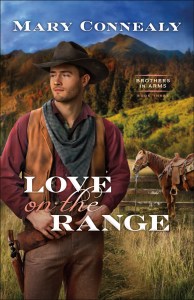 Falling for someone who doesn’t want to get married is soon be the least of Wyatt Hunt’s concerns.
While his brothers and their new wives search for who shot him, Wyatt is temporarily bedridden and completely miserable. Somehow Molly Garner’s limited skills have made her the most qualified in their circle to care for Wyatt. But by the time he’s healed, she’s fed up with him and the whole ungrateful family. For even worse than his grumpiness were the few unguarded moments when he pulled at her heartstrings, and she has been long determined to never repeat her mother’s mistakes.
When alternate plans of finding her own independent life fall through, Molly volunteers to work for the Pinkertons and help investigate nearby ranch owner Oliver Hawkins. She signs on to be his housekeeper, hoping to find clues to prove his nefarious, and possibly murderous, past. Wyatt refuses to let her risk it alone and offers to act as Hawkins’s new foreman.
But when another Pinkerton agent gets shot, they realize Hawkins isn’t the only danger. The Hunt brothers will have to band together to face all the troubles of life and love that suddenly surround them.
Buy at Baker Book House if you’d like an alternative to Amazon


 Several months ago, I blogged about starting on my “ancestry” journey. I gave myself a subscription to Ancestry . com, and voila! I was on my way!


 Greetings! I’m excited to be your guest author today on the Petticoats & Pistols blog! I write inspirational romance, both historical and contemporary. It is my hope that my books will encourage you and warm your heart!
 marks the hazardous north entrance to Commencement Bay, located outside of Tacoma. In writing this story, I became curious about the history of lighthouses and their development in America, particularly along the Pacific coastline.
 century BC.
 The first lighthouse in America was the Boston Light, built in 1716 at Boston Harbor. In 1851, the U.S. Congress passed “An Act Making Appropriations for Light House, Light Boats, Buoys, &c.”, leading to the creation of the United States Lighthouse Board to replace the Department of Treasury’s Lighthouse Establishment as the governmental agency responsible for the construction and maintenance of all lighthouses and navigation aids in the United States.

 Unfortunately the channel from Commencement Bay to Elliott Bay was treacherous, renowned for its thick fog blankets. Mariners complained that the light at Browns Point couldn’t be seen.


 Trudy C! You’re my winner of an ebook copy of THE MERCENARY’S KISS!
