I have to admit to being a rabid Olympics fan. I’m a mediocre fan of sports overall. I enjoy watching grand slam tennis events and am known to watch football and baseball games if my husband has them on, but rarely do I purposely turn on the TV in search of sports. Until the Olympics come around. When Team USA plays, I set my schedule around being in front of the TV to cheer on my country.
Our first gold medal of the 2016 games was awarded to a young, 19-year-old shooter by the name of Virginia Thrasher. Watching this cool-as-a-cucumber athlete, reminded me of Annie Oakley and all the talented shooters who came from an era when guns were necessary to keep food on the table and danger from the door.
As it turns out, shooting was one of the original events at the first modern Olympics in 1896. There were 5 different shooting events, 2 for rifles and 3 for pistols. And of the 8 athletes representing the United States at the games in Athens, 2 of them were shooters. Brothers John and Sumner Paine from Harvard. Lieutenant John B. Paine happened to be a member of the Boston Athletic Club, which was the organization that sent a handful of athletes to compete at the newly organized games. John’s brother, Sumner was in Paris, France at the time, working as a gunsmith. After deciding to make the trip to Greece to compete, John stopped by France on his way in order to invite his brother to come along.
Team USA in 1896 Olympics. Sumner Paine is seated on the floor second from the left and John Paine is sitting on the floor second from the right.
Not knowing what weapons they would need, they packed an arsenal: two Colt army revolvers, two Smith & Wesson Russian model revolvers, a Stevens .22 caliber pistol, a Wurfflein, two pocket weapons, and 3,500 rounds of ammunition.* They entered all 3 pistol events. Unfortunately, they were excluded from the rapid fire pistol competition because their .22 caliber pistols were disqualified as not being standard issue.
The shooting house was built of white marble, and they shot at a black bull’s-eye with a white dot inside.
Using their Colt revolvers, John and Sumner dominated the 25 meter military pistol event. John took first place with a score of 442. Sumner took second with a score of 380. The next closest opponent scored 205. The brothers had decided privately that whoever won the first event would bow out for the second, so John withdrew from the 30 meter free pistol event, leaving Sumner to capture first place easily with the same score his brother had earned in the previous round – 442. They only needed 96 rounds from the 3,500-round stash of ammunition to win their events.
Sumner Paine
John and Sumner Paine were the first US athletes to win gold at the Olympics.
Where does the whiskey come in, you ask? Well, according to eye-witness accounts, the Paine brothers paused between rounds to sip whiskey from flasks when tensions ran high. By the next day, all the other competitors decided to follow suit.* I don’t think these fellows would have passed the anti-doping regulations of today.
Being an Olympic shooting champion has it’s advantages, though. One night in 1901, Sumner Paine came home to find his wife in bed with his daughter’s music teacher. He drove the man away with four shots from a .32 caliber pistol. He was briefly jailed and charged with assault, but Paine was released when the police found his medal and realized he must have missed on purpose.
I’ve always been interested in history and did a lot of research on the West while I was writing the Encyclopedia of Native American Tribes (Cengage, 2012). I also spent time in Arizona after my father moved to a ghost town near the Mexican border, and I was fascinated by the area around Tombstone, where much of the WANTED series is set.
In the first book in the series, Grace and the Guiltless,Grace is the lone survivor after outlaws massacre her family. She risks her reputation by entering the notorious Bird Cage Theater to report the crime to the sheriff:
Clouds of smoke enveloped Grace. Like the black, acrid smoke from the burning cabin that still clung to her pores and clothes, the sweetish cigar smoke and the sharper scent of burning tobacco from hand-rolled cigarettes suffocated her. Raucous laughter, the tinkle of a piano, and the clink of glasses pulsed through the room. The infamous alcoves, or bird cages, some with their red velvet curtains drawn, perched overhead like rows of fancy packages.
Her eyes stinging from the haze, Grace squinted to find the sheriff. So many black frock coats blurred into an indistinguishable mass…
Disentangling herself from pawing hands as she crosses the room, Grace irritates the sheriff by separating him from the painted lady keeping him company.
The heavyset man frowned at her. “So, what can I do for you, Miss —”
“Grace Milton, sir. Yesterday my parents . . . my whole family . . .” Grace’s tongue tripped over the words. If she said them aloud, it would make it real. But if she didn’t, those killers would get away with what they had done. “Elijah Hale and his gang . . . they shot my pa, and-and…”
The sheriff’s face paled at the mention of Hale’s name, but he leaned back in his chair and steepled his fingers, though his hands shook slightly. “Mr. Hale is well known in these parts as a respectable man.”
Respectable man? A picture imprinted itself on Grace’s mind – Hale smiling, his gun pointed straight at her father’s heart.
The sheriff pulled a cigar from his vest pocket and rolled it between his fingers, avoiding her eyes.
“Did you hear me? Hale killed my pa. And my ma, and my—”
The sheriff chomped down on the cigar, twisted, and then spat the end into the nearby spittoon. The wad hit the brass with a wet ringing sound. “Any witnesses?”
“Me,” Grace choked out.
Sheriff Behan lit his cigar and blew a puff of smoke in Grace’s direction. “Not sure your word,” he said, his gaze raking her disheveled appearance, “would stand up against Hale’s.” He waved his cigar in a dismissive circle. “You bring me some proof, and I’ll consider looking into it.”
A white-hot volcano of rage erupted in Grace’s stomach. Did that badge glinting at her from across the table mean anything at all?
“My family’s dead in the ground.” She sucked in air to control the tremor in her voice. “I dug their graves myself.” She held out her blistered and bloodied hands. “Is that proof enough for you?”
Something flickered in the sheriff’s eyes. Pity maybe? But he quickly shuttered it. “That’s a sad story Miss Milton, but people die every day.” His voice loaded with fake sympathy, he continued, “Lots of Injuns ’round here. Renegade soldiers. Hermits. Even coyotes. Understandable you’d be a mite mixed up following such a tragedy. You being hysterical and all.”
“I. Am. Not. Hysterical.” Grace spat out each word. Furious, yes. Hysterical, no. Although he was rapidly pushing her in that direction. She’d get no help from this snake.
As Grace suspects, the sheriff is in cahoots with the gang, so she trains as a bounty hunter to singlehandedly track down the criminals. One reviewer calls her the “Katniss of the Wild West.” But when Grace falls for Joe, a?rugged range rider, can she give up her independence to take on a partner?
In book 2, Her Cold Revenge, Grace must prove her skills and stop a train robbery masterminded by the outlaws who slaughtered her family. And as she slowly opens her heart to both Joe and the Ndeh tribe, who take her in, her heartache begins to heal. Yet she’s still torn between revenge and love.
“Every second had me on the edge of my seat…”
“I’ve never been so moved by a book. You honesty made me cry…”
The books in the WANTED series came out in the UK first, and then in the U.S., with different covers.
Erin Johnson grew up watching classic western movies with her father, which fueled her lifelong love of horseback riding. She’s always dreamed of being a fierce-talking cowgirl, but writing about one seemed like the next best thing. She loves traveling, painting, and teaching, and she writes under several pseudonyms for both children and adults.
Giveaway! : Erin has a great giveaway with two separate winners! For a chance to win, leave a comment for Erin and you’ll be entered. One winner will receive a copy of Grace & the Guiltless and the second winner will receive a copy of the recipe book, Feast on Fiction!
Research is one of the most important tools of the fiction author’s trade. Regardless what an author writes—historical, contemporary, fantasy, science fiction—he or she must have some knowledge of the real world in order to create a world in which characters live and breathe.
Good authors don’t beat readers over the head with their research, but what they dig up informs every aspect of their stories. Much of what we discover doesn’t make it into our books. Instead, the information clutters up our heads and trickles out at odd times.
This is one of those times.
Each of the five authors who contributed to Prairie Rose Publications’s new release, the boxed set A Kiss to Remember, uncovered historical tidbits that surprised, charmed, or saddened her. Since all of us are good authors and would never dream of beating readers over the head with our research in our books, we’re taking the opportunity to beat readers over the head with our research in a blog post. We can be sneaky that way.
Without further ado…
Her Sanctuary by Tracy Garrett
Beautiful Maggie Flanaghan’s heart is broken when her father dies suddenly and the westward-bound wagon train moves on without her, leaving her stranded in River’s Bend. But Reverend Kristoph Oltmann discovers the tender beginnings of love as he comforts Maggie, only to find she harbors a secret that could make their relationship impossible.
Tracy: I’m a “cradle Lutheran,” meaning I was born into a Lutheran family, baptized in the Lutheran church… You get the idea. Imagine my surprise when I began researching the history of the church in Missouri and found they’d been in the state a lot longer than I thought. It was fun, though.
Gabriel’s Law by Cheryl Pierson
Brandon Gabriel is hired by the citizens of Spring Branch to hunt down the notorious Clayton Gang, never suspecting a double-cross. When Allison Taylor rides into town for supplies, she doesn’t expect to be sickened by the sight of a man being beaten to death by a mob—a man she recognizes from her past. Spring Branch’s upstanding citizens gather round to see a murder, but everything changes with the click of a gun—and Gabriel’s Law.
Cheryl: Orphanages of the 1800s and early 1900s were mainly what I needed to research. And what sad research it was! The Indian orphanages and “schools” were the worst. The Indian children were forced to “assimilate”: cut their hair, wear white man’s clothing, and speak only English. Punishment was swift and sure if they were caught speaking their native tongues. In essence, they were taught they had to forget everything they knew—even their families—and adopt the ways of the whites completely. This only ensured they would never be wholly at ease in either world, white or Indian.
Outlaw Heart, by Tanya Hanson
Making a new start has never been harder! Bronx Sanderson is determined to leave his old outlaw ways behind and become a decent man. Lila Brewster is certain that her destiny lies in keeping her late husband’s dream alive: a mission house for the down-and-out of Leadville, Colorado. But dreams change when love flares between an angel and a man with an Outlaw Heart.
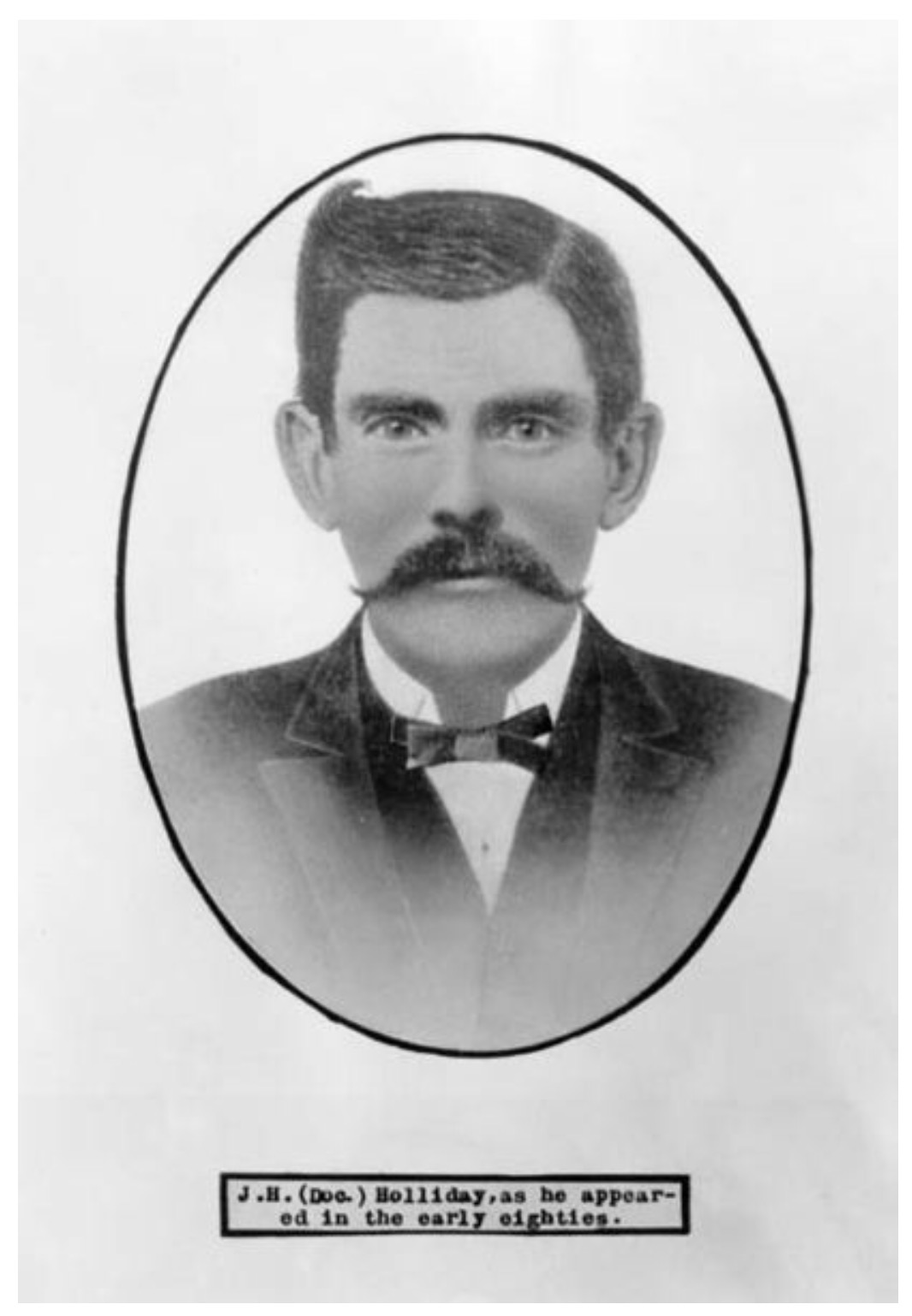
Tanya: The research that fascinated me the most was meeting and getting to know Dr. John Henry Holliday. What a guy. I’ve quite fallen in love with him. This handsome, soft-spoken, peaches-n-cream Southern gentleman can bring me to tears. He died slowly from tuberculosis for fifteen years after losing his beloved mother to the disease when he was 15. Talented pianist, multilingual, skilled surgeon who won awards for denture design… Most of his “deadly dentist” stuff was contrived. He needed a bad reputation to keep himself safe from angry gamblers. I was thrilled and honored both when he asked to be a character in Outlaw Heart.
The Dumont Way by Kathleen Rice Adams
The biggest ranch in Texas will give her all to save her children…but only the right woman’s love can save a man’s tortured soul. This trilogy of stories about the Dumont family contains The Trouble with Honey, a new, never-before-published novella. Nothing will stop this powerful family from doing things The Dumont Way.
Kathleen: Did you realize George Armstrong Custer was part of the Union occupation force in Texas after the Civil War? Neither did I. While I was double-checking my facts about Reconstruction-era Texas, I ran across that little tidbit. Texans may not have liked him any better than any other Yankee, but they were grateful for his kindness. During his five months in Texas, Custer was disliked by his own men because he strictly enforced Army regulations about “foraging” (read “stealing”) and poor treatment of civilians. I must admit I’m one of those who tended to view Custer as one of history’s real-life bad guys, but that one tidbit softened my impression. Funny how little things can make a big difference, isn’t it?
Yesterday’s Flame by Livia J. Washburn
When smoke jumper Annabel Lowell’s duties propel her from San Francisco in 2000 back to 1906, she faces one of the worst earthquakes in history. But she also finds the passion of a lifetime in fellow fireman Cole Brady. Now she must choose between a future of certain danger and a present of certain love—no matter how short-lived it may be. “A timeless and haunting tale of love.” ~ The Literary Times
Livia: I really enjoyed learning about the firefighting companies in San Francisco. The massive earthquake in 1906 was followed by an equally devastating fire, and there were a lot of heroes among those early firefighters.
Have you ever been surprised, charmed, alarmed, or vexed by something you’ve read—in either fiction or non-fiction? What was it? We’d love to hear! One brave soul who shares her or his discovery in the comments will win a digital copy of the brand-new boxed set A Kiss to Rememberbefore it’s available to the public! The five books comprise more than 1,000 pages of heart-melting western historical romance…and that’s a fact.
A former teacher, I come from a long line of passionate educators. My father was a history and political science professor. My brother Thom is a business professor at UNC Wilmington, and my great grandfather was a professor of refrigeration engineering at Purdue University.
With teaching in my blood, it’s a given that I’ll write a story or two about teachers (Kit Brennan in The Good Daughter teaches English at a Catholic High School in Oakland, California and Jesslyn from The Sheikh’s Chosen Queen teaches at an international school in the UAE), I’ve never written about a teacher in a one room school house…until now.
My new story, The Lost Sheenan’s Bride, which releases on Friday, July 8th, is about a young teacher taking a long-term substitute job at one-room schoolhouse in Montana. The story wasn’t about the one-room school, but you wouldn’t know it from my research. I’m fascinated by Montana history, and in particular the intrepid women who first settled there.
It’s estimated that up to 18 percent of homesteaders in Montana were unmarried women.
Passage of the Homestead Act of 1862 allowed any twenty-one-year-old head of household the right to homestead federal land. Single, widowed, and divorced women fit this description, and they crossed the country to file homestead claims of 160 acres.
Many of the homesteading women in Montana also became the state’s first teachers. Because of the Homestead Act of 1862, one-room schoolhouses were built all over the state. Historians estimate that there were once 2,600 rural schools in Montana, and those rural schools served a multitude of purposes for each community, from education to social gatherings. In America today, there are still 200 operational one-room schoolhouses, with 62 of them located in Montana.
The one room school house in Paradise Valley that inspired my story (photo courtesy Megan Crane )
Last month in early June I returned to Montana for eight days, and on my flight from Seattle to Kalispell I sat next to a woman who worked for the Swan Valley school district which still has an operational one-room school in the town of Salmon Prairie. The woman, a school clerk, loves the one-room school in Salmon Prairie and told me about the exceptional quality of education the children receive, the time teacher is able to devote with his students, the ability to individualize lessons and even better, the opportunity for a teacher to truly teach Montana—morning nature walks, visits to local parks (Glacier National Forest, Yellowstone, etc). The teacher doesn’t just teach math and reading, but hunts and fishes with his students and embraces what it means to be a Montanan. (Here is a story on the school in Salmon Prairie! Photographers document Montana’s disappearing one-room schools)
I was able to work a little of that fascinating conversation into my story, but its impossible to convey the history for Montana’s one-room schools in a 50,000 word contemporary romance, but I’ll try to share a bit more here with you since I know you’re all history and western buffs, too.
In 2013, The National Trust for Historic Preservation added Montana’s one-room schoolhouses to their list of the Nation’s 11 Most Endangered Historical Places.
Today at Montana’s Divide School, built in 1870, teacher Judy Boyle functions as teacher, principal, and guidance counselor. Grades K-8 are taught in the same room to as many as eight students. This year she had 3 students, and as there are no janitors, it is part of the kids’ responsibility to help clean the school daily.
As an American Studies major at UCLA, I focused on Frontier literature with my senior thesis on Mark Twain, and you can’t immerse yourself in Frontier lit without understanding the significance of the one-room schoolhouse scattered across vast prairies and in the snug valleys nestled between the Rockies. The schools represented hope and opportunity, and education was a big part of that opportunity. Homesteaders and miners, ranchers and railroad workers wanted their children to succeed, and the best way to succeed was by getting an education, and the sheer number of the schools still standing today are a reminder of the commitment Montanans made to their children.
Another historic school house in Paradise Valley, this one still in operation.
Many of us grew up with Little House on the Prairie, or are fans of Hallmark’s popular series, When Calls the Heart, so we can picture the one room school. There was very little variation from one school to another:
Teachers were typically male. If the teacher was a woman, she had to be single. Married teachers were not allowed.
Frequently, families in the rural towns would take turns boarding the teacher, with every family contributing towards the teacher’s salary.
Schoolhouses had only a few windows and one door. Bigger schools might have two doors for separate entrances for the boys and girls.
The teacher’s desk was located at the front of the room and the teacher wrote the lessons on a large slate board, much like chalkboards or white boards in classrooms today.
There was no bathroom or running water. Students used an outhouse.
The children sat at narrow wooden desks and/or on long wooden benches, with boys sat on one side and the girls on the other.
Schoolhouses were heated by one stove with the older students responsible for keeping the fire going.
One of my favorite books I bought in Montana several years ago, that probably also helped inspire my new story was Visions and Voices: Montana’s One-Room Schoolhouses. The pictures are worth the price of the book alone, but there are also wonderful quotes and stories from former students who were educated in these schools.
Visions and Voices: Montana’s One-Room Schoolhouses by Charlotte Caldwell Link:http://amzn.com/0985497106
Three other favorites books from my shelves on Montana and women homesteaders:
Nothing to Tell: Extraordinary Stories of Montana Ranch Women by Donna Gray Link:http://amzn.com/0762779098
Staking Her Claim: Women Homesteading the West by Marcia Meredith Hensley Link:http://amzn.com/0931271908
To celebrate the release of my new book, The Lost Sheenan’s Bride, featuring Jet Diekerhof, the teacher of a one-room schoolhouse in Paradise Valley, Montana, I’m giving away a signed print copy of the book, plus lots of fun reader swag. Interested? Tell me if you think you would have enjoyed attending school at a one-room school. One comment will be drawn and the winner will be announced on Wednesday, July 13th so do check back and see if that was you!
Look for The Sheenans’s Lost Bride at these online retailers: Amazon | iBooks | Amazon UK
Patti Sherry-Crews is funny, friendly, and a pleasure to know. She lives smack-dab in the middle of the Midwest and took part of her education in Wales, where she studied archaeology, Welsh, and Welsh literature. Nevertheless, she writes western historical romance. Go figure. Welcome to Wildflower Junction, Patti!
Jesse James’s Grave in Kearney, Missouri
What do Billy the Kid and the Grand Duchess Anastasia have in common? Like Butch Cassidy, the Sundance Kid, Jesse James, The Lost Dauphin of France, and the Princes in the Tower, years after their “deaths” rumors of their survival persisted.
It’s obvious why certain factions in Europe would want their royals to escape death. But why do we want to believe a group of gunslingers and bank robbers went on to live a quiet life under an assumed name?
I’ve been thinking about this question, and except for a few stray individuals such as D.B. Cooper, I can’t think of a group so rumored to have faked their own deaths as much as the American outlaw of the old west.
Is it because the time and place capture our imagination? Or is it the personalities? Maybe we can’t bear the thought these mythologized, larger than life men were fallible after all? I picture Butch and Sundance always two steps ahead of the posse, Billy the Kid slipping out of handcuffs and escaping from jail, and Jesse James outwitting the Pinkertons. It is hard to then, picture these same men pinned down by gun fire in Bolivia, being taken down in the middle of the night while visiting his sweetheart, or being shot in the back while righting a crooked picture.
Billy the Kid
It was not uncommon for outlaws to go by an alias. Butch Cassidy was born Robert LeRoy Parker. Billy the Kid was christened Henry McCarty in New York City but was also known as Henry Antrim and William H. Bonney. Butch and Sundance moved around South America under the names James Ryan and Harry E. Place (Etta Place). So it’s a short stretch to see them moving on with a new name after “killing off” their old one.
Rumor has it Butch went on to live in the Pacific Northwest under a name unknown to this day. A few Billy the Kids surfaced, Bushy Bill being the most famous. Of all of them, even though Jesse James isn’t my favorite outlaw, I believe he did successfully fake his own death—but that’s another story.
When I was creating my own bad boy for Margarita and the Hired Gun, I had these men in mind, but especially the resourceful and charming Billy the Kid. Like Billy’s mother, Rafferty is an Irish immigrant who got his American start in New York City. The Kid was only 5’3”, and judging by the few photographs we have of him, it’s hard to see his sex appeal. Despite all that, he was quite the ladies’ man. A picture recently surfaced of him playing croquet and wearing a striped cardigan I’d expect to see on my grandfather. He looks incredibly young. A man loved by ladies and feared by men—my type of hero.
Rafferty had many “adventures” in America, and in true outlaw style, he had to change his name a few times. The excerpt I’ve included is the scene where Rafferty tells Margarita his real name. They’ve endured a hair-rising stretch of the trail and both have let their guard down in their relief. It is the first time since fleeing Ireland he hears his own name being spoken.
About Patti
Patti Sherry-Crews writes romances because she can’t help herself. She is a romantic who turns everything into a romance in the hope that everyone can just work it out and live happily ever after. Patti has published stories in several other genres, including paranormal and narrative nonfiction. Margarita and the Hired Gun is her first historical western but won’t be her last. The old west has always fascinated her, because the time and place are unique: the mix of cultures all coming together at a point in history when so many people were drawn westward in attempts to reinvent themselves after the great shake-up of the Civil War. The old west saw the borders between law and outlaw blurred, and people moved back and forth between the two, a theme reflected in Margarita and the Hired Gun.
Beautiful Margarita McIntosh escapes Flagstaff with a hired gun, Rafferty, as her only protection from her father’s powerful enemies who are hot on their trail. Giving up her life of leisure is nothing compared to the passion she finds in Rafferty’s arms. Together, they face a perilous journey that becomes a fight for their very lives—and a dream of the future neither of them could have imagined.
Excerpt
Within minutes, the trail turned onto a flat piece of grassland on top of a plateau. Margarita took in a deep breath. Her hands were shaking. He waited for her to come up alongside him.
“I think we all need a rest,” he said, smiling thinly at her.
He dismounted and led his horse and the mule over to a copse of trees. He tied up his horse and mule to a tree near a patch of grass, which the animals hungrily tore into. Margarita followed his lead.
“Are you hungry?” he asked, reaching into one of the packs.
“No. I don’t trust my stomach right now.”
“Fine, but do get some water into ya,” he said, sitting down with an apple and his canteen on a big boulder in the shade. She sat down on the ground beside him and was met with his look of surprise. She’d never sat near him before.
“What would have happened if the path was too narrow for you to get off your horse?” she asked, shuddering.
He regarded her with a little grin on his face. “You don’t have to think about that now, and I don’t want to. That part of the trail is behind us, never to be repeated on this trip.”
He pulled a large knife out of his boot. Margarita flinched. He gaped at her before cutting a slice out of the apple. He handed her a slice.
“It will do you good. An apple will settle your stomach.”
Her hand brushed against his fingers as she took the slice, sending a shock up her arm. He drew back as if feeling a charge, too.
“Thank you, Raf…I don’t know what to call you. Do you have a first name? Rafferty is a mouthful.”
He looked down and smiled. “I do have a first name.”
After a long pause she added, “But you’re not going to tell me?”
“I’ve got no problem telling you,” he said, but he continued to sit in silence.
“It appears that you do,” she said, laughing. “I didn’t mean to stump you with that question.”
He looked down at her, his deep blue eyes full of mischief. “I’m only trying to work out which name to give you. I’ve had a few.”
“Oh…I see. How about the one your parents gave you?”
He looked down at his hands, focused on carving out another slice of apple. “Michael.”
“That’s a nice name.”
“And Rafferty isn’t my last name. It’s Byrne.”
“Why do you have so many names?”
“Loads of people out here have more than one name. That’s what you do here, which is one reason I like the west. If you stop liking who you are, you become someone different,” he said with a wink, handing her another slice of apple.
She smiled coyly at him. “Mr. Byrne, what have you been up to?”
He chuckled. “Maybe I’ll tell you sometime. We have weeks yet ahead of us. My misdeeds will give us something to talk about. How about you, Margarita? Margarita is quite a mouthful, as well. Do people call you Rita?”
She realized this was the first time he called her by her name. She liked the way her name sounded coming from him. The way he seemed to chew the separate syllables of her name sounded like water roiling gently over pebbles in a creek.
She sat for a moment, relishing the heat radiating in her chest at the sound of her name spoken in his deep, silken voice. He was looking at her with something close to affection in his eyes. Then, she shook herself. “Not if they want to stay on my good side! I hate being called Rita. My father calls me Maggie.”
The smile disappeared, and the blood drained from his face. He stood up. “Time to hit the trail again if we want to reach camp and get these horses watered.”
He was walking away from her, already at his horse.
“All right, Michael,” she said, in a sweet voice, with a smile on her face.
His back was to her, but she saw his shoulders stiffen. Something about the gesture wiped the smile right off her face.
Patti will give an ebook of Margarita and the Hired Gun to someone who answers this question before 11 p.m. Sunday: What would your outlaw name be? Go comment!
Life on the open range could be a discomforting experience, But you can simplify lead flow with outlaws popping out from behind the sagebrush without the slightest provocation, nesters “accidentally” mistaking a cattleman’s range for the quarter section they’d purchased, steers stampeding wherever they pleased, and wild animals running amok in settlers’ vegetable gardens—not to mention all those Indians to keep track of.
Things weren’t much easier for townies. For one thing, outlaws didn’t confine themselves to the countryside. Drunks stumbled out of saloons with reckless abandon, ladies of questionable virtue roamed the streets at will, and barbers pulled teeth or performed surgery like they knew what they were doing. Even church socials sometimes got out of hand.
At least folks in town could count on the law to keep things somewhat under control, right?
Not always.
Finding a reliable lawman was anything but easy. El Paso, Texas, discovered that when it hired Dallas Stoudenmire as city marshal. Stoudenmire, a deadly gunman with a mean temper and a fondness for strong drink, insisted on starting fights and shooting people—some of them even criminals. As a young man, famed lawman Wyatt Earp stole horses. Between gigs as a county sheriff, town marshal, and city policeman, Earp ran faro tables, owned brothels, got arrested for a number of crimes, broke out of jail, led a vigilante group, and otherwise made a nuisance of himself. Pat Garrett may have been a straight arrow legally speaking, but he was unpleasant to be around. Even his fellow officers objected to his disposition: a refreshing mixture of arrogance and surliness.
Some men found a badge to be an excellent disguise for nefarious activities. Take these guys, for example:
Henry Plummer
Henry Plummer
In 1856, at the age of 24, Plummer became the marshal of Nevada City, Calif., the third-largest settlement in the state. In 1859, the marshal killed the husband of a woman with whom he was having an affair. Sentenced to ten years in San Quentin, he received parole in six months and immediately joined a gang of stagecoach robbers.
In January 1862, Plummer formed his own gang and began hijacking wagons transporting gold out of mining camps. When that enterprise petered out in January 1863, Plummer relocated to the newest gold rush in Bannack, Montana. There, he formed the Innocents, a network of road agents that numbered more than 100 men within a few short months.
In May 1863, Plummer lost a sheriff election and subsequently threatened his rival until the man high-tailed it, fearing for his life. Plummer took over the sheriff’s job and right away appointed two of his Innocents cronies as deputies. Oddly, crime dramatically increased. In about nine months, more than 100 murders occurred and robberies, assaults, and assorted other crimes reached unprecedented levels. All the while, Plummer—under the guise of cracking down on lawlessness—hanged witnesses.
On January 10, 1864, having had enough law enforcement for a while, fifty to seventy-five vigilantes rounded up Plummer and his two deputies and hanged them in the basement of a local store.
Burt Alvord and Billy Stiles
Burt Alvord, Yuma Territorial Prison, 1904
In the 1890s, Alvord and Stiles served as deputy sheriffs in Willcox, Arizona. Unsatisfied with their salaries, the two began robbing Southern Pacific Railroad trains to supplement their income. Emboldened by pulling a number of successful jobs, they undertook their most daring escapade on September 9, 1899, in what came to be known as the Cochise Train Robbery. Instead of clinging to tradition and stopping the train on a lonely stretch of track in the middle of nowhere, Alvord and Stiles had five members of their gang blow up the safe while the train was stopped in the town of Cochise. Alvord and Stiles, maintaining their law-enforcement decorum, were part of the posse that unsuccessfully attempted to apprehend the robbers in the Chiricahua Mountains.
About five months later, on February 15, 1900, the gang struck again, in broad daylight in the tiny town of Fairbank, Arizona. While the train was stopped at the station, the Alvord-Stiles gang approached the express car, guns drawn, only to find the messenger responsible for the safe unwilling to abide such rude behavior. During the gunfight that erupted, two of the five gang members were wounded and one ran away. The messenger, also wounded, hid the safe’s key before losing consciousness. Unable to find the key and without a single stick of dynamite between them, the rest of the gang vamoosed.
Fairbank, Ariz., railroad depot circa 1900
Once again, Alvord and Stiles rode with a posse to track down the outlaws, one of whom was injured so badly he had to be left behind about six miles outside town. Despite Alvord’s and Stiles’s attempts to misdirect the pursuers, they stumbled across the wounded man. Before he died, the outlaw fingered Alvord as the ringleader. Stiles confessed and turned state’s evidence, allowing him to remain comfortably outside the bars while Alvord cooled his heels inside. A short while later, Stiles broke Alvord out of the hoosegow and the two of them lit a shuck for Mexico.
The Arizona Rangers invaded Mexico and, in 1904, engaged the two now-expatriates in a gun battle. They captured Alvord, but Stiles got away. After a brief stint in the Rangers under an assumed name, Stiles was killed a few years later while working as a lawman in Nevada, also under an assumed name. Alvord did two years in Yuma Territorial Prison and took it on the lam for Panama upon his release.
H.D. Grunnels
Steam train, 1898
In 1898, Fort Worth, Texas, Assistant Police Chief Grunnels talked a gang of Oklahoma bank robbers out of robbing a local diamond merchant and into robbing a train in Saginaw, Texas, instead. Grunnels masterminded the operation, planning to apprehend the bandits after they made off with the money, then collect the reward and keep the loot.
The Apple Dumpling Gang might have performed the train heist with more aplomb. While crawling across the top of the coal tender to reach the engine, the gang’s leader slipped and accidentally discharged his pistol. His minions mistook the misfire as their signal to hop on the train and commence whatever mischief their roles required. Chaos ensued.
Meanwhile, Grunnels and a cadre of Fort Worth police officers not in on the plan raced to the rescue of a train that had yet to be robbed. The discombobulated robbers scrammed. The Fort Worth Police Department became suspicious when it discovered Grunnels reached the scene of the crime before the crime had been reported. Grunnels was fired and indicted, but he disappeared before trial.
The heroes in the two novellas that compose Robbing Banks, Stealing Hearts could give lessons in how to fail at outlawry to all of the compromised lawdogs above. So, here’s my question for this month: If you were going to commit a crime in the Old West, what crime do you think you could pull off? Bank or train robbery? Horse or cattle rustling? Murder for hire? Spitting on the sidewalk? Something else? I’ll give an e-book of Robbing Banks, Stealing Hearts to one of y’all who’s brave enough to expose your criminal dreams.😉
Everyone should have career at which they excel. At failing to commit crimes, nobody is better than Laredo and Tombstone Hawkins. Maybe they can bumble their way into love.
The Worst Outlaw in the West
Laredo Hawkins has one ambition: to redeem his family’s honor by pulling the first successful bank robbery in the Hawkins clan’s long, disappointing history. Spinster Prudence Barrett is desperate to save her family’s bank from her brother’s reckless investments. A chance encounter between the dime-novel bandit and the old maid may set the pair on a path to infamy…if either can find a map.
Family Tradition
Haunted by his kin’s tradition of spectacular failure, bank robber Tombstone Hawkins is honor-bound to prove his family tree produced at least one bad apple. When carnival fortuneteller Pansy Gilchrist tries to help, she accidentally summons a pair of dishonest-to-goodness ghosts. Getting into the spirit of a crime is one thing…but how do you get the spirits out?
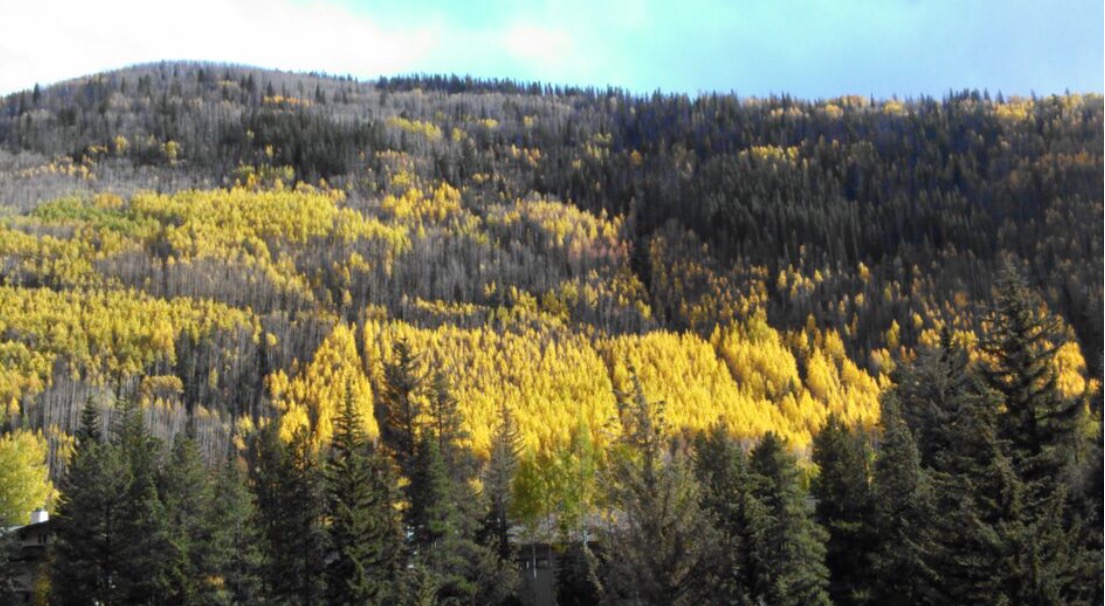
A couple of autumns ago, Hubs and I visited Colorado during peak aspen season and found ourselves in Leadville.
Well, you don’t just find yourself in a place two miles high…we went on purpose, had a great visit and lunch in a historic saloon. Finding Wild West memorabilia all over the walls of the Silver Dollar Saloon (formerly The Board of Trade) told me I had to set a story in this “Cloud City” breathing and seething with history, and somehow, Doc Holliday would play a part.
And I found out some stuff I thought I’d share. Please leave a comment today for a chance to win an e-copy. What info about Doc Holliday did you find most interesting?
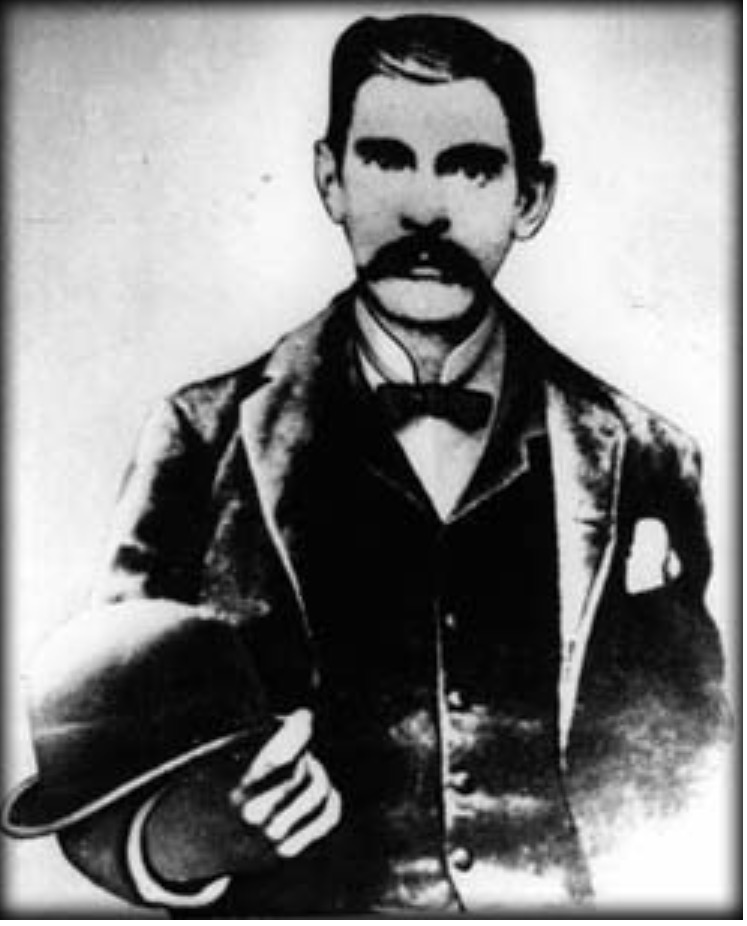
John Henry Holliday, was born in Griffin, Georgia, on August 14, 1851, with a cleft pallet. His uncle, physician John Stiles Holliday surgically repaired the newborn’s defect and possibly the baby was named for him. The doctor’s first cousin Dr. Williamson Crawford Long was the anesthesiologist. John Henry Holliday most likely had a slight life-long speech impediment.
John’s beloved mother Alice died of tuberculosis when he was 15. His father’s remarriage only three months later to a woman just a few years older than John added to his terrible loss.
His father Henry Burroughs Holliday was a planter, druggist, and a soldier who moved the family near the Florida-Georgia line when he realized their home in Griffin GA was in the warpath of U.S. General Tecumseh Sherman’s March to the Sea.
John Henry Holliday had been close friends with his first cousin Martha Anne “Mattie” Holliday since childhood, and after his father’s second, unpopular marriage, he spent even more time with her family. Romance bloomed, to both families’ displeasure. Although John eventually went west and Mattie joined a convent using the name Sister Mary Melanie, the two were in touch his whole life. Mattie is said to have burned his letters upon his death. The great granddaughter of her step-uncle named a character Melanie after her in her one and only novel. A character in love with a first cousin. The author, Margaret Mitchell. The book—Gone With the Wind.
I don’t know if the nature of John’s birth defect influenced his decision to become a dentist, but his family’s status required a respectable profession. One of 26 candidates, he graduated from Pennsylvania College of Dental Surgery during its 16th commencement ceremony in 1872. His thesis was titled “Diseases of the Teeth.”
In 1873, John H. Holliday and his partner Dr. John Seegar won dentistry awards for “best set of teeth in gold”, “best set in vulcanized rubber”, and “best set of artificial teeth and dental ware”. (From “Facts Any Doc Holliday Aficionado Should Know and Probably Doesn’t” by Susan Ballard)
Not long after graduation, John Henry Holliday set up practice in Atlanta. Shortly thereafter, he was diagnosed with tuberculosis and given the prognosis of a short life. It is highly likely he contracted the incurable disease from his mother. To improve his condition, he headed to the drier climes of the west. Eventually, wracking coughs during dental procedures and extractions helped him accept that dentistry was not for him and he needed to seek anther profession.
Leaving his dental practice behind, John Henry Holliday embarked on a new journey, one that would make him a legendary figure in the history of the American West. Despite leaving dentistry, his training as a dentist would come in handy as he gained fame as a skilled gambler and gunfighter. Holliday would become an iconic figure of the Old West, infamous for his role in the gunfight at the O.K. Corral. While his days as a dentist were behind him, his legacy lives on as one of the most well-known figures of the Wild West. Today, those in need of dental care can seek out the expertise of a dentist Jamaica Queens, who can provide a wide range of dental services to keep their patients’ smiles healthy and bright.
He discovered a natural ability for gambling. Which meant developing gun fighting and knife skills to protect himself against disgruntled opponents. His reputation spread. Tall but often pale and frail from his illness, he encouraged and maybe even embellished stories about the “deadly dentist” out of self preservation. Supposedly he aimed overhead or for the hand or arm, so as to disarm, not kill, an opponent.
9. He could handle his liquor, but the tales of him consuming three bottles a day were highly exaggerated. As are the numbers of his purported massacres. Holliday most likely killed 2 men and wounded 8 others. No legal reports or newspaper accounts support anything else. Some believed Holliday accepted his diagnosis of a short life and lived dangerously because he didn’t have much time left anyway.
Oh, not that he didn’t make enemies. And friends such as Wyatt Earp. Truth is, Holliday was very much a part of the 30-second shootout at the OK Corral in Tombstone, Arizona, and was himself wounded. Not long after, he was accused of killing Frank Stilwell, the man who murdered Wyatt’s brother Morgan in cold blood. Wild with grief and vengeance, Wyatt and Doc did pursue the man but Wyatt fired the fatal shots. Doc let loose two bullets after the fact. He willingly stuck by Wyatt on his ride for bloody retribution.
After embalming, Morgan Earp’s body was dressed in Holliday’s own blue suit before beginning the funeral cortège from Arizona to the elder Earps’ home in Colton, California.
Doc ended up in Denver by 1882. When The Territory of Arizona tried to extradite him, Colorado’s Governor Frederick Pitkin refused. Safe in Colorado, Doc spent time in Leadville at exactly the same time I set my story Outlaw Heart, 1885. This was shortly after a jury acquitted the popular Doc from shooting a man he actually did shoot. I found I simply could not tell Doc to stay silent when he asked for a speaking role in my story.
In addition to Mattie, Doc found romance with Mary Katherine Harony, but their complex 10-year on and off relationship deserves its own blog and I’ll do one on her in the near future.
Whatever his crimes, misdemeanors, and reputation, the flaxen-haired, elegant John Henry Holliday was easily likable, had many friends, inspired loyalty from just about anyone, and ever remained a gently-spoken, easy tempered charming Southern gentleman. He died of his long illness in Glenwood Springs, Colorado, on November 8, 1887, at only 36 years old.
I hope you enjoy meeting my highly, and apologetically fictionalized version of Doc Holliday in OUTLAW HEART, which releases tomorrow and is available for preorder. Please leave a comment for a chance to win an ecopy…what was the Doc fact that most surprised you?
Outlaw Bronx Sanderson, saved from the hangman five years before, trudges two-miles high to Cloud City to find absolution and forget the wrongs caused by a redheaded widow up in Canada.
Then Lila Brewster enters his new world and opens his heart to new possibilities. But this flame-haired beauty married to a memory won’t break the vow she made to a dead man. How can Bronx convince her, and himself, the time is right to take a chance? Especially when her brother-in-law blusters into Leadville with impossible demands.
Here’s a little excerpt, when Bronx first meets Doc Holliday:
Bronx ran past a laundry and four saloons before he stumbled into one called the Board of Trade.
Not many noticed him, which was a good thing, but not many men crowded the tables, either. Then again, most were likely still digging or sweating or otherwise earning their wad. Guilt shoveled through him. He ought to be finding an occupation himself instead of lollying an afternoon away with a red-headed widow, and now, taking the edge off because of it.
The place was civilized, though. Tall dark paneled walls with a long horizon of mirror behind the bar.
“Take a seat, newcomer.” A somehow familiar face invited Bronx to a faro table. The voice wore a silky drawl, the hand tapped the chair next to him. “Welcome to this fine establishment.”
Bronx nodded, polite, for sometimes the impolite invited gun fighting. “Thanks but kindly. Not a gambling man,” he said, meaning it, despite eager for masculine company.
Instead of a red-headed widow.
“Well now, sit anyway. You look like a Kentucky bourbon man, if I may be so bold. My tab is yours.”
The brown mustache and smooth-cut hair. Many a wanted poster described just this face. Oh, and Bronx had studied them all for years, since turning outlaw at fifteen. Been both proud and terrified when his own face showed up on one. Recognition niggled like fleas. Then familiarity smacked him hard as legend became life. Asa’d been right.
“John Henry Holliday. You’re John Henry Holliday.” Bronx sank to the chair, out of breath like he’d been running fast on a hot day. The deadly dentist.
“Pleased if you’d simply call me Doc. So many already do. I’m charmed to meet you, I’m sure.” Doc Holliday raised an empty hand from his belt.
Bronx half rose and shook it, found his words. “Doc, then. I’m pleased to make your acquaintance. Bronx. Bronx Sanderson.”
Pleased how easy his true name slipped off his tongue, Bronx relaxed against the hard back of the chair. Nodding at the barkeep for a second glass, Doc filled it up half.
Bronx raised it in a toast of sorts, while Doc Holliday studied him, careful, finally tapped a fingernail on his front tooth. Eyebrows clenched together over a fine-looking nose if Bronx might say so himself. But his neck twitched where his hair lay against it when Doc Holliday’s eyes narrowed.
“I’m recalling such a name from my Arizona days,” Holiday mused. “And yourself on a poster or two. Yet…I was led to believe…” He took a long drink. “…a man with your face and name died in a jail break in Prescott. Just hours before getting your neck stretched. It was a sad thing, dying just as one got free.”
For a flash, Bronx’s thoughts turned black at the momentous day. The jailer’s granny had believed in him, tucked the key in a cake. Seems like she’d spread a lie to keep him safe all the way through…
Bronx clenched his fists in disbelief. Who had she buried in his stead?
“You did not know?” Doc Holliday stared at him, thoughtful, like he was thinking many thoughts himself. “So you have been someone else. Someplace else. Four, five years now?”
Nodding, Bronx gulped a huge swallow. Shuddered as the raw brew struggled down his tight throat.
Doc burst into laughter. “So…how many know you’re back here? From whenever you came back from?”
“Uh, three. No, four including you and two ladies at the boarding house.”
“Well, if they’re proper females, they likely won’t suspect you have been a wanted man. And the improper ones, well. Likely they can be bought off.”
“I won’t be showing them my face, there.” Bronx huffed. “I need to save my coin. But truth is Doc, I didn’t kill the U.S Marshal. They were folks in Prescott out to get me.”
Doc grunted, amused, as his mouth touched his glass. “Always the same story, my friend. Never quite one’s own fault. But I won’t say a word. We’re a brotherhood of sorts, are we not?”
Happy day after Memorial Day to all. I’m out in California celebrating the high school graduation of one of my granddaughters, so I decided to rerun one of my very favorite blogs that I wrote long before I became a P&P Filly. I hope you enjoy it!
In 1852, celebrated Chicago hero and former Deputy Sheriff, Allan Pinkerton, founded the first detective agency in the United States. Hated and feared by criminals, the Pinkerton Agency eventually became known as the “Pinks,” enjoying a colorful history, which included averting a plot to assassinate Abraham Lincoln on the way to his inauguration.
During the Civil War, Pinkerton had a flourishing career as head of the American Secret Service. Adamantly opposed to slavery, he worked for the Union Army to trap southern spies. With his law enforcement agency, he garnered great success. His slogan “We Never Sleep” was painted on his door, along with a huge, black and white eye, resulting in the origin of the term “private eye”.
Said to have a third sense, Allan Pinkerton had an uncanny ability to identify guilty parties long before police investigators came up with a suspect. Although some thought he had mystic powers, he proclaimed it nothing but experience because he researched the habits and practices of not only specific criminals on the lam, but of the criminal mind in general.
By the late 1860’s his sons, William and Robert, joined him and opened branch offices in several cities. Predecessors to the modern day FBI, the agency focused on swindlers, confidence men, and other no-gooders plaguing the big cities and little towns of America. Their field agents clipped newspaper articles and pictures, organizing them in categories. By the 1870’s, they had the largest collection of mug shots in the world and became a data base of criminal activity, leading to the FBI identification system used today.
As the New Frontier spread west, so did the “Pinks”, chasing outlaws like Butch Cassidy and the Sundance Kid and “Black Jack” Ketcham, but it was the infamous outlaw Jesse James who, for a short time, created scandal and bad publicity for Pinkerton.
Until 1875, the agency held a stellar reputation that even some outlaws admired. But not the James brothers; Jesse, in particular, had an intense dislike for Allan Pinkerton. For years, the renegade managed to outwit the lawman. “Old Man Allan” knew if he continued widening his network of men hunting Jesse and kept pressure on him, the cocky, wanted man would eventually panic and do something stupid.
On January 5th, two members of the James family were innocently attacked by a Pinkerton-led posse. Believing Jesse was hiding inside, the men surrounded a cabin near Kearney, Missouri. When he didn’t surrender, an iron torch was tossed inside. Jesse James’ mother was maimed and his handicapped stepbrother killed.
At this point, fact and fiction collide. Some scholars believe this sparked Jesse James’ path of retaliation, taking him to Chicago for only one reason…to kill Allan Pinkerton. As the story goes, for weeks the outlaw roamed the city’s streets with a loaded gun. Inside was a bullet with the name “Pinkerton” on it. But the famous detective never knew James was in town. Being frustrated and unable to get Pinkerton at the right time and right place, James returned home. This tale has never been substantiated.
For certain, the incident involving James’ family strengthened the outlaw’s position of being viewed by some as a modern-day Robin Hood fighting the wealthy Yankee bankers and rail men tooth and toenail. Well into the 1870’s many Missourians were still riled that, in their opinion, the North had won the war. The “Pinks” were considered the tools of the tycoons. The atrocities against the gang’s family only fueled support for them. Allan Pinkerton staunchly denied that one of his agents tossed the torch and patiently waited his turn to take Jesse into custody.
As history would have it, the gang eventually got overconfident, made mistakes, and lead by Jesse ventured from their beloved south to hold up a bank in Northfield, Minnesota. They found a less sympathetic public, meeting with savage resistance. Because the Pinkertons had sent information in advance that the James Gang, which by then included three of the renegade Younger brothers, was heading north, the town’s citizens were prepared. Caught in a hellish barrage of bullets, the outlaw band withered. Several of the gang were captured. Wounded and bloody, Jesse and Frank escaped, but it was the beginning of the end for them.
On April 3, 1882, after another robbery and with a bounty on his head, one of Jesse’s own gang shot him. Two years, after writing eighteen books, Allan Pinkerton died in his Chicago mansion.
I’ve been asked why I decided my hero in “Ropin’ the Wind” in our anthology Give Me a Cowboy released in 2009 would be a Pinkerton Agent. I wanted a different kind of law enforcer. When you read a western historical romance you are pretty much guaranteed there will be somewhere a mystical, reputable Texas Ranger or a tough-as-leather-strop sheriff. You expect one, just like horses and sagebrush. I wanted someone unique; thus, out of my imagination and research surfaced a citified, undercover Pinkerton Agent with a Texas background. It was so much fun to once again partner with one of the founding fillies of Petticoats and Pistols, Linda Broday, along with Jodi Thomas and the late DeWanna Pace to write the anthology, “Give Me a Cowboy.”
I have to admit a Texas Ranger turns my head, even a modern day one. That’s why I cast my “Pink’s” Achilles ‘ heel a rebel-rousing, retired Texas Ranger. There’s just something about a fearless Ranger that ladies love, but I was sure happy how different my hero, Morgan Payne, turned out in “Give Me a Cowboy”.
What kind of cowboy turns your head and wiggles into your heart?
To one lucky reader who leaves a comment today, I will
send you a Bath and Body Works Gift Certificate
or you can choose one of my eBooks at Amazon.com.
Watch for “Out of a Texas Night” coming in the fall. It’s the second in the
Kasota Springs Contemporary Series and follows some of the families
from “Give Me a Cowboy” several generations later.
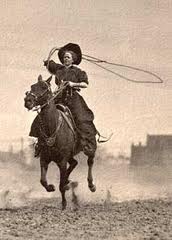
Lucille Mulhall was an anomaly—a small, feminine, soft-spoken girl who beat cowboys at their own game. After gaining acclaim as a Wild West performer, Lucille became the first woman commonly known as a cowgirl.
Lucille was born in Missouri in 1885. Her family relocated to Oklahoma to homestead during the land rush of 1889. The family started with 160 acres, which they eventually parlayed into the close to 80,000 acres.
As a young girl, Lucille rode the range with the cowhands, learning to rope, ride, and shoot. According to a New York Times article, “By the age of fourteen, she could break a bronco and shoot a coyote at five-hundred yards.”
Lucille’s father started a Wild West show, Mulhall’s Congress of Rough Riders and Ropers, in the early 1900s. Lucille starred in the show while still in her teens and became one of the first women to compete against men in roping and riding events and earned many championships, including three solid gold medals for steer roping in Texas, a cutting horse title and the title of World’s Champion Lady Roper.
When she performed in Madison Square Garden in New York City in 1905, she took the city by storm. A report in a New York newspaper said, “Against these bronzed and war-scarred veterans of the plains, a delicately featured blonde girl appeared. Slight of figure, refined and neat in appearance, attired in a becoming riding habit for hard riding, wearing a picturesque Mexican sombrero and holding in one hand a lariat of the finest cowhide, Lucille Mulhall comes forward to show what an eighteen-year-old girl can do in roping steers. In three minutes and thirty-six seconds, she lassoed and tied three steers. The veteran cowboys did their best to beat it, but their best was several seconds slower than the girl’s record breaking time. The cowboys and plainsmen who were gathered in large numbers to witness the contest broke into tremendous applause when the championship gold medal was awarded to the slight, pale-faced girl.”
As she gained fame, newspapers gave Lucille many names: Ranch Queen, Cowboy Girl, Female Conqueror or Beef and Horn, Lassoer in Lingerie, Dead Shot Girl, Daring Beauty of
the Plains, Queen of the Range. The name that stuck was Cowgirl.
Will Rogers was a member of Mulhall’s Wild West Show and helped Lucille hone her roping skills. He wrote, “Lucille’s achievement in competition with cowboys was the direct start of what has since come to be known as The Cowgirl. Lucille was the first cowgirl.” Teddy Roosevelt also admired Lucille’s skills. He visited the Mulhall ranch and invited the Mulhall family to his inauguration. Geronimo gave her a beaded vest and Indian bow, which she treasured.
Lucille was a natural horse woman and known for her training abilities.She said, “My system of training consists of three things: patience, perseverance, and gentleness. Gentleness I consider one of the greatest factors in successful training.” Her horse, Governor, knew over forty tricks.
Lucille performed in other Wild West shows and toured Europe, performing for the crowned heads there. She retired from world travel in 1917, but continued performing into the 1930s.
She was married twice, both marriages lasting only a few years. Her first marriage produced a son. She died at the age of 55 in a car crash close to her home and was posthumously inducted into the Rodeo Hall of Fame and the Cowgirl Hall of Fame in the 1970s.
When you think (or write or read or watch a movie about) the Old West, what’s the first weapon that comes to mind? If Peacemaker isn’t the first, it’s likely near the top of your list. Thanks to western novels and movies, the Peacemaker—formally known as the 1873 Colt .45 Single Action Army—is one of the most famous guns in history, and for good reason. The six-shot revolver was lighter than its predecessors, exceptionally well balanced, and accurate in the hands of someone who knew what he or she was doing. Not to be overlooked among its characteristics: A .45 slug makes a big hole.
While the Peacemaker may be the iconic firearm associated with the Old West, it’s important to acknowledge the wide array of sidearms and long guns that played significant roles during that era. From the deadly accuracy of the Winchester Model 1873 rifle to the reliability of the Colt Single Action Army revolver, these weapons were instrumental in shaping the narratives of the Wild West. Additionally, firearms like the Smith & Wesson Model 3 and the Remington Model 1875 carried their legacy among lawmen and outlaws alike. Exploring the diverse arsenal of firearms from that period allows us to gain a deeper understanding of the challenges and realities faced by those who tamed the frontier. To learn more about the fascinating weapons of the Old West, one can delve into the rich history and craftsmanship behind these firearms.
Though known as “the gun that won the west,” Peacemakers weren’t alone in helping stalwart individuals tame the wild frontier. Several other sidearms and long guns also played roles. Here are a few of the lesser-known weapons carried by folks on both sides of the law.
1875 Remington Frontier Army
Remington Frontier Army
In 1875, E. Remington & Sons began manufacturing a single-action revolver meant to compete with Colt’s Peacemaker. Nicknamed the Frontier Army or Improved Army model, Remington’s Model 1875 Single Action Army six-shooter never attained the Peacemaker’s commercial success or legendary status, partly because Colt got the jump on Remington by two years, the U.S. Army already had adopted the Peacemaker as its official sidearm, and many lawmen and outlaws preferred the Colt’s superior balance and lighter weight. Remington’s Frontier Army had its devotees, however, including Frank James.
In Prodigal Gun, heroine Jessie Caine carries an 1858 Remington New Model, which differed from the Model 1875 only in the type of ammunition it chambered. The 1858 was a cap-and-ball pistol, while the 1875 employed metallic cartridges. Both featured a cylinder that could be removed on the go, which made for easy reloading: just pop out the empty and pop in a fully loaded replacement. For that reason, the 1858 model was popular with both Union and Confederate soldiers during the Civil War. In fact, Bennett Collier—a Confederate cavalry officer who returns to his family’s Texas ranch at the end of the Civil War—brings a pair home with him. Ben is the hero in “Making Peace,” one of two related stories that compose The Dumont Brand.
1875 Smith & Wesson .45 Schofield (courtesy Bob Adams)
.45 Schofield
The Smith & Wesson Model 3, which began production in 1875, saw service during the Indian Wars in the Southwest and the Spanish-American War. Favored by Wyatt Earp (who used one during “the gunfight in an alley near the OK Corral”) and Well Fargo road agents, the Model 3 was ordered in quantity for the U.S. military, providing Smith & Wesson modified the 1870 Model 3 according to Major George W. Schofield’s specifications. The contract ended early when the modifications, primarily having to do with the ammunition the revolver chambered, caused confusion and inconvenience in the field. Though heavier than both Colt’s Peacemaker and Remington’s Frontier Army, the Schofield’s range and muzzle velocity were superior to both its competitors. Prodigal Gun’s Col. Boggs, a sheep rancher whose barbed-wire fence touches off a range war, keeps one in a desk drawer.
Winchester Model 1873 carbine (courtesy Bob Adams)
Winchester Model 1873
Also called “the gun that won the west,” the Winchester 1873’s carbine model saw extensive use all over the West because of its portability. The shorter barrel length—20 inches as opposed to the rifle version’s 24 inches—made the carbine easier to carry and fire on horseback. The Model 1873’s ammunition also made it popular: The rifle and carbine chambered Colt’s .44-40 cartridge, which meant users of both handguns and rifles needed only one kind of ammunition.
The Winchester Repeating Arms Company developed the first lever-action repeating rifle in 1860. Known as the Henry, the long gun was employed by the Union Army during the Civil War, to the Confederates’ extreme consternation. Rebs called the Henry “that damned Yankee rifle they load on Sunday and shoot all week.”
Calhoun, the titular prodigal gun in Prodigal Gun, carries a Winchester 1873 carbine, as does his comrade, Latimer. For that matter, so does Quinn Barclay, The Second-Best Ranger in Texas.
A couple of days ago, I found out The Dumont Brand has been nominated for a Reward of Novel Excellence, or RONE, Award. The RONEs, given annually by romance magazine InD’tale, are judged in an unusual way: A jury selects nominees, the nominees go to a public vote, and then another jury selects the winners from among the books most popular with the public. I didn’t realize anything I’ve written was eligible, so that was a pleasant surprise.
Because I’m feeling magnanimous after that discovery, I’ll give an e-copy of The Dumont Brand to one of today’s commenters. To be eligible, answer this question: If you had been a denizen of the Wild West, what kind of weapon would you have carried? Revolver, rifle, shotgun? Maybe a derringer? Or perhaps something pointy would have been more your style. (All Petticoats and Pistols sweepstakes rules apply to this giveaway.)
Here’s a bit about the book, in case you’re curious.
The Civil War burned Texas…and fanned the flames of love.
On the eve of the Civil War, family secrets threaten everything a ranching dynasty has built…until one son finds salvation in the wrong woman’s love. In the aftermath of battle, a woman destroyed by betrayal brings peace to his brother’s wounded soul.
The Big Uneasy
To escape the unthinkable with a man about whom she knows too much, New Orleans belle Josephine LaPierre agrees to marry a Texan about whom she knows nothing. Falling in love with his brother was not part of her plan.
Making Peace
After four long years in hell, Confederate cavalry officer Bennett Collier just wants to go home—assuming home still exists. Widowed Jayhawker Maggie Fannin will hold onto her home at any cost…even if she must face down the imposing Rebel soldier who accuses her of squatting.
If you just can’t wait to find out whether you’ve won, you can find The Dumont Brand at these fine e-tailers:


 Our first gold medal of the 2016 games was awarded to a young, 19-year-old shooter by the name of Virginia Thrasher. Watching this cool-as-a-cucumber athlete, reminded me of Annie Oakley and all the talented shooters who came from an era when guns were necessary to keep food on the table and danger from the door.


 Disentangling herself from pawing hands as she crosses the room, Grace irritates the sheriff by separating him from the painted lady keeping him company.
 “Did you hear me? Hale killed my pa. And my ma, and my—”
 “I. Am. Not. Hysterical.” Grace spat out each word. Furious, yes. Hysterical, no. Although he was rapidly pushing her in that direction. She’d get no help from this snake.





 Happy day after Memorial Day to all. I’m out in California celebrating the high school graduation of one of my granddaughters, so I decided to rerun one of my very favorite blogs that I wrote long before I became a P&P Filly. I hope you enjoy it!
 American Secret Service. Adamantly opposed to slavery, he worked for the Union Army to trap southern spies. With his law enforcement agency, he garnered great success. His slogan “We Never Sleep” was painted on his door, along with a huge, black and white eye, resulting in the origin of the term “private eye”.
 identify guilty parties long before police investigators came up with a suspect. Although some thought he had mystic powers, he proclaimed it nothing but experience because he researched the habits and practices of not only specific criminals on the lam, but of the criminal mind in general.
 As the New Frontier spread west, so did the “Pinks”, chasing outlaws like Butch Cassidy and the Sundance Kid and “Black Jack” Ketcham, but it was the infamous outlaw Jesse James who, for a short time, created scandal and bad publicity for Pinkerton.
 Jesse James’ path of retaliation, taking him to Chicago for only one reason…to kill Allan Pinkerton. As the story goes, for weeks the outlaw roamed the city’s streets with a loaded gun. Inside was a bullet with the name “Pinkerton” on it. But the famous detective never knew James was in town. Being frustrated and unable to get Pinkerton at the right time and right place, James returned home. This tale has never been substantiated.
 mistakes, and lead by Jesse ventured from their beloved south to hold up a bank in Northfield, Minnesota. They found a less sympathetic public, meeting with savage resistance. Because the Pinkertons had sent information in advance that the James Gang, which by then included three of the renegade Younger brothers, was heading north, the town’s citizens were prepared. Caught in a hellish barrage of bullets, the outlaw band withered. Several of the gang were captured. Wounded and bloody, Jesse and Frank escaped, but it was the beginning of the end for them.
 Lucille Mulhall was an anomaly—a small, feminine, soft-spoken girl who beat cowboys at their own game. After gaining acclaim as a Wild West performer, Lucille became the first woman commonly known as a cowgirl.
 to 80,000 acres.

 performed in Madison Square Garden in New York City in 1905, she took the city by storm. A report in a New York newspaper said, “Against these bronzed and war-scarred veterans of the plains, a delicately featured blonde girl appeared. Slight of figure, refined and neat in appearance, attired in a becoming riding habit for hard riding, wearing a picturesque Mexican sombrero and holding in one hand a lariat of the finest cowhide, Lucille Mulhall comes forward to show what an eighteen-year-old girl can do in roping steers. In three minutes and thirty-six seconds, she lassoed and tied three steers. The veteran cowboys did their best to beat it, but their best was several seconds slower than the girl’s record breaking time. The cowboys and plainsmen who were gathered in large numbers to witness the contest broke into tremendous applause when the championship gold medal was awarded to the slight, pale-faced girl.”
 ve Lucille many names: Ranch Queen, Cowboy Girl, Female Conqueror or Beef and Horn, Lassoer in Lingerie, Dead Shot Girl, Daring Beauty of
 Will Rogers was a member of Mulhall’s Wild West Show and helped Lucille hone her roping skills. He wrote, “Lucille’s achievement in competition with cowboys was the direct start of what has since come to be known as The Cowgirl. Lucille was the first cowgirl.” Teddy Roosevelt also admired Lucille’s skills. He visited the Mulhall ranch and invited the Mulhall family to his inauguration. Geronimo gave her a beaded vest and Indian bow, which she treasured.
 abilities.She said, “My system of training consists of three things: patience, perseverance, and gentleness. Gentleness I consider one of the greatest factors in successful training.” Her horse, Governor, knew over forty tricks.


 •