 In my latest release, Dulcina, book 5 in “The Widows of Wildcat Ridge” series, I feature a heroine who has a natural singing talent and, with her husband, owned a saloon in a gold mining town in Utah Territory. Her contribution was being the “talent” at the various saloons she and her husband owned over the eight years they were together. They ran a respectable establishment with no fancy ladies, relying on Dulcina’s singing talent to draw in the customers. Although she wasn’t well accepted by the women in the town, Dulcina looked on her talent as providing the right type of atmosphere to keep the atmosphere calm.
 I’m an author who believes in including lots of historical facts in my stories. If you read about a certain product or tool or company, you can be sure that product existed at the time the story is set. Often, I’m lucky enough to find a resource that provides me with an image so I can describe what the products looked like to create an authentic visual. Researching what the popular music she would have performed proved enlightening, at least to me. I had no idea some of the songs that I’ve learned from various settings (elementary school choir, Girl Scouts, camps, music tapes for my children) were as old as they are.
Consider that many people who settled the western part of the United States after the Civil War were a vast mix of people. Some came from well-established homes in the East where too many sons existed and a third or fourth son wouldn’t inherit much. These individuals would have an upbringing that included music and many could play piano, including the women. Other settlers came from foreign countries and brought their own music and songs. For many, a piano, or a banjo, or a violin—or all three—and sheet music provided an entire evening’s entertainment with people of all ages joining in.

In the 1870s and 1880s, the plays by W. S. Gilbert and Arthur Sullivan provided lots of songs. H.M.S. Pinafore was their first huge success and provided “Never Mind the Why and Wherefore”, “Things Are Seldom What They Seem” and “Sorry Her Lot Who Loves Too Well.” From Pirates of Penzance came “Away, Away, My Heart’s on Fire”, “A Rollickin’ Band of Pirates, We” and “I am the Very Model of a Modern Major-General” and from Iolanthe “When Britain Really Ruled the Waves”, “None Shall Part Us” and “Welcome to our Hearts Again.” Or other familiar tunes were “My Bonnie Lies Over the Ocean”, “Farmer in the Dell”, “Oh, My Darling Clementine”, “Polly Wolly Doodle”, “The Fountain in the Park” (better known as “I Was Strolling in the Park One Day”), “There is a Tavern in the Town”, “Blow the Man Down” and “Sailing, Sailing.”

Not only would the singing be a unifying activity for the family, or residents of a boarding house, or citizens traveling through a small town in a sparsely populated area, but it also put the people in touch with what was happening in other places in the world. What fun to perform songs that were also being sung in theater performances across the continent in New York or halfway around the world in London. Oftentimes, people living on the frontier had a limited scope of life, meaning they didn’t travel far from the place where they were raised, but music made them feel like they belonged to a larger society.
BLURB
Left widowed following a Utah mining disaster, Dulcina Crass faces running a saloon on her own when her previous contribution was solely as the singer. She struggles to learn the necessary tasks but her heart isn’t in being a saloon keeper. All she ever wanted was to be a famous singer. Will asking Gabriel Magnus, a neighbor from her New Mexico hometown, bring the help she needs or a new kind of trouble?
Gabriel Magnus isn’t fulfilled by his role as ranch hand on the family’s New Mexico sheep ranch. What he wants is the chance to prove his boot making skills are good enough to start his own business. When he receives a letter from recent widow Dulcina offering a partnership in the Last Chance Saloon, he recognizes the chance to come to the rescue of the vivacious girl he wanted to court a decade earlier. Upon his arrival, he presents her with a demand–her answer could decide both of their fates.
Amazon buy link: http://amzn.com/B07JL58L4B
Web Contacts:
Website: http://www.lindacarroll-bradd.com
Blog: http://blog.lindacarroll-bradd.com
Facebook: http://www.facebook.com/linda.carrollbradd
Twitter: http://www.twitter.com/lcarrollbradd
Amazon author page: http://www.amazon.com/author/lindacarroll-braddhttp://www.amazon.com/author/lindacarroll-bradd/abr?tag=pettpist-20 Bookbub page: http://www.bookbub.com/authors/linda-carroll-braddhttp://eepurl.com/bjKueH
I’m giving away a print copy of A Year in Romance, Books 1-4 of “Dorado, Texas” series (US only, ecopy to international winner).
 Last year, I had the opportunity to go to the location my first series was set in, Castle Town, Montana. It’s a ghost town now, although it is inhabited by cattle rather than ghosts. Even so, it was fun to see it. And now I feel like I need to rewrite my series. But I won’t.




 Hola! Jolene Navarro checking in from my front porch in the Texas Hill Country. I’m so happy to be here today.


 Now to be fair there are family fights…sauce from fresh cranberries or the stuff from the can? Some people will only eat that stuff from the can, but I’m not here to judge. We welcome everyone…no matter how they take their cranberries.
 So, hosting Thanksgiving in a cabin on the river became a new tradition. A few of us stay for three or four days to set up, clean up and just hang out. The rest of the family comes in for Thursday. How can I not incorporate this kind of family fun (and maybe a little drama) into my books? In Lone Star Hero, the big family gathering is new to my hero Max and his three younger brothers. They have never spent the holidays together let alone in such a huge setting.


 Surrounded by God’s creations has a way of healing the bumps and bruises the world leaves behind. How could I not bring this into my stories and share with the world? I love being a country girl.


 MARRIAGE, CONSENT, AND MAIL ORDER BRIDES
 It may have been a poor choice of words.
 So what do you think? Is intimacy simply a matter of being married? Or is it something deeper, coming out of the kind of love, care and respect that will last a lifetime?


 Sophie Dawson has been making up stories in her head ever since she was a child. She has written fiction and non-fiction, contemporary and historical romance, and has also ventured into the increasingly popular arena of audio books.


 Hello. I’m Sunny Marie Baker and I’m thrilled to be a guest blogger today at Petticoats and Pistols. From the time I was a child I loved the old west. Watching Roy Rogers and Gene Autry on T.V. I got lost in the stories. I became one of the characters continuing the adventure outside in my yard long after the T.V. show ended. Every Christmas my special gift from Santa was a new pair of cowboy boots. There’s a pair of red ones sitting in my closet right now. Yep, once a cowgirl, always a cowgirl.


 Hello everyone, Jodi Thomas here.


 Gold is found in tough clay. To dissolve the clay the miner fills a pan made of sheet-iron or tinned iron, with a flat bottom about a foot in diameter, and sides six inches high, inclining outwards at an angle of thirty or forty degrees. At a river bank, he squats down, puts his pan under water, and shakes it horizontally. Once the mass is thoroughly soaked, he picks out the larger stones, mashes up the largest and toughest lumps of clay, and again shakes his pan. When all the dirt appears to be dissolved, allowing the heavier gold to move to the bottom, he tilts up the pan a little to let the thin mud and light sand run out, until he has washed out all except the metal, which remains in the pan.
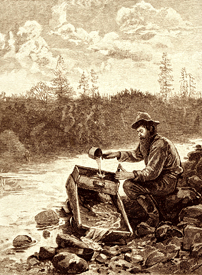 The rocker resembles a child’s cradle. On the upper end is a riddle, made with a bottom of sheet-iron punched with holes. This is filled with pay dirt and rocked with one hand, while, with a dipper, the miner pours water into the riddle with the other. Being agitated, the liquid dissolves the clay and carries it down with the gold into the floor of the rocker, where the metal is caught by traverse riffles, or cleats. The mud, water, and sand run off at the lower end of the rocker, which is left open. The riddle can be removed, allowing the miner to throw out the larger stones mixed with the clay.
 In Nevada, a total length of 6,000 miles of canals and flumes were created. The largest mine, the Eureka, had 205 miles of ditches, constructed at a cost of $900,000. As placers were gradually exhausted, the demand for water and the profits of ditch companies decreased. Flumes, blown down by severe storms, carried away by floods, or destroyed by the decay of the wood, were not repaired.
 In Hydraulic mining a stream of water is directed under heavy pressure against a bank or hillside, tearing the earth down and carrying it into the sluice to be washed. The force of a stream of water rushing through a two-inch pipe, under a pressure of two hundred feet perpendicular caused hills to crumble as if piles of cloud blown away by a breath of wind. When dried by months of constant heat and drought, the clay becomes so hard, not even the hydraulic stream, with all its
 The erection of a long sluice, the cutting of drains (often necessary to carry off the tailings), and the purchase of water from the ditch company, required capital; and the manner of clearing up rendered it impossible for workers to steal much of the gold. Thus, the custom of hiring miners for wages became common in placer diggings.
