Estella! You’ve won a Kindle copy of Ruthy’s new historical Western “A Most Inconvenient Love”! Congratulations!!!! Email Ruthy at loganherne@gmail.com and she’ll get that out to you! Thanks for coming by!

Estella! You’ve won a Kindle copy of Ruthy’s new historical Western “A Most Inconvenient Love”! Congratulations!!!! Email Ruthy at loganherne@gmail.com and she’ll get that out to you! Thanks for coming by!

The winner of the owl scarf and Family Ties giveaway is. . .
Janine
Congratulations!
I will contact you at the email
address you left concerning getting your giveaway.
Again, congratulations Janine, and thank you to everyone who stopped by to chat. I’ll leave you with one final bit of cowboy wisdom. “Never give the devil a ride. He will always want the reins.”
Julie
Every generation says growing up is harder for the current one, but the issues I see today’s children dealing with makes my heart ache for them. As I pondered how we as a society start  dealing with the problems facing our young people something in my Pinterest feed caught my eye:
The Cowboy Code
If it’s not yours,
Don’t take it.
If it’s not true,
Don’t say it.
If it’s not right,
Don’t do it.
Something so simple, and yet, so profound. The first part—if it’s not yours, don’t take it—is easy for most of us. We know what stealing is and that it’s wrong. But the other two are tougher. If it’s not true, don’t say it—I don’t lie about someone, but I’ve been known to gossip. Because I’ve come to believe gossip can be as dangerous and damaging as lying, I try to avoid listening to or repeating it. As to the last part of The Cowboy Code—if it’s not right, don’t do it—I think it’s the most complicated. How do we tell what’s right with so many gray areas? For me, if I listen to my gut, it becomes clearer. When I feel that little twinge, I know something isn’t a good decision, and I’m learning to trust that. So far, my gut’s served me well.
 Inspired by The Cowboy Code, I searched Pinterest and found other western advice. Maybe because cowboys work with cows and steers—animals known for requiring patience—but what I found has encouraged that very trait in me. I’ve always been a “Lord, give me patience right now” gal. I’ve been quick to honk at drivers who don’t move the minute the light turned green. I’ve fumed at someone taking too long leaving a parking space. But now, I try to be the driver I want on the road with me. When someone allows me to pull out in heavy traffic, I give them the “thanks pardner” wave to acknowledge their kindness, and more importantly, I try to be the person who makes room for others.

Yup, I’m taking The Cowboy Code and philosophy to heart. I did this hoping to brighten someone else’s day and made a profound difference in my own life. Doing so has helped me slow down, be more patient, and live happier. Maybe that’s The Cowboy Code is a possible answer to some of our problems.
I’ll leave you with another cowboy tip that hopefully makes you smile as it did me. You got it. “Never climb a barbed wire fence naked.” Okay, so maybe they aren’t all diamonds, but you got to admit, it’s solid advice!
 Click here to head to the Petticoats and Pistols Pinterest site and check out more cowboy philosophy inspiration I found.
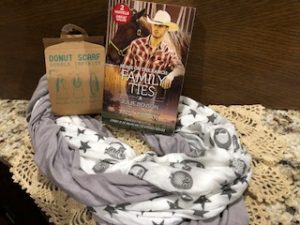
Now it’s your turn. Leave a comment about your favorite cowboy or downhome wisdom to be entered to win the gray and white owl scarf and a copy of Family Ties containing my novel Cowboy in the Making pictured here.

Congratulation to my Tuesday Winner …
Lori
Lori, I will contact you later today at the email
address you left concerning getting your copy of
Out of a Texas Night.
Again, congratulations, Lori!

Thanks to everyone who stopped by to play along with Monday’s Game Day! All of the entries were so good I had a difficult time picking a winner. In fact, I decided to award prizes to my two favorites.
And they are:
and
Congratulations ladies! Let me know which two of my books you want and then contact me via my website with the titles and your mailing info.

Hello, Winnie Griggs here, and I’m excited to welcome you to our very first official game day, something we plan to do once a month going forward.
To kick things off, I thought we’d play something fun but relatively simple – a game of Caption This!
Because I’m indecisive, I’m going to give you two choices of photos to play with. Look at the photos below and provide a caption for one or both, indicating which one your caption goes with. They can be witty, funny, poingant – whatever strikes your fancy. That’s it – easy peasy!
PHOTO #1

PHOTO #2


I can’t wait to see what all you creative folks can come up with! The prize will be winner’s choice of any 2 books from my back list, along with this fun little magnetic cowboy poet kit.

So let the games begin!!
We are so pleased to welcome guest author Shirleen Davies to the Junction! Today Shirleen is giving away a copy of her latest book to one lucky person! Please join us in welcoming her!

Christianity has a rich history spanning centuries and continents, with various traditions and denominations that have evolved over time. From the early days of the church to modern times, Christianity has been a driving force in shaping culture and society around the world. For those interested in learning more about the history and evolution of Christianity, there are many resources available, including books, documentaries, and online articles. If you’re curious about the role of Christianity in the development of the American frontier, you might want to pop over to this article for a fascinating look at the religious landscape of the time.
In the 19th century, Methodists, Baptists, and other revivalists offered grassroots, non-traditional Christianity to settlers across the frontier. The sermons which were impassioned and spoken from the heart appealed to these frontier settlers.
Who were some of the more well-known preachers?
Barton Warren Stone believed in bible based teaching. His rallying cry was “The Bible only” when he headed west and served two Presbyterian parishes in Concord and Cane Ridge Kentucky. Other Presbyterian ministers criticized him for his unorthodox views, chiefly his denial of the Trinity, which he said was not found in the bible. In 1830 Stone met Alexander Campbell, another Bible only Presbyterian-turned-independent preacher. Their friendship and common passion led to a merger in 1832. Stone’s legacy endures in the large number of churches called “Disciples of Christ” or “Church of Christ,” which are committed to “Bible only” Christianity.

Peter Cartwright, one of the most colorful frontier ministers, joined the Methodist Episcopal Church at 16 at a camp meeting. Within two years, he was traveling the backwoods of the new nation, preaching the gospel. Crowds flocked to hear him throughout Kentucky, Tennessee, and Illinois. His meetings often ran day and night. The passion in his booming voice could make women weep and strong men tremble. Cartwright once warned General Jackson, who was later President of the United States, that he would be damned to Hell as quickly as any other man if he didn’t repent. Cartwright championed the creation of Methodist colleges to train more ministers. His autobiography became a classic as much for his good deeds as for the picture it painted of frontier life.
Lucy Wright, a woman, and a Shaker, was another popular religious figure. After joining the Shaker sect with her husband, they had to dissolve their marriage due to the denomination’s strict adherence to celibacy. Lucy then went back to using her maiden name. By the late 1780s, the Shakers divided into male and female orders due to their belief in God as Father-Mother. In 1787, Lucy was appointed as the leader in the female line. Nine years later, Joseph Meacham, the second successor to founder Mother Ann, by-passed his male assistant and appointed Lucy as Elder. At Meacham’s death, she took the Shaker helm as Mother Lucy. She broke a 12-year hiatus of Shaker evangelism and sent missionaries to the western frontier in 1804. Mother Lucy also brought singing back to the Shakers and added dancing, hand motions, and worship marches.
Francis Asbury was known as Mr. Circuit Rider. He rode horseback, or in a carriage when he was sick, about 300,000 miles during his 45-year ministry, delivering 16,500 sermons. He created districts of churches, each served by preachers who traveled from church to church. Asbury drove missionary expansion into Tennessee and Kentucky despite the constant threats of illness and Indian attacks on the frontier. Asbury founded five schools and promoted Sunday schools to teach children reading, writing, and arithmetic. He hated slavery and even petitioned George Washington to enact antislavery legislation. The Methodist church expanded to 200,000 strong under Francis Asbury’s leadership.
Revivals
On the new frontier, church revivals took the form of camp meetings. James McGready initiated the camp meetings movement around 1800 in Kentucky.
Camp meetings soon became a colorful part of pioneer life. Families for miles around attended. The camp meetings usually began on Thursdays and ended on Sundays, but some lasted for up to two weeks. Several worship services were held daily, leading up to the big evening service. Often preachers from several denominations were on hand.
The religious message was clear and simple—stop sinning and repent now to save yourself from hellfire and damnation!
 My newest release, Bay’s Desire, book nine in my MacLarens of Boundary Mountain series, is now available. I’m pleased to give away an eBook to today’s blog post lucky contest winner.
I’d love to read your comments. Also, please take a moment to sign up for my Newsletter and Follow Me on: BookBub
Buy Links for Bay’s Desire (released 1/29/2019)


 Did you know that the American Valentine greeting card business was started by a woman in 1847? Not only that, but she ran her extremely profitable business out of her home and employed other women in assembly-line craftsmanship years before Henry Ford made the business model famous.
Esther Howland was a college-educated woman who also happened to be the daughter of a stationer and bookseller. The year she graduated from the Mount Holyoke Female Seminary in 1847, she received an English Valentine from one of her father’s associates. At this time, such cards were imported from Europe and very expensive. They would only be available for the wealthy elite. Yet, as she looked at this card, her entrepreneurial mind saw possibilities. Have you ever found something in a store with an outrageous price tag and thought, “I could make that for a fraction of the cost”? Well, Esther not only had that thought, but she created a business plan.
 She asked her father to order lace paper, paper flowers, and other supplies from Europe, then she set about creating her own designs. When she had a dozen, she presented them to her brother who reluctantly agreed to take them with him on his next sales trip. She hoped to receive perhaps $200 worth of orders. She received $5,000!
She dedicated a room in her home as her manufacturing shop, recruited her friends to help, and got to work. She would create the patterns for each piece of the valentine, then pass them off to the other girls to duplicate. Each one would be in charge of a certain piece of the multi-layered card. By 1849, the assembly line had been perfected and her business was born. She began to advertise and eventually expanded into the Christmas and birthday card market as well. Her basic cards sold for five cents. Her more elaborate designs containing hidden doors, ribbon trimmings, and gilded lace would sell for as much as one dollar.
In 1870, she incorporated the New England Valentine Company, but she continued running the business out of her home until 1879 when she moved it into a factory. She even allowed customized verse. All of her cards included four lines of poetic verse. However, if you fell in love with a particular card design but didn’t care for the verse, you could purchase The New England Valentine Co.’s Valentine Verse Book and simply cut one you like better from the 131 available in the book and paste it over the verse that didn’t suit. Clever woman!
********** GIVEAWAY **********
In honor of Valentine’s Day and clever women who create romantic masterpieces, I’d like to invite you to a Facebook party and offer a chance to win one of three fantastic Valentine prizes.
Sixteen fabulous historical authors are coming together to celebrate romance on Feb 13-14. We’ll be chatting live with readers during this party, and I’d love to see you there. My time slot is
7:00 pm CST on Feb 14th.
Click here to join the party.

Not only are we chatting at the party, but from now until the end of the party, there is a HUGE giveaway going on.
One winner will receive a $100 Amazon Gift Card.
Another winner will receive a copy of each of the 16 highlighted books – all romantic reads fit for an extended Valentine escape.
And a final winner will receive this fun Jane Austen inspired book bag.
.
.
.
.
.

Click here to enter the giveaway.
Have you ever made a Valentine by hand?
What is the best Valentine’s gift you ever received?

Thanks to everyone who stopped by to leave a comment on my post featuring Phoebe Couzins, First Female U.S. Marshall. The winner selected to receive her choice of any one of my books is
Congratulations Debra! Just check out my list of books on my website (www.winniegriggs.com ) and then email me with your choice of book and mailing info and I’ll get it out to you ASAP.

Hello everyone, Winnie Griggs here. Last month I started a series of articles about 10 amazing women who paved the way for females in various branches of law enforcement. January’s post focused on Kate Warne, the first female Pinkerton Agent. (If you missed it, you can read it HERE)
This month I want to talk about Phoebe Couzins, the first woman to be appointed to the U.S. Marshall service.

Growing up, Phoebe’s parents taught her to view public service as something to be valued. They were a couple who truly walked the walk. For instance, when Phoebe was about six years old, St. Louis was devastated by a terrible cholera epidemic where thousands of residents perished. John and Adaline Couzins stepped forward and headed up the local relief organization that was responsible for helping the victims.
And that was only one instance of many. Among other things, John Couzins, was an architect and builder, served as a Union Major during the Civil War, and became Chief of Police in St. Louis. Adaline Couzins, was also quite active. She served as a nurse during the Civil War, tending soldiers on the battlefield at Wilson Creek, Shiloh, and Vicksburg. During the course of this, she herself was actually wounded at Vicksburg.
Which may be why, as she grew, Phoebe pushed against the boundaries imposed on nineteenth century women in a BIG way.
In 1869, she became a delegate to the American Equal Rights Association Convention in N.Y. That same year, Phoebe spoke on behalf of women suffrage to a joint meeting in the Missouri State General Assembly. She advocated the passage of State legislation granting women the right to vote. Unfortunately the proposal was ultimately rejected by a vote of 89-5.
Later that year, Phoebe was one of the first women to enter Washington University in St. Louis law school when they opened admission to women, and in 1871 she became the second woman in the nation to graduate with an L.L.B. degree. A big proponent of equality for women, once she graduated she stated that she primarily pursued a law degree in order to “open new paths for women, enlarge her usefulness, widen her responsibilities and to plead her case in a struggle which [she] believed surely was coming. . . . I trust the day is not far distant when men and women shall be recognized as equal administrators of that great bulwark of civilization, law.” After graduating, she went on to become the second licensed attorney in her home state of Missouri and the third licensed attorney in the entire United States. Eventually she was also admitted to the bar associations of Arkansas, Utah, and Kansas, as well as the Dakota Territory federal courts.
In 1884, Phoebe’s father was appointed as the U.S. Marshal in eastern Missouri. Her father then named her a deputy U.S. Marshal, which placed her among the first women to hold that position. When John Couzins died in 1887, President Grover Cleveland asked Phoebe to step into the position temporarily, making her the first woman U.S. Marshal. She only held the position for two months, however, leaving the service altogether when she was replaced by a male.
As I mentioned above, Phoebe was a strong proponent of women’s rights. She was active in the suffrage movement for many years, as had been her mother. In the early days of the twentieth century she made the following statement: ”… today we round out the first century of a professed republic,—with woman figuratively representing freedom—and yet all free, save woman.” And she also stated “Until we are large enough to think of mind, of genius, of ability without the consciousness of sex, we are yet in the infancy of our development, we belong in kindergarten.”
Unfortunately, Phoebe’s life did not end well. As the years passed, her strong personality and outspoken ways rubbed her associates and fellow suffragists the wrong way, eventually leaving her with few friends. At the age of sixty-eight, she found herself in a dire situation – destitute, in failing health, and unable to work – so she returned to St. Louis. She died there in December of 1913.
Phoebe was buried with her U.S. marshal’s badge pinned to her chest in an unmarked grave in Bellefontaine Cemetery. Only six people, including her brother, attended her funeral. It was a sad ending to a remarkable life.
However, in more recent years, Phoebe’s life and groundbreaking accomplishments have received more appropriate recognition.
In 1950 Phoebe Couzin’s final resting place received a marker. In that year, to acknowledge Phoebe’s many groundbreaking accomplishments, the members of the Women’s Bar Association of St. Louis placed a simple stone monument on her final grave.

And in 2000 , Phoebe, as well as Lemma Barkeloo (another early female lawyer) were honored by the establishment of the Lemma Barkeloo and Phoebe Couzins Professor of Law Chair at the Washington University school of law.
There you have it, a very brief sketch of the trailblazing life of yet another brave and ahead-of-her-times woman. What struck you most about her? If you’d already heard of her, did you learn anything new, or do you have more to add to her story?
Leave a comment and you’ll be entered in a drawing for winner’s choice of any book from my backlist.