Hello! Paula Altenburg here.
It seems so early to be discussing a Christmas book! And yet, here we are.

My latest release, the seventh book set in Grand, MT and number four in The Endeavour Ranch series, involves a retired professional bull rider, a cute baby, and a perky blonde elf.

A lot of The Cowboy’s Christmas Baby talks about forming new Christmas traditions. The perky blonde elf heroine, Tate, has lost her twin brother. The retired rodeo hero, Miles, finds himself starting a new chapter in his life with a brand-new daughter he didn’t anticipate. Miles and Tate both love their family traditions from Christmases past. Both recognize the need to move forward and create new ones—for the people they love.
I’d like to talk about traditions; more importantly, the role women have played in the creation of them. This is going to take a little backtracking on my part, so bear with me.
I have a degree in Social Anthropology, so even though I write contemporary western romance, when I want to understand the mindset of a culture or society, I look at its origins.
Montana’s history is fascinating.
If you’ve read Zane Grey or Louis L’Amour, or watched old western movies on television, you’ve no doubt seen the litter of old pianos and heavy furniture left behind on the trail as wagon trains crossing rivers and deserts are forced to lighten their loads. You’re also familiar with the absurdity of it—why would anyone think these frivolous things are important for survival when traveling into the wild west?

As it turns out, these weren’t frivolous items at all. They played a significant role in survival.
While doing research, I stumbled across a master’s thesis from the University of Montana: “A Little Bit of Paradise”: Women’s Search for Comfort in Late-Nineteenth Century Montana by Allison Badger (May 2003). The study focuses on middle class women, who history often overlooks because they don’t appear to have much at stake. That doesn’t mean triumphs and struggles didn’t exist for them.
The thesis talks about colorful handkerchiefs tied to poles so women on the prairie could tell which way the wind blew as a means of preserving their sanity.

But the author challenges this observation. One quote caught my attention:
“Western domesticity allowed Montana women to continue operating in their feminine sphere and gave women the means to cope with their circumstances.”
Not every woman who came west wanted to dress and act like a man or become another Annie Oakley. Many women saw turning their backs on civility and the rules of society as defeat. Clinging to things that made everyday life more familiar and “normal” came with a sense of pride—things such as social etiquette, home furnishings, and fashion. These women knew how to turn a house into a home.
I like to write my western heroines feminine as well as strong, to take after the women who blazed trails for them. I think Tate Shannahan fits their model quite nicely as she struggles to rekindle the joy in Christmas for others, even though she believes the magic is lost to her forever.

For a chance to win a copy of The Cowboy’s Christmas Baby, drop one of your favorite Christmas traditions in the comments below.
THE COWBOY’S CHRISTMAS BABY
 Rodeo champion and buckle-bunny favorite Miles Decker is the “face” of professional bull riding. So when his famous face is badly scarred in a bull riding accident, he retires from public life and returns to Grand, Montana, to manage the new circuit rodeo on the Endeavour Ranch. He has few regrets—he’s made his money and has had his fill of beautiful women. But his future is upended when a surprise Christmas gift lands on his doorstep: an eight-month-old baby girl with his eyes and smile.
Local girl Tate Shannahan just lost her elf job, so being hired as the caregiver for Miles Decker’s baby is a godsend for an already difficult Christmas. Her twin brother’s death in a bull riding accident fractured Tate’s family, leaving her and her older brother to continue the Shannahan traditions alone—or not, as her brother decides. The baby is a joy, but working for a man who represents everything her family has lost isn’t easy.
Miracles happen at Christmas though, and as Miles and Tate discover new traditions together, can love grow where they least expect it?
You can purchase a copy of The Cowboy’s Christmas Baby here.





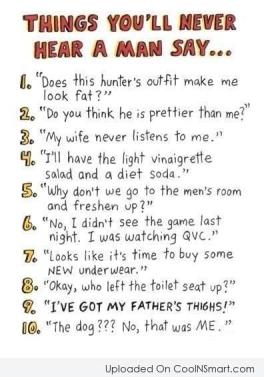

 This leads into my next point. Women use around 20,000 words as day versus the paltry 7,000 men use. Guys are like Sergeant Joe Friday in Dragnet. They keep it to just the facts. They don’t embellish or add emotion to the story. (When I taught fourth grade writing, that was the hardest thing for boys to learn—to add their feelings to their writing.) Nor do men notice the same details women do. Women notice what people wear, jewelry, outfits, shoes, and hair. My heroine might think a friend’s dress is aqua, but then qualify if as turquoise, but not the blue kind, the type that has a green hue. Guys? They’ll say it’s blue if they notice the color. But a car? Men will often know the make, model, color, how much horsepower it has, and Lord only knows what else. Me? I’m lucky if I know how many doors the car had. This can be fun, though, giving a character an unusual trait such as the heroine being a car expert or a sharpshooter as in The Andy Griffith Show when his date, Karen beats him in shooting competition. Or I might have a hero who has two or more sisters notice details other heroes wo


 Okay, I’m back. However, occasionally songs play a big part in my stories. In To Marry A Texas Cowboy, George Strait’s “Here For A Good Time” became my hero’s theme song. Despite knowing Zane’s backstory and him almost taking over a couple books in the series, when I started his story, I couldn’t grasp him. He put up a good front, even from me. But when I heard “Here For A Good Time” Zane’s personality and fears fell into place.

 And speaking of Wicked, when attending that musical, the solution to the same problem with my heroine, Maggie in Bet On A Cowboy hit me. When Elphaba sang “I’m Not That Girl” I instantly knew everything about Maggie. I even whispered, “she’s Elphaba” right there in my Broadway seat.

 To be entered in today’s random giveaway for the car coasters, air freshener, and signed copy of Family Ties leave a comment on what song has or could serve as a theme for you?


 Well, if you’ve been reading my blogs here for any length of time, you know already that this took me down a strange rabbit hole. Out of curiosity, and because I’m a romance writer, I decided to see if there were any brands with hearts. I mean, if I had a ranch, I’d want a heart in my name. I found a couple cute ones and some okay ones and one I…ew. You’ll have to form your own opinion.


 The first apple trees in North America were grown in the late 1500s from seeds brought by French Jesuits. The Pilgrims also brought young trees and seedlings from England and planted them in Massachusetts and throughout New England. Settlers traded fruit, trees, and seeds with American Indians. Apples were a staple in the diet of early pioneers, since they could be eaten fresh, fried, stewed, baked, and made into cider, vinegar, and brandy. Even mediocre apples could be cooked into preserves and apple butter, and the poorest fruit was used as livestock feed.


