
 I grew up in a hard rock mining world, knew a lot of miners, and eventually worked underground myself. One memory I have is of a time in Alaska when one of my dad’s miners said that he wouldn’t work on Friday the 13th. The guy flat out refused. What happened? My dad didn’t make him go to work that day and didn’t dock him.
When working in a dangerous environment–one in which you only have the illusion of control, because there are so many things that can go wrong–superstitions give a person that much needed sense of control. Mining and danger go hand in hand, so miners had a lot of superstitions. As a woman working underground, I undermined one of the superstitions (undermined…get it?), with no ill results, but I understand why miners had/have their beliefs. They helped the guys get through the day.
Here are a handful of superstitions:
1)Having a woman underground, or even near a mine, was bad luck. This belief is thought to have arisen from the fact that the only time women came near a mine was when a disaster had struck and their loved ones were involved. Therefore women near a mine = potential disaster. A redheaded woman was particularly unlucky.
2) If the miner’s candle went out, he needed to think about leaving the mine. Candles went out in bad air, which is not detectable, but will kill you (thus the canary in the coal mine). If a candle went out three times, it meant there was trouble at home and, again, a miner needed to get out of the mine. Side note–I once had my headlamp fail me, and I can promise you that there is nothing darker than being underground. The darkness feels thick.
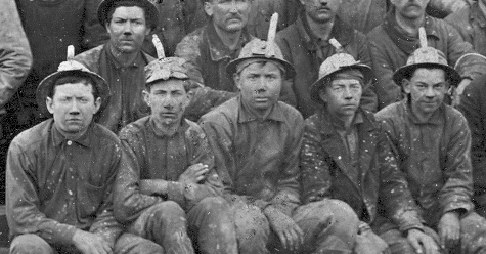
3) Do not whistle underground. Tommyknockers came to this country with the Cornish miners. These goblin-like creatures could help miners, warning them of danger by knocking, or hurt them, depending on how they were treated. Miners would leave a bit of their lunch for the tommyknockers, which in turn, caused the tommyknockers to watch out for them. However whistling at a tommyknocker was considered disrespectful and disaster would follow.
4) Whistling underground was also thought to trigger earth movements, which could cause the drift (tunnel with only one opening) to cave in. Side note–I was underground when the planets aligned in 1980. The miners were afraid that increased gravitational pull would cause earth movement. We got lucky. It didn’t.
4) Of course there were to be no black cats underground. A black cat underground meant someone would die.
5) There are a lot of personal superstitions involving clothing and not turning around backward shirts or inside out socks. Things that, again, helped a miner feel like he was in control.
Those are a few of the mining superstitions, but superstitions abound in all environments. Do you know of any interesting superstitions ? Curious minds want to know.

 This is part of my collection of desert buttons, which I have found walking the area shown in the photograph. How these buttons got to where I found them under sagebrush and along dried up streams is a mystery. They are old. Some from the 1800s and early 1900s. They were scattered over a large area (a couple of square miles) so I don’t think they were the result of clothing rotting in a single “dump”.


 Now that I’m living close to my mom, who is in her eighties, we have a lot of interesting discussions about the “good old days.” For instance, her grandfather, a Finnish immigrant, never farmed with a tractor. He used mules until he died in the 1940s. I’ve learned about pitching hay into the hay wagon while kids stamped it down, and tying the milk cow to the car bumper and pulling her to the neighbor’s field to put her in with the bull.
 hole dug in the back yard, covered with boards, where milk was kept. Talk of food preservation led to stories of preserving eggs in water glass. This fascinated me, so I looked into it.


 I have long been in awe of elaborate hairdos, particularly those from the Victorian era. As a teen, with the aid of my trusty curling iron and a lot of bobby pins, I attempted to turn my baby fine hair into some semblance of a Victorian do. It never occurred to me a that these woman were using something other than a curling iron and pins to create their hairdos. I’d never heard of hair pads to increase fullness or thought about waxes and pomades necessary to keep hair in place. Had I thought about that, I would have been grossed out at the idea of having gunk in one’s hair.
 available, hair was treated with grease, waxes, sugar water, and/or sap products to keep things under control. In the 1850s and 60s, a product called bandoline became popular for maintaining hairdos. Bandoline is a clear liquid made of diluted tree gum, alcohol (such as rum) and fragrances. It made hair sticky, which in turn, helped it stay in place.

 Even though the term “snake oil” evokes images of charlatan salesmen making outlandish claims about the benefits of their elixirs, therapeutic snake oil had actual health benefits.
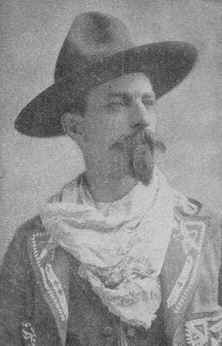 Clark Stanley, a former Texas cowboy, became The Rattlesnake King. He claimed that he studied with a Hopi medicine man in Arizona for two years and learned the secret of snake oil. He attended the 1893 World’s Fair in Chicago, where he would take a live snake, slice it open, drop it in boiling water and then skim the fat off the top to create Stanley’s Snake Oil, a topical liniment. People snapped up the product after the demonstrations.
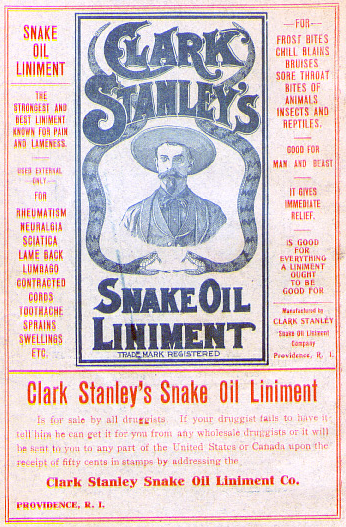 omega-3 acids, so it does not help with inflammation, so it would never have been effective against joint pain. But that wasn’t the biggest problem with Clark Stanley’s snake oil. When Pure Food and Drug Act was passed in 1906, Stanley’s Snake Oil was tested and found to have no snake oil at all. It was mainly mineral oil which has zero effect on joint inflammation, combined with chili peppers and turpentine. Clark Stanley was a fraud and the term “snake oil” has become synonymous with fake cures and medicines.