Guest Susan Page Davis: East Vs. West

Susan Page DavisBeing an Eastern girl, when I married a westerner and moved to Oregon, I noticed a lot of things were different in the West.

For instance, things are a lot farther apart in the West.

It’s true—towns, trees, everything is more spread out in the West than in the East, particularly in contrast to New England, where I grew up.

A corollary to this is: People are willing to travel farther. It seemed to me that folks in Oregon were willing to drive a hundred miles at the drop of a hat.

Another thing: When I moved to Oregon, I thought nothing there was more than 200 years old, but then I discovered that the West has ancient things, too. Older than the Viking runes in Maine.

I won’t even start on the snakes.

But the reptiles in general—well, they’re different. Once in Idaho, my kids started squealing and laughing and hopping around when they saw a little lizard. A native Idahoan expressed surprise at their antics.

Outlaw Takes a Bride“We don’t have lizards where we come from, and they’ve never seen one before,” I explained.
“Where are you from?” she asked.
I said, “Maine.”
The woman blinked. “You mean Main Street?”
I said, “No, the state of Maine.”
She said. “I don’t know where that is.”
I said. “Oh. Don’t they teach you that in school?” I mean, really. WE knew where Idaho was.

I’m sure most people west of the Mississippi know about the East. This was probably a rare specimen I was talking to. Anyway, things are different on the two sides of the country. Trust me.

Okay, I’ll say one thing about snakes. In Maine, we didn’t have poison ones. And that’s all I’m saying about that.

My newest book is a western, and I hope you enjoy it. In The Outlaw Takes a Bride, Johnny Paynter flees Denver to escape being hanged for a murder he didn’t commit. At his brother Mark’s ranch in Texas, where he thought he could take refuge, he finds his brother dead. Johnny strongly resembles his brother, and the people in town think he is Mark. Reluctantly at first, Johnny assumes Mark’s identity. But what will he do when he learns Mark has been corresponding with a widow in St. Louis? Sally Golding is en route to be a mail-order bride to Mark. Johnny must decide whether or not to go through with the wedding, posing as his brother. How will a marriage survive amid this deception?

I’m giving away a print copy of this book, The Outlaw Takes a Bride.

Click on the book cover to order from Amazon!


Susan Page DavisSusan Page Davis is the author of more than fifty published novels and novellas. Her historical novels have won numerous awards, including the Carol Award, the Will Rogers Medallion for Western Fiction, and the Inspirational Readers’ Choice Contest. She lives in western Kentucky. Visit her website at: www.susanpagedavis.com


High Tea at the Beach ~Tanya Hanson

I’m blessed not only to have a wonderful sister in law, but I also often get to party with her in OAHU where she and MarryingMinda Crop to Useher hubs moved last year!  In fact, it was her guest room I was staying in a year ago April that inspired my 2014 Western historical romance The Christmas Room.

Last week, we tea-partied at the Moana Surfrider Hotel in Waikiki.

First lady today

This gorgeous hotel is called “the First Lady of Oahu.”  Waikiki’s first hotel, then simply The Moana, opened for guests in 1901. Architect Oliver Traphagen designed a luxury hotel in the “Hawaiian Gothic” style that included amenities in its 75 rooms that were not usually seen–private baths, telephones, billiard parlor, and the first electric elevator in the islands. (In 1898, when Theodore Roosevelt annexed Hawaii as an American territory, the reality of a tourist economy was already burgeoning.)

Daily rate in 1901 was a heady $1.50!


Over the years, guests have included visitors such as the Prince of Wales (later the abdicated Edward 8), Agatha Christie, Amelia Earhart, Frank Sinatra, and Jane Stanford, co-founder of the famed university. In fact, her death inside the hotel in 1905 is a suspected homicide.

Almost immediately upon the hotel’s opening, afternoon tea became a tradition on “The Veranda”.

Banyan tree

Although King David Kalakaua (1836-1891) had actively promoted a return to many island cultural ways quashed by American missionaries early in the 19th century, most turn-of-the-century Honolulu citizens (including King David) valued Victorian fashion and practices.

Tea tray

These days, high tea on The Veranda is a special event I highly recommend. Guests are attended almost constantly by classy waitstaff and served a marvelous meal of sweets and savories. Tiny fingers sandwiches to start, scones with Devonshire cream and lemon curd, and pastries displayed on elegant 3-tired English bone china trays… Teapots are continually refreshed; I indulged in The Veranda’s signature tea, Moana Sunset, a black tea highlighted by mango and ohelo berry.

Plate

Berries and cream…and a cleansing finish of green tea sorbet.

Strawberries and cream

Sorbet with gift fan

An additional highlight, each of us received a souvenir fan!

And what could beat the tableside view?

IMG_0528 (1)

Also widely renowned is The Veranda’s Banyan tree, planted in 1904 as a toddler of 7 feet and 7 years of age.

Nowadays the tree is 75 feet high with its branches spreading 150 feet. In 1979, the banyan was placed on the Exceptional Tree List, a registry created to protect rare and historic trees.

IMG_0533

The interior of The Moana Surfrider is a gorgeous mix of traditional and tropical.

Grand staircase

IMG_0525 (1)

IMG_0542

The front porch is inviting as well, filled as it is with dozens of old-style rocking chairs.

Front porch

We took a load off with tradewinds rustling across our fans, er, faces.

Us with our fans in the rocking chairs

It was an afternoon to remember!

How about you? Who of you enjoys afternoon tea, whether elaborate like this or a simple cuppa in your home?

TheChristmasRoom_w9259_750


Blurb: (click on cover to purchase)

Running from her past in Lake Tahoe and healing from unspeakable grief, Martita Akala has built a new life on the island of Oahu…until a handsome cowboy from the mainland disrupts her well-ordered peace. 

American cowboy Rooney Lind travels the ocean to fulfill a death-bed promise to find his late cousin’s  lost love. But spending time in Martita’s “Christmas Room” makes him realize he’s found what he’s been looking for his whole life long. 


Susan Page Davis Coming Friday!

Outlaw Takes a BrideMs Susan Page Davis has put her feet in the stirrups and will arrive on Friday, May 8th!

How different is the West from the East? Bet you never thought it was still like going to another country.

Ms Susan is going to shed some light.

And…she’s toting a book to give away!

Get your behinds over here on Friday. We’ll have a party!

Fallen Lone Stars: Indianola

Kathleen Rice Adams header

Founded in 1840 as an Indian trading post, Indianola, Texas, served as a major seaport from 1844 to 1886. The city and Galveston, about one hundred fifty miles northeast, had many things in common—including a desire to outstrip the other and become Texas’s maritime leader.

Indianola in 1860 (Helmuth Holtz, Library of Congress collection)

For a long time, Indianola seemed to be winning. Companies in the city’s industrial district began canning beef as early as 1848. In 1869, Indianola became the first U.S. port to ship refrigerated beef to New England.

The city’s reputation for innovation and dogged determination paid off handsomely. Ships arrived from New York and other New England ports, ferrying passengers and goods bound for San Antonio and California. Indianola became a major debarkation point for European immigrants…and a few boatloads of camels imported for the U.S. Army’s notorious Camel Corps experiment. (The experiment was abandoned at the outbreak of the Civil War, and some of the camels were turned loose. The last feral camel sighting in Texas took place in 1941.)

“Union Troops in the Streets of Indianola, Texas.” Civil War wood engraving by Thomas Nast, published in the New York Illustrated News, April 6, 1861. From the collection of the Calhoun County Museum, Port Lavaca, Texas.
“Union Troops in the Streets of Indianola, Texas.” Civil War wood engraving by Thomas Nast, published in the New York Illustrated News, April 6, 1861. (From the collection of the Calhoun County Museum, Port Lavaca, Texas.)

Indianola did so well that it made itself a target during the Civil War. Determined to cut one of the major Confederate supply lines, Yankee vessels blockaded the port in October 1862 and demanded surrender. Being Texans, the nearby fort politely declined with a cannonade. Several scuffles later, Indianola and its port fell to the Yanks on December 23, 1863. One of the jewels of Texas remained in Federal hands for the rest of the war.

In 1867, fire and a yellow fever epidemic ravaged the town. Indianola rebuilt bigger and better, reaching a population of 5,000 by the time the first death knell rang. Although the city had been damaged by a strong storm in 1851, a major hurricane in 1875 demolished almost everything. Tough to the core, the people of Indianola used the debris to rebuild again.

Indianola ca. 1875. Image courtesy of the Texas State Library and Archives Commission.
Indianola ca. 1875. (Texas State Library and Archives Commission collection)

Then, in August and September 1886, two major hurricanes six weeks apart left Indianola and its celebrated seaport in ruins. Sand and silt blown in by the storms made the bay too shallow for big ships to navigate. Most of the residents moved inland.

The post office closed in 1887, and what remained of the town was abandoned.

The storms ended Indianola’s competition with Galveston for maritime supremacy. Galveston got its comeuppance in 1900 when the Great Storm leveled the island city, giving Houston the right break at the right time to become—and remain—the dominant economic power in Southeast Texas.

The city once known as “the Queen City of the West,” today is “the Queen of Texas Ghost Towns.” Though an unincorporated fishing village stands on the shore, Indianola lies beneath the water, 300 feet off the coast in Matagorda Bay.


We Have Winners!

Twice a Texas BrideThank you all so much for coming by to help me celebrate the release of Twice a Texas Bride! I had tons of fun.

The Winners of the five book giveaway are…….

ROSIE

CAFFEY

COLLEEN

ALISA BOISCLAIR

KIM AMUNDSEN

YAY! Congratulations, Ladies! I’ll contact each of you to find out which format you want the book in.

Twice a Texas Bride – Book Release and GIVEAWAY!

sceneryWhat price would you pay for love? Would you risk everything?

IT’S FINALLY HERE! Twice a Texas Bride is officially out.

Book two of the Bachelors of Battle Creek series features middle brother Rand Sinclair. I knew he had a powerful story to tell when I introduced him in Texas Mail Order Bride, but I didn’t know how fiercely he’d fight for the woman he loves. Or what he was willing to risk.

ONE CHANCE. ONE LOVE.

ONE OUTLAW WHO’S COMING FOR THEM.

Former saloon owner, Rand Sinclair, finally has his dream—land and a ranch. He knows two certainties—he’ll never fall in love again. Never Marry. Everyone in his life always walks out on him—from his parents to every woman he took a chance with and opened his heart to. No more pain and crushing disappointment. He’s closed his heart.

Twice a Texas BrideIn the dead of winter, he discovers a woman and six-year-old boy hiding in one of his outbuildings. They’re half-frozen and starving. He takes them into his home, feeds them and gets them warm. One look at Callie Quinn tells Rand she’s running from something or someone. He can’t send her back out in the cold. So he offers her a job cooking for him and the future ranch hands he intends to hire.

In the days and weeks that follow, he learns a killer outlaw is after her and the boy. Rand assures Callie that whoever wants to harm her will have to go through him—and that will be a mighty tough job.

While Rand fights his attraction for her and knows that he’s losing, the outlaw Nate Fleming finds them and demands the boy, saying he’ll let Callie live if they’ll hand him over. Rand pushes all his chips to the center of the table.

He risks everything…his name…his heart… his life for the woman who’s awakened a fierce hunger for love.

Locked in a desperate battle to rid themselves of the outlaw’s special brand of terror, he reaches deep inside for every weapon in his arsenal.

One of them will die. Who will it be?

I hope you’ll take this thrilling journey with me in this story of learning to trust again, of taking one more chance, of defeating the odds.

What would you do, or have done, for love? What would you risk? Would you wager everything you have?

To celebrate the release, I’m giving away five copies (your choice of print or ebook) of TWICE A TEXAS BRIDE!

Visit me at: www.LindaBroday.com (sign up for my newsletter)
On Facebook: www.facebook.com/linda.broday1
Facebook Author Page: http://www.facebook.com/lindabrodayauthor
On Twitter: http://twitter.com/lbroday

Reloading Cap & Ball Revolvers

Cap and ball weapons were all “the thing” during the Civil War and later—right up until Smith & Wesson’s patent ran out on the bored-through cylinder and Samuel Colt could get in the self-contained cartridge game. Numerous models of cap and ball revolvers were produced until 1873.

In past blogs, I’ve discussed the limitations of a cap and ball weapon because it can’t be reloaded quickly. A muzzle-loaded long gun gives you one shot. A cap and ball revolver with six shots is just that—six shots. Your hero won’t be reloading it while running from the bad guys or riding to the rescue. Keep reading and you’ll understand why.

Unlike a modern cartridge, where the bullet, powder and primer are enclosed in a brass case, reloading a cap and ball revolver takes 6 steps for each chamber. That’s six steps times six chambers to fully reload a revolver.

I took most of these pictures of my friend and fellow cowboy action shooter, Major Misalot, reloading his cap and ball revolver cylinder. The reloading can be done while the cylinder is in place on the revolver, too.

The loading is done in reverse order of the firing process, from the barrel side of the cylinder:

1. Add powder

powder


metering flask


In the above picture, Major Misalot used a reloading “station”. Another cowboy friend “Noz” used a metering flask to measure the powder for each cylinder. He put his index finger over the hole at the top, tipped the flask upside down and back upright to measure out the correct grains of powder, then poured the powder into a chamber.


2. Place a lead ball on the powder in each cylinder

place ball


3. Ram the ball home, all the way down into the chamber. Major Misalot used his modern reloader, but there is a ramming rod under the barrel of the revolver. The revolver is held muzzle up, the rod is firmly pressed into the chamber then the cylinder is rotated until all six lead balls have been rammed into place.

ramming


4. Grease the cylinder to prohibit chain firing – where the burning powder from one shot ignites the others in the cylinder = obviously not a good thing!

grease


5. Cap the nipple (think blasting cap here)

capping


capper


Another method to “cap” the chamber is to use a capper, a spring-loaded brass disc that presents the cap. Above, Major Misalot hand capped his. Noz uses a capper. On every stage of our 12-stage shoot, Noz pressed a cap into position six times then went back over all six chambers to be sure the caps seated properly. Then he loaded his second gun.

After all that, the revolver is finally ready to fire.

With practice, it doesn’t take all that long to reload a cylinder, but you really can’t pour powder, ram a ball, cap the nipple and grease the chamber at a gallop. I can certainly see why many who relied on a cap and ball revolver carried fully loaded spare cylinders.

And, just to remind you that someone shooting black powder can’t hide…

smokin


Tracy

www.TracyGarrett.com

Linda Hubalek’s Winners!

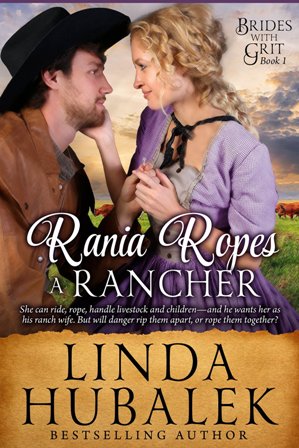
Rania Ropes a RancherIn response to the great turnout this weekend Miss Linda has decided to give 5 books instead of 2!!

I put all the names in my Stetson and the winners are …..

NANEE

ANNETTE NAISH

MELANIE BACHUS

RACHEL B

SALLY SCHMIDT

Woo-Hoo!! Congratulations, ladies! Miss Linda will contact you with instructions on how to claim your prize.


Linda Hubalek Introduces Brides With Grit

2015 header1

Linda_HubalekHello from the Kansas prairie! I’m honored to be a guest blogger on Petticoats and Pistols today, because this site features a group of authors I’ve admired for a long time.


Today I’m blogging about my new historical romance series, Brides with Grit. Set in the Ellsworth, Kansas area during 1873, the town’s top cattle drive year, these sweet western romances combine sweet clean love stories with cowtown history.


I also live close, so it was handy for me to explore the area, and envision the vast herds of cattle that dotted the hills almost a century and a half ago.
Ellsworth-1873One can find a vast amount of information on the internet about the cattle drives which went through Kansas in the 1870’s. Here’s some interesting tidbits, written by F. B Streeter in 1935, for an article in the Kansas Historical Quarterly.
As a means of advertising the new trail and the shipping points on the line, the Kansas Pacific issued a pamphlet and map entitled, Guide Map of the Great Texas Cattle Trail from Red River Crossing to the Old Reliable Kansas Pacific Railway. The writer has located only two editions of this pamphlet: one issued in 1872, the other in 1875. To quote from the 1875 edition:


Drovers are recommended to make Ellis, Russell, Wilson’s, Ellsworth and Brookville the principal points for their cattle for the following reasons: Freedom from petty annoyances of settlers, arising from the cattle trespassing upon cultivated fields, because there is wider range, an abundance of grass and water, increased shipping facilities and extensive yard accommodations. Large and commodious hotels may be found in all these places, and at Ellsworth, especially, the old “Drovers’ cottage,” so popular with the trade for years, will be found renovated and enlarged.

Drovers Cottage-1872


Ellsworth became the principal shipping point for Texas cattle on the Kansas Pacific Railroad in 1872. The first three droves of longhorns that season arrived in Ellsworth early in June. These droves numbered 1,000 head each. Two weeks later a total of twenty-eight herds, numbering from 1,000 to 6,000 head each, had arrived and many more were on the way. The fresh arrivals contained a total of 58,850 head of longhorns. These, together with over 40,000 head which had wintered in the county, made a total of more than 100,000 head of Texas cattle in Ellsworth county. 


That season 40,161 head were transported from Ellsworth, or one fourth of the total number marketed over the Kansas Pacific…Besides those shipped by rail from Ellsworth, about 50,000 head were driven to California and the territories from that place. In the months of June and July more than 100,000 head of beef and stock cattle changed hands at Ellsworth. Drovers found buyers on their arrival, enabling them to close out at a good price and return to their homes.


The prices paid for cattle that season were as follows: $19 to $22 for beeves; $15 to $18 for three-year-olds; $9 to $10 for two-year olds; $12 for cows; and $6 for yearlings.
My first thought on reading this? Wow! That’s a lot of cattle to surround the little town.
My second? Dust, manure and flies…and a good setting for a western romance…
cattle drive

The first three books in the eight book series are available now on Amazon, and more titles will be released during the year. Here’s the titles and taglines for the first five books.

brides wit grit-wood frame

Rania Ropes a Rancher – Book 1

She can ride, rope, handle livestock and children—and he wants her as his ranch wife. But will danger rip them apart, or rope them together?

Millie Marries a Marshal – Book 2

This mail-order bride arrives to find out her groom has died! So, she moves into the town marshal’s house—and into his heart.

Hilda Hogties a Horseman – Book 3

She bought his homestead out from under him with her horse race winnings…and now he wants it back.

Cora Captures a Cowboy – Book 4

She has just days to convince the cowboy into marrying her, or its back to Boston as another man’s bride.”

Sarah Snares a Soldier – Book 5

She leaves her groom at the altar, because there’s a soldier who has snared her heart. But can she catch him as he marches away?

* * *

Sound interesting? I’ve had fun writing these stories, so I hope you’ll enjoy reading them too—without having to worry about the dust, manure and flies…
What’s your first thought when you hear the words “cattle drive?”

Please leave a comment for a chance to win one of two Kindle copies of Rania Ropes a Rancher.
Many thanks from the Kansas prairie…
where I’m writing love stories for you to enjoy

Linda Hubalek

Website | Amazon Author Page | Twitter | Facebook | Pinterest


Linda_HubalekLinda K. Hubalek lives in Kansas and writes endearing historical fiction and romance stories about the strong pioneer women who homesteaded on the Kansas prairie during the 1800’s.

How Wild Was the Old West—Really?

MargaretBrownley-header
I heard a TV commentator liken the violence of Baltimore back to the Old West. Is that a fair comparison? Some historians would probably disagree. Some have even gone as far as to describe the Old West as “a quiet, peaceful and law-abiding place.” Hard as that is to believe they may be on to something for the following reasons:

The Old West Practiced Gun Control

dodge-gunsYep, that’s right. In fact, the very first law passed in Dodge City was a gun control law. Many towns including Tombstone had similar strict laws barring guns. Visitors were required to turn guns over to the stable owner or sheriff. Checks or receipts were issued much like they are today when checking coats at a restaurant. Gun owners could reclaim their weapons upon leaving town.

Not everyone followed the law, of course. Drunkenness and disorderly conduct would get you a free pass to the hoosegow, but so would toting a gun. The gunfight of OK corral was actually sparked by an effort to enforce the “no gun” law.

Gun control made economical sense. Towns wishing to attract businesses and commerce or even the railroad couldn’t afford to let crime run amok.

The Law of Wagon Trainswagon
Some wagon trains reportedly contained more than a hundred wagons and as many as 800 people, so keeping law and order was of primary concern. Many of these trains had their own constitutions which spelled out a judicial system. Ostracism and threats of banishment kept most travelers in line and there are few reported instances of violence on these trains. That’s pretty amazing considering the conditions and long months on the trail.

What About All That Cattle Rustling?

cowsIf we believed all those old time Western movies there wasn’t a steer in the land that hadn’t been rustled at least once. No question; Cattle rustling was a problem. That is until ranch owners got together and formed cattlemen associations. These groups hired private protection agencies, which pretty much put cattle rustlers out of business.

Bank Robbers Ruled, Right?

Wrong again. According to the book Banking in the American West from the Gold Rush to Deregulation by bankLynne Pierson and Larry Schweikart, only eight actual bank heists occurred in the 15 states that made up the frontier west during the forty year period between 1859-1900. (Holy Toledo! My little hometown has had more bank robberies than that just in the last decade.)

Why so few bank robberies in the Old West? The answer is simple; Banks were hard to rob. Banks were located downtown often next the sheriff’s office. People slept above shops so the town was far from deserted. The bank’s walls were often doubly-reinforced. Blasting through the walls would wake everyone in town including the sheriff.

Some, like Butch Cassidy simply walked in the front door, but even that type of bank holdup was rare. Robbing stagecoaches was easier. But transporting money by stage fell out of favor when trains came along. Robbers who shifted attention to trains soon had to contend with Pinkerton detectives.

What About All Those Gunslingers?

gunDime novels, old newspapers and movies would have us believe that shooting from the hip and quick draw duels were the norm. In reality, gunfights were few and far between.

Some well-known shootists (the word gunslinger didn’t come into play until the 1920s) deserved their reputations but, by today’s standards, most would be considered lousy shots. Some, like Wyatt Earp, killed nowhere near as many men as they were given credit for. A gunslinger’s reputation, however exaggerated, was sometimes more valuable than his skills.

Peter Hill, co-author of  the Not so Wild, Wild, West wrote “If one wants to see the “Wild, Wild West” in action one should turn to congressional hearings, political demonstrations and arguments over recreational and consumptive vs. non-consumptive uses of forest lands.”  Now there’s a thought…It kind of makes you wonder what those old cowpokes would have thought about the recent riots.

So what do you think? Was the Old West a quiet, peaceful and law-abiding place or wasn’t it?

Speaking of Wild:

Maggie Michaels is sent to Arizona Territory as an undercover mail order bride to track down the notorious Whistle-Stop Bandit. If she doesn’t prove the suspect guilty before the wedding—she could end up as his wife!

undercoversmallClick cover to Preorder

Available in print, eBook or Audio