Let’s Go to the Movies with Wyatt Earp

Few things have made such a huge impact on our lives than the movie industry. I don’t know about you but I love sitting in a dark theater and watching magic unfold on the screen. I’m drawn into the story and love watching how the actors chose to portray each scene. Some are excellent and I lose myself to the magic to the point where I’m up there in the story with them. It’s a beautiful thing and deeply personal.

Roundhay Garden Scene was the first recorded short silent film in 1888 by a Frenchman named Louis Le Prince. It’s definitely the oldest surviving one. Amazing!

Thomas Edison started capturing motion on film around that same time. Everything was very short, approx. a minute or two.

The first film with a sustained plot was a 12 minute one titled The Great Train Robbery. Suddenly America had a new form of entertainment. They called those early films flickers and I’ll bet you can guess why.

They were all silent as no one had figured out yet how to record sound. The theaters hired men and women to play the piano while the movie showed. Slow songs, fast songs, medium songs designed for the biggest impact.

They built huge movie palaces with ornate lobbies, crystal chandeliers, and luxurious carpet. Instead of hiring one pianist, they had orchestras and they hooked the American public.

I recently watched an eight part documentary that Robert Redford made called The American West and it was so interesting. I found it on Amazon Prime. Redford started at the end of the Civil War and showed each step in the progression of the settlement of the west. President Grant actually opened up the west and offered cheap land as a last ditch effort to keep another Civil War from starting and hold the country together.

I didn’t know that.

At the end of the documentary, was a clip of Wyatt Earp on a film set in Hollywood. He was 80 years old and a young John Wayne (21) was working as a prop boy. John Wayne was enamored by the man he idolized and hanging out with Earp forever changed John Wayne. He imitated Earp’s manner of walking and talking and he adopted the Code of the West that Earp lived by.

Wyatt Earp must’ve been drawn to movie making. I’d love to have known what he thought. He was often found on movie sets and that’s where John Ford, the director met him. Ford got Earp to draw on paper exactly how the gunfight at the OK corral happened and he used the sketch to film the gunfight scene in My Darling Clementine.

Wyatt died in 1929 in Los Angeles and cowboy actors Tom Mix and William S. Hart were pallbearers.

Can you imagine a world without cinema? I can’t. I’m sure glad they invented sound though.

Tell me—do you like to go to the movies? If so, what is it that draws you? Maybe it’s the popcorn. Or what is one of your favorite movies?  I’m giving away a copy of either To Catch a Texas Star or Gunsmoke and Lace to two people who comment. In addition to title, winner chooses either print or ebook. I’ll draw the winners on Sunday.


LOST SISTER, MY FAVE SHORT STORY–by Cheryl Pierson

I know we’ve mentioned Dorothy M. Johnson before, the iconic western short story writer who penned such classics as The Man Who Shot Liberty Valance, The Hanging Tree, and A Man Called Horse; but today, I wanted to tell you about another short story of hers that I read and absolutely loved. It’s quite possibly the best short story–in any genre—that I’ve ever read.

You may never have heard of it. It wasn’t made into a movie, because it too closely mirrored the true life of a real person, Cynthia Ann Parker, mother of Quanah Parker.  The story is called Lost Sister.

I’d heard this story mentioned before by a couple of friends, and thought, “I need to read that—I’ve never read much of Mrs. Johnson’s work but the movies have all been good.” I know. I hate it when people say that, too.  Anyhow, I bought a collection from Amazon that contained the three stories I mentioned in the first paragraph and Lost Sister as the fourth. Of course, I had to read The Man Who Shot Liberty Valance, since that’s tied for my all-time favorite western movie, along with Shane. I was so disappointed. The characters in the short story were not the same as my beloved Jimmy Stewart and John Wayne! Hmmm. Well, even though I was disappointed, I decided to give Lost Sister a shot.

It more than made up for my lukewarm feelings for The Man Who Shot Liberty Valance.

Lost Sister is the story of a woman who has been kidnapped as a young child by “the hostiles”. She has an older sister, who remembers her well from childhood, and loves her with the devotion that most older sisters have for a younger sister. Through the forty years she has been gone, the oldest sister, Mary, has cherished memories of her younger sibling.

There are three younger sisters, as well, who have no recollection of the Lost Sister, Bessie. The older sister doesn’t live with them, but in a different town thousand miles away. The three sisters are notified that their sister, Bessie, has been “rescued” and is being brought back to them. The story is told from the eyes of a nine-year-old boy, whose mother lives with the sisters. She is the widow of their brother, who was killed by the Indians. The boy has dreams of growing up and avenging his father’s death, but something changes once his Aunt Bessie comes back to live with them.

Up until Bessie is returned to them, they have gotten much attention from the neighbors, and have been pitied as being the family who had a sister stolen by the savages so many years ago. Once Bessie is returned, their standing in the community takes a subtle twist. The other sisters don’t know how to handle Bessie’s homecoming. They make plans to go into her room and “visit” with her every day. One of them decides to read to Bessie from the Bible for thirty minutes each day. The others come up with similar plans, none of which include trying to understand Bessie’s feelings at being ripped away from her Indian family.

The oldest sister, Mary, comes to visit. What’s different? Mary loves Bessie, and accepts her; and Bessie loves her—they both remember their childhood time together. The language of love overcomes the barriers of the spoken language that neither of them can understand, for Bessie has forgotten English, and Mary doesn’t know Bessie’s Indian dialect.  But Bessie has a picture of her son, and Mary admires it, and by the time Mary is to go home, she has made arrangements for Bessie to come live with her—a huge relief to the other pious sisters who had made such sympathetic noises about her being reunited with them in the beginning.

In a fateful twist, Bessie makes her own decision about what she will do, taking her own life back, and helping her son avoid capture. This is one story you will not forget. Once you read it, it will stay with you and you’ll find yourself thinking about it again and again. It doesn’t fit the mold of a romance story, except for the fact that I think of Bessie being in love with her husband, having children with him, and then being “rescued” and forced to live in a society she had no ties with any longer…except one—the love and understanding of her older sister, Mary.

No specific Indian tribe is mentioned in the story, probably for a purpose. I think, one of the main reasons is to show us the cultural differences and how, in this case, the “civilized” world that Bessie had come from and been returned to was not as civilized as the “savages” who had kidnapped her.

Cynthia Ann Parker, Quanah Parker’s mother


Also, as I say, Cynthia Ann Parker’s story, at the time this story was published, was not that old. There were still raw feelings and rough relations between whites and Indians. But by leaving the particular tribe out of the story, it provides a broader base for humanity to examine the motives for “rescue” and the outcome for all concerned, of a situation such as this in which it would have been better to have let Bessie (Cynthia Ann) remain “lost.”

I’ve posted the link below for the story as it was printed in Collier’s Weekly on March 30, 1956. It’s also available on Amazon in several collections.

http://www.unz.org/Pub/Colliers-1956mar30-00066

Heather Blanton Has Winners!

Thank you for visiting, Miss Heather!

We loved talking horses and legends with you!

Okay, now for the drawing…..drumroll…………

Winners of her Romance in the Rockies box set are…………

JOYE

LAINIE

DENISE

And…Winner of the $25 Amazon gift card is…..COLLEEN

Woo-Hoo! There’s gonna be a lot of happy people. Ladies, Miss Heather will contact you so keep your eyes peeled.

Heather Blanton – The Ghosts of Horses Past Live On

Hello everyone. Please welcome Heather Blanton to the Junction. Heather is sponsoring a very generous 4 item giveaway today – three individuals will receive her e-book box set of the Romance in the Rockies trilogy and one will receive a $25 Amazon gift card. So join  in the discussion by leaving a comment to get your name tossed in the hat for your chance at one of these prizes. 
Now, let’s hear from Heather:


Legends, myths, ghost stories. Experts say they are all rooted in at least some fact. Recently, I had the honor to see some Spanish ponies—genetically-proven descendants of horses left in the West by Spanish explorer Coronado in 1519. Five hundred years ago.

Oh, what I wouldn’t have given to hear the stories the braves and the medicine men and chiefs told about seeing those amazing, beautiful animals for the first time.

The initial sightings did, indeed, spawn some amazing tales. I heard a few of them when I was in South Dakota this summer, and my favorite is the Legend of Swift Blue One.

One day a brave was out hunting, and he saw a horse draped in flowing, blue raiment with a man covered in shiny metal on its back. Afraid, but determined to show courage, the warrior shot an arrow at this amazing animal. It struck a crack in the man’s metal and he fell to the ground. The brave rushed up and was going to shoot again, but, the stallion, a mystical blue-gray color, pawed angrily at the ground, screamed, and bared his teeth when the brave approached.

The brave wanted very badly to possess this animal, but each time he came near, the blue horse chased him away. Through signs, the man on the ground said if the warrior would save his life, he would teach him to talk to the horse called Swift Blue One.

The warrior agreed, and he and the man rode the horse back to his tribe, amazing everyone in camp at this spectacle. But the horse was fierce, kicking and attempting to bite anyone who came too close. The man taught the young brave how to talk to blue horse, but soon died from his wound. The only other one who could ride the magnificent animal, the brave still did not remove the covers that draped around Swift Blue Horse. He believed they kept the stallion from harming anyone in camp.

The blue horse was the fastest creature the tribe had ever seen. They said he had lightning in his hoofs. When the brave died in battle, though, the elders turned the horse out for no one else could talk to him. For a long time they would see him racing about, kicking up his hoofs, calling for others to join him.

Soon, Swift Blue One had gathered many horses to himself and was chief of them all. His herd grew large and his offspring were many. His descendants still roam the great plains of the West today. Some say if you look hard enough, you will see the ghost of Swift Blue One running among his children, his blue raiment flickering in the sun.

I love that story. During a visit to the Black Hills Wild Horse Preserve I saw the Spanish ponies——and the Swift Blue Ones were there, too.


Click on cover to learn more

There is an old poem in my forthcoming release, Daughter of Defiance, that a reader gave me about a horse with four white socks. Supposedly, not a good thing.

I am giving away a $25 Amazon gift card and digital copies of my Defiance books—all of which were just optioned by a movie producer! To WIN, just comment with any story, old wives’ tale, or legend you know about a horse. I’d LOVE to hear them!

And if you’d like to learn more about wild horses and their stories, I hope you’ll check out the Black Hills Wild Horse Preserve.


Charlene Raddon’s Winners!


Big congratulations to . . .

Connie Saunders

and

Deanne Patterson

Connie won a copy of Charlene’s upcoming novel, Priscilla, and Deanne won her choice of one book from Charlene’s back list.

Woohoo!

You ladies are going to be spending some quality book time in the old west.

Warning! A Tomato Can Kill You!

Ha!  Did I get your attention?

This time of year when tomatoes abound in our gardens, and many of us are canning, freezing and eating the vegetable (or is it a fruit?) in any way, shape or form we can think of, it seems impossible to believe that at one time, tomatoes were very much feared.

It’s true.  

Tomatoes have been traced clear back to 700 AD, which is amazing in itself.  By the 16th century, European adventurers here in the Americas discovered them and brought them home.  At that time, the rich were served their food on pewter dishware.  Unbeknownst to them, when high-acid foods like tomatoes were served on the pewter, the lead leeched out into the food, which resulted in lead poisoning and death.  

The poor, however, used wooden plates and thus did not have the lead poisoning problem.  Notably, many Italians were poor and thrived on the tomatoes.  Wasn’t long before they developed some pretty darn delicious dishes with those tomatoes, and we all know what those are–pizza and spaghetti sauce are only the beginning.

Every year I plant tomatoes.  Usually one plant, sometimes two.  This year is my first for Romas, and my lone plant is a workhorse!  It’s so prolific, I can hardly keep up with its bounty.  Can you see how it’s spilling out of its cage? It can’t be contained.  Enough already!  I’ve preserved three batches of spaghetti sauce, two of salsa, one of plain tomatoes, and that doesn’t include all the tomatoes I’ve used in dinner dishes or eaten plain by the bowlful.  

Ah, well.  Won’t be long, I’ll pull the darn thing up.  Nights are getting shorter and cooler, which means the tomatoes are slowing down.  In the midst of winter, I’ll certainly miss walking out to the garden for a fresh tomato right off the vine.

If you’re drowning in tomatoes, too, I’d love to share my spaghetti sauce recipe with you.  It’s wonderful and easy.  The best part of all, you cook it in the Crockpot, let it cool, then freeze.  (Of course, if you prefer to can in a hot water bath, go for it.  That works just as well.)


Slow Cooker Spaghetti Sauce

4 onions, chopped

4 cloves garlic, minced

1 green bell pepper, chopped

1/2 cup vegetable oil

16 cups peeled and chopped tomatoes

2 Tb dried oregano

2 Tb dried basil

1/4 cup chopped parsley

1/4 cup white sugar

2 Tb salt

3/4 tsp black pepper

6 oz can tomato paste

Directions:

  1. In a 6 quart slow cooker on high, saute onion, garlic, green pepper and vegetable oil until onion is transparent.
  2. Add chopped tomatoes, oregano, basil, parsley, sugar, salt and pepper.  
  3. Cook for 2 to 3 hours on low heat.  Stir frequently.
  4. Let sauce cool.  Pour sauce into quart size freezer containers.  Store in freezer.
  5. When ready to use sauce, stir in can of tomato paste.

Notes: I start sauteing first while I’m peeling the tomatoes.   Also, I use an immersion blender to smooth the sauce a bit.  

Do you plant tomatoes, too?  What’s your favorite way to cook with them?  If you have a recipe to share, please do!

We Have a Winner for Karen Kay’s E-book Give-Away

Howdy!

Yes, we do have a winner, but before I announce who that is, please let me take a moment to thank each and every one of you who came to the blog today and who left a message.  I loved hearing your thoughts and learning about your own experiences and memories.

As an aside, all names are written down and then drawn, so that the chance of winning is purely luck.

The winner this month is:

Patricia B.

Congratulations Patricia.  Please email me privately so we can discuss which book you would like and how to get the book to you:  karenkay(dot)author(at)earthlink(dot)net.

My thanks to every one of you who came to the blog today.

Heather Blanton Visits Friday!

Miss Heather Blanton is coming around the bend and will arrive Friday, Sept. 7, 2019!

Often horses have this mystical quality about them and legends are born, especially among the Native Americans. Heather will talk about some of those.

She’s offering a bundle of giveaways, drawing from the commenters’ names.

Please head over Friday and help us welcome her.

This will be a fun party talking about horses and legends and whatall.

And you might come away a winner.


Welcome Guest – Charlene Raddon!!!


Placer Mining

Gold is found in tough clay. To dissolve the clay the miner fills a pan made of sheet-iron or tinned iron, with a flat bottom about a foot in diameter, and sides six inches high, inclining outwards at an angle of thirty or forty degrees. At a river bank, he squats down, puts his pan under water, and shakes it horizontally. Once the mass is thoroughly soaked, he picks out the larger stones, mashes up the largest and toughest lumps of clay, and again shakes his pan. When all the dirt appears to be dissolved, allowing the heavier gold to move to the bottom, he tilts up the pan a little to let the thin mud and light sand run out, until he has washed out all except the metal, which remains in the pan.

The arrastra, a Mexican contrivance, rude, but effective, was used in the early days to pulverize the ore. Winnowing, or “drywashing” was also practiced by the Mexicans where the ore was found too far away from a sufficient supply of water to make any other practice possible. The wind bears away the dust and light particles of earth, and leaves the gold dust, which is heavier.
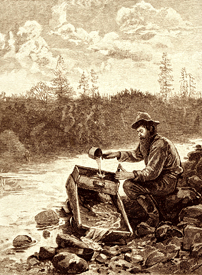
The rocker resembles a child’s cradle. On the upper end is a riddle, made with a bottom of sheet-iron punched with holes. This is filled with pay dirt and rocked with one hand, while, with a dipper, the miner pours water into the riddle with the other. Being agitated, the liquid dissolves the clay and carries it down with the gold into the floor of the rocker, where the metal is caught by traverse riffles, or cleats. The mud, water, and sand run off at the lower end of the rocker, which is left open. The riddle can be removed, allowing the miner to throw out the larger stones mixed with the clay.

The chief want of the placer miner was an abundant, convenient supply of water not always readily available. One resolution was an artificial channel about two miles long. After eight years, six thousand miles of mining canals supplied water to all the principal placer districts of Nevada and furnished the means for obtaining the greater portion of the gold yield.

Where the surface of the ground furnished the proper grade, a ditch was dug. Where it did not, flumes were built of wood, sustained in the air by framework that rose sometimes to a height of three hundred feet in crossing deep ravines, and extending for miles at an elevation of 100-200 feet. Aqueducts of wood, and pipes of iron, were suspended upon cables of wire, or sustained on bridges of wood; and inverted siphons carried water up the sides of one hill by the heavier pressure from the higher side of another.

In Nevada, a total length of 6,000 miles of canals and flumes were created. The largest mine, the Eureka, had 205 miles of ditches, constructed at a cost of $900,000. As placers were gradually exhausted, the demand for water and the profits of ditch companies decreased. Flumes, blown down by severe storms, carried away by floods, or destroyed by the decay of the wood, were not repaired.

The sluice was a broad trough from 100-1000 feet long, with transverse cleats at the lower end to catch the gold. With a descent of one foot in twenty, the water rushes through it like a torrent, bearing down large stones, and tearing the lumps of clay to pieces. The miners had little to do save throw in the dirt and take out the gold.

In Hydraulic mining a stream of water is directed under heavy pressure against a bank or hillside, tearing the earth down and carrying it into the sluice to be washed. The force of a stream of water rushing through a two-inch pipe, under a pressure of two hundred feet perpendicular caused hills to crumble as if piles of cloud blown away by a breath of wind. When dried by months of constant heat and drought, the clay becomes so hard, not even the hydraulic stream, with all its

momentum, could steadily dissolve it. Often the miner would cut a tunnel into the heart of his claim, and blast the clay loose with powder, so that it yielded more readily to the action of water.

The erection of a long sluice, the cutting of drains (often necessary to carry off the tailings), and the purchase of water from the ditch company, required capital; and the manner of clearing up rendered it impossible for workers to steal much of the gold. Thus, the custom of hiring miners for wages became common in placer diggings.

Even today, men continue to search for gold and some manage to find enough to keep them going. Others give up and return home. I found gold once, at Knotts Berry Farm in California. I was eight years old. I wish I still had that miniscule vial of gold flakes, but it was lost long ago.

************************************************************

Priscilla is Book 1 in The Widows of Wildcat Ridge Series. It is on preorder now and will be released on 9/15. There will be 17 books (or more) released the first and fifteenth of each month. Book 2, Blessing, by Caroline Clemmons is also up for preorder. There are ten authors: Charlene Raddon, Caroline Clemmons, Zina Abbot, Tracy Garrett, Christine Sterling, Linda Carroll-Bradd, Pam Crooks, Kit Morgan, Margaret Tanner, and Kristy McCaffrey. The series is about a Utah gold mining town in which the mine has been destroyed, killing off most of the men and leaving the women and children destitute and at the mercy of a greedy mine owner who also owns the town. To save their town they must remarry. Forty-six strong, determined women set out to save their town and find love at the same time.

After losing her father and husband in a mine disaster, Priscilla Heartsel faces poverty and eviction from her home by a heartless mine owner. Tricked into a bank robbery gone wrong, Braxton Gamble finds himself shot and unconscious in Priscilla’s bed. Can they survive long enough to find a love more precious than gold?

************************************************************

Charlene will be giving away two e-books.
One will a be copy of her brand new release – Priscilla (delivered 9/15).
Another will be the winner’s choice of any of her backlist titles.
You can find all of her books listed on her website
here.
Leave a comment for a chance to win!

And Then He Kissed Me — A Look Back at an Astounding Era — E-book Giveaway

Howdy!

I grew up in the 50’s — Okay, I’m giving away my age, but then, probably most of you know I’m a Grandmother — that gives away my age, as well.

Oh, how I loved that Motown sound of the 50’s and 60’s.  Do you remember it?   The Crystals, The Ronettes, Little Anthony?

If you’re too young to remember, come experience the magic of the 50’s music (for us young’ins).  I’m going to leave some links:

The Ronettes, Be My Baby — One of my favorites:  http://www.youtube.com/watch?v=jrVbawRPO7I

How many of you remember the dance names that they are doing in this link?  Can you believe that I do remember?  The main one, I believe, is the Bird, and in the middle they switch briefly to the Jerk.  Oh, how I loved those dances.  Did you?

And for all us romance lovers:  The Crystals, And Then He Kissed Me — http://www.youtube.com/watch?v=NUaUIwuU8so

I still know all the words to this song.  Do you?

Me and hubby and a smooch — off to the right here.

Not to be outdone:  Anthony and the Imperials, Hurts So Bad — http://www.youtube.com/watch?v=MSF2oLgyV5M

Oh, how I love this song.

Do you remember The Duke of Earl — another song I sing to my Grandchildren:  Gene Chandler and The Duke of Earl:  http://www.youtube.com/watch?v=QQnfooEED8Y

Okay, and how many of you remember the dance those girls are doing in the background?  Would that be the Twine?  I think it is.  Did you do this dance?

And how about Rockabilly — that’s rock and country all in one.  Do you remember the Everly Brothers?  Oh, my gosh, how I loved all their songs:

Here’s one of my favorites — beautiful, romantic, magical — Let It Be Me — http://www.youtube.com/watch?v=e2ImS9RBszE — oh, my goodness, I melt when I listen to this

And how about one of their humorous songs:  Bird Dog — just recently I was singing this song to my grandchildren, who laughed and laughed and laughed and couldn’t believe it was an actual song.  So of course I had to find it online and play it for them:  Love this:  http://www.youtube.com/watch?v=US49tQbYsg0 — When men’s hairstyles defied gravity…

Of course, we can’t leave out The Beatles:  Here’s one of my favorites:  The Things We Said Today — http://www.youtube.com/watch?v=6_-NHOPt3Mc

You might argue, that the Beatles are the 60’s — but oh, well, I can’t leave them out — they are probably the most inspirational band of all time.

Here are some of my other favorite Beatles songs:  Love in the Open Air, by James Paul McCartney — A very under rated song that I believe might be the most beautiful song written in the last Century.  http://www.youtube.com/watch?v=ir-Pl4szYOs

And of course, the most beautiful song, in my opinion, from the Album, Revolver:  Here, There, and Everywhere:  http://www.youtube.com/watch?v=xdcSFVXd3MU&index=5&list=OLAK5uy_n9q-ezB2RZF1WS7PR3h3drrTgNCf-DRSk — This, in my opinion, is a runner up for first place in what might be the most beautiful song of the last Century.

What, you might ask, does this have to do with Native American Romance?  Well, perhaps a great deal, in several different ways.  One is always searching for inspiring music to write by — I think we, as authors, often write to music.  And for a lively scene, nothing beats the 50’s and 60’s music in my opinion.  But there is also this little bit of fact:  Did you know that the Native American Men who toured Europe  mirrored the Romantic Inspiration and female response as that of many rock stars?

And why not?  Many of those men were extraordinarily handsome.  All these photos here are of a couple of the men who were with Buffalo Bill’s Wild West Show. 

Well, that’s all for today.  Come on in and leave a comment and let me know what you think.

As always, many of us writers are a bit busy and so we depend on your coming to the blog on Wednesday or Thursday to check to see if you are the winner of the Give-away.

And most of all, thank you for coming to the blog today.  And then he kissed me.