The Victorian Parlor: aka The Chamber of Horrors

MargaretBrownley-header

This past week I wrote a scene in which my cowboy hero was forced to sit in a formal parlor. It was during the 19th century age of clutter which meant the front room was filled to capacity with ornate furniture, needlepoint cushions, framed photographs, musical instruments, and enough froufrou to create a dusting nightmare. The poor man in my story couldn’t move without knocking over a beaded fringed lamp or a delicate music box. Worse, he had to trust his six foot parlor6two bulk to a spindly chair since no “sincere” furniture existed.

Parlors Were Never Designed for Comfort

A proper parlor had one purpose and one purpose alone; to showcase a woman’s gentility to all who entered.

In his book Domesticated Americans Russell Lynes describes the parlor as a chamber of horrors for children. “It (the parlor) set husband against wife, daughter against father and swain against maiden.” It also took a lump out of the family budget.

A Hostess Must Avoid Any Allusion to the Age, Personal Defects or Ill-manners of Guests

No one really knew how to act in a parlor and this unleashed a steady stream of articles and books on the subject. Not only were people counseled on how to enter a parlor without “Jiggling their bodies” but how to leave it.  Phrases, such as”What-d-ye call it,” “Thingummy,” “What’s his name,” or any such substitutes for a proper name or place were to be avoided at all costs.

Go Already!

The Ladies Indispensable Assistant explained the rules of exiting in great detail. “Don’t stand hammering and fumbling, and saying ‘Well I guess I must be going.’ When you are ready go at once.”

parlor2Parlor rules existed for every possible situation, even courting. Never was a man to sit with his “arms akimbo” or strike an awkward pose. Nor was he to enter a parlor without the lady’s invitation.

God Made Weather to Give Us Something to Talk About

Visitors were cautioned against talking about religion, politics, disease, dress or, heaven forbid, one’s self. Cookbook and etiquette writer Miss Leslie wrote that inquiring about a hostess’s children was to be done “with discretion.” Saying that a son “was the very image of his father,” could be offensive if the father was not a handsome man. Even then the visitor could be treading on ice if “the mother was vain and wished the children to look like her.”

Sparlor1everal things happened to make the parlor with its endless rules fall out of favor. Women were admitted to college and soon after entered the work force. No longer was a woman judged by her parlor but rather by her contributions to society.

The westward movement should also receive credit for putting sanity into the home. Though some pioneer women tried to carry the tradition westward, many soon learned the folly of such ways—much to their husbands’ gratitude.


Not all parlors died a quiet death. Some lingered into the twentieth century. As a child, I remember our next door neighbor’s parlor—and yes, that’s what she called it. Everything in it including the lampshades was covered in plastic which made a crinkling sound if you wiggled. Did any of you spend time in such a room?

Working Undercover is no Job for a Lady!

Click cover to pre-order book 1 in Margaret’s exciting new series

Petticoat Detective coversmall


Maps – A Researcher’s Hidden Treasure

newsletter_headerjpg - 2

When I start researching a new project, or even when I’m in the middle of one and just need some quick directions, there is nothing quite so practical as a good, historic map. They are hard to find, but when I stumble across a site that has maps in a format that I can enlarge and use, I get a little giddy. One of my favorites is on the Library of Congress’s site called American Memory. The maps that I have found the most pertinent to my personal research are the Railroad Maps. Most of my books are set in the 1880s, the decade that saw the most growth in the Texas railroad system. It was critical for me to know which towns the railroad had reached by which years. This site, combined with the Handbook of Texas Online, answered those questions.

For example, here is a map of the railroads in Texas in 1883:

1883 Texas Railroad Map

Now, the beauty of using these maps online, is that I can enlarge them to the point that I can read all the little town names alone each of those tracks.

I used the map below to plot my setting for Stealing the Preacher. The Archer brothers lived on a ranch outside Palestine, and I needed my hero to travel to a town to interview for a preaching position. I opted for Brenham since it was a fast-growing town in the 1880’s. But Crockett never makes it there because he is abducted from his train just outside of Caldwell. The outlaws take him overland past the small town of Deanville and back to their ranch where he eventually meets the heroine, Joanna. I’ve circled the key cities in red.

Close up railroad map

Beyond railroad maps, historic city maps are priceless. Sometimes I use fictitious towns which gives me the freedom to put things wherever I want, but many times I set my stories in real places. In order to describe these places accurately and to give the reader a true feeling of steeping back in time, I need accurate maps.

This is a piece of the Sanborn Map for Ft. Worth back in 1885. These maps were collected for fire insurance purposes, and they are a wonderful resource. Not only do they show street names, but when you enlarge them, you can also see the name of local businesses that were in existence during that time frame. I gained access to the Texas maps through my local university library. I used this piece of the Fort Worth map when plotting the opening of Head in the Clouds.

Ft. Worth 1885

Adelaide Proctor traveled to Ft. Worth, chasing the traveling book salesman she thought was going to marry her. I needed to give her a place to stay while she was there, and this section of the map shows a section of town right next to the railroad depot. The blue arrow points to Clark House which was a fashionable hotel in the area. Adelaide ended up staying here, but she brought her beloved horse, Sheba, with her on the journey and needed a place to stable her. Thanks to this map, I found a handy livery stable just up the street and was able to have my hotel drummer point her in that direction. (Green arrow) Unfortunately for poor Adelaide, this lovely hotel did not prove to be the welcoming retreat she had hoped, for it was here that she discovered the scoundrel she had quit her job to follow was already married.

Click cover to pre-order.

Never fear for our intrepid heroine, however. I was able to use another portion of this map to lead her to a lawyer’s office on the corner of Houston and W. 13th Streets so that she might inquire about a governess position on a sheep ranch over in Menard County where a much more suitable hero waited.

My next release, Full Steam Ahead, is partially set in Galveston. And once again, I hit the goldmine in finding a map that fit my time frame. I found a 1859 Galveston map, only 8 years removed from the time period of my story. Combined with other resources, I was able to piece together where my heroine’s family house would be and the route she would take to escape to the docks in order to board a steamboat heading to Liberty, Texas. Here is the link to the Galveston map. You can enlarge as needed. Imagine Renard House (my heroine’s family residence) in Lot 61. I was able to verify the existence of other historical houses from the 1830s in the same neighborhood, so I felt safe placing her home there.

Are you a map person?

When you travel, do you use GPS or do you prefer the good old fashioned paper maps?

Do you get excited by looking at old maps that give a picture of what things used to be like, or is that pleasure saved for geeky researchers like me?

Reprise of 'When The Mississippi Ran Backwards'

Hi!  Winnie Griggs here.  When we decided to run our favorite posts here this week, I knew exactly which one I”d chose.  This story has always fascinated me from the very first time I heard it.  If you saw it the first time, I hope you”ll enjoy reading it again.  Oh, and read on to learn how to get entered for a nifty giveaway sponsored by our own Phyliss Miranda.

I’ve always been intrigued by the snippets I heard here and there about the time the Mississippi ran backwards, but I never New Madrid 01followed up to learn more.  The other day I heard another reference to it and decided it was time to do a bit of research.  I thought I’d relay a little of what I learned to you here.

Here in America, when the subject of earthquakes comes up, most of us immediately think of California.  But there is an earthquake-prone area in the Central Mississippi Valley known as the New Madrid Seismic Zone.  It’s also been called the Reelfoot Rift and the New Madrid Fault Line.  The fault runs from southern Illinois to Arkansas, cutting through sections of Kentucky, Missouri and Tennessee in between.

In the early part of the nineteenth century, a series of earthquakes which occurred over a four month period, shook the area.  These started on December 16, 1811 and the first two, only six hours apart, had an epicenter in northeast Arkansas.  I was surprised to learn that these quakes have been billed as the most powerful in US history.   

They had magnitudes of 8.1 and 7.0 respectively.  Because of the scarcity of settlements in the area at this time, there was little damage to manmade structures.  The natural environment, however, was violently affected, with the opening and closing of fissures on the earth’s surface, landslides and violent waves on waterways, most notably the Mississippi.

On January 23, 1812, a quake with a 7.8 magnitude struck, this time with an epicenter in southeastern Missouri, an area known as the ‘bootheel’.  Again there was landslides, land warping and rerouting of rivers and streams.New Madrid 03

Then, on February 7, 1812 an earthquake of magnitude 7.4 struck at New Madrid, Missouri.  The entire town was destroyed and this time there were numerous first person accounts of the damage.  Witnesses spoke of the ground breaking open, of the sinking and rising of large lands masses, of the ground rolling fluidly like the waves of the ocean.   Water poured into the sunken landmasses from ground fissures and entire hillsides were flattened while lowlands became ridges and bluffs.  In Arkansas, swampy places along the St Francis River suddenly spewed out sand and coal.  The level of the river itself rose by some twenty-four feet.  Below are a few eyewitness accounts:

“In more open country the surface of the earth could be seen to undulate in regularly advancing waves proceeding at about the pace of a trotting horse”

“…the earth was rocked about like a cradle & its surface rolling like waves a few feet high & in places causing fissures in the earth from which large volumes of warm water, sand & charcoal was blown up…”

“…at that instant all the shrubs and trees began to move from their roots, the ground rose and fell in successive furrows, like the ruffled waters of a lake…”

Along the Mississippi River, banks caved in, islands disappeared, boats were overturned or washed New Madrid 04away.   The very course of the mighty river was permanently altered.  And for a time, it appeared that the Mississippi did indeed flow backwards.  What actually happened, according to scientists is the following:

A thrust fault created a sudden waterfall and two dams on the Mississippi River’s Kentucky Bend.  Additional falls may have also been created in other areas.  These geographical uplifts caused a severe disruption of the river, generating a major upstream wave and retrograde current as the river adjusted to these changes.

One eye-witness account put it this way:

“… we tied up eight miles north of New Madrid near the house of my cousin… In a moment, so great a wave come up the river that I never seen one like it at sea. It carried us back north, up-stream, for more than a mile. The water spread out upon the banks — covering three or four miles inland.  It was the current going backward. Then this wave stopped, and slowly the river went right again.”

The writer in me is fascinated by these accounts.  Can you picture these scenes, can you imagine the untold stories of loss and courage, tragedy and sacrifice that must have occurred during these events?   What part of this story speaks to you the most?

~~~~~~~~~~~~~~~~~~~~~~~~~~~~~~~~~~~

I”m excited to announce that The Bride Next Door, the second book in my Texas Grooms Series, is now available for pre-order at Amazon.


Love Thy Neighbor?

After years of wandering, Daisy Johnson hopes to settle in Turnabout, Texas where she hopes to open a restaurant.  And perhaps find her a husband while she”s at it. Of course, she”d envisioned marry a man who actually likes her.  Not someone who offers a her marriage of convenience in order to avoid scandal.

Turnabout is just a temporary stop for newspaper reporter Everett Fulton. Thanks to one pesky connecting door and a local gossip, however, he”s suddenly married, but his dreams of leaving haven”t changed, no matter what his new wife longs for.  What Daisy wants – home, family, tenderness – is something he can”t provide. Yet his big-city plans are starting to pale beside small-town warmth….

 ~~~~~~~~~~~~~~~~~~~~~~~~~~~~~~~~~~~

 And now for the giveaway. 

Our wonderfully generous Phyliss Miranda is offering to reward one lucky person who posts on this blog today a $25 gift certificate to Bath & Body Works.  Just right for scooping up some decadent bubble bath so you can indulge yourself by relaxing in the tub with a wonderful book!

Cheryl St.John: What Would Laura Ingalls Think of Your Kitchen?


There are an awful lot of modern conveniences I wouldn”t want to do without. Showers come to mind. Coffee pots. Washing machines. I can”t even fathom a day in the kitchen without electricity.


kitchen range


Most of us have heard of the Ben Franklin stove, but it wasn”t really what we think of as a stove at all. In 1744 Ben Franklin invented an open cast iron heater, like an insert, that projected out from the fireplace and radiated to all parts of the room. It was used for heating purposes.


pot bellied stove 1875
So the stoves we read about clear through the 1850s and 1860s were heaters. The pot bellied stove was a common heater for over fifty years. It was much bigger than we”d imagine, and most often used in depots, general stores, livery stables and shops.


A stove to cook on wasn”t invented until 1870, when the fireplace heater was improved upon for cooking and baking. It was still a fireplace insert, often ornate.


By 1885 the common kitchen range had a flat top and round burners, but still no reservoir.


heater


In the late 1890s and early 1900s hard-coal heaters were common, and the flames inside could be seen through an isinglass window. Once gas was piped into city homes in the 1890s, people had gas cook stoves and space heaters.


The steel-plated kitchen ranges with reservoirs, warming closets and nickel plated trim were the norm around the turn of the century. A fancy one cost about twenty dollars or less.

kitchen range 1885


I can tell you I”m very thankful for my kitchen range and microwave. What would Laura Ingalls make of it?

A Texas Bonanaza

Quiz time!

What was the leading industry in Texas at the turn of the 20th century?

Oil? – No, that came later.

Cattle? Cotton?

The answer: Lumber.


Lumber? Are you kidding? I live in Texas. There are no trees. Oh, we’ve got some scrubby little mesquite and an occasional oak, but nothing that this California native would call a tree. So how in the world did the lumber industry out-perform cattle and cotton, two Texas staples?

A virgin stand of longleaf pine in the East Texas Piney Woods region, 1908.

Well, as anyone who has ever driven across this great state can tell you, Texas is a big place. Yes we have desert regions and prairie and grassland and hill country, but over in the southeast is a lovely section called the Piney Woods. And as the railroad worked it’s way west in the 1870’s and 1880’s, lumber men from Pennsylvania like Henry Lutcher and G. Bedell Moore saw the virgin forests of east Texas as a gold mine. Local boys like John Henry Kirby got in on the action, too, buying up and consolidating individual sawmills into complete lumber manufacturing plants. By merging 14 sawmills into the Kirby Lumber Company in 1901, Kirby gained fame as the “Prince of the Pines” for becoming the biggest lumber manufacturer in the state. Sales skyrocketed after the implementation of an analytical scale, which provided precise weight measurements.

Not only did the railroad boom make travel to the Texas woods easier, it was also one of the biggest  sources of demand for timber. Railroads needed lumber to construct rail cars, stations, fences, and cross ties in addition to the massive amounts of wood they burned for fuel. Each year railroads needed some 73 million ties for the construction of new rail lines and the maintenance of old ones, estimated by the magazine Scientific American in 1890. From the 1870s to 1900, railroads used as much as a fourth of national timber production.

This combination of supply and demand fueled a “bonanza era” for the Texas lumber industry that lasted 50 years, from 1880 until the Great Depression. During this time, Texas became the third largest lumber-producing state in the nation.

Northern investors swooped in to buy up land, sometimes even taking advantage of “use and possession laws” to seize property from families who had owned it for generations. Corruption abounded as logging companies controlled their workers, paying them only in vouchers for the company store despite the incredibly hazardous working conditions. These “cut and get out” operations left acres of land decimated.

This is the climate in which my next book, Short-Straw Bride, is set. Travis Archer and his brothers own a prime piece of forested land that also happens to be the key to connecting investor Roy Mitchell’s holdings to the railroad. Mitchell wants the ranch and is willing to get it any way he can. But the woman he’s been courting (to get his hands on her inheritance, which just happens to be more piney woods land) overhears him plotting to take the Archers out. Meredith Hayes has secretly carried a torch for Travis since he rescued her when she was a girl of ten. When she hears the threat, she knows she has to warn Travis. Unfortunately, her good deed goes awry and she ends up with more trouble than she bargained for. She ends up a short-straw bride.

Short-Straw Bride releases June 1st. If you’d like to read the first two chapters, click here.

Life at the Livery

Before I get started with my post, I just wanted to share how excited I am to be the newest filly in the corral here at the Junction! I’ve been an active follower for several years, and I know how talented and fun this group of ladies is. I couldn’t be more pleased to find myself in their company on a regular basis.

Now, back to the livery . . . take a close look at the picture below. Can you guess what’s missing?

Women. You’ll find nary a one. That’s because the livery stable was a man’s domain. Females flocked to dry good stores, dress shops, milliners, and drug emporiums but avoided the masculine hub known as the livery. Why? Mostly because of the smell. And the likelihood of stepping in something no lady would want clinging to the sole of her shoe or staining the hem of her skirt.

For a man, however, this was the western version of an English gentleman’s club. A masculine sanctuary, a place to pass the time discussing crops or swapping stories by the potbellied stove. So what if the air was a bit gamey? A little manure never hurt anyone. The only nags were out back in the corral, and they didn’t seem to mind if a fella was of a mind to spit his tobacco juice on the floor or wipe his nose on his sleeve.

But the livery was more than a gathering place for men who wanted to escape their womenfolk for a time. It was a place of business. The liveryman kept prime horseflesh on hand for harness or riding, maintained a respectable selection of carriages and wagons for rent, pitched hay, tallied accounts, and even dealt with colicky critters when the need arose. Travelers stopped by to board their mounts or rent a saddle horse for the day. Young swains coughed up hard-earned coin to impress their gals with romantic country drives in a rented rig. The livery supplied an essential service to the townsfolk.

As I researched livery stables for my debut novel, I came across a fabulous find in one of our local library’s genealogical collections—a transcribed log book from a livery in Bonham, Texas dating back to 1885. Not only did I learn what prices were charged, I also gained insight into the types of services offered. Here is a sampling:

  • Horse rental per day – $0.50
  • Horse and buggy rental – $1.00
  • Carriage and team – $2.00
  • Carriage and driver – $4.00
  • Buggy to depot – $1.00
  • Horse to pasture – $0.50
  • Feed – $0.25
  • Bucket of oats – $0.50
  • Stall rental – $1.50
  • Stall plus hay – $2.50
  • One month board on horse – $10.00
  • Currying horse – $0.10
  • Saddling horse – $0.25
  • Repairs on carriage – $0.50 to $1.50 or higher depending on extent of repair needed
  • Fee for lost horse blanket – $0.75 for regular blanket, $2.00 for double blanket

In addition to accepting cash for payment, this log book also chronicled a variety of barter offerings. Customers were known to pay in corn or cords of wood. One fellow who had accrued a rather large debt paid with a big black sow.

If a man had no goods to offer, he might pay in services like hauling hay in from area farms, working the nightshift at the stable, working as a carriage driver, or painting the livery.

Yet as the 19th century faded into the 20th, and the horse no longer held sway as the primary mode of transportation, what happened to all these livery stables? Did they simply fade away into the yore of yesteryear? Some may have. But many enterprising livery owners adapted successfully to the times and converted their stables and wagon yards into garages for the newfangled horseless carriages that dominated the streets.

So the next time you take you car to the shop, try to picture the mechanic with a handlebar mustache, hat, and boots. Who knows, maybe one of his great-great-grandfathers owned your town livery.

A Different Kind of Horse for a Different Kind of Cowboy

When I started writing HONEYMOON WITH THE RANCHER, I figured that a special kind of cowboy – an Argentine Gaucho – rode a special kind of horse. Turns out I was right, and today I’m going to introduce you to the Criollo.

This native horse of Argentina descends from the horses of the Iberian conquest. When parties went to explore and conquer South America, horses were shipped to the river Plate from Iberia, and as in all the Spanish and Portuguese conquests, they brought the toughest, hardiest horses they could. Conditions were tough on such voyages with insufficient food and water. Many horses died or were unable to regain health. Whether it was the primitive characteristics that cropped out under the wild conditions in the New World, or whether some of the shipments were of rather primitive Iberian horses in the first place, fact is that until fairly recently, the Argentine Criollo and the Criollo in general, bore a considerable resemblance to the ancient Sorraia wild horse of Portugal and Spain (zebro, or encebro).

During long campaigns with Indians, many horses escaped or were turned loose. Also after destruction of Buenos Aires by Indians, many horses were driven into the wild. Natural selection resulted in physical hardiness and the survivors became the progenitors of the Argentine Criollo breed.

The Criollo horse is still the choice of the South American cowboys, the best-known of which is Argentina’s gaucho. On cattle drives or gathers, the Criollos are usually ridden for a week, then returned to pasture and substituted by new ones. All along, the native grass is their only feed. Horses on the ranches are not necessarily registered Criollos, in fact, they seldomly are. The registered Criollo horse has become too valuable to be exposed to the dangers and hardships of many ranches, but those horses used for ranch work are still criollos in the original sense of the word. It is a bit confusing that the breed carries the name of a horse that, traditionally, was not a breed, but a wild or semi-wild horse without a pedigree. Now the pedigreed horses carry that same name: Criollo. In that respect, too, the situation is similar to that of the mustangs of North America, where mustang also described a wild-living horse without a pedigree, but registries exist that use the term to describe their registered animals.

Just like from the work of the North American cowboy, several events resp. contests have derived from the South American herdsmen’s work, some are similar to those in North America, some are quite unique. The Criollo horse excels in all of them.

Criollos of Central and South America were the basis for several specialized breeds, such as the different Paso breeds, or the Mangalargas of Brazil. If you’ve never seen a Paso in motion before, it’s a real treat. I never got to ride one but my sister did, and she said it was like gliding on a magic carpet.

The Criollo horse became only really known beyond its homeland through the famous ride by Swiss Aim Tschiffely with two Criollos from Buenos Aires to New York City. The two horses, Mancha and Gato, were 15 and 16 years of age, respectively, when he set out. He was received by the U.S. president in Washington when he arrived there three years later, after approx. 13,500 miles that took him, among other hardships, over the over 18,000 feet high Condor Pass in Bolivia. That both, Mancha and Gato, afterwards lived to be over 40 years of age is further testimony to the extraordinary toughness and vitality of the Criollo horse.
In some ways, I learned that the Criollo is practically a symbol for the strength and resilience of the Argentine people.

HONEYMOON WITH THE RANCHER is out now from Harlequin Romance.

*info provided by http://www.horseshowcentral.com/horse_breeds/criollo_horse/421/1

The Best Surprise Ever!

Have you ever given a surprise party?  Have you been the guest of honor at one?  Several months ago my sister-in-law called me about a surprise party for my brother’s 50th birthday. They live in Denver, so it’s been awhile since we’ve all gotten together.  No way would I miss it! But oh my goodness!  Keeping the trip to Denver a secret for that long nearly did me in.  I had visions of talking on the phone and blurting, “See you in September!”

Well, I managed to keep quiet and I’m so glad I did.  My sister-in-law planned the best-ever surprise. She sent my brother on a scavenger hunt with a series of clues. Instead of finding trinkets, he found people.  I was Clue #5. The clue directed him to the  place were he works and told him to look for a loved one.  He saw his wife first and said, “Where’s my clue?”

“I don’t have it,” she answered. “Keep looking.” 

My brother works at a western supply store. Among other things, they sell cowboy boots. I was seated on a bench with boots in hand. To anyone else, I looked like a customer trying on a pair of Tony Lamas.  They were cool boots but not nearly as cool as the moment my brother spotted me.  It’s not often you get a chance to completely shock someone, but that’s what happened.  I’ll never forget that moment…It was the highlight of my trip to Denver.

The good times just kept coming.  After the big birthday bash, we did a mini-tour of the mountains around Castle Rock.  Some of you will remember Bounty Hunter’s Bride and the final scene with Beau Morgan and outlaw Clay Johnson in a canyon. The book is set in Castle Rock, Colorado, so a lot of my research consisted of calling my brother for info on the terrain. A cowboy at heart, he’s ridden all over the area and he told me about a particular place on the Platte River.

On Sunday we piled into his big truck and and drove to the place he described.  What a glorious feeling to kick off my sandals, wade into the river and feel the reality of my characters from the book!  I could picture Beau riding up the river and then into a side canyon. The dirt was as red as I’d imagined, the walls of the canyon as steep.  Rocks jutted just like my brother had described.  Fiction came alive for me in those moments.

It also came alive in Cheyenne, Wyoming. Wyoming Lawman is on the shelves now.  The first chapter takes place in a fictional place called the Dryer Hotel.  Before the surprise party, my husband and I detoured to Cheyenne where we spent a night at the Plains Hotel.  The lobby has been maintained in the style fitting the year it was built.  I could practically see my hero and heroine sitting on the chairs while the heroine made braids for the hero’s five-year-old daughter.

The last stop on the Wyoming journey was the Wyoming Territorial Prison. My all time favorite hero, the Reverend John Leaf from Abbie’s Outlaw, spent time in this place. Online research provided the facts, but walking through the prison yard, seeing the monstrous walls and the dying grass, brought the place to life in a new way.  The cells were what I’d imagined, and I got to see where the women were housed.  Did you know the first chaplain for the prison was a woman?  She’s definitely blog-worthy, if not a heroine worthy of her own book.

So that’s my trip to Cheyenne and Denver . . . I had a great time combining research with a family celebration. About the boots I was trying on when I met my brother . . . I wear them all the time and I love them!

Available now at Amazon: Wyoming Lawman 

A Pass, a Town and a Story

South Pass is a bleak, sagebrush-dotted valley amid the high country of southwestern Wyoming.  The place isn’t much to look at but it played a vital role in the history of the Westward migration.  Here’s why.  South Pass is the lowest point on the Continental Divide between the Central and Southern Rocky Mountains.  At an elevation of 7,550 feet, the pass furnishes a natural crossing point of the Rockies and has historically been the route for the Oregon California Trail and Oregon Trail during the 19th century.  If you go there now, you can still see the deep ruts where the wagons passed.

South Pass City sprang into existence as a stage and telegraph station on the Oregon Trail during the 1850s. In 1866 gold was discovered in the vicinity, and a year later prospecting began. Prospectors and adventurers quickly arrived. Within a year the community’s population had swelled to about 2,000.

At one time or another, most of the West’s legendary figures would have passed through the place.  One of those who arrived in 1869 was Esther Hobart Morris. In 1870 she was the first woman in the U.S. to serve as a Justice of the Peace.  A  young barmaid who worked there came to be known later as Calamity Jane.

By 1870 most of the gold had played out, and the population of South Pass had dwindled to about 100.  With the coming of the Union Pacific Railroad, the area had also lost its importance as a migration route.  Over time, South Pass City became a ghost town.

At the end of the 20th century steps were taken to renew the community and turn it into a historic site. As a result the community today consists of two areas: South Pass City, in which a handful of residents live, and South Pass City State Historic Site, which preserves more than 30 historic structures dating from the city’s heyday in the 1860s and 1870s. In 1970, the community was added to the National Register of Historic Places.

So why am I telling you all this?  Because my new Western time-travel romance, CHRISTMAS MOON, now available in Amazon in Kindle format, is set in and around South Pass, both past and present.  Here’s a summary:

Anything can happen under a Christmas Moon…

Pregnant, unwed and down on her luck, history teacher Emma Carlyle is facing the worst Christmas of her life.  Needing some research for her master’s thesis on legendary Wyoming lawman J.D. McNulty, she makes a Christmas Eve drive to South Pass City, where J.D. was buried.  Heading home, she loses her way in a storm.  After her car vanishes, she ends up in 1870, half-frozen and in labor, on the doorstep of a remote mountain cabin.  When J.D. himself opens the door with a pistol in one hand and a bottle of whiskey in the other…well, let’s just say that sparks start flying.  These two lost souls are clearly meant for each other.  But there’s one problem.  Emma has studied everything about J.D.–and she knows he has only a few weeks to live.

Elizabeth Lane has penned a sensual time travel romp that will delight the reader from beginning to end.  

More about the story next month.  Meanwhile, you can find an excerpt and purchase link on my web site, http:// www.elizabethlaneauthor.com .

Hayin’ Season!

I’m a farm girl. Maybe that’s why writing westerns feels so good to me – I understand that soul-deep link to the land, I understand being at the mercy of Mother Nature and I know for certain that growing up on a farm is responsible for my work ethic.  Work hard, treat people honestly, be a straight shooter.  Everything else just kind of looks after itself.
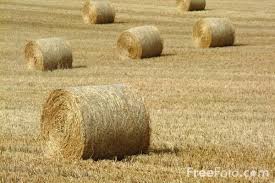
There’s a problem though.  You see, even though I grew up in a farming community, and those oh-so-interesting smells were for the most part pleasant ones (except hogs and when people spread chicken manure, P.U!), I didn’t grow up with livestock.  My family were apple growers.  And I could go on at length about apple blossom time and pruning and how much I loved harvest time…

But I won’t. Because today I’m going to talk about haying.

I’m almost ashamed to admit that I’ve had to research haying a little bit.  Equipment has changed over the years, and my memory fades a little. I found it quite interesting, actually.  I looked at pictures of different kinds of balers and rakes.  I read about drying times before baling and different types of bales and the advantages of each. 

Where I grew up, most of the farmers made the small, rectangular bales but when I moved out west to Alberta, mostly there are the huge round bales and sometimes a new shape – bigger square bales.  I always kind of wondered the reasoning for the round bales, actually.  At home in Atlantic Canada, you hayed, you made small bales, and you brought the bales back to the haymow.  You never left them in the field.  With the large round bales, you have more hay with a smaller surface area so it protects from the elements, meaning you can leave the bales in the field.  There are coverings too.  Some that leave the ends open, protecting the surface but allowing airflow so they don’t ferment, and complete wrappings that allow the bale to become silage – rather than using a silo.

So I learned some interesting stuff about the process that I either didn’t know or had forgotten.

All that comes in handy when writing.  For instance, in the last book I handed in, my hero is rushing to get the first cut done and baled before the storm that is forecast hits.  That research was pretty useful figuring out how things would play out on a time scale.  I love that when I’m writing, I can manipulate the weather to suit my needs, by the way.

But there’s another component to haying that has nothing to do with function.  There are feelings.  It sounds funny, I know, but the feelings needed no research at all. For that I just drew on my own memory.

When I was growing up, our neighbours hayed and I remember lots of evenings seeing the wagons loaded with bales make their way into the farm yard.  They were loaded on to a chain-operated conveyor belt and stored in the loft.  Quite often this was in the hazy, hot evenings of July when the sky was pink and purple and the air smelled like clover and fresh cut grass.  There is something so satisfying about a harvest gathered in and even as a young child I could feel that.  There’s also the sinking feeling of dread when you see the storm clouds roll in, and you hold your breath praying there will be no hail.

But by far my favourite memory is sleeping with my window open, and hearing the drone of the hay dryer (a huge fan) at the barn next door.  Rather than disturb, it always lulled me to sleep.  That hay dryer meant that the hay was inside, safe and secure for the next year.  It meant it was summer, and school holidays. In some ways, having that hay dryer on meant everything was right in the world.  And I kind of like how when you’re writing, it’s the personal feelings that give your research context.  How facts can work to reveal character.

Happy Hay Season, everyone.

Petticoats & Pistols