
 Once upon a time I was a miner. Not for long, but long enough. I worked pretty deep, on the 6700 and 6900 levels of the Star Mine in Burke, Idaho. The level numbers indicate how far below the surface we were, so 6700 means that we were 6700 feet under the surface.
I drove a muck train with my partner Billy. We would drive the train back into the drift (commonly called a tunnel, but a tunnel has an entry and exit point while a drift just “drifts” back into the rock with no exit), stop under a chute containing rock that the miners working far above us had mined, open the chute, load the cars and then drive back to the station, which is the main area of each underground level. There we would dump the cars, each of which contain about a ton of ore, into a bigger chute, which collected ore during the day that would be carried to the surface in muck skips on the graveyard shift.

When we hauled ore (trammed muck) one of us drove the motor or engine, and the other rode on the back of the last car. A train usually had four. Each day we got a list of which chutes to pull and how many loads to haul from each by the shift boss and that was our work for the day. If we got done early, we were supposed to “maintain” the ditches next to the tracks, as in shovel them out. We usually tried not to get done too quickly. On the other hand, sometimes we didn’t get done at all because the train would jump the tracks and we would spend a lot of time jacking that darn thing back on, which was no easy feat when the motor weighed 5 tons and Billy and I combined weighed close to 250 lbs. We learned a lot of on-the-job physics.
So how did we communicate in the dark? With lights and clangs. The lights were most important. When you wear a light on your head all day, there are etiquette rules, such as never look directly at someone and blind them. You always directed the light to the side of the person’s face. The light was used for signals. To have someone move away from you, you nodded your head up and down, meaning go back. When you wanted someone to come your way, you circled your light. When you wanted someone to stop you shook your head back and forth. If you wanted them to stop fast, you shook your head really fast. Many was the time when I was helping my dad hook up the horse trailer and forgetting I was not in the mine, I would shake my head when I wanted him to stop. Head shaking never worked the same as it did underground.

And then there is the clangs, which were handier when positioning the cars under the chutes. When the guy riding the back car had the position they wanted, they would hit the edge of the car one time. If the motorman didn’t manage to stop in the right place, more signals would follow. Three clangs meant move forward. Two clangs meant move back. One meant stop. Clangs were quicker than lights for signals.
I enjoyed my time underground, but I was raised in mining. To answer the question that I get a lot, no I never minded being that deep in the earth. I much prefer it to being high in the air. Oh, but I hate heights.


 come right out and say that I’m picky about the texture of my cornbread. I like it moist on the inside and crispy on the edges. Too many times I’ve bitten into a golden square of deliciousness, only to blow crumbs because it was as dry as a desert inside. After trying recipes that gave me overly dry or overly spongey cornbread, I came up with my own. I like it. I hope you do, too.
 19th century using blocks of sod as building materials. Some were dug into banks. The use of sod blocks for walls was a practical solution for the lack of timber on the plains. The roofs were made from a framework of branches or wood if available, covered with hay or straw, then topped with more sod. The floor was usually packed dirt. As you can imagine, the buildings were well insulated, but could be damaged by prolonged rain.
 Keeping a cat kept down the rodent populations. Of course, the cat was also prey to larger creatures such as coyotes, so keeping a cat could be tricky.
 I love colorful women who push boundaries and Goldie Griffith was just such a woman. Born in Illinois in 1893, she perhaps had a head start in the boundary pushing game, her father being a medicine showman and her mother an entertainer.
 comprised of women wrestlers, boxers and gymnast. Goldie performed as a boxer and a wrestler. Her next stint in the entertainment involved Buffalo Bill Cody, whose Wild West Show she joined as a lady bronc rider. Goldie didn’t know how to ride a horse when she was hired, but she quickly learned.


 When I was eleven years old, my favorite television show was Here Comes the Brides. For those who are unfamiliar, the show involved the Bolt brothers–Jason, Joshua and Jeremy (the cute one)–owners of a logging operation near Seattle. Their lumberjacks threaten to leave the area due to the lack of women, so they make a deal with the local sawmill owner. If he pays for 100 marriageable women to travel to the area, the Bolt brothers will guarantee that all will stay for one year. If the women don’t stay, then the sawmill owner will get the Bolt brother’s land and operation. The interesting thing is that this is loosely based on a true story.
 and sole instructor of the Territorial University of Washington, which would eventually become the University of Washington. He received no pay.
 Mercer made another trip in 1865, partially funded by local lumber mill owner Hiram Burnett. He procured additional funds by charging local men a $300 fee for the transport of a future wife. After he arrived on the east coast, Mercer’s activities were written about in The New York Herald, which reported that the women he recruited were destined to marry poorly. Due to the bad publicity, he only managed to recruit 100 women instead of the 500 promised. And then there were difficulties getting to Seattle. The captain of the ship transporting the women refused to go farther than San Francisco. Eventually he convinced lumber schooners to transport the women for free and he (finally) arrived in Seattle with the brides-to-be.
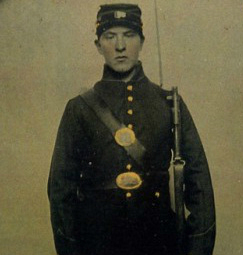 Union soldier Lyons Wakeman, who served in the 153rd New York Volunteer Infantry during the Civil War had a secret—Lyons’s real name was Sarah Rosetta Wakeman.
 Campaign in Louisiana. She saw combat on April 9, 1864 and survived the battle. After the battle, she sent her last letter home. Unfortunately, she became ill with dysentery and died on June 19m 1864. (Thousands of soldiers died of dysentery from drinking contaminated water during the war.) She was buried with full military honors at Chalmette National Cemetery in New Orleans, with a headstone that read Lyons Wakeman.