
By Jeannie Watt
 Hi everyone and Happy Wednesday! I was fortunate to be able to spend the past weekend in my favorite
city, San Francisco, with my family. I love the history of this city, so thought I’d share a bit about the lost ships for those that are unfamiliar with this rather unique facet of the area.
Before the California Gold Rush, San Francisco was a quiet port, with a population of several hundred
people. After the rush, the population swelled to more than 42,000–25,000 of which arrived by water. Ships poured into the harbor, dropping off would-be prospectors, miners and speculators as well as people starting businesses to support the gold miners.

Many of the ships that anchored in the harbor never set sail again. At one point there were more than 500 ships in the harbor, many of which were totally aband oned. Eventually some of the ships were refurbished and put back into service, while others rotted away at their moorings.
A ship-breaking yard, known as Rotten Row, began operation. Crews of mostly Chinese workers would break down ships and sell the wood and metal, or re-purpose the ships into bars, businesses, hotels and storage units. There is even record of a jail and church being build out of refurbished ships.
As business boomed in San Francisco, the locals wanted to fill the shallow part of the harbor in order to allow larger ships to unload cargo in the deeper parts. The easiest way to do this was to sell water lots, which the owners were required to fill with material to bring it above sea level. In order to have title, the owner needed to have real property on the lot and an easy way to do that was to sink a ship on it, prior to filling. Another ways to get a water lot was to sink a ship on it first, and then lay claim to the land around the ship as part of the salvage. Many ships sank in the dead of night.

The original coastline of San Francisco began where the hills hit the water.The flat areas that now make up the Embarcadero and Financial District were once underwater. Eventually a seawall was built in 1871, creating the current shoreline. Between the seawall and the original coasts are the remains of as many as 75 buried ships.
 The Old Ship Saloon, still in operation, opened in 1851 in the hull of the Arkansas. Original patrons had to walk up a plank to enter the saloon.

The most inland known ship, the Niantic, was beached on the corner of Clay and Sansome Streets in the Financial District in 1849 and served as a storehouse until the fire of 1851 leveled her to the ground and she was buried.
The ship Euphemia became the local prison in 1850. During the day the prisoners would work on a chain gang and in the evening return to the ship to be locked in the hold. The conditions on the Euphemia worsened throughout the year and eventually a new prison was built in 1851. The fate of the Euphemia was unknown until her remains were dug up in 1921 at the corner of Battery and Sacramento streets. [Note: There is still some controversy as to whether that particular ship is the Euphemia.] In 1925 the store ship Apollo was discovered nearby.


More recent discoveries have been made and most have been reburied, with buildings going in over the top of them.
The ship Rome was discovered while building a Muni tunnel at the foot of Market Street. The ship was too large to excavate, so the tunnel was built through the hull of the ship.
If you’re ever in San Francisco, strolling along the Embarcadero, remember than you may well be literally walking over the top of the ships that helped build the city.
 Hey everyone and happy Wednesday! When I got back from the Romance Writers of America National conference one week ago today, I was greeted by a house with no electricity or water, and a slightly stressed out husband. He also had to replace the refrigerator while I was gone. I was kind of getting afraid to answer the phone while I was in San Diego.
 Hey everyone and happy Wednesday. Today I’m going to toot my own horn and discuss a western craft I love.
 n see some beautiful hitching in the prison gift store, along with other crafts created by the inmates.
 ou hitch? First you get some decent tail hair. Tail hair is different from mane hair—it’s courser and longer. Mane hair is used for the tassels and also can be twisted into ropes called mecates.
 ady cleaned and of equal length. I get it in black, brown and white. The white I dye on the stove, using plain old Rit dye, to create the not-so-natural colors.
 it has a knot in both ends, it stays put.


 I love early western movies—those made in the late 1920’s or early 1930’s. These movies were made close enough to the times they portrayed—the 1860s-1890’s—that the sets, the clothing, the horse gear, have a fighting chance of being fairly accurate. And if they’re not accurate, at least they’re interesting.
 n I’ve ever seen clothing-wise…but it was interesting.
 the homestead. When Jed gets out of prison, he goes to Nevada, to seek revenge against the Haydens. Lynn is hot on his heels, hoping to stop the violence. Matters are further complicated by the fact that Lynn’s in love with Ellen Colby (Esther Ralston) and the two hope to marry. I loved the final shootout, where people were actually reloading weapons, and the reloading took some time, just like it does in real life. T
 he women are shooting as much as the men.
 robably not–the leg part anyway. Nor were her 1930’s pencil thin eyebrows and semi-marceled hairdo accurate. But, since I love the 1930s, it was fun to see the 30’s influence on the 1870s fashions.
 Lucille Mulhall was an anomaly—a small, feminine, soft-spoken girl who beat cowboys at their own game. After gaining acclaim as a Wild West performer, Lucille became the first woman commonly known as a cowgirl.
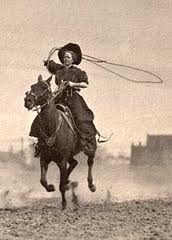 to 80,000 acres.
 performed in Madison Square Garden in New York City in 1905, she took the city by storm. A report in a New York newspaper said, “Against these bronzed and war-scarred veterans of the plains, a delicately featured blonde girl appeared. Slight of figure, refined and neat in appearance, attired in a becoming riding habit for hard riding, wearing a picturesque Mexican sombrero and holding in one hand a lariat of the finest cowhide, Lucille Mulhall comes forward to show what an eighteen-year-old girl can do in roping steers. In three minutes and thirty-six seconds, she lassoed and tied three steers. The veteran cowboys did their best to beat it, but their best was several seconds slower than the girl’s record breaking time. The cowboys and plainsmen who were gathered in large numbers to witness the contest broke into tremendous applause when the championship gold medal was awarded to the slight, pale-faced girl.”
 ve Lucille many names: Ranch Queen, Cowboy Girl, Female Conqueror or Beef and Horn, Lassoer in Lingerie, Dead Shot Girl, Daring Beauty of
 Will Rogers was a member of Mulhall’s Wild West Show and helped Lucille hone her roping skills. He wrote, “Lucille’s achievement in competition with cowboys was the direct start of what has since come to be known as The Cowgirl. Lucille was the first cowgirl.” Teddy Roosevelt also admired Lucille’s skills. He visited the Mulhall ranch and invited the Mulhall family to his inauguration. Geronimo gave her a beaded vest and Indian bow, which she treasured.
 abilities.She said, “My system of training consists of three things: patience, perseverance, and gentleness. Gentleness I consider one of the greatest factors in successful training.” Her horse, Governor, knew over forty tricks.
 A few weeks ago, I set up my small vending booth at the 27th annual
  kids grow up, from being babes in arms to competing in stick horse races, then sheep riding, then…well, I haven’t been there long enough to see any of the kids reach the age where they compete on an actual ranch hand team, but I’m sure it’s coming.
 een teams of cowboys and cowgirls representing different ranches. The events are those that a working cowboy might encounter in the course of their day. There are a few traditional rodeo events—bronc riding, team roping and steer stopping—along with ranch events—branding (with paint), ranch doctoring, cow mugging, steer loading. The wild horse races and wild cow milking may not be everyday ranch occurrences, but they add some spice to the competition.
 The rodeo starts off with a Calcutta, where people bid on the teams. The money goes into a pot proceeds are used as prize money, with a portion going to the person buying the winning team(s). Yes, you can buy your own cowboys.
 TESTING THE LIMITS


 weren’t supposed to prospect for precious metals in the 1800s. They were considered too delicate to travel across wilderness and deserts, collecting ore samples and chasing veins while carrying everything they needed to survive in a backpack. Ferminia Sarras did it anyway.

 may travel on its stomach, but soldiers also appreciate clean underwear. In honor of Veteran’s Day, I’m saluting the only women recognized by the US Army during the 19th century—the military laundresses.
 After that, the clothes were rinsed and hung to dry, then ironed with heavy flat irons. Imagine a hundred soldiers tending to their laundry in a camp environment on top of their other duties. Laundresses were essential, so in March of 1802, the “Act Fixing the Military Peace Establishment in the United States” recognized women retainers as military personnel.
 whiskey a day. (The ratio later changed to one laundress per 19 ½ men.) In addition to their food ration, they were also allowed bedding straw, fuel and the services of the surgeon. If the laundress was married, she shared quarters with her soldier husband. If not, she shared housing with the other laundresses, as well as a hatchet, a camp kettle and two mess pans. Housing consisted of tents when on the move and actual quarters when serving at post, although at some posts, the laundress quarters, located on suds row, were the most cramped and squalid.
 e laundresses were paid before their debts to the sutlers, or merchants. The amount the laundresses were paid was set by the camp administrators. In 1851 at For Crawford, the laundresses received 50 cents for two shirts, two pair of underwear and two pairs of socks. In Fort Boise in 1866, enlisted men paid $2.00 a month and officers paid $5.00, since their uniforms might require starch or bluing. Soap was a rare commodity, so the price shifted according to who supplied the soap. In addition to doing laundry, laundresses served in other capacities, cooking, cleaning and acting as midwives. Many baked and mended for extra money.
 Soldiers were free to do their own laundry if they did not wish to hire a laundress. Some soldiers, particularly those who were convalescing from injury or illness, made extra money doing laundry for their fellow soldiers.
 nd could be banned from the post by the commanding officer. Not so the laundresses. They traveled with the Army, except in combat situations. Once combat was over, the laundresses once again joined the company. As recognized retainers, the laundresses were subject to Army regulations and there are records of laundresses being brought before military courts.
 d the laundresses come from? They were often the wives of senior enlisted men and their pay helped to support the family. Widows or mothers of soldiers also became laundresses. The captain of the company hired the laundresses, who were required to have a letter of recommendation or a certificate of good character. No woman of bad character was allowed to follow the Army. However, that didn’t mean these women were refined. Most were illiterate, so there are no written journals or diaries of laundresses. Most information about the laundresses comes from soldiers’ letters and military records.
 fascinating stories and lore about individual laundresses, and I really enjoyed reading about these tough women who provided such an essential service to our armed forces over a century ago.


