

If the very words “Texas Rangers” make you think of heroes, you’re not alone. For many of us, those men who wear the star are legendary, their stories larger than life. That’s one of the reasons I made Jackson Guthrie, the hero of A Tender Hope, a Ranger. But as I researched the Rangers, I discovered a number of things that surprised me.
It started with the stars. Did you know that the early Rangers did not necessarily wear badges, and if they did, they were ones they’d either created or purchased? It’s true. The state did not issue badges to Rangers until 1935. Prior to that, the only official proof that they were Rangers was the documentation the state provided, a description of their physical appearance that served to identify them. The early badges were often

made from Mexican silver eight-real coins or simply tin.
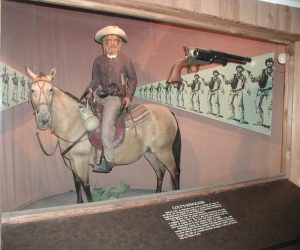
Then we come to the uniforms. There were none in the early days. While Rangers are often shown wearing slouch hats, those were not mandatory. Instead, those particular hats were chosen for their practicality, keeping the sun and rain out of the Ranger’s face.
Do you picture the Ranger carrying his Colt revolver? While it’s true that many of them had Colts after Jack Hays, who was famous for his one-man stand against a band of Comanche near Enchanted Rock, introduced them to the Rangers, they weren’t something the state provided. The first time the state issued firearms to Rangers was in 1870 when they provided breech-loading cavalry carbines. But – and this is a big but – the cost was deducted from the Rangers’ pay.

So, what did the state provide to its famed peacekeepers? Food, forage for their mounts, ammunition, and medical assistance. The Rangers were responsible for their horses, their weapons, and their clothing.
Until 1874, the Rangers were citizen-soldiers, meaning that they were called when needed and disbanded when the need was over. While the 1866 legislature established three battalions of Rangers, the bill to finance them failed. In 1870, the legislature authorized the creation of twenty companies of Rangers, but only fourteen were actually established.
The creation of the Frontier Battalion in 1874 marked a significant
change for the Rangers, creating a professional law enforcement agency with civil police powers. The Frontier Battalion consisted of six companies, each with a captain, two lieutenants, and 72 men who enlisted for twelve months.
How much were these men paid? In 1835, the daily pay was $1.25. You might have thought that by 1874, the pay would have increased, but a private’s monthly pay was only $30 and a corporal’s was $40. Sergeants made $50, lieutenants $75, and captains $100. Since pay day was once a quarter, I suspect that the state-provided meals were critical to a Ranger’s survival.
Does all this make you want to enlist? I didn’t think so. The men who joined the Rangers were men who believed in justice, men who wanted to keep their home safe, men who sought adventure rather than comfort. Men like Jackson Guthrie.
(Note: These are all photos I took at the Ranger Museum in Waco. We won’t talk about the challenge of getting these pictures from a machine running Windows 95 to one with Windows 10. Such fun!)

As far as Thea Michener is concerned, it’s time for a change. With her husband murdered and her much-anticipated baby stillborn, there is nothing left for her in Ladreville. Having accepted a position as Cimarron Creek’s midwife, she has no intention of remarrying. So when a handsome Texas Ranger appears on her doorstep with an abandoned baby, Thea isn’t sure her heart can take it.
Ranger Jackson Guthrie isn’t concerned only with the baby’s welfare. He’s been looking for Thea, convinced that her late husband was part of the gang that killed his brother. But it soon becomes clear that the situation is far more complicated than he anticipated—and he’ll need Thea’s help if he’s ever to find the justice he seeks.
I’m giving away a print copy of A Tender Hope to a US winner.
Just leave a comment to be eligible to win!

Amanda Cabot’s dream of selling a book before her thirtieth birthday came true, and she’s now the author of more than thirty-five novels as well as eight novellas, four non-fiction books, and what she describes as enough technical articles to cure insomnia in a medium-sized city. Her inspirational romances have appeared on the CBA and ECPA bestseller lists, have garnered a starred review from Publishers Weekly, and have been nominated for the ACFW Carol, the HOLT Medallion, and the Booksellers Best awards. A popular workshop presenter, Amanda takes pleasure in helping other writers achieve their dreams of publication.
Social Media Links
http://www.facebook.com/amanda.j.cabot
http://twitter.com/AmandaJoyCabot/
http://amandajoycabot.blogspot.com/
 Cadence is Book 13 of The Widows of Wildcat Ridge. The series is winding down. Only three more to go. Are we getting eager to see whether Mortimer Crane gets his comeuppance? You bet. You can get a taste of this in Cadence.


 Thanks so much for having me here today. I’m really excited to be a part of Petticoats & Pistols.

 Let’s talk about series books today. Do you prefer your favorite cowboy books to be part of a series? As you start the book, do you begin to imagine the secondary characters having stories of their own? Have you ever written to an author to ask for a secondary character to have their own book?


 Her Last Chance Cowboy


 Born and raised in Scotland, I heard tales of the wild Highlanders who fought battles in little more than their plaids (if that). They slept beneath the stars and brandished swords and clubs, but I’d never heard of a cowboy until I ventured to Montana Territory in search of answers about my family. These men: cowboys, ranchers, horsemen, certainly are interesting specimens and I’ll admit I’ve become rather fascinated by them.

 WILD MONTANA WINDS


 Americans protecting the sacred mines. Even as recently as 1990 there have been reports of modern-day prospectors being fired upon as a warning by Native Americans who protect the land near historic mining operations.
 Rosemary Brennan is recovering from the loss of her husband five months prior in a devastating mine accident that took the lives of nearly all the men in Wildcat Ridge. The mine owner, Mortimer Crane, has given the widows an ultimatum—find husbands or he will evict them from their homes and businesses. Desperate to keep the assay office that her deceased husband had managed, she heads into the hills in search of an old Spanish mine called The Floriana in the hope she can lay claim to a bonanza of gold.
 Kristy McCaffrey writes historical western romances brimming with grit and emotion, along with contemporary adventure stories packed with smoldering romance and spine-tingling suspense. Her work is filled with compelling heroes, determined heroines, and her trademark mysticism. Kristy holds a bachelor’s and master’s degree in mechanical engineering, but writing has been her passion since she was very young. Her four children are nearly grown and gone, so she and her husband frequently pursue their love of travel to the far corners of the world. Kristy believes life should be lived with curiosity, compassion, and gratitude, and one should never be far from the enthusiasm of a dog. An Arizona native, she resides in the desert north of Phoenix. To learn more about her work, visit her

 he headed west and served two Presbyterian parishes in Concord and Cane Ridge Kentucky. Other Presbyterian ministers criticized him for his unorthodox views, chiefly his denial of the Trinity, which he said was not found in the bible. In 1830 Stone met Alexander Campbell, another Bible only Presbyterian-turned-independent preacher. Their friendship and common passion led to a merger in 1832. Stone’s legacy endures in the large number of churches called “Disciples of Christ” or “Church of Christ,” which are committed to “Bible only” Christianity.

 his 45-year ministry, delivering 16,500 sermons. He created districts of churches, each served by preachers who traveled from church to church. Asbury drove missionary expansion into Tennessee and Kentucky despite the constant threats of illness and Indian attacks on the frontier. Asbury founded five schools and promoted Sunday schools to teach children reading, writing, and arithmetic. He hated slavery and even petitioned George Washington to enact antislavery legislation. The Methodist church expanded to 200,000 strong under Francis Asbury’s leadership.

 I’m so happy to be back at Petticoats & Pistols. Hey there, Fillies! I get to see old friends and make some new ones. I’m also glad to be here because I get to share my new release with you.

 The shotgun messenger was literally that: he rode shotgun beside the driver, with the treasure box between his feet, holding a sawed-off shotgun loaded with buckshot. A shotgun messenger had to stay alert, identify danger in an instant and not be afraid to act on his decision to shoot. Though Wells Fargo policy said to let a robber have the money rather than risk lives, the shotgun in the hands of a good shooter was an effective deterrent.
 shotgun messengers. They were ‘the kind of men you can depend on if you get into a fix,’ according to Wells Fargo detective Jim Hume. If thieves were foolhardy enough to try and steal a treasure box in transit, they would find themselves staring down the barrel of a sawed-off shotgun, loaded with 00 buckshot, possibly held by Wyatt Earp himself.” [from


