Traveling, Christmas, and a Give Away!

Hello, P&P readers. Lacy Williams with you today asking a couple of questions: How far would you travel to be with your loved ones at Christmas? What are you willing to go through to get there?

During my freshman year of college, we had a massive, unusual-for-us snowstorm here in Oklahoma. It delivered a massive twelve inches of snow and the (few) snowplows couldn’t keep up. I was living on campus, and even though I was only ten miles away from home, I can still remember the adrenaline rush and my white knuckles as I drove home for Christmas break with my laundry basket of belongings in the back of my small car.

Probably the worst experience I’ve had traveling home at Christmas was flying cross-country to visit my in-laws for the holiday. This was before we had kids, and between my husband and I one of us is the kind of person who likes to have a list and be packed and double-check the night before. The other one likes to throw things in a bag just before we walk out the door. I will let you try to figure out which is which.

Hubby and I arrived at the airport with what we thought was enough time to check our bags and get through security, but it turned out we were wrong. The airline wouldn’t let us check our bags because it was too close to the flight time and it was possible they might not get on board the plane. We had gifts for his family packed in our luggage and we couldn’t leave them behind or combine them into our carry-on luggage, so basically we missed our flight because of our luggage.

It was devastating for two broke college kids (we were paying our way through night school at the time) to think we had missed our chance to be with our family. Luckily, we were able to get on another flight a few hours later. It could’ve turned out much worse than the couple hundred dollars it cost us.

(Am I wrong or does Hallmark have a sub-genre of their Christmas movies like this? Films about travel gone awry where either the hero or heroine gets stranded in a small town and falls in love while they are trying to get through all the obstacles it takes to get home.)

Fighting to get home for Christmas is the premise of my new release, Christmas Homecoming. Set in 1914, my hero Walt is on a train ready to take the wanted criminal in his custody to a judge where he will face justice. Surprise! His younger sister and her beautiful friend hop on the train mid-journey and suddenly Walt is getting lectures about why he should come home for Christmas when he hasn’t been home in years due to a broken relationship with his father and brother. Before he can blink, the train is part of a hold-up and Walt finds himself in a heap of trouble. It’s gonna take a lot more than he thought to get home for Christmas and to rescue the woman he’s falling for from the bad guys.

This new book is an adventurous romance. Tell me about your most disastrous trip home for the holidays. If you don’t have a story like that, tell me your favorite holiday food.

I would love to give away a paperback copy plus a $10 gift card to one of the readers who makes a comment today.

Thanks for chatting with me today!


About the book:
All traveling nurse Libby wanted was a quiet Christmas to grieve losing her younger brother. She’s on a westbound train heading home when she and a friend find themselves in the middle of a hijacking and then taken hostage by a gang of outlaws.

Walt White is a U.S. Marshal who has been chasing down the Seymour gang for years. But he’s kidnapped along with two innocent women, he must figure out how to keep them alive—and it doesn’t help that he’s completely distracted by the beautiful Libby. He’ll need his wits about him if he hopes to save them.

As they work to engineer an escape, Walt realizes that Libby is resilient and cunning—and vulnerable, though she hides it well. He must give his all to protect her heart and bring her home in time for Christmas.


Find it on Amazon    
Available soon on OverDrive!


Author bio:
Lacy Williams wishes her writing career was more like what you see on Hallmark movies: dreamy brainstorming from a French chateau or a few minutes at the computer in a million-dollar New York City penthouse. In reality, she’s up before the sun, putting words on the page before her kids wake up for the day. Those early-morning and late-night writing sessions add up, and Lacy has published fifty books in almost a decade, first with a big five publisher and then as an indie author. When she needs to refill the well, you can find Lacy birdwatching, gardening, biking with the kiddos, or walking the dog. Find tons of bonus scenes and reader extras by becoming a VIP reader at http://www.lacywilliams.net/vip .

Susan Payne’s Midwest Mail Order Bride Series

My great aunt was born in 1873. She married at age fourteen. She kept house for her husband and his brother, who were more than ten years older than she was. She married young to relieve her parents of having another mouth to feed. She had two children and then buried her husband, leaving her a widow at a young age. She eventually found the love of her life—and then unselfishly allowed him his freedom to marry another.
My great aunt did what she knew. She rented out rooms in her home and then became a land owner by ‘flipping’ houses, sometimes making them into two or more apartments and renting them out. She became the matriarch of her family while still a teen. She gave sisters, aunts and other women jobs in her multiroom boarding house and laundry. She gave the male family members jobs and references to keep them working. They all followed her from VT to PA and then to MI following the logging camps. She settled in west Michigan as logging slowed to a trickle and manufacturing was rising. Families came into the cities looking for work and rental homes.

That woman and her sisters are my inspiration. It is why I write about such strong female leads. Why I know how women of that age thought. Uneducated past the sixth grade, my great aunt carved a prosperous career out of hard work, common sense and guts. She personally cared for her aging parents and any relative who fell on hard times. At 96 years old, she left enough money in her will so that even her great nieces and nephews received an inheritance they could use toward college.

I have always been intrigued by the mail order bride phenomenon. It was truly a western United States experience, although women from all over participated, and it is still active to this day in the form of ads on the internet. Particularly from Russian brides. It was similar to the age-old practice of neighboring families planning for their children to marry one another when they got to marital age. Only this time, the actual couple had a say in whether they married or not.

In the US, there were magazines such as The Matrimonial News, which bragged it had assisted in over three thousand marriages. Either the man or woman could place an ad for the fee of $1.50 per word (about $30 in today’s money); so they were short and sweet. Only those serious enough to put their lives in a stranger’s hands need apply.

The beginning of such ‘contracts’ began when gold had been discovered and men rushed west. It was said to have begun when men, after setting up a homestead or mining claim, wrote home asking family or their church if there were any single women interested in joining them with marriage in mind. I can see some safety in doing such a thing. The man would be known by others, and they could vouch for his competency and integrity.
The ones where men answered female-placed ads seemed a little less safe. Many times, these women were widows or spinsters without a family to depend on. If the woman arrived and found the man less than desirable, she didn’t usually have any other option than to marry him. Divorce was fairly high, with either party walking away from their commitment.

If the men were less than honorable, the women—young or old – could be sold to brothels or made slaves south of the border. No one knows how many women ended up like that, but it did happen. To help keep that from occurring, women were advised to ask for references from people who knew the potential husband. The sheriff and local minister were the two most trusted sources. The fact the women had no knowledge as to those references being truthful, was another thing. Usually, a few letters sent to one another over a couple of months was all they had to base their selection on.
I have wondered at the destitution of those seeking husbands among the rough men in areas where men outnumbered women sometimes ten to one. Not unmarried females, just females in general. Where fourteen was not an uncommon age for wives, where tombstones noted the early deaths of wives and the even higher mortality rate among infants.

Some of my mail order brides face hardships both before and after their marriages. Having the women I had as examples, my leading ladies and gentlemen eventually find their happy ever after with their spouses, and the reader can sleep easily knowing everything works out. Just as it did for the women in my family eventually.

I’m giving away a free e-book copy of In the Sheriff’s Sights to one winner from the comments.

Happy Reading!


Welcome Lynn Landes!

What inspired my books? I’m often asked what inspires a book? Where do your ideas come from? The truth is they come from many places. Past experiences, dreams, bible verses, music… life. I think from now on I’ll answer with that one word- Life.

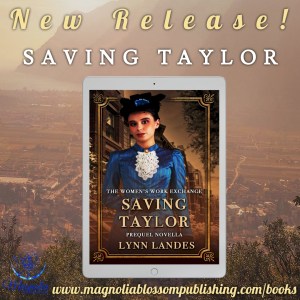
I’ve recently joined with Magnolia Blossom Publishing and my first series, “The Women’s Work Exchange,” is about a group of young women who join together to help middle class women support themselves.

“Saving Taylor,” is about a young singer named, Taylor Allen. Trained as a child to use the gift of her voice for the Lord, she is unprepared for the reality of her father’s gambling debts. Taylor’s voice is a magnet that draws in crowds, but not even her talent can save her when Thomas Whitt calls in her father’s debt.

Thomas realizes what he has when the crowds come to hear her sing and he isn’t about to let her go without a fight. After a brutal attack, Taylor runs for her life.

This prequel shows how the Women’s Work Exchange comes to life when Taylor finds help in an unusual place. She learns that the Lord has guided every step of her life and if she trusts in the power of his perfect Love everything will work together for his good.

The Women’s Work Exchange was inspired by the “New York Exchange for Women’s Works.” In 1878, two women decided to help middle-class war widows support their families. Instead of being forced into workhouses or working as soiled doves, they suggested that women could make items at home, and sell them.

“The Exchange sold handmade luxury goods that women could make at home and gave the women a percentage of every item sold. Thus allowing middle class widows to earn a living while still maintaining their reputations.” https://wams.nyhistory.org/a-nation-divided/reconstruction/ny-exchange-for-womens-work/

I was inspired by these women and thought it would make a great story. My characters aren’t war widows, but they are enterprising women who want to care for themselves in spite of their circumstances. They are single mothers, divorced, widowed, and some, like Taylor, are just in a bad situation. Saving Taylor is the beginning of how the Women’s Work Exchange comes to be and the special women who fight for more, and the men who come to love them.

Giveaway!

I love to discover unique facts about history that I learn through my research. Did you know that a man could divorce his wife simply by having a divorce announcement in the newspaper? It didn’t even have to be printed in the state they lived in! You can bet I used that in an upcoming book. Do you have a unique fact to share? Comment and I’ll send a free e-copy of Saving Taylor to one lucky commenter!  

Saving Taylor

Can she convince him to trust her?

She is a woman on the run…

Taylor Allen is an eyewitness to a double murder. Raised in the church, she only sang for the Lord until her father sold her to pay off his gambling debts to the local Opera House. Taylor’s voice is a magnet that draws in crowds but not even her talent can save her from a murderer. After a brutal attack she runs for her life.

He’s taken hostage by a desperate young woman…

John Fielding Jr is on the way home from a business trip. How did a beautiful killer end up in his private sleeping car with a gun pointed at him?

Time is running short as they search the train to New York, seeking the woman that robbed and set fire to a saloon. They say she killed the owner and burned down several buildings in the process. John Fielding Jr. is determined to help prove her innocence and claim her heart in the process.

Lynn Landes
BESTSELLING AUTHOR – Illumination Award Winner
Check out Lynn’s many titles at:

http://www.followlynnsthread.com 

Join me on 
Facebook, Twitter, Pinterest,

Instagram, Followlynnsthread.com

Follow me on

Amazon, Bookbub

Pullman Cars with Guest Charlene Raddon (and a give away)

Whenever I write a blog to introduce a new book, I like to talk about some of the things I learned through my research for that story. Carrianne’s research centered mostly on the Union Pacific Railway and, in particular, the Pullman cars that Carrianne and her husband enjoyed in my story for their trip from Denver to San Francisco, where they fought to bring down the worst criminal on the Barbary Coast at the time.

The Barbary Coast also required fascinating research, but that deserves its own blog.

I think all of us would have enjoyed a train ride in an elegant, plush Pullman car. I was shocked to learn just how fabulous they were.

According to legend, a highly uncomfortable overnight train ride from Buffalo to Westfield, New York, prompted George Pullman to find a better way to provide comfortable, clean, efficient passenger service.


Traveling over early, hastily constructed rail beds, trains inevitably swayed, rattled, and clacked. Most passenger cars ran on two four-wheel trucks. Pullman used eight-wheel trucks supplied with an improved suspension for a smoother ride. He even added lighter wheels with pressed-paper cores to minimize jolts. He installed double-glazed windows and doors for quiet. The ventilators in a Pullman car brought in fresh air but filtered out dust and cinders.


The true glory of the Pullman car was in the decor. Victorian taste ran toward the baroque, and Pullman offered the utmost in ornamentation: carved walnut paneling, polished brass fittings, beveled French mirrors, Brussels carpets, brocade, tassels, and fringe. At night, porters made up the berths with pristine white sheets.

Thanks to the low $2 extra fee a passenger paid to ride in a Pullman car, such luxury was affordable even for the upper-middle class.

1872: Passengers bedding down onboard a luxurious Pullman sleeping car of the Pacific Railroad. (Photo by Three Lions/Getty Images)


Before George Pullman introduced his first diner, the Delmonico, trains stopped briefly at stations to allow passengers a hurried meal, and I mean hurried. Dining cars ended this inconvenience. There were also parlor cars, where a passenger could relax in an upholstered armchair, which swiveled to allow a view of the scenery. Wide windows and elegant furnishings added to the sense of privilege. An organ provided entertainment.

Illustration shows a crowded Pullman dining car on a train as waiters serve the passengers, late nineteenth century. (Photo by Interim Archives/Getty Images)

An important Pullman innovation was the vestibule train. Early cars had platforms front and back so that passengers had to step outside to move from one car to another. The vestibule was a spring-driven accordion covering that allowed cars to be joined seamlessly. It made moving from car to car more easily and helped to stabilize the train at high speeds.

The ultimate in Pullman extravagance was the private car, known in the business as a “private varnish.” These cars allowed the ultra-wealthy to travel comfortably without rubbing elbows with fellow passengers. A typical car might have an open fireplace and a marble bath. Italian artists supplied paintings of fuchsias and hummingbirds for the ceiling. Lamps and fitting were gold plated. The car contained several bedrooms, a central parlor/dining room, and a kitchen. Such cars sold for $50,000, equal to 1.3 million today.


I’d love to provide more details on how everything worked, but I believe I’d better quit before I wear out my welcome. I’ll provide photographs instead to show you what you missed by not having been born much, much sooner.

What would you pay today to enjoy such luxury as the Pullman cars offered?

Please comment to enter the give away. One winner will receive a copy of my current book, Carrianne’s Debacle, and a second winner will receive a book of their choice from my backlist.

Charlene Raddon is a multi-published, award-winning author of Victorian/Western romance. Originally published by Kensington Books in the 1990s, she now self-publishes. She also creates book covers, specializing in western historical designs.

Twitter
Facebook
Goodreads

Pinterest

Linkedin

Bookbub

Instagram

Facebook Author Page

Linktree


Guest Author Caryl McAdoo and a Give Away

Hello, Petticoats & Pistols readers! I’m Caryl McAdoo, hybrid (traditional and independently published) author of several Christian genres, and I am so glad to be here with you today!

I grew up in Dallas, Texas and only remember going to Fort Worth one time as a child when my parents took me to their zoo.

I always thought of it as a wild town and not nearly as cultured and refined as Big D! “Where the West begins!” they say of Cowtown, and I believed them!

It wasn’t until my early forties that I visited the city again on an invitation from a writer friend and his wife for dinner and an evening at the Stockyards. I had a wonderful time and was quite amazed with the Fort Worth I never knew! I’ve been back many times since.

The photo is me and a friend on her birthday outing with Bass Hall, our destination, in the background.

So, when I started writing book three in my historical Cross Timbers Mystery series, COERCION at The Cow Palace, I decided to set the story in a notorious half acre in 1870’s Fort Worth history! I loved the research!

The famous Chisholm Trail went right through ”Cowtown”! Its dust and beef weary cowboys would gallop into town shooting their pistols and even riding their horses right into the saloons! A red-light, gambling district sprang up that indulged the cowpokes’ vices.

The area became quite famous for its lawlessness, giving Hell’s Half Acre its memorable name and less-than-angelic reputation. That’s right where I set The Cow Palace, COERCION’s setting for the murder that needed to be solved.

In researching, I also discovered two things that kept the town from flourishing as Dallas had. The first was a faraway bank failure!

In 1872, the Texas & Pacific Railroad had laid track through Dallas—bringing prosperity and growth—and about six miles west of the city to Eagle’s Ford. The company stopped only twenty-four miles from Fort Worth before disaster struck.

Bankers to the U.S. government, Jay Cooke & Company, failed up in New York causing an international panic. Cooke was also major financial backers for the railroads. The bank’s collapse devasted Fort Worth’s future! Almost overnight, the population dwindled from four thousand to less than a thousand.

One former resident reported to a Dallas paper that Fort Worth was so deserted, he witnessed a black panther sleeping in the street. This gave Fort Worth a new nickname, Panther City or Pantherville.

The other factor was a terrible winter in the same year.

So, the city “Where the West Begins” got set back and became known as a wilder, less cultural place than its nearby sister-city Dallas

Excerpt from COERCION:
The youngest woman definitely knew Fort Worth better than either Charity or Vivian, from Dallas County. She filled in a lot of Cow Town’s history she’d learned along the way. Arriving at the new dress shop, the boardwalks were practically empty.

Where were all its customers?

“Well, my goodness, it’s like a ghost town or something.” Vivian stepped out of the carriage first. Virgil offered his hand to help her down. “Where are all the people?”

“There used to be a lot more, but so many left last winter.”

“I know it was a bad one, but why would so many leave?” Charity was last out of the carriage. “Thank you, Virgil. I’m certain you do not want to come into the shop with us, so you may either wait at the door or sit with Gilbert.”

“Yes, Miss Charity.” He hurried ahead and held the shop door for the ladies.

“The weather was only a part of it. You know they just had an orgy of building once everyone heard the railroad was coming.”

Charity glanced at Vivian. The young woman had an odd way of saying things.

“Then in August—or was it September?—anyway, some bank up in the Northeast went under. Supposedly, they’d invested in railroads pretty heavily. In no time, a lot more banks and railroads failed.”

“What a shame.”

“You know the tracks stopped in Eagle Ford and never made it here. Businesses all over town were closing right and left.”

“That’s too bad. Now that you mention it, a lot of new folks came to Delaware Creek last fall.” Vivian turned to face Charity. “The Banks and the Gregorys are from Fort Worth. Oh, and the Winslows, too. They had a gun repair shop here that closed.”

“I’ve met them and the Banks, but don’t think I know the Gregorys yet. You’ll have to introduce me. Do they come to the barn dances?”

“I think they have.”

“Well, that’s a shame some bank up in the North would have such a terrible impact on the city. Morgan has mentioned how the train not coming on into Fort Worth hurt its growth.”

“Oh, it was truly devasting. So many lost their homes, too.”

“How is it you’re aware of all that, Yolanda?”

“Oh, you know, Miss Viv. I hear things from some of the city’s big men of finance who frequent the Palace.”

COERCION at The Cow Palace debuted January 12th, so is now available at Amazon and subscribers to Kindle Unlimited may read it for free—all of my titles (except a few published by New York houses) are in that great readers’ program! I hope you’ll enjoy it and the Texas history I’ve included in the story!

I pray all the great authors and readers at Petticoats & Pistols have a BLESSED and wonderful New Year! May God shower you all in His high favor!

GIVEWAWAY: I would love to offer an eBook of DUPLICITY at The Lowell House, book one in the Cross Timbers Mystery series! Just answer this question to be entered! Have you ever visited Fort Worth, Texas or had an inkling to?


BIO: Award-winning, Christian author Caryl McAdoo prays her story brings God glory. Of her best-selling novels, readers love her historical Christian romance family sagas most, but she also writes Christian contemporary romance, mysteries, Biblical fiction, and also for young adults and mid-grade booklovers. The large majority of reviewers award her stories five-stars and praise Caryl’s characters, counting them family or very close friends. The prolific writer loves singing the new songs God gives her almost as much as penning tales—hear a few at YouTube! Married to Ron over fifty years, she shares four children and twenty-one grandsugars. The McAdoos live in the woods south of Clarksville, seat of Red River County in far Northeast Texas, waiting expectantly for God to open the next door.

LINKS:
Amazon – https://www.bookbub.com/authors/caryl-mcadoo?follow=true

Website: http://www.CarylMcAdoo.com

Newsletter: http://carylmcadoo.com/sign-up-to-the-caryler/

YouTube: https://www.youtube.com/channel/UC_1hQx6UZbWi3OYwmKKxh6Q

(Hear Caryl sing her New Songs!)

Facebook: http://www.facebook.com/CarylMcAdoo.author

Readers’ Group: https://www.facebook.com/groups/Carylers


Researching a Historical Novel with Guest Jodie Wolfe

Research is always a fun part about writing a historical romance. At least it is for me. 🙂 Although I admit from time to time, I find myself straying on different bunny trails when researching. One subject often prompts me off on another search and I forget about actually writing the book for a while. During the process of creating Protecting Annie, I had a variety of topics to research.

My heroine, Annie McPherson has a lot of book knowledge, but not too much common sense or experience. Whenever she’s thrown into an unfamiliar situation, her first inclination is to consult her trusty guidebook for information. Annie is a planner, so she thoroughly immersed herself with vast research before traveling from the east to Kansas. When she comes across an animal in the alley of the western town she moved to, she’s convinced it’s a wolf. After all, it looks like the ones in her guidebook.

I knew this would be the opening scene for the book, so I started researching various dogs that happen to look like a wolf and would be feasible to have in a Midwest town. I came across the Native American Indian dog. I won’t tell you more, so I don’t ruin the opening scene for you. 🙂

Later in the book, Annie finds and picks some beautiful plants. Again, she consults her guidebook but can’t find an entry on the mysterious plant. She starts to have a reaction to one of them. The hero, Joshua Walker, happens upon her and tells her it’s poison hemlock.

Almost every summer growing up, I had issues with poison ivy however I didn’t know much about poison hemlock and whether it is found in Kansas. Like Annie, I had to do some research. Turns out the plant is in Kansas, and I also learned it’s highly poisonous and contact with the skin can cause nausea and blurred vision. Well, this made for a fun scene…at least to read. 🙂 It wasn’t so much fun for Annie.

My hero is a town sheriff. I have scene where he is sorting through wanted posters. I had some knowledge of them but needed to know if it was feasible to have one be hand-drawn. Off I went researching again. Turns out, they did often have posters that were drawn by hand.

One thing I didn’t research, but I had my heroine try to learn about was the care of a kitten. Annie tries to find a book at the local stores but to no avail. In fact, the townspeople have a hard time trying to figure out why she would want to keep a cat indoors.

I love researching as I write a story. Not only do I learn things, I also am able to share some of those items with my readers. Hopefully they enjoy it as much as I do. 🙂

How about you, what are some of your favorite things to learn about when you’re reading a historical novel? Leave a comment for your chance to win a CD with 12 historical romance novels on it. (US only)

Blurb

After twenty years of living along the trail as a deputy U.S. Marshal, Joshua Walker takes a job as sheriff in Burrton Springs, Kansas so he can be closer to his sister. Only problem, she no longer requires his protecting so he’s unsure of his next step.

Annie McPherson needs a change after the death of her father. She accepts a position as schoolmarm, hoping her past won’t catch up with her. Life is good, except for the pesky sheriff who continues to question her ability to adjust to life in the west and creates confrontations at every turn.

When the irritating schoolteacher’s past and present collide, dragging him into the turmoil, Josh has to decide who he’s willing to defend.

Purchase Link

Jodie Wolfe creates novels where hope and quirky meet. She is a member of American Christian Fiction Writers (ACFW), Faith, Hope & Love Christian Writers, and COMPEL Training. She’s been a semi-finalist and finalist in various writing contests. A former columnist for Home School Enrichment magazine, her articles can be found online at: Crosswalk, Christian Devotions, and Heirloom Audio. When not writing she enjoys spending time with her husband in Pennsylvania, reading, walking, and being a Grammie. Learn more at http://www.jodiewolfe.com.

Welcome Guest – Laura Strickland!!!

A Woman’s Western Heart

By Laura Strickland

When we think about the Old West, several images readily leap to mind. The outlaw facing a showdown in the street of some wooden-fronted town. The steely-eyed sheriff who stands up to protect his patch. The devoted (or dastardly) ranch owner. The cowboy out on the lonely trail. The trail guide, the leader of the wagon train, the mountain man.

These admittedly-stereotyped characters tend not to include very many women. Why not? We know women were present in the West but when we do picture them, they seem to fall along a few equally-stereotypical lines. The saloon girl. The homesteader wife struggling to survive. The widow faced with the theft of her land. What about the real women who populated the West? And what about their hearts?

When I was approached to create a new Western Romance series for Magnolia Blossom Press, I knew above all else I did not want my heroine to be a stereotype. I wanted her to be fully fleshed out, a woman with a past, one with an edge. I wanted her to hurt and hope and hate. Thus was Irine Wicklow born.

I am in awe of the women who populated the Old West. It would have required courage for any female to strike out for the unknown some hundred and fifty years ago, especially on her own. Horace Greeley’s directive to, “Go west, young man!” didn’t include, “And bring your sister.” These were extraordinary individuals. If I wanted my heroine to stand out among such an august company, I had to give her the right attributes, and a few significant flaws.

So Irine needed to be courageous and stubborn. It would require both to face the hardships of a land barely-settled in the year 1866 when my series begins, as well as strength difficult to imagine in our day and age. She’d have to be smart and resourceful, wary and determined. She’d either have to be reaching for something like a better life or running from something so terrible she doesn’t dare go home.

Irine Wicklow is running from deep trauma and the belief that she can’t rely on anyone but herself. She’s remade her own image in the form of a man—because men function in the West much more easily than women. She has in fact become the infamous bounty hunter Wolverine who doesn’t need much and isn’t afraid of much, and no longer believes in love.

What has that done to her heart? Because as we readers and writers know, it’s the heart of a woman that truly matters. Irine Wicklow’s heart is in chains. Even though a good man swears he loves her and though he stands by her even when she tries to send him away, she knows it’s caring that makes her vulnerable. It will take all seven books of this series for Irine Wicklow to decide which will win—her fear of being hurt or her heart.

The first three volumes of Irine’s story are available exclusively from Amazon and Magnolia Blossom Publishing. Come join Irine and her black mare Jezebel on their adventures. Find out just how bold a woman’s heart can be.

Blurb for first book, Love and Guns Don’t Mix:

Irine Wicklow lives her life as the merciless bounty hunter, Wolverine. Nobody knows she’s a woman, and she’s earned a reputation that’s as mean as her namesake. For eight years, she’s been running from a past so painful it turned her from a young girl who believed in love, to one with steely armor around her heart. She relies only on her guns and her wild mare, Jezebel, and the need for vengeance drives her on.

Justice Turrant also understands the desire for vengeance. A survivor of the Civil War, he came West with his family after serving time in a Union prison camp. But their bid to settle a homestead went terribly wrong. A varmint called Virgil Clary and his men brutalized Jus’s sister, Jenny, and Jus feels responsible.

He wants Wolverine to bring in Clary, even after he discovers she’s a woman. He never expects to lose his heart to a dangerous female who doesn’t believe in love.

Giveaway!

I’m giving away an e-copy of Book One, Love and Guns Don’t Mix to one person who leaves a comment.

If you were creating a tough, hard-edged heroine, what characteristics would you include?

Purchase the first three books in the series here:

Love and Guns Don’t Mix
A Woman by Any Other Name
Absence Makes the Heart Grow Colder

Welcome Guest – Julia Ridgmont

Could This Really Happen?

I’m 46 years old, and I can honestly say that my life has been stranger than a fictional story could ever tell—but it reads more like a horror story in places, so I’ll spare you the gory details. Don’t get me wrong—I have a great life, too, and appreciate the fact that the Lord has seen me through some very difficult circumstances that helped to shape me into the person I am today.

That being said, as an avid reader of romance before I ever wrote my first novel, I remember coming to the end of a book several times and thinking, That was a great story, but it never would’ve happened in real life. And it irked me that a writer would have the audacity to exaggerate so much, pushing what I felt was too far beyond the bounds of what could logically occur in real life.

This way of thinking was tempered when I became a writer. After being tutored by some highly successful authors, I realized that fiction needs to strike a balance between realism and fantasy—where the magic is less about abracadabra and more about the sparkles illuminating the characters. Believability is important for sure, but a reader also wants to escape reality and be immersed in a fairy tale for a while. I mean, what reader of romance doesn’t wait in breathless anticipation for the hero and heroine to kiss for the first time?

So when my heroine, Ariana Stover, finally meets her father again after being separated from him for almost twenty years, having thought he was dead, or another heroine, Emma Hutchins, runs off to help a U.S. Marshal apprehend a duo of wanted thieves, I look at these ideas and realize they could have actually happened, but if so, they were very uncommon experiences for young women living in the 1880s indeed. Another experienced writer, Regency author Sarah Eden, taught in a writing conference I attended a few years ago that if a writer of historical fiction asks her hero or heroine to break one of the conventions of society, the writer needs to make sure there’s a good reason for the character to do so. Along with the need for a good reason, the character needs to suffer the natural consequences later on for his or her decision.

I kept these nuggets of wisdom in mind as I crafted the plot of my Brides of Hope Hollow romance, Hope in Her Heart. The previous book, On the Wings of Hope, leaves Emma Hutchins caught in a bank during a robbery. Fortunately—or perhaps unfortunately—U.S. Marshal Patrick Carter also happens to be in the bank when the robbers storm inside. While Emma and Patrick come through the experience okay, they each have their reasons for chasing after the robbers once they leave the bank. (He, of course, being a lawman, needs to bring the criminals to justice, and she needs to recover her stolen necklace, which is a family heirloom.) I knew the bulk of this book would be spent with Emma and Patrick pursuing their quarries, and I needed to create ways they could spend enough time together to fall in love but still be watched over by chaperones for part of the time as well. Secondary characters to the rescue!

Or those secondary characters might be the foil to a larger scheme that Emma and Patrick need to uncover. And will they suffer the consequences of their decisions? You betcha! But in the process, they might just discover that the other is a prince and princess in disguise.


Today I’m offering signed paperback copies of On the Wings of Hope and Hope in Her Heart to a randomly chosen winner.

To enter the contest, comment with a fictional incident that gave you a jolt when you first read it, thinking it could never happen in real life, and then to your surprise, it did happen. Or comment with an incident you’ve seen or read about that actually happened and it made you think it would make a good fictional piece.

This is where the idea originated for Ariana’s father to come back into her life after being absent for so many years. I read an article about a Holocaust victim who thought his wife had died, and then was miraculously reunited with her many years later. Truly, real life can be, and often is, stranger than fiction. More importantly, the Lord is the author and finisher of our faith and can work miracles that our finite brains could never imagine!


Welcome Guest – Malory Ford

Homemade Christmas gifts the way our great grandmothers did it – with a few modern shortcuts

It happens every year. I sit down to make out my Christmas list, and the list seems to get longer and longer until it closely resembles something Mr. Clause himself might make. Between church friends, teachers, extended family, and the folks who keep our household running smoothly, I could easily spend a small fortune on Christmas gifts.

Enter – easy homemade Christmas gifts. The special bonus is that I’m a toddler mom with a baby on the way right after Christmas and these can all be done months beforehand and placed in a closet until gatherings commence. My toddler can help me with many of these, and I’ll note which ones specifically as we go. They’re great projects for children or grandchildren to get involved and feel even better about giving gifts to those they love.

Homemade Soap

Nope, this is not your great grandmother’s soap process.

Safe for little hands

I know what you’re thinking. I did indeed say these were easy, and I have not misled you. The modern shortcut we’ll be using for this one is melt and pour soap bases from your favorite craft store. There’s no caustic fumes, no danger of burns, and it’s completely safe for little hands to help.

Simply follow the directions on the soap base to melt it in the microwave and add essential oils for scent. You’ll see my silicone soap molds pictured here, but you could absolutely do this in a loaf pan with parchment paper and simply cut the bars with a knife when finished. My daughter loves to add drops of essential oil for scents and stir the melted base. She’s not quite old enough to pour the soap into the molds yet but an older child would absolutely be able to.

Synthetic scents and dyes are inexpensive and lots of fun for littles, but you can also keep the process more natural by using essential oils for scents and coloring with natural coloring agents like those listed here.

Dry Brownie Mix

This is an excellent way to use those old quart mason jars you found in your grandmother’s attic.

Safe for little hands if you don’t mind a bit of a mess

This one’s a common one, but sometimes the most obvious things slip my mind as the countdown to Christmas parties approaches. Many of the items for these you’ll already have in your pantry, and they’re an easy and adorable way to remind those around you that you’re thankful for them.

The ones pictured here are from this recipe but many are available if you do a quick search. You can trade out chocolate chips for red and green chocolate candies for a little extra Christmas fun.

For decorating, I generally print off some cute Christmas tags on cardstock with a quick note and the wet ingredients they’ll need to add. Fat quarters in Christmas fabrics from your local hobby store and a ball of twine or ribbon are really all you need to make these festive and adorable.

Homemade Jams and Jellies

This requires a little bit of knowledge on safe canning practices, but it’s an easy foray into canning if it’s always been a bit intimidating.

I don’t know about you, but nothing quite beckons Christmas like homemade jams, jellies and preserves. Spread a spoonful of peach jam preserved at the height of their sweetness over a loaf of homemade bread from a neighbor and I’m a happy girl.

Not only is this a great way to use up the apples your neighbor’s always bringing you from their apple tree (apple butter, anyone?), but you can also easily substitute store bought fresh or frozen fruit if you weren’t lucky enough to have a surplus of sugary goodness earlier in the year.

Safe canning practices for jams and jellies would take far too many words for me to get into here, but the good news is that most fruit jam recipes will be high acid enough to water bath can rather than needing a pressure canner. Here’s a great resource on high acid canning safety, as well as a link to the USDA’s free downloadable guide from the National Center for Home Food Preservation.

Crocheted Scrubbies and Soap Holders

Even if you don’t know how to crochet – yet!

Two things you should know about me: I love to develop random skills and I’m not particularly talented in textile arts. I know my way around a simple sewing pattern and can do a total of three stitches with some yarn and a crochet hook, but I’ll not be dropping jaws with my skills anytime soon.

I learned to crochet from a youtube video (like this one) and quite a bit of trial and error. My scrubbies and soap holders utilize exactly one stitch (the most basic of basic stitches), but they’re soft and handmade and can be thrown in the washing machine over and over (amen!). The secret to these is that I don’t measure anything, I don’t keep up with how long my rows are other than by sight, and I just fold over and stitch two of the sides together when I think I’ve got a big enough piece. They vary in size, and I certainly don’t want anyone looking too closely at the mistakes, but people will feel so loved that you took the time to learn something solely to bless them.

For those of you who already knit or crochet, you can probably do much fancier projects, but I’ll stick with my beginner skills for now. If you made the soap above, it’s an extra step to make the gift even more special. This is also a great project for upper elementary school kids to learn, and it’s certainly doable for that age.

Whatever you do, keep it fun and lighthearted. Homemade gifts aren’t special because they’re perfect, they’re special because you took the time to make them. Leave the perfectionism at the door, because the charm of many of these is the slipped stitch, the chocolate chip that somehow settled down into the flour in the brownie mix, and the spot where your toddler just couldn’t keep her finger out of the soap as it set.

This is only the tip of the iceberg when it comes to homemade gifts, and I’d love to hear some of your favorites! Leave a comment to be entered to win a copy of my new book, A Way to Joy.

The Way to Joy

Violet Gilbert is carrying the weight of her bitterness against her father. Not only does she feel crushed under the burden, but her faith is in tatters as well.

Nicholas Carson is a cowboy turned farmer who can’t shake his feelings for Violet no matter how many times she rebuffs him. He remembers the girl she used to be, and he’s fighting for the opportunity to see that girl again.

When Nicholas’s sister Lily enlists Violet to help with their yearly Christmas program, she has no idea Nicholas has been recruited to build the sets. As sparks fly and feelings grow, Violet struggles to forgive her father and imagine a future of joy and love. And when an unforeseen winter storm threatens both their lives and those of the school children, the two must work together to avoid disaster.

The Way to Joy – Amazon

Also, the box set for my Legacy series is currently on sale for only $0.99!

The Legacy Series Boxset – Amazon


Fortune Hunting in the Old West

By Linda Shenton Matchett

Thanks to the Homestead Act of 1862, the West was populated by farmers and ranchers who took their chances with 160 acres and a dream. But from 1828 in Georgia through the early 1900s in Alaska, thousands more flocked across the U.S. and its territories seeking their fortune.

Have you seen photographs of those intrepid miners: scruffy-looking, bearded men in dirt-encrusted garments, a man wearing a broad smile and holding a lump of ore, and men on mules or standing in a river gripping what looks like an oversized dinner plate? If you look further, you might stumble on pictures of women in these same poses.

You didn’t misread that last sentence. A small percentage of women worked alongside the men who converged on the the gold, silver, and copper fields. The reasons for the women’s presence are as varied as the women themselves. Some came with husbands, fathers, or brothers, then stayed after said male relative died. Other ladies were already in the area and decided to give mining a go. Still others heard about the possibilities for riches and were adventuresome enough to try mining on their own. A few came out of desperation.


However, men were not happy to have the women “horn in” on their domain, so many of the ladies dressed as men to blend in or fool their competitors. Apparently, the practice was so common during the California gold rush that when a newspaper photographer advertised for a “lad” to help him, he specified that “no women in disguise need apply.”

Widespread prejudice from the men made life as a female prospector difficult. Claim jumping and stealing by the men were common practices among themselves, but some reports indicate it may have been worse for the ladies. The women also had a tough time selling the claims they did keep. Then it became official when the United States National Bureau of Mines banned the women from mining in 1915. But still they persevered.

                           Fanny Quigley Home

Because of the lack of sources, it is unknown how many women prospectors were successful, but there are articles and books about some of the more “colorful” characters such as Fannie Quigley who started her career as a dance hall girl, then headed to the Alaskan gold fields to cook for the miners.

She eventually staked her first claim in 1907, going on to own twenty-five more. Her personal life was less successful-she left two husbands during her search for gold. Then there’s Lillian Malcom (also part of the Klondike rush) who was a Broadway actress. Several of her claims were stolen by men, so she moved to Nevada, acting out her Alaskan adventures along the way to fund her journey. The picture below is of a gold nugget in 1920.

Panning for gold the old-fashioned way is a simple, yet backbreaking process of scooping gravel from a river into a pan, swirling and dipping the pan to let the current carry most of the silt away, then repeating the action until there are about three tablespoons of sand from which to pick out the eyelash-sized flakes. And just in case you’re wondering, prospectors typically worked from sunup to sundown.

Would you have taken your chances as a prospector in the Old West?

I WILL GIVE AWAY AN EBOOK EDITION OF GOLD RUSH BRIDE HANNAH TO ONE RANDOMLY SELECTED COMMENTER.

About

Gold Rush Bride Hannah

(Book 1, Gold Rush Brides):

A brand-new widow, she doesn’t need another man in her life. He’s not looking for a wife. But when danger thrusts them together, will they change their minds…and hearts?

Hannah Lauman’s husband has been murdered, but rather than grief, she feels…relief. She decides to remain in Georgia to work their gold claim, but a series of incidents makes it clear someone wants her gone…dead or alive. Is a chance at being a woman of means and independence worth risking her life?

Jess Vogel never breaks a promise, so when he receives a letter from a former platoon mate about being in danger, he drops everything to help his old friend. Unfortunately, he arrives just in time for the funeral. Can he convince the man’s widow he’s there for her protection not for her money?

Purchase Link:  Linda Shenton Matchett, author of

History, Hope and Happily Ever After

Linda Shenton Matchett Website