Songs that take you back by Jodi Thomas

Last night I went to a lecture/concert at West Texas A&M University to hear a legend, Red Steagall.

He talked about this way of life in the West and how important it is to America. He told stories of ‘Riding for the Brand’ and being loyal to the man who signs your checks and doing the best you can. He talked of ‘Working until the job’s done’ and I was reminded I’d been burning midnight oil to get my next book finished for about a month.

Now I’ve never dug a post hole or ‘Ridden the River’ but I understood what he was saying. By the way (for you city folks—like me) Riding the River with someone means you trust them with your life.

I come from five generations of farmers and ranchers. Mostly dry land and small ranches. ‘Helping your neighbor.’ ‘Being kind.’ ‘Loving your country’ were a few themes Red talked about.

As a writer I often feel I live in two worlds. One is real and the other is in my mind. Somedays Honey Creek is real to me. I know just where it is, a small town in the heart of Texas.

But last night the country music was what touched my heart and made me smile. The song took me back in time to an old Ford on the way to Hollis, Oklahoma. Four kids in the back seat and my dad singing cowboy songs to put us asleep.

Red sang a few early cowboy songs last night that my father sang on road trips. Sometimes stepping into fiction is great, but then again so is walking into the past. I’ll be playing Red’s songs while I’m writing the west.

Here are two versions of the songs:

https://www.youtube.com/results?search_query=there+is+a+bunk+in+the+bunkhouse+tonight

https://www.youtube.com/watch?v=OCtqvGhXqt8


Click to Buy
………..Click to Buy………..

If you’re looking for something new to read, my latest book will be out April 26. SUNDAY AT THE SUNFLOWER INN is a fun read about Honey Creek. Love must be in the air because in addition to the mystery, I’ve added lots of laughs and three love stories. Please order your copy at http://www.jodithomas.com.

I’d love to hear the name of your favorite country song. I’ll listen to them all and pick one lucky winner for an autographed copy of my new book SUNDAY AT THE SUNFLOWER INN.

Looking forward to chatting with you,

Jodi is giving away one autographed copy of

Sunday at the Sunflower Inn

Jessica Ann McKenzie—“Jam” to everyone in Honey Creek—has fulfilled her dream of owning the best restaurant for miles around. Serving candlelit dinners to every couple in town on Valentine’s Day is a reminder of another dream, one she’s just about given up on. Until, that very night, Sergeant Tucson Smith clambers out of the muddy river and onto her land, bringing the promise of something they’ve both been searching for.
 
When McCoy Mason crashes on Interstate 45, he doesn’t just bust up his Mustang, his leg, and his relationship. He also loses his prospects of a job and apartment in Houston. Honey Creek, home to his estranged grandfather, offers a temporary respite, a place to recover before moving on again. After all, what permanent use could a town so picture-perfect have for a man like him?
 
At sixty-seven, Charles H. Winston III lives by order and routine. One of his most cherished rituals is a regular lunch date with three lovely ladies at the Honey Creek Café, including the very proper Miss Lilly Lambert. But it’s not too late to surprise the whole town—or himself—by seizing a chance for a once-in-a-lifetime adventure. And there’s no better season than spring, when the warm breeze blowing in from the Brazos River brings fresh hope and second chances to those who need them most . . .

About Jodi

With millions of books in print, Jodi Thomas is both a New York Times and USA Today bestselling author of over 50 novels and countless short story collections. Her stories travel through the past and present days of Texas and draw readers from around the world.

In July 2006, Jodi was the 11th writer to be inducted into the Romance Writers of America Hall of Fame. With five RITA’s to her credit, along with National Readers’ Choice Awards and Booksellers’ Best Awards, Thomas has proven her skill as a master storyteller. You can connect with her on Facebook, Twitter, Instagram, and her website – https://www.jodithomas.com/

Laura Ashwood Adds Fact to Fiction

Hi, I’m Laura Ashwood and I’m honored to be guest blogging here today. I write sweet historical western romance, contemporary small town romance and women’s fiction. Something for everyone, LOL. Today though, I’d like to talk about one of my historical western romances.

One of my favorite things about being an author is having a reason to research and a place to use that information. But that doesn’t come without its own challenges either. Too little research will upset readers familiar with a time period, and too much research can take readers out of your story. It’s a delicate balance.

So, where does one start? When I write a story, I generally have a location in mind. It might be a specific location or it might be as general as simply knowing what state I want it to be set in. Once I know that, I’ll spend some time looking at the location. The topography, the average weather – if it’s a historical book, I’ll look at the averages and topography from the year I am setting the story.

Courting Danger is a historical western suspense that starts in St. Paul, Minnesota in 1873. I knew my character, Clarissa, came from a wealthy family, that she was an only child, and that her parents (her mother in particular) wanted her to marry “up” to help further cement their place in society. Very common practices during that time period.  Clarissa didn’t want to have anything to do with it though. My research told me that the suffragette movement was strong at that time and she was a well-read young lady. She wanted to make her own way.

During that time frame, the Pinkerton Detective Agency was in its prime – solving crimes across the nation and had even started taking on female agents. The first official female Pinkerton agent was Kate Warne. So I did come research about Kate and some of the cases she worked on. So, I had Clarissa find an advertisement from the Pinkerton Agency in the newspaper – looking for female agents. She immediately replied and was chosen to work a case in St. Louis, Missouri. This case was modeled after one of Kate Warne’s cases. I used several of the details of the actual case, but added my own twists to make it original.

So because a great deal of the story was set in St. Louis, I wanted to incorporate as much “fact” into it as I could. The first thing I looked for was a City Directory. Think of it as a phone book before there were phones. The City Directory gave me names of stores, hotels, even characters. The names of the nurse, the undertaker, and the Chief of Police in my story were taken from this directory as the actual undertaker, nurse and Chief of Police in St. Louis in 1873.

The hotel Clarissa stays in while she’s in St. Louis, The Planter’s House Hotel, was an actual hotel in 1873. Because it actually existed in 1873, I was able to find photographs of it and that helped me describe it as though I was actually there, including the famed Turkish Lounge.

St. Louis is famous for its Eads Bridge and Gateway Arch, but through my research, I discovered that the construction on the Eads Bridge wasn’t completed until 1874 and the Arch wasn’t constructed until the 1960s. So, when Clarissa saw the bridge at one point in her adventure, I made sure to mention it was under construction. I also consulted a city map of St. Louis when determining what to name my streets and neighborhoods my characters visited. They were all authentic to that time.

How important is all of this? Will my readers know this? The answer to both of those questions is probably no. Those details will not make or break my story. But they’re Easter Eggs I’ve sprinkled throughout and they make the story come alive for me because I know Clarissa is seeing the actual things she’d see if she were alive and in St. Louis in 1873. Plus, it’s a lot of fun.

If you’d like to read about Clarissa’s adventure as a Pinkerton Detective in training, you can find it on Amazon, both in paperback and ebook. (buy link: https://www.amazon.com/gp/product/B09TJTSVFZ?tag=pettpist-20)  It’s also available in Kindle Unlimited.

I’d also love to give away three copies (ebook only) of Courting Danger – Just answer the question “how much does historical accuracy and detail mean to you when reading a book?” in the comments below. Three random winners will be announced on Sunday.

Laura is giving away 3 e-book copies of Courting Danger

Courting Danger

She thought the biggest danger would be to her reputation. She didn’t realize it would be to her life and her heart.

Clarissa Ferguson craves a life of adventure. The last thing she wants is to become a socialite and marry a curmudgeon to appease her mother. When she sees an advertisement for female Pinkerton Agents, she leaves on the next available train to Denver Colorado. What she doesn’t expect is the handsome man she meets on the train to be her new trainer.

Noah Harding, recovering from the loss of his wife and family, vows never to marry again. Throwing himself into his work as a Pinkerton agent, he has finally found a sense of purpose. He prides himself on being able to read people, until he observes a peculiar woman on a train headed west. He soon discovers she’s his new trainee, and he must temporarily wed her while they solve a murder, or he’ll jeopardize his career.

Will Noah be able to stay focused on the case with Clarissa distracting him? When the case forces them to pretend to be something they aren’t, what happens when their feelings become real?

* * * *

ABOUT LAURA……

Laura and her husband live in northeast Minnesota. She works a full time day job, and in her spare time, she likes to read, cook and spend time with her husband. She is a devoted grandmother and chihuahua lover.

In her novels, Laura brings to life characters and relationships that will warm your heart and fill you with hope. Her stories often have themes involving redemption, forgiveness, and family.

Laura’s website: https://www.lauraashwood.com 


Apple-y Ever After By Annee Jones


A few weeks ago, I posted on the Sweet Americana Sweethearts blog about the history of apple farming in North America. I discovered so much fascinating information about this topic that I decided to expand on it here. Archaeologists have found evidence of people eating apples since at least 6500 B.C. Did you know that apples are not native to North America? Genome testing reveals that the fruit actually originated in Kazakhstan (central Asia east of the Caspian Sea). In fact, the capital of Kazakhstan, Alma Ata, means “full of apples.”

The first apple trees in North America were grown in the late 1500s from seeds brought by French Jesuits.  The Pilgrims also brought young trees and seedlings from England and planted them in Massachusetts and throughout New England. Settlers traded fruit, trees, and seeds with American Indians. Apples were a staple in the diet of early pioneers, since they could be eaten fresh, fried, stewed, baked, and made into cider, vinegar, and brandy. Even mediocre apples could be cooked into preserves and apple butter, and the poorest fruit was used as livestock feed.

1880 to 1910 was knows as the “Apple Boom” in the south. By 1910 at the height of the period, North Carolina alone was producing ten million bushels for sale to other parts of the country.  However, over production, falling prices after WWI, and competition from the West Coast soon led to the decline of the apple industry in the eastern and southern states by the mid 20th century.

The proverb “an apple a day will keep the doctor away” first appeared in print in 1866 and comes from the tales of the Arabian Nights, in which a magic apple is found capable of curing all human diseases. In ancient Greece, to throw an apple at someone was to symbolically declare one’s love; and, to catch it was to show one’s acceptance of that love.

The fruit is not specifically named in the Old Testament’s Book of Genesis. It’s reputation as a “forbidden fruit” may actually be the result of a pun – the Latin word “malus” means both “apple” and “evil.”  The apple became a symbol for knowledge, temptation, and sin. The larynx in the human throat is called the “Adam’s apple” due to the idea that it was caused by the “forbidden fruit” remaining in the throat of Adam after the fall of man into sin.

Slice of delicious fresh baked apple pie with whipped cream. Extreme shallow depth of field with selective focus on slice of pie.

Speaking of folklore, who was Johnny Appleseed and how did he get this name? The real person behind the nickname was John Chapman of Massachusetts. He condemned grafting – an farming technique used to propagate specific varieties – insisting that the only “good” apple was that which arose from seeds. However, the only variety of the fruit in North America that grows naturally without propagation is the crab apple – known as the “common apple.”  Johnny began collecting seeds from Pennsylvania and ferrying them west. But because the apples were too sour to be eaten, they were primarily used to make cider and applejack (in other words, booze). Temperance activists condemned the apple as a source of sin and actually demanded that moral people burn their trees!


apple orchard background, agricultural, garden, agriculture, apple, autumn, background, blue, branch, crisp, delicious, fall, farm, food, fresh, fruit, green, harvest, health, healthy, leaf, nature, orchard, red, season, shine, sky, texture, tree

More fun facts:

  • Today there are over 7,000 apple varieties grown around the world
  • Apple trees take four to five years to produce their first fruit
  • The largest apples ever picked weighed over three pounds
  • One of George Washington’s hobbies was pruning apple trees
  • Apples will float in water because they are 25% air
  • Granny Smith apples were first grown by Maria Anne Smith in Australia in 1867


Here is a lovely vintage recipe from Taste of Home that is made with granny smith apples (though any variety will work).

International Cuisine – Desserts – Cake with “ricotta” cheese and sour apples.

Oma’s Apfelkuchen (Grandma’s Apple Cake)

Ingredients

  • 5 large egg yolks
  • 2 medium tart apples, peeled, cored and halved
  • 1 cup plus 2 tablespoons unsalted butter, softened
  • 1-1/4 cups sugar
  • 2 cups all-purpose flour
  • 2 tablespoons cornstarch
  • 2 teaspoons cream of tartar
  • 1 teaspoon baking powder
  • 1/2 teaspoon salt
  • 1/4 cup 2% milk
  • Confectioners’ sugar

Directions

  1. Preheat oven to 350°. Let egg yolks stand at room temperature for 30 minutes. Starting 1/2 in. from 1 end, cut apple halves lengthwise into 1/4-in. slices, leaving them attached at the top so they fan out slightly. Set aside.
  2. Cream butter and sugar until light and fluffy, 5-7 minutes. Add egg yolks, 1 at a time, beating well after each addition. In another bowl, sift flour, cornstarch, cream of tartar, baking powder and salt twice. Gradually beat into creamed mixture. Add milk; mix well (batter will be thick).
  3. Spread batter into a greased 9-in. springform pan wrapped in a sheet of heavy-duty foil. Gently press apples, round side up, into batter. Bake until a toothpick inserted in the center comes out with moist crumbs, 45-55 minutes. Cool on a wire rack 10 minutes. Loosen sides from pan with a knife; remove foil. Cool 1 hour longer. Remove rim from pan. Dust with confectioners’ sugar.


I don’t know about you, but after learning about the history of the apple in agriculture and literature, I might not look the same way at the fruit again!  I hope you enjoy my book, Apples for Ashley, Book 2 of The Orchard Brides series. It will be published on April 4 and is available for pre-order here:

Annee is offering reader’s choice of any title from her backlist to one winner who answers the question…Do you have a favorite kind of apple or recipe?

BUY LINK: https://books2read.com/ApplesForAshley


Bibliography: 

Historic Apple Sites

https://www.nationalgeographic.com/culture/article/history-of-apples

https://en.wikipedia.org/wiki/Apple

https://www.tasteofhome.com/recipes/oma-s-apfelkuchen-grandma-s-apple-cake/

Photos: Courtesy of Deposit Photos

About Annee Jones

Annee Jones is a heartwarming romance and soon-to-be cozy mystery author who enjoys sharing her heart and imagination with others.  She is passionate about writing stories that offer readers a place where dreams come true!

Professionally, Annee works as a disability counselor where she helps her clients navigate through complex medical and legal systems while rediscovering their wholeness in Spirit.

Annee also enjoys freelance writing for Publishers Weekly and multiple publishing companies.

Subscribe to Annee’s newsletter on her website:  http://www.anneejones.com


Find Annee’s books here:

AMAZON  /  GOODREADS  /  BOOKBUB  /

Want to join Annee’s private Facebook reader group, Annee’s Angels?  Request your spot now:

https://www.facebook.com/groups/anneesangelgroup

You can also connect with Annee on her FB author page: https://www.facebook.com/AuthorAnneeJones

The Pinkerton & the Outlaw–E.E. Burke

In my upcoming historical romance, Lawless Hearts, a female Pinkerton detective and an Irish-Cherokee outlaw work together to find a missing agent and become entangled in a net of corruption, crime and murder. It’s a tale of daring deception, pulse-pounding suspense and sizzling romance, in a Western setting that is as authentic as it is wild.

The entire series is rooted in historical events that follow the expansion of the railroad across the American West, and it features numerous secondary characters from the pages of history. For my heroine, I took inspiration from the history of the Pinkerton Agency and the country’s first female detective.

A woman who made history

In 1856, a young 20-something woman named Kate Warne answered an advertisement for detectives posted by Allan Pinkerton to fill his fledgling agency. According to Pinkerton’s records, she convinced its progressive founder that women could be “most useful in worming out secrets in many places which would be impossible for a male detective.” Her arguments and determination impressed Pinkerton and he hired her over the objection of his brother Robert, who was also a partner in the business. Thus Warne became the first female private detective in the United States.

Warne was an excellent private investigator and acted undercover, infiltrating social gatherings and events. During the Civil War, she was instrumental in saving Lincoln from the first assassination attempt. She wore disguises and changed her accent at will and became a huge asset for the agency. Later, Pinkerton hired other females and appointed Warne as Supervisor of Female Detectives. She mentored and trained other young women who sought to break out of the Cult of True Womanhood that persisted throughout the 19th and into the 20th century.

Two opposites who defy historical norms


In Lawless Hearts, Brigit Stevens is modeled after the young female detectives mentored by Kate Warne. These were women who sought to break out of the Cult of True Womanhood. They defied cultural norms and broke down societal structures. In that sense, they were truly “lawless” in their pursuit of justice.
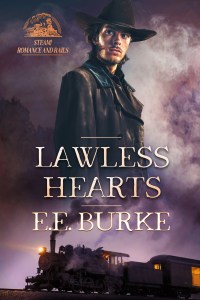
Jasper Byrne isn’t just an outlaw whose heart is reawakened. His conscience is under intense reconstruction, as well. After spending most of his life attempting to be someone he isn’t—a bad guy—he takes Brigit up on her offer to join her on the right side of the law. Although he doesn’t perceive himself as a hero. In fact, he’s confused when Brigit treats him like one. But her determination to reform him inspires Jasper to resist the flow of culture and history and end up like so many others in his situation—at the end of a rope.

Unfortunately, there are some who have the law on their side and are using it for nefarious purposes, and they have Brigit and Jasper in the crosshairs.

Here’s a blurb:

Lawless Hearts

Book 5 in the series Steam! Romance and Rails

The deal she offers him could be a path to freedom or a detour straight to hell.

Jasper Byrne has been an outlaw more than half his life. He’d do things differently, if he had the chance, but it is too late to change—or so he thinks. In chains, on his way to court where he expects to be convicted, he is hijacked from under the nose of a U.S. Marshal by a woman who pretends to be a reporter.

Brigit Stevens has worked as an undercover Pinkerton agent for ten years, guarding her heart while putting high-ranking rascals behind bars. But when a fellow detective goes missing during a railroad investigation, she has to turn to a train robber for help. She offers him a deal if he’ll guide her to an outlaw hideout where even lawmen don’t dare to go.

Jasper admires the beautiful detective’s pluck and her clever disguises, but she doesn’t seem to understand he’s a scoundrel. As for Brigit, she is more even more surprised when the dangerously sexy outlaw steals her heart before she can find the lock.

Can an outlaw and a Pinkerton form more than a temporary partnership? Does love have the power to rewrite the future and create second chances?

A high-powered Western romance that transports readers back to the wild American frontier where lawless hearts reigned. Don’t miss the last, most exciting, episode in the series Steam! Romance and Rails.

Lawless Hearts will be released this summer, but it’s available as a preorder now. In the meantime, if you haven’t read the series, you can get started with Her Bodyguard for free if you sign up now for my newsletter.

As a special offer, I’ll also give away a copy of Fugitive Hearts, which sets the stage for Lawless Hearts.

What would be a woman’s strengths in working for the Pinkerton’s that a man wouldn’t have? I can think of several.

E.E. Burke is a bestselling author of historical romances that combine her unique blend of wit and warmth. Her books have been nominated for numerous national and regional awards, including Booksellers’ Best, National Readers’ Choice and Kindle Best Book. She was also a finalist in the RWA’s prestigious Golden Heart® contest. Over the years, she’s been a disc jockey, a journalist and an advertising executive, before finally getting around to living the dream–writing stories readers can get lost in.

Find out more about her and her books at her website: http://www.eeburke.com

Guest Blogger Lisa Prysock – Nuns in the Wild West?

Hello Petticoats & Pistols! Thank you so much for having me on your blog today, Fillies.

It’s hard to imagine Annie Oakley, cowboys, and nuns holding down the Wild West. I’m envisioning something like The Sounds of Music starring Julie Andrews, or Whoopi Goldberg’s Sister Act, or my absolute fav, The Trouble with Angels starring Haley Mills, right?


Well, kinda. Bear with me.

Columbia Pictures Image It is believed that this poster art may be shared in conjunction with the Fair Use Act. Columbia Pictures owns the copyright.

In publishing my newest series, Montana Meadows, in conjunction with Magnolia Blossom Publishing, I began researching Montana Territory in the 1870s at the onset for the setting. I discovered some pretty cool stuff. Montana is known for their great big blue sky, gorgeous mountains mainly in the west, and plains throughout the middle of the state. They share a corner of Yellowstone in the southeastern part of the state, and they’re wildly famous for huckleberry pie.

I also ran into a Catholic mission operating as St. Peter’s Mission in my research. The mission had nuns, priests, and orphan students. The nuns and priests had come to Montana from a diocese in Toledo, Ohio. One of the volunteers for the mission, Mary Fields, an African American and former slave, moved to the area seeking freedom and independence. She eventually became known as “Stagecoach Mary,” a fascinating real-life heroine who ultimately became a stagecoach driver delivering mail to the mission and other establishments and residents in the area. You can learn more about Mary here–:


Fascinated by Mary’s story and all I’d learned about missions in the western hemisphere, for Book 1 of the series, Cherry Crossing, I invented a fictitious mission and town loosely based on my research. I named my fictional mission St. Paul’s and sketched out the lay of a fictitious version of the mission building and nave in my book and character building notes, resembling the one in my research. I didn’t have a “Stagecoach Mary,” but I did create and invent an interesting cast of nuns and priests who play a fun and significant role in the book. My nuns and priests come from a variety of dioceses in the western hemisphere.


I named the town in Cherry Crossing, Honey River Canyon. Imagine eight mountains trailing around the northwest corner, a river named Honey River winding through those mountains, and the town of Honey River Canyon spilling out from this backdrop.


The series is based on three Hayes sisters—Jocelyn, Jacqueline, and Jillian—whose parents perished in a blizzard some years before. The sisters rise to the challenge of managing the farmstead, named Cherry Crossing for the imported Canadian fruit trees on the property. Each book centers around a romance blossoming for one of the three sisters.

Of course, there are some gangstas, or bad guys, antagonists, or bad dudes, and we’ll definitely need a hero. Enter, Jake Hunter. Jake inherits the mayor’s mansion and remaining town plattes from his grandfather. He comes to Montana Territory to claim his inheritance, and Josie (Jocelyn) immediately thinks he’s swindled her out of the horse she planned to purchase. These two clash right from the start.

Jake has his work cut out for him in Book 1. He’s also framed for a murder. He has to find his faith, clear his name, capture the gangsters, and win the girl’s heart in order for us to have a happy ending. In Book 2, Sparrow’s Hope, readers will meet more of Jackie, but wear your bullet proof vest and hold onto your hat. She can load and shoot a six-shooter better than most men in the Wild West. (Coming soon!) In Book 3, Silver Mountain, readers will get to know the sweet, quiet Jillian as she finds her own true love and her dream of being a teacher.

I hope you’ll pick up a copy of this faith-filled romance. I’ll give away a signed paperback to one person who comments. Just tell me what you love about western romance or ask me a question about writing. We’d love to hear from you at Petticoats & Pistols!

Lisa M. Prysock is a USA Today Bestselling, Award-Winning Author of more than 33 Christian romance novels and a devotional. She and her husband reside in beautiful Kentucky in a rural area. Together, they have five children, grown. New empty nesters, they are slowly reclaiming their average colonial style house. Lisa loves espadrilles, long sundresses, and hats. She enjoys cross-stitching, crochet, sketching, reading, cooking, swimming, and many other things she finds hard to get to because she’s usually writing the next book. She loves sharing her faith in Jesus through her writing.

Readers can check out more about this author and view her books on the carousel at her author website. Sign up for her free newsletter here–: https://www.LisaPrysock.com

They can also connect with me at–:

https://www.facebook.com/LisaMPrysock

https://www.instagram.com/lisaprysock

https://twitter.com/LPrysock

https://www.amazon.com/-/e/B00J6MBC64?tag=pettpist-20

https://www.bookbub.com/authors/lisa-m-prysock

Guest Linda Shenton Matchett – Law Enforcement in the Old West

Photo credit: Pixababy/ArtTower

I settled on Gunnison, Colorado as the setting for my upcoming release, Ellie’s Escape. I’ve been fascinated with the state since visiting on business many years ago. The rugged mountains, deep canyons, and expansive vistas captivated me, and when I discovered that my boss is from Crested Butte (the next town over), I knew I had my location. He shared lots of photos and information that only a “local” would be privy to.

The premise for Ellie’s story is that she is an eye witness to a bank robbery and can identify the thieves. Frightened for her life, she decides to leave the area and agrees to become a mail-order bride. I knew very little about law enforcement in the Old West, so dug into my research with gusto.

Most folks think a constant stream of gun duels, shootouts, hangings, and chasing stage and train robbers made up the typical career of a lawman in the Old West, but in reality most of their work involved mundane and routine tasks such as collecting taxes, ensuring licenses were current, preventing the illegal sale of liquor, checking that businesses were locked up tight after hours, cleaning the streets, and keeping order in the saloons, gambling sites, or other entertainment venues.

Photo credit: Pixabay/Prawny

Sheriffs and marshals were the two main types of lawmen. U.S. Marshals have been appointed by the U.S. Marshal Service since its inception in 1789. They are not elected, and as federal employees their jurisdiction extends beyond county lines, often working with an assigned territory. Prior to 1896 when they were put on salary, marshals worked on a fee system, collecting set amounts for performing certain tasks. Between 1790 and 1870, marshals were responsible for taking the census every ten years. Up until 1861 when Congress created the Department of Justice, they reported to the Secretary of State.

Town marshals were elected or appointed depending on town laws and worked strictly within town limits. Towns and counties were also served by sheriffs (again depending on their laws). Privileges and responsibilities varied widely by territory and state. Most hired their own deputies and only rounded up a posse when necessary. In states that have not expressly repealed it by statute, forming a posse is still legal. Additionally, in some places the sheriff had the authority to carry out death sentences, most frequently by hanging.

The majority of lawmen were good and honest people, performing their jobs to the best of their abilities. Others were dependable only when wearing their badge, but lived outside the law during their off-hours. Still others were evil, using their powers and authority to break the law.

Photo credit: Pixabay/ddzphoto

A fun tidbit I unearthed is that famous marshal Wyatt Earp spent the winter of 1882-1883 in Gunnison. His cohorts Warren Earl, Doc Holliday, Texas George, and Big Tip were with him, all well-armed with a team of mules and entire camp outfit. Earp is said to have run the faro bank at one of the local saloons. Described as a fine-looking man, Earp had a drooping mustache that curled at the ends.

Gunnison “busted” shortly after that year, losing nearly half its population. The ore deposits had been exaggerated, with most mines producing low amounts and quickly running dry. Those who remained soon turned to cattle, ranching, and timber.

What areas of the Old West, if any, have you visited or lived in? I WILL GIVE AWAY AN EBOOK EDITION OF ELLIE’S ESCAPE TO ONE RANDOMLY SELECTED COMMENTER.


Ellie’s Escape

She’s running for her life. He needs a trophy wife. They didn’t count on falling in love.


Ellie Wagner is fine being a spinster school teacher. Then she witnesses a bank hold up and can identify the bandits. Fellow robbery victim Milly Crenshaw happens to run the Westward Home & Hearts Matrimonial Agency so she arranges for Ellie to head West as a mail-order bride. But her groom only wants a business arrangement. Can she survive a loveless marriage?


Banker Julian Sheffield is more comfortable with numbers than with people, but he’s done well for himself. Then the bank president tells him that in order to advance further he must marry in six weeks’ time. The candid, unsophisticated woman sent by the agency is nothing like he expected, but time is running out. When her past comes calling, does he have what it takes to ensure their future?


Purchase HERE 

Linda Shenton Matchett is an author, speaker, and history geek. She writes about ordinary people who did extraordinary things in days gone by. Her books are regularly praised for their accuracy and realism. A volunteer docent and archivist for the Wright Museum of WWII, Linda is also a trustee for her local public library.

She was born a stone’s throw from Fort McHenry in Baltimore, Maryland and has lived in historic places all her life. Now located in central New Hampshire, Linda’s favorite activities include exploring historic sites and immersing herself in the imaginary worlds created by other authors.

Guest London James – Monkeying Around

So, this post isn’t book-related, but I couldn’t help myself. And although it happened years ago, I still think about this day often.

Before I get into my little tale, let me start by telling you that I don’t like monkeys. Yes, you read that right, monkeys.

I know people think monkeys are cute and, oh by golly, we send them to the moon and teach them sign language because they are so intelligent. Oh, my stars, how can I not love monkeys? I don’t know how. The point is, though, I don’t like them. They freak me out.

So, with this new-found knowledge of my weirdness, you can imagine how blatantly ironic it is that out of all the homes in this country, I live in one that is one-tenth of a mile away from a monkey rescue reserve.

Oh yeah. It’s true. I can see it from my house.

Don’t get me wrong; I think what this woman is doing is a very commendable thing. She’s giving these animals a good life, taking them in when no one else will. I applaud her for her work, as I am a big animal lover and believe in helping animals. Not to mention, I bought my home knowing about the reserve, so with that, all I can do is accept and respect that it’s there. And that’s what I’ve done. For the most part, I’ve even forgotten about it…well, not entirely forgotten, I mean, they freak me out, remember?

Not to mention, it’s kind of hard to ignore when every now and then I hear a bunch of monkeys screaming, cages start rattling like thunder, men and women start shouting, and then I hear pops of what I assume are tranquilizer guns. And all I can think is ‘OMGoodness, they’ve killed the older woman and are running free, and you know they are going to come straight to my house, because . . . well because I’m crazy!’

Anyway, with that said, I don’t think about it much . . . at least I didn’t until this now infamous one night.

After walking around my entire property looking for my daughter’s miniature horse, I discovered he was missing. While I know the concept of having a horse go missing is quite odd, it’s the summertime, and my horses are out on seven acres of pasture, so some days, unless I catch them heading into the barn to sleep or heading to the water for a drink, I don’t see them all day. After running to tell the neighbor, her husband informs me that he saw a sign propped up at the end of the driveway of the monkey reserve that read “Pony Found”.

At what point do you have to laugh at how karma can mess with you?

So, armed with a rope, we head up to the reserve. At this point, I’m thinking. “I’m okay. She’ll bring Thomas out, and I’ll walk him home. It’s no big deal. I’m okay. I’m okay. I’m okay. All of the enclosures are behind the large wall anyways to detour prying eyes, so I’m sure she’s not going to take me back there. I’ll be totally fine.”

Wrong.

After she greets me at the gate, she motions me to follow her . . . behind the wall . . . into the deepest part of her property . . . THROUGH THE MONKEY ENCLOSURES!!!!

Just before she leads me in through the security gate, she turns to me and says. “Keep your arms down at your sides, okay. And try to keep your distance.” I’m sorry, but I think I just hallucinated. Come again? While I told her. “Okay.” In my head, I’m screaming. “Are you insert a lot of unmentionable words kidding me?” But what can I do? I have to get my pony. My ridiculously stupid pony who will spend all the days of his life on this earth locked up with the goats after this.

She started walking through the enclosures, leading me between several cages that were feet apart. Feet apart, people!!! Some of the monkeys didn’t do anything other than watch me walk by them, but of course, wouldn’t you know some were not happy with my presence. They screamed, hissed, showed their teeth, and worse of all, they reached through the chain-link fencing and TRIED TO GRAB AT MY ARMS AND CLOTHES!!

I think my pony has a death wish . . . it’s the only logical explanation.

So finally, after walking me through more enclosures than I can count, she points me in the direction of a small pasture area, and of course, there is my pony in the far corner…next to another enclosure.

Now granted, I have to give this lady props. The property is quite lovely. The lawn is kept up with; the enclosures are clean, trees are planted everywhere, giving the place a relaxed, lush feeling. It was tranquil…without the screeching from the monkeys, of course.

But back to my story, so as I’m kneeling in front of Thomas, securing the halter on him, about five or six monkeys are mere inches from me, screaming, jumping all over their fence, and reaching through the chain links trying to touch him and me. Of course, he’s not phased. I mean, why would he be? Obviously, he doesn’t mind being around monkeys at all.

Finally, I get the halter on and start leading him out. Well then, of course, all heck breaks loose. Apparently, the monkeys are attached to the little horse, and I’m taking him away . . . I clearly must die . . .

While I made it out safely (albeit left in the emotional state of desiring nothing more than a corner, a blanket, and my thumb to suck on), I suppose all I can do is shake my head and laugh off what will go down as the experience of a lifetime even though I’m still having nightmares.

Now that I’ve shared mine, are there any types of animals that freak you out for one reason or another? Each comment is an entry into a drawing to win ONE of THREE eBook copies of Her Mail Order Mix-up (Brides of Lone Hollow #1). You’re also welcome to join my reader group on Facebook. We have lots of fun there, daily! https://www.facebook.com/groups/4009277229199536

Her Mail Order Mix-Up (Brides of Lone Hollow #1)

Cullen McCray has no desire for marriage and love after the death of his first wife. A self-proclaimed lone wolf, he only wishes to spend his life in his cabin in the mountains, far away from his family’s ranch and his brother. But when Clint dies in an accident, he leaves behind a young daughter and it’s up to Cullen to pick up the pieces to help the girl. The question is can he also pick up the pieces for the woman, whom he knows nothing about, coming to marry his dead brother?

When Maggie Colton steps off the stagecoach in the small town of Lone Hollow, she’s unaware of her intended husband-to-be’s accident. She also doesn’t know about his brother or the condition of the cattle ranch she believed was something other than what it is. Clint hadn’t exactly been honest about everything, leaving Maggie to rough it in an older ranch house, an even older guest house, and a barn that has seen better days. Not to mention hundreds of cattle, dozens of chickens, pigs, horses, and what she is sure is the fattest cat she’s ever seen.

Will Cullen send her back before her bags are unpacked? And if she stays, will Maggie be able to not only win his heart but survive this new life she’s found herself in?


Buy Link

https://books2read.com/u/mdd0ry

Grab the series HERE

Guest Author Amanda Cabot – Did You Know?

Research. Authors tend to be in two camps where it’s concerned: those who love it and those who hate it. I’m firmly in the first category. I love learning new things about the time period and location I’ve chosen for my books, but – and this is a big but – there’s a problem. All too often I uncover tidbits that I find fascinating but that won’t fit into my stories. Since I hate to have them languish in my research folder, I thought I’d share ten of them with you today.

The first five come from The Texans, part of Time-Life’s The Old West series. 

  1. Although there’s no denying Stephen Austin’s importance in Texas history, colonizing the area wasn’t his dream. It was his father, Moses’s. In fact, Stephen was less than enthusiastic about the idea. But when Stephen learned that his father’s dying wish was that he ensure that Moses’s plans for Texas were realized, the dutiful son agreed. And the rest, as the saying goes, is history.


  1. One of the terms of the land grant Austin (Stephen, that is) received was that he’d bring 300 families to settle on that land. Though he’d expected that to be relatively easy to accomplish, he was only able to recruit 297. No one seemed too distressed by that breach of contract, and those families were soon referred to as the Old Three Hundred.


  1. The Mexican government had two stipulations for land ownership: settlers must become both Mexican citizens and Roman Catholics. Since most of the immigrants were Protestants, it was generally understood that Catholic rites would not be strictly enforced.


  1. Because not all communities had priests, couples who wanted to marry but didn’t want to wait for the priest to reach their town would often have a civil ceremony. That ceremony included signing a bond that they’d have their marriage confirmed by a priest as soon as possible. In theory, the bond was legally enforceable, but unhappy couples who wanted to dissolve their marriage simply destroyed the bond and declared themselves once more single.


  1. Speaking of marriage, Sam Houston, another legendary figure in early Texas history, had a disastrous one. Within three months of marrying the much younger Eliza Allen in 1829, they were separated, perhaps because of his drunkenness. Fortunately for him, when he married again in 1840, also to a considerably younger woman, the marriage was a longer and presumably happier one that resulted in eight children.


My second source of tidbits is T.R. Fehrenbach’s Lone Star.

  1. You’re undoubtedly familiar with the term hidalgo, but did you know that it’s derived from the old Spanish term Fijo d’Algo, meaning “son of someone important”?


  1. When Texas became a state, its constitution included some unusual (at least for the time) provisions. (1) No minister could serve in the legislature. (2) Married women were guaranteed property rights. (3) Private households were exempt from foreclosure. (4) Banks could not incorporate.


  1. In 1838 Texas became the first part of America to enact homestead legislation.


  1. Immigrants, particularly from Europe, formed a large part of the population. In fact, by 1850 European – mostly German – immigrants outnumbered Mexicans and Anglos in San Antonio.


  1. Among the immigrants who settled in the Hill Country were a number of intellectuals who formed utopian colonies referred to as “Latin Colonies” because they conducted weekly meetings where they discussed topics ranging from politics to literature to music in Latin. While there was no doubting the founders’ education, their lack of farming experience led to a predictable decline in the towns’ fortunes.


And there you have it: ten tidbits that intrigued me. Were you surprised by any of them? Which did you find the most interesting? Can you envision a story with one of these as its basis? If so, which?

Amanda is graciously giving away a print copy of The Spark of love to one lucky commenter.


The Spark of Love


Buying Links

Amazon

BakerBookHouse

Barnes & Noble

Christian Book Distributors


She’s determined to start a new life in the West . . . if only the old one will leave her alone


When a spurned suitor threatens her, heiress Alexandra Tarkington flees New York for Mesquite Springs in the Texas Hill Country, where her father is building a hotel. But the happy reunion she envisions is not to be as her father insists she return to New York. Instead, Alexandra carves out a niche for herself in town, teaching schoolchildren to paint and enjoying the company of Gabe Seymour, a delightful man she met on the stagecoach.


But all is not as it seems. Two men, each with his own agenda, have followed her to Mesquite Springs. And Gabe is an investigator, searching for proof that her father is a swindler.


With so much to lose—and hide from one another—Alexandra and Gabe will have to come together if they are ever to discover whether  the sparks they’ve felt from the beginning can kindle the fire of true love.


Amanda Cabot is the bestselling author of more than forty books and a variety of novellas. Her books have been honored with a starred review from Publishers Weekly and have been finalists for the ACFW Carol Award, the HOLT Medallion, and the Booksellers’ Best.


Social Media Links

http://www.amandacabot.com

https://www.facebook.com/amanda.j.cabot

https://twitter.com/AmandaJoyCabot/

http://amandajoycabot.blogspot.com/


What Makes a Cowboy and a Giveaway!

We’re so happy to have USA Today Bestselling author Paula Altenburg with us. She has a giveaway so scroll down. 

Thank you to Petticoats & Pistols for having me here!

Cowboys are made, not born.

But being a cowboy takes a certain type of personality, and those are the heroes I love to write.
Even though I write contemporary western romance, I do a significant amount of historical research, because real people are a product of their histories and their cultures. That’s one reason why you see so many successful marriages among childhood sweethearts. It’s also why no one will ever know you as well as your siblings do—they shared the same upbringing and understand where you come from. I say this from experience. (Not the childhood sweetheart part, though. My husband is Dutch. I will say that the majority of our disagreements over the years can be directly attributed to language nuances and having been raised in very different cultures.) This is a segue into European colonization, by the way.


The Irish in particular formed a strong presence in the American Old West. You can read a fascinating article on them here. Irish surnames show up all over the present-day west. In fact, two authors I use as writing resources have Irish names—Larry McMurtry (Lonesome Dove) and David McCumber (The Cowboy Way). McMurtry is Texan and McCumber is from Montana.

Grand, Montana was set up in my first series, The McGregor Brothers of Montana, as an Irish community. Grand’s fictional founders were two enterprising young Irish brothers (and ancestors of the contemporary McGregors) who made their money off selling liquor to soldiers. I’ve loosely based my Grand on real-life Miles City, Montana, which sits where the Tongue River flows into the Yellowstone River. I love the opportunities doing this offers me as a writer. If I need a setting detail, I can dip into the Miles City website and let my imagination run wild. The Miles City Chamber of Commerce is another great resource.


But setting Grand up as a fictional town means I get to make it my own. I read Lonesome Dove to get a feel for the landscape and what cowboys were like in the latter part of the 19th century. I read The Cowboy Way because I wanted to see how ranching has evolved. While ranch practices have changed with the times, cowboys, as it turns out, have not evolved in the least.
                                            

Sheriff Dan McKillop is definitely a product of his history and his environment. He’s
hardworking, he loves women (maybe a little too much) and he’s uncomfortable with money. When he and two friends inherit the Endeavour Ranch and billions of dollars, the only positive he sees is the opportunity to give back to his community. It takes a lot to knock him off his stride, but firefighter Jazz O’Reilly manages to do exactly that.
The Montana Sheriff is the first book in the Grand, Montana series.

Buy now

Four books will release this year with two more arriving in 2023.


Also in 2023, USA Today bestselling author Roxanne Snopek will be joining me with a series of her own. It’s tentatively titled The Lost Malones and familiar faces will appear.

And now, as a thank you to Petticoats & Pistols for having me here, I’m going to give away three electronic copies of another Grand, Montana book (and my USA Today bestseller!), The Rancher Takes a Family. You can check it out on my website.

All you have to do to qualify to win a copy is answer the following question and drop it in the comments below. “If you could live in any story world, what world would it be, and why?”
I’ll be stopping by throughout the day to chat and answer any questions.

Follow Paula at:

It’s Fun to Research Western Romance!

Howdy! Jan Scarbrough here! Before writing The Dawsons of Montana, I surfed the Internet for the setting and found a dude ranch in Southwestern Montana near Yellowstone National Park. I had also researched professional bull riding for an earlier book. Most of the setting for my fictitious dude ranch was made up and, of course, so were the characters.

In January, I added the fourth book to the series, Ben, and completed The Dawsons of Montana.

When my husband and I had a chance to go out west in 2016, I wanted to go to a dude ranch. After Internet research, I discovered The Covered Wagon Ranch in Gallatin Gateway, Montana. We made reservations and planned our trip for three days in July.

OMG! It was fun—two days on horseback riding into the mountains, gourmet meals prepared by a professional chef eaten in a rustic dining room with other friendly “dudes.” The owners, wranglers and staff were super friendly. Like many of the returning guests, we felt right at home at the ranch.

And yes, there were real working cowboys, men and women who make a living wrangling horses and caring for us city slickers. Their knowledge, love and respect for the land, and their devotion and caring for the horses impressed me.

I was given my own horse for the two-day stay. He was a six-year-old Tennessee walking horse named Mr. Black. He didn’t trot but performed a running walk. We never got up enough speed to go that fast because we were climbing up the sides of mountains! The view from the top looking down over the ranch property was scary. Believe me!

I could have had more fun trail riding but acquired a case of altitude sickness. The 6000+ feet of southwestern Montana mountains were very much higher than the 500 feet Ohio Valley where I live. I began to feel better on the second day, just in time to leave.

We also took a day trip to Paradise Valley, the actual setting of the Dawson ranch in my series, and ate lunch at a place called Chico Hot Springs near Emigrant, Montana.

On the trip, I got to see firsthand the mountains, canyons, and valleys that make this part of Montana so beautiful. Sagebrush is real. And so are lodgepole pine trees and aspens with their green and silver leaves shimmering in the wind. Of course, I came home pondering another Western series set in this beautiful part of the United States of America.

If you were going to write a Western novel, where would you like to visit?

Check out my two Contemporary Western Series, both on Kindle Unlimited.


The Dawsons of Montana tells the stories of rancher Jim Dawson’s widow Liz, and his children Brody, Mercer, and Ben. Can they find happiness and love in the aftermath of the heartache of the patriarch’s untimely death?

Hank brings two series together: the romantic The Dawsons of Montana and the romantic mystery Ghost Mountain Ranch!


Ghost Mountain Ranch, where old secrets are stirring, secrets someone might be willing to kill to keep. Can they finally lay the old ghosts to rest, or will the echoes of a decades-old murder destroy their second chance at love?

I’ll give away two ebook copies of Darby drawn from the comments left on the blog. Please answer my question: If you were going to write a Western novel, where would you like to visit?

About the book. DARBY: Thirty years ago, Darby Heston fled her family’s Montana dude ranch. Now she must return to help her father. Would the boyfriend she’d abandoned still be there? Hank Slade has never stopped loving Darby, but is he willing to risk his heart again? Secrets tore them apart once. Given a second chance at love, will more shocking secrets from the past destroy their hopes for the future?


Website 
BookBub 
Newsletter
Amazon Author Page 
AllAuthor