By Jeannie Watt
 Hi everyone and Happy Wednesday! I was fortunate to be able to spend the past weekend in my favorite
city, San Francisco, with my family. I love the history of this city, so thought I’d share a bit about the lost ships for those that are unfamiliar with this rather unique facet of the area.
Before the California Gold Rush, San Francisco was a quiet port, with a population of several hundred
people. After the rush, the population swelled to more than 42,000–25,000 of which arrived by water. Ships poured into the harbor, dropping off would-be prospectors, miners and speculators as well as people starting businesses to support the gold miners.

Many of the ships that anchored in the harbor never set sail again. At one point there were more than 500 ships in the harbor, many of which were totally aband oned. Eventually some of the ships were refurbished and put back into service, while others rotted away at their moorings.
A ship-breaking yard, known as Rotten Row, began operation. Crews of mostly Chinese workers would break down ships and sell the wood and metal, or re-purpose the ships into bars, businesses, hotels and storage units. There is even record of a jail and church being build out of refurbished ships.
As business boomed in San Francisco, the locals wanted to fill the shallow part of the harbor in order to allow larger ships to unload cargo in the deeper parts. The easiest way to do this was to sell water lots, which the owners were required to fill with material to bring it above sea level. In order to have title, the owner needed to have real property on the lot and an easy way to do that was to sink a ship on it, prior to filling. Another ways to get a water lot was to sink a ship on it first, and then lay claim to the land around the ship as part of the salvage. Many ships sank in the dead of night.

The original coastline of San Francisco began where the hills hit the water.The flat areas that now make up the Embarcadero and Financial District were once underwater. Eventually a seawall was built in 1871, creating the current shoreline. Between the seawall and the original coasts are the remains of as many as 75 buried ships.
 The Old Ship Saloon, still in operation, opened in 1851 in the hull of the Arkansas. Original patrons had to walk up a plank to enter the saloon.

The most inland known ship, the Niantic, was beached on the corner of Clay and Sansome Streets in the Financial District in 1849 and served as a storehouse until the fire of 1851 leveled her to the ground and she was buried.
The ship Euphemia became the local prison in 1850. During the day the prisoners would work on a chain gang and in the evening return to the ship to be locked in the hold. The conditions on the Euphemia worsened throughout the year and eventually a new prison was built in 1851. The fate of the Euphemia was unknown until her remains were dug up in 1921 at the corner of Battery and Sacramento streets. [Note: There is still some controversy as to whether that particular ship is the Euphemia.] In 1925 the store ship Apollo was discovered nearby.


More recent discoveries have been made and most have been reburied, with buildings going in over the top of them.
The ship Rome was discovered while building a Muni tunnel at the foot of Market Street. The ship was too large to excavate, so the tunnel was built through the hull of the ship.
If you’re ever in San Francisco, strolling along the Embarcadero, remember than you may well be literally walking over the top of the ships that helped build the city.
 Since this is the first weekend since Easter that dh’s and my calendars were empty, and it was supposed to rain and storm (note I said “supposed”) – it is the perfect weekend for staying off the boat and off the lake and getting our spring cleaning done.
 s, and get the dust, ash and soot out of the house. [http://en.wikipedia.org/wiki/Spring_cleaning]
 Lucille Mulhall was an anomaly—a small, feminine, soft-spoken girl who beat cowboys at their own game. After gaining acclaim as a Wild West performer, Lucille became the first woman commonly known as a cowgirl.
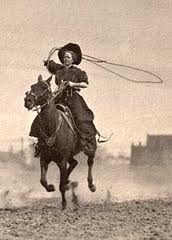 to 80,000 acres.
 performed in Madison Square Garden in New York City in 1905, she took the city by storm. A report in a New York newspaper said, “Against these bronzed and war-scarred veterans of the plains, a delicately featured blonde girl appeared. Slight of figure, refined and neat in appearance, attired in a becoming riding habit for hard riding, wearing a picturesque Mexican sombrero and holding in one hand a lariat of the finest cowhide, Lucille Mulhall comes forward to show what an eighteen-year-old girl can do in roping steers. In three minutes and thirty-six seconds, she lassoed and tied three steers. The veteran cowboys did their best to beat it, but their best was several seconds slower than the girl’s record breaking time. The cowboys and plainsmen who were gathered in large numbers to witness the contest broke into tremendous applause when the championship gold medal was awarded to the slight, pale-faced girl.”
 ve Lucille many names: Ranch Queen, Cowboy Girl, Female Conqueror or Beef and Horn, Lassoer in Lingerie, Dead Shot Girl, Daring Beauty of
 Will Rogers was a member of Mulhall’s Wild West Show and helped Lucille hone her roping skills. He wrote, “Lucille’s achievement in competition with cowboys was the direct start of what has since come to be known as The Cowgirl. Lucille was the first cowgirl.” Teddy Roosevelt also admired Lucille’s skills. He visited the Mulhall ranch and invited the Mulhall family to his inauguration. Geronimo gave her a beaded vest and Indian bow, which she treasured.
 abilities.She said, “My system of training consists of three things: patience, perseverance, and gentleness. Gentleness I consider one of the greatest factors in successful training.” Her horse, Governor, knew over forty tricks.
 ted to be a guest on Petticoats and Pistols today. A big thank you to Karen Witemeyer for hosting me.
 story. My hero, Toby, is certain the army will pay fistfuls for trained horses that can survive without supplemental oats and corn. The fastest and cheapest way to start was to round up wild mustangs who roamed the plains. My heroine, Nia, thinks Toby’s loco because mustangs are called wild for a reason! If you’ve ever seen a bronco busting rodeo event, you understand why Nia was concerned.
 Becca Whitham (WIT-um) is a multi-published author who has always loved reading and writing stories. After raising two children, she and her husband faced the empty nest years by following their dreams: he joined the army as a chaplain, and she began her journey toward publication. Becca loves to tell stories marrying real historical events with modern-day applications to inspire readers to live Christ-reflecting lives. She’s traveled to almost every state in the U.S. for speaking and singing engagements and has lived in Washington, Oregon, Colorado, Oklahoma, and Alaska.
  weren’t supposed to prospect for precious metals in the 1800s. They were considered too delicate to travel across wilderness and deserts, collecting ore samples and chasing veins while carrying everything they needed to survive in a backpack. Ferminia Sarras did it anyway.


 s them for their first night together.


 King Ranch in the Wild Horse Desert of South Texas. Henrietta was a tall, lovely young woman when she met and married Robert King. In her own words, she describes her happiness:
 Molly Ann Dyer married rancher Charles Goodnight. In May of 1877, Charles and Molly built a two-room cabin in Palo Duro Canyon in the Panhandle of Texas. The nearest neighbors were 75 miles away from where Molly Goodnight established the first ranch household in the Texas Panhandle. In her biography, she explains how happy she was, although left alone much of the time. She loved her husband.
 age 33, Dan Roberts was a fine specimen of a man, tall, lanky, and strong. He joined Company D of the Frontier Battalion of the Texas Rangers in 1874, when the rangers were reorganized to offer protection to pioneers on the Texas frontier. When Dan was ordered to go into Indian country, he asked to take his new wife along. She agreed and was eager to travel with the Rangers.
 On a blustery, chilly November afternoon, dh and I were invited to a friend’s remote property for food, friends and some shooting. We took our cowboy guns, of course, but our host had a surprise: A crossbow.
 n named Mozi. This philosophy, although it asserted a belief in universal love, also called for the development of a political structure within which there was no central authority other than Mozi’s writings. The Mohists developed many ideas on fortification, statecraft, as well as agricultural theories, and were soon hired as advisors for the leaders of warring states.”
 Though it took longer to reload than a longbow—a crossbow could manage only two volleys per minute while a bow could fire as many as 10—any soldier could be proficient with crossbow in a matter of days.
 t angle across the stock at its forward end. The stock was grooved, and an ordinary arrow was laid in the groove. The bow was pulled back with both hands, and the string caught in a notch on the barrel from which it was released with a simple trigger device.


 he Civil War, schoolteachers were mostly men because the prevailing belief was that women could not maintain discipline in the classroom. When the men left for the war, women moved in and filled positions at 60% less salary. When the men returned, they refused to work at the reduced wages (even though they did make more than the women teachers) and most left the profession.

