I’m no s tranger to cold weather. I was born in northern Idaho and I was there for the record cold temperature of -42°F in 1968. My dad was in college and we lived in a house with no insulation to speak of. My bedroom window, frame and all, would occasionally fall into my room if the front door was shut too hard and the nail holding it in wasn’t adjusted just right. I remember my mom putting so many blankets on my bed during that cold snap that once I was under them, I could barely move. The horses started running because of the cold and broke through the fence into the wheat fields. They had to be caught. Good times.

Then I moved to northern Nevada, which is also very cold in the winter. On my daughter’s sixth birthday, we woke up to temperatures of -34°F. The pipes were frozen, the truck wouldn’t start. We had a birthday celebration booked at the local McDonald’s. Fortunately, my friend’s truck did start and she was able to pick us up and take us to the party while my husband dealt with hairdryers, heat tapes and engine block heaters.
This fall I moved to Montana. I thought I was ready for the low temperatures—the record so far has been -24°F—but I’d forgotten just how face-burning cold this place can be when one has to go outside a lot. It felt different than the Nevada cold, which made no sense, since we also had numerous below zero days there. A kid at the Mac store in Bozeman cleared it all up for me. He mentioned that the cold must be a change. I assured him that we had cold weather in Nevada and he quickly said, “That’s desert cold. This is prairie cold.”
He’s right. Prairie cold is colder—which got me wondering about ho w in the world did the early settlers on the prairie–and I’m thinking the wind-whipped prairies with no mountains in sight–stay warm in those little cabins and sod houses with no wood to stoke the fires? The answer is cattle and buffalo chips and hay twists. The chips are, of course, dried bovine dung. The hay twists are bundles of dry grass twisted together. Both of these fuels burn hot, creating a lot of ash. The fire needs tended full time. One excerpt I read talked about one family member leaving the cabin with a bucket of ashes every time another came in with a load of fuel.
 The following excerpt illustrates the ongoing battle of staying warm and cooking with cattle chips.
“Here is the rundown of the operations that mother went through when making baking powder biscuits. … Stoke the stove, get out the flour sack, stoke the stove, wash your hands, mix the biscuit dough, stoke the stove, wash your hands, cut out the biscuits with the top of a baking powder can, stoke the stove, wash your hands, put the pan of biscuits in the oven, keep on stoking the stove until the biscuits are done (not forgetting to wash the hands before taking up the biscuits).”
— From Western Story: The Recollections of Charley O’Kieffe,
1884-1898. Lincoln: U of N Press, 1960.
I am in awe of the men, women and children who weathered the prairie winters back in the day in order to build a better life. I’d like to think I’m tough enough to have endured, as my great-grandmother did, but I’m also very glad I don’t have to find out for real.
What about you? Do you think you could have handled a prairie winter in a cabin or sod house?
 involves participating in the
 er, I had a little bit of problem fitting into the old costume. I was close–as in if I wore a corset, I’d be fine. I don’t want to wear a corset all day, so the only thing I could do was to make a new dress. Fast. In the middle of moving. We do not yet have water in our house, but we have electricity, and that was all I needed to make the sewing machine run.
 created by Kay Gnagey, faithfully recreates the original. You can read more about the original pattern

 redo the skirt tabs so that they are not spaced so far apart. But that is a project for another year. I’m debating about tassels on the buttons. The tassels I bought are too small, but Britex Fabrics is one of my San Francisco stops, so perhaps I will have tassels when I attend the Fair.
 involves snaps or hooks and eyes. But I persevered and got the darned things sewn on.


 5. In addition to loving to sew, I collect vintage patterns on ebay, then sew them into clothes that I may or may not be able to wear. Sometimes they look a lot different on the pattern than they do on a real body. I’ve discovered that I have 1930s shape. Those patterns fit me well.
 7. I started running when I was in my forties because my kids were in cross country. I hated it, but like sewing, eventually came to embrace it. I’m slow and steady.
 10. My family and I
 attend the Great Dickens Fair in San Francisco every year. I made all the clothing for the family. I found that I really enjoy tailoring. I think we look very dapper.


 And the winners are…Susan P., Teresa Fordice and Eliza! Please email me at jeanniewrites @ gmail .com (without the spaces, of course) to claim your prize. Eliza-I’ll send you a print copy of my latest Harlequin Western.
 Hello and Happy Wednesday! Today I’m in Florida, attending a writing conference and hanging out with my fellow authors. My husband is home packing the house for our move to Montana, which earns him a Great Guy Award.


 oned. Eventually some of the ships were refurbished and put back into service, while others rotted away at their moorings.

 The Old Ship Saloon, still in operation, opened in 1851 in the hull of the Arkansas. Original patrons had to walk up a plank to enter the saloon.


 Hey everyone and happy Wednesday! When I got back from the Romance Writers of America National conference one week ago today, I was greeted by a house with no electricity or water, and a slightly stressed out husband. He also had to replace the refrigerator while I was gone. I was kind of getting afraid to answer the phone while I was in San Diego.

 Hey everyone and happy Wednesday. Today I’m going to toot my own horn and discuss a western craft I love.
 n see some beautiful hitching in the prison gift store, along with other crafts created by the inmates.
 ou hitch? First you get some decent tail hair. Tail hair is different from mane hair—it’s courser and longer. Mane hair is used for the tassels and also can be twisted into ropes called mecates.
 ady cleaned and of equal length. I get it in black, brown and white. The white I dye on the stove, using plain old Rit dye, to create the not-so-natural colors.
 it has a knot in both ends, it stays put.


 I love early western movies—those made in the late 1920’s or early 1930’s. These movies were made close enough to the times they portrayed—the 1860s-1890’s—that the sets, the clothing, the horse gear, have a fighting chance of being fairly accurate. And if they’re not accurate, at least they’re interesting.
 n I’ve ever seen clothing-wise…but it was interesting.
 the homestead. When Jed gets out of prison, he goes to Nevada, to seek revenge against the Haydens. Lynn is hot on his heels, hoping to stop the violence. Matters are further complicated by the fact that Lynn’s in love with Ellen Colby (Esther Ralston) and the two hope to marry. I loved the final shootout, where people were actually reloading weapons, and the reloading took some time, just like it does in real life. T
 he women are shooting as much as the men.
 robably not–the leg part anyway. Nor were her 1930’s pencil thin eyebrows and semi-marceled hairdo accurate. But, since I love the 1930s, it was fun to see the 30’s influence on the 1870s fashions.
 Lucille Mulhall was an anomaly—a small, feminine, soft-spoken girl who beat cowboys at their own game. After gaining acclaim as a Wild West performer, Lucille became the first woman commonly known as a cowgirl.
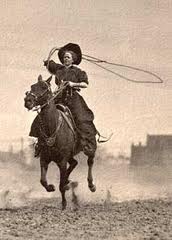 to 80,000 acres.

 performed in Madison Square Garden in New York City in 1905, she took the city by storm. A report in a New York newspaper said, “Against these bronzed and war-scarred veterans of the plains, a delicately featured blonde girl appeared. Slight of figure, refined and neat in appearance, attired in a becoming riding habit for hard riding, wearing a picturesque Mexican sombrero and holding in one hand a lariat of the finest cowhide, Lucille Mulhall comes forward to show what an eighteen-year-old girl can do in roping steers. In three minutes and thirty-six seconds, she lassoed and tied three steers. The veteran cowboys did their best to beat it, but their best was several seconds slower than the girl’s record breaking time. The cowboys and plainsmen who were gathered in large numbers to witness the contest broke into tremendous applause when the championship gold medal was awarded to the slight, pale-faced girl.”
 ve Lucille many names: Ranch Queen, Cowboy Girl, Female Conqueror or Beef and Horn, Lassoer in Lingerie, Dead Shot Girl, Daring Beauty of
 Will Rogers was a member of Mulhall’s Wild West Show and helped Lucille hone her roping skills. He wrote, “Lucille’s achievement in competition with cowboys was the direct start of what has since come to be known as The Cowgirl. Lucille was the first cowgirl.” Teddy Roosevelt also admired Lucille’s skills. He visited the Mulhall ranch and invited the Mulhall family to his inauguration. Geronimo gave her a beaded vest and Indian bow, which she treasured.
 abilities.She said, “My system of training consists of three things: patience, perseverance, and gentleness. Gentleness I consider one of the greatest factors in successful training.” Her horse, Governor, knew over forty tricks.