Time For A Make-Over

Last Thursday was a big day for me. I hit “send” on a new ms for Bethany House. It’s a contemporary instead of a historical, but the story has many the same elements that characterize my LIHs.  The hero owns a truck and a Harley instead of a few horses, but he’s a cowboy at heart. If I put the heroine in the Old West, she’d be running the local paper like she does in the contemporary.  No website, of course. But she’d still be in the thick of things and good at her job.  

I don’t have a final title yet, but the  tentative pub date is Spring 2014.  I’m glad it’s a ways off, because I have a lot of background work to do.  my website (www.victoriabylin.com)  in desperate need of a makeover, and so is my social media stuff.  The fact I call it “stuff” tells you this isn’t my wheelhouse.

So here’s what I’d like to know . . . What are the most important things to you as readers about an author’s internet presence? I’d love to hear what you think about everything from Twitter to book trailers to websites.

 To say thank you, I’m going to give away a few books.  To enter the drawing, just leave a comment. Three lucky winners will get to choose a title from my backlist.  Just one exception–I’m out of Wyoming Lawman.  (I either gave away a lot more of them than I thought, or my closet ate a box of author copies.) 

Here are some questions to get us started. Answer one or as many as you’d like. Or make up your own.  That’s even better.

 The first place I go online to check out an author’s work is _______________.

My favorite place on an author’s website is ___________________. (booklists, FAQs, bio, etc.)

I don’t like websites that __________________________.

Pinterest rocks because ___________________________.

Twitter rocks because ____________________________.

Facebook rocks because __________________________.

I love book trailers because _______________________.

I skip book trailers because _______________________.

I like to read reviews because _____________________.

I never read reviews because _____________________.

 Thank you all for your input!  Check back late tonight for the drawing winners.


Charlene Raddon & Chocolate: A Victorian Treat? Or More?


Today, chocolate is a universal sweet loved by virtually everyone, but how long has it really been around? The Victorians adored the hot drink, but did they invent it?

Actually, the first chocolate house in London opened in 1657, advertising the sale of “an excellent West India drink”. In 1689, a noted physician, Hans Sloane, developed a milk chocolate drink, which was initially used by apothecaries. Later Sloane’s recipe was sold to the Cadbury brothers. London chocolate houses became trendy meeting places for the elite London society that savored the new luxury.

But chocolate goes back much farther than the seventeenth century. The fermented, roasted, and ground beans of the Theobroma cacao (chocolate), can be traced to the Mokaya and other pre-Olmec people, with evidence of cacao beverages dating back to 1900 B.C.

The Maya are credited with creating a drink by mixing water, chile peppers, cornmeal, and ground cacao seeds. The Aztecs acquired the cacao seeds by trading with the Maya. For both cultures, chocolate became an important part of royal and religious ceremonies. Priests presented cacao seeds as offerings to the gods and served chocolate drinks during sacred ceremonies. Chocolate was so revered, the Aztecs used it as both a food and currency. All areas conquered by the Aztecs that grew cacao beans were ordered to pay them as a tax, or as the Aztecs called it, a “tribute”.
In 1521, during the conquest of Mexico, the Spanish conquistadors discovered the seeds and took them home to Spain. The Spaniards mixed the beans with sugar, vanilla, nutmeg, cloves, allspice and cinnamon. The result was coveted and reserved for the Spanish nobility. Spain managed to keep chocolate a secret from the rest of the world for almost 100 years.

Once discovered, the drink spread throughout Europe.

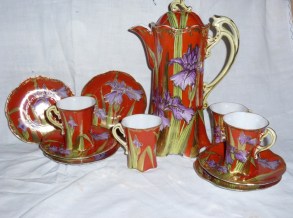
Somewhere along the way, some European decided a special pot to serve the beverage was needed. The earliest pots were silver and copper. Later, European porcelain manufactures began producing them as well. These pots had a right-angle handle and a hole in the lid in which a wooden stirrer, called a molinet or molinillo, stirred the mixture. Rather than a log spout which began in the middle of the side of the pot, as coffee and tea pots do, the chocolate pot has a flared spout at the top. If you look on e-Bay, you’ll see pots of both styles, those with the long side spouts offered as combination coffee or chocolate pots. Prices range considerably, but a good pot can run as much as $700.00, and a set, with cups and saucers and sometimes sugar and creamer, can be as high as $3,000. Although none of mine are this valuable, my personal collection of chocolate pots numbers about 25 at the moment. The photographs are from my assortment.

Although it doesn’t appear in my book, To Have and To Hold, hot chocolate would have been served in Viola Simses’ eatery, and my heroine, Tempest Whitney and her children would have gone there to enjoy the special beverage. Viola undoubtedly owned a chocolate pot, but she would have reserved its use for her private quarters, not the eatery where the cups and saucers would surely have ended up broken.

The origins of the word “chocolate” probably comes from the Classical Nahuatl word xocol?tl (meaning “bitter water”), and entered the English language from Spanish. How the word “chocolate” came into Spanish is not certain. The most cited explanation is that “chocolate” comes from Nahuatl, the language of the Aztecs, from the word “chocolatl”, which many sources derived from the Nahuatl word “xocolatl” (pronounced [ ?o?kola?t?]) made up from the words “xococ” meaning sour or bitter, and “atl” meaning water or drink. Trouble is, the word “chocolatl” doesn”t occur in central Mexican colonial sources.

Chocolate first appeared in The United States in 1755. Ten years later the first chocolate factory in the U.S. went into production.

BIO:  Charlene”s first serious writing attempt came in 1980 when she awoke one morning from an unusually vivid and compelling dream. Deciding that dream needed to be made into a book, she dug out an old portable typewriter and went to work. That book never sold, but her second one, Tender Touch, became a Golden Heart finalist and earned her an agent. Soon after, she signed a three book contract with Kensington Books. Five of Charlene”s western historical romances were published between 1994 and 1999: Taming Jenna, Tender Touch (1994 Golden Heart Finalist under the title Brianna), Forever Mine (1996 Romantic Times Magazine Reviewer”s Choice Award Nominee and Affaire de Coeur Reader/Writer Poll finalist), To Have and To Hold Affaire de Coeur Reader/Writer Poll finalist); and writing as Rachel Summers, The Scent of Roses. Forever Mine and Tender Touch are available as e-books and after January 24, To Have and To Hold will be as well.

When not writing, Charlene loves to travel, crochet, needlepoint, research genealogy, scrapbook, and dye Ukrainian eggs.


Charlene is having TWO giveaways today. First prize winner can choose between a Nippon Geisha Girl chocolate pot (photo to the right) or a $10 Amazon gift card. A second prize winner will receive whichever item the first prize winner does not select. All you have to do to be entered in the drawing is leave a comment.


DEBRA ULLRICK ~ ROMANTICIZING RANCHING


Boy, howdy, do we romanticize the old west ranching days or what? Let me tell you, there’s nothing romantic about ranching. Or is there?

My husband and I worked and lived on mountain cattle ranches for over 25 years. I remember my first year working on the ranch was a real shocker. As a rodeo barrel racer, I never dreamed how difficult it would be working with cattle.

Sorry to bust anyone’s bubble about those big doe-eyed, four-legged animals, but them cows sure are stupid. I could never figure out why they just didn’t save themselves the trouble of getting poked and prodded by just walking into the chute when they were coaxed to. When my husband had to get tough with them, me in my ignorance would holler at him and say, “H-o-n, treat ‘em with kindness.” He would just give me a look that said, yeah right lady. I truly felt that way until one day when I had roped a calf and had finally gotten it in the alley between the corrals. I jumped off my horse, and when I went to remove my rope from around the little “darlin’” calf’s neck, the thing waylaid me in the shin. I was so mad, I started pounding on that little duffer with my rope. (Please note that my pounding would be like getting a slight punch on

the arm.) My husband peeked over the fence and said, “Treat ‘em with kindness, huh, Deb?” To which I replied, “Oh, shut up!”

Ranching is hard work. Actually it’s a lifestyle that you have to love because you live it every day by working from sunup to sundown and the work is never done. When you finish with a long arduous, sleep-deprived calving season, then there’s the branding, the moving of cattle from one grazing parcel to another all summer long, the doctoring, irrigating meadows, the long haying seasons, the weaning, etcetera, etcetera, and then the cycle begins anew.

Living in town now, however, has made me appreciate the lifestyle I used to have. Things were much simpler. Life was much simpler. And now because I miss ranching so much, I set a lot of my stories in the ranch and county where I used to live, and relive those days through my characters.

Sunny Weston, the heroine in my Colorado Courtship story, The Rancher’s Sweetheart, loves ranching too. In fact, it’s in her blood, it’s all she knows. But there are those that don’t think Sunny’s capable of running her own spread. She’s out to prove them all wrong. That is, if love doesn’t get in the way.

So, is there romance in ranching?

Well, just ride through the trees with the man you love and discover hidden waterfalls, wild strawberry patches, abandoned broken down homestead cabins that scream of stories to be told, watch wild animals in their natural habitat, or have your hubby pick you a batch of wildflowers and give them to you when you least expect it. Or go for a sleigh ride together while feathery snowflakes are falling, or cuddle with your hunky cowboy husband in the pickup with the heater blowing full blast under a snow covered windshield while you wait to make sure a mama cow is going to have her calf successfully. Or take a walk on a warm sunny evening under a canopy of stars listening to a chorus of frogs, water running, coyotes howling, and owls hooting. I’ve experienced all this and more. So while there may be plenty of work to go around, there’s equally plenty of romance to go around too.

Leave a comment to be entered in a drawing for one copy of Colorado Courtship signed by both Debra & Cheryl St. John.

Horse Power to Horsepower


“When a man opens a car door for his wife,

 it’s either a new car or a new wife.” 

                                                                                      Prince Phillip

Ah, the automobile. What would we do without it?  The car I most remember is a battered old ’61 white Valiant with a stick shift.  The clunker almost caused me to gave birth and file for a divorce on the same night.  That’s because my husband steadfastly refuses to drive over the speed limit.  No thanks to him, I missed giving birth in that auto by mere seconds.


 The reason I have cars on my mind this month is because  of my new book, Waiting for Morning, a historical romance set in Arizona Territory in 1896. The hero, Dr. Caleb Fairbanks introduces the Last Chance Ranch cowhands to his beloved gas-powered “horseless carriage,” Bertha. When Caleb and backfiring Bertha incite gunfire from former dance hall girl, Molly Hatfield, the handsome doctor barely escapes with his life.  Little does he know that his troubles have only just begun.


Today, cars are blamed for everything from global warming to funding terrorism through oil dependency.  It might surprise you to learn that it wasn’t that long ago that the old gray mare was held responsible for the social and economic ills of the world.


In 1908, it was estimated that New York City alone would save more than a million dollars a year by banning horses from its streets. That’s how much it cost back then to clean up the tons of manure clogging the roadways each year. 


 A tree never hits an automobile except in self defense. 

American Proverb

Horses were also blamed for traffic congestion, accidents, diseases and, of all things, noise pollution.  Hooves clattering on cobblestones were said to aggravate nervous systems.  Even Benjamin Franklin complained about the “thundering of coaches, chariots, chaises, waggons, drays and the whole fraternity of noise” that assailed the ears of Philadelphia residents.


The first automobiles to drive west were driven by insurance salesmen and land agents.  When an attorney in a small Texas town rose to leave during an important trial, he practically emptied the courtroom. Jurors,  witnesses and spectators all wanted to see his two-cylinder Maxwell.  An irate judge pounded his gavel and ordered the autorist to “Drive the contraption a mile out of town where there are no horses and permit everyone to look it over so the court can resume its regular business.”


As with all technology, outlaws were quick to see the advantage of automobiles. The auto allowed for a quick get-away and would keep going long after a horse gave out. This left local sheriffs at a disadvantage. 


Youths hopped on the auto band-wagon long before their elders and many ceased driving the family springboards entirely. Frontier lawmen suddenly found themselves issuing stern warnings, not to outlaws, but to racing youths.


Remember: When everything’s coming your way,

you’re in the wrong lane.


The automobile was supposed to make the world a safer, saner, quieter and healthier place.  That’s something to think about the next time you’re stuck in traffic.  But take heart: the safer, quieter, more economical Robot Car is here.


www.margaretbrownley.com 

To celebrate the publication of my book, my publisher is running a fun contest. To enter all you have to do is write a paragraph or two about the car that played a part in your life’s story and send to:

contests@nancyberland.com

That’s it!  The winner will receive a $100 gas card. 

 So what car played a part in your life story?


To order print or eBook click on cover

Better yet, order from your local bookstore.

USA Today Best-Selling Author Jo Goodman's THE LAST RENEGADE


I’ve always been drawn to romance novels.  I don’t necessarily mean love stories, although I certainly have nothing against them.  I’m talking about romance as a broader concept, the idea of adventure and drama and mystery and characters that are moved as much by ideals as they are moved by ideas.  If someone gets kissed along the way, well, that’s all to the good. Is it any wonder that I found my way to the popular fiction of a century ago – the dime novel?

Dime novels figure prominently in The Last Renegade.  Most of the townsfolk in 1880’s Bitter Springs, Wyoming are of the opinion that Nat Church, the titular hero of over twenty novels, is a flesh and blood adventurer.  They have good reason to harbor that notion since people like Buffalo Bill Cody and Wild Bill Hickok did appear in serialized stories. Like many readers (me included), they want to believe in the Western hero: a man who will right wrongs, stand up for the oppressed, shoot the eye out of a one-eyed jack at ten paces, and save the town.  He might even get the girl, although he’d be real gentlemanly about it.

Dime novels, with their lurid covers, violent content, and heroic themes, were choice reading for adolescents, especially boys.  Certainly they were more exciting than the moralizing primers of the day, and along with newspaper accounts that read more like fiction, they romanticized life on the frontier to the extent that they might have contributed to the Western movement.   

In the tradition of dime novels, fact and fiction rub elbows in The Last Renegade.  Nat Church’s murder on his way to Bitter Springs has far reaching consequences for a town held hostage by a tyrannical family, a determined widow who wants justice for her sister’s death, and a stranger on a train who is chosen to serve and protect – not, it seems because of any particular skills – but because of the dime novel he is reading.

Let the adventure begin!

If this blog piques your interest, please leave a comment.  I will send a $10 gift card (reader’s choice) to

the winner (drawn from the comments by Petticoats and Pistols) along with a copy of The Last Renegade (if you would like one).  Wow.  Three parenthetical expressions in one sentence.  That might be some kind of record for me.

[This blog was originally published in USA Today online]

Alison Henderson ~ Real or Make Believe


It’s lovely to be back at Petticoats and Pistols, one of my favorite watering holes on the web. Today, I want to talk about mixing fiction and history.

How do you feel about real-life historical figures in romance? I occasionally like to use them as minor characters—possibly because I’m a research junkie and can’t resist including some of the most interesting bits I come across in my reading. I had great fun brushing shoulders with Jesse James in my first book, Harvest of Dreams. He only appeared in one scene and had few lines of dialogue, but his presence added a nice sinister touch.

My current novella, The Treasure of Como Bluff, is set in Wyoming in 1879, during the fascinating period known as the Bone Wars. In 1877, enormous deposits of fossils were discovered in the barren hillsides of Como Bluff, about one hundred miles northwest of Cheyenne near Medicine Bow. Two eastern professors, O. C. Marsh of Yale (photo on the right) and Edward D. Cope of the University of Pennsylvania, waged war on each other (largely through surrogates) in a decades-long campaign. They instructed their hired bone hunters to do everything in their power to gain the upper hand, from misdirecting shipments of fossils to dynamiting the rival’s dig site.

It might seem an unconventional choice of setting for a romance, but I had wanted to write a story about the Bone Wars for several years before starting The Treasure of Como Bluff. I love feisty, independent heroines, and a female paleontologist in the American West seemed just the ticket. I also wanted to capture the excitement of the blossoming of scientific discovery in this country in the last quarter of the nineteenth century.

My search for source material took me to Mark Jaffe’s terrific book, The Gilded Dinosaur. It’s a detailed account of the long rivalry, complete with original documents such as a letter to Marsh from a pair of bone hunters using the aliases of Harlow and Edwards describing their initial finds and asking for financial support. That letter painted such a vivid portrait of the two railroad workers-turned-dinosaur hunters that I included them in a scene but had them working for Cope (a valid choice since they changed sides depending on whichever sponsor paid the best at the moment).

I gave Professor O. C. Marsh a more prominent role, although he, too, has limited page time. My heroine, Caroline Hubbard, is excavating at Como Bluff, having tricked Marsh into hiring her, believing her to be a man. When the professor arrives unexpectedly to check on her progress, she has to persuade Nick Bancroft (the hero) to play the part of her husband, the paleontologist Marsh believes he hired. As you can imagine, mayhem ensues.

I don’t always include historical characters in my books, but when I do they mingle happily with the fictional ones. How about you? Do you enjoy real-life historical figures popping in to visit your make-believe world, or do you prefer that they confine their activities to sedate non-fiction? Let me know, and I’ll send a pdf of The Treasure of Como Bluff to one lucky commenter.  Here’s the blurb to whet your appetite:

In her race against rival bone hunters, the last complication paleontologist Caroline Hubbard needs is an unconscious stranger cluttering up her dig site. Nicholas Bancroft might have the chiseled features and sculpted physique of a classical statue, but she’s not about to let him hamper her quest to unearth a new species of dinosaur and make her mark on the scientific world.

Nick has come to Wyoming in search of silver but, after a blow to the head, finds himself at the mercy of a feisty, determined female scientist. Despite his insistence that he’s just passing through, he agrees to masquerade as Caroline’s husband to help save her job. Once their deception plays out, they face a crucial decision. Will they be able to see beyond their separate goals and recognize the treasure right in front of them?

Thanks so much to the lovely fillies at Petticoats and Pistols for hosting me today, and thank all of you for stopping by to visit.  You can read more about me and my books at www.alisonhenderson.com.

Alison

Noelle Marchand – Location Matters


Last week a friend and I went on a day trip to celebrate my recent graduation from college. The landscape went from the towering glass and steel buildings of Houston to the rolling hills and wildflowers of the country in less than two-hours. Suddenly, the tension I accumulated during my undergraduate years floated away like the fluffy white clouds painting that big Texas sky. I left the hustle of the city and the normalcy of my everyday life to experience a new adventure. And an adventure it was… Somewhere between a miniature horse attack, rambling through a rose garden, and singing “Chantilly Lace” at a 1950s style diner, I finally got it. Location matters.

I wandered into Peppin, Texas for the first time in 1877. It was a sleepy little township tucked away in Texas Hill Country. Back then, there wasn’t much to Main Street other than what the hero and heroine of my debut novel, Unlawfully Wedded Bride, needed to keep their farm and the story going. Only a few months passed before I started working on the next book in the series, The Runaway Bride, but that ended up being about ten years in Peppin. Imagine my surprise when I walked into that country hamlet and found it had changed into a bustling small town with modern conveniences like the railroad and telegraph.

After double checking the map of my imagination to make sure that I was in the right place, I set about familiarizing myself with Peppin, Texas of 1887. There was the boardinghouse, the seamstress shop, the hat maker, the livery, the blacksmith, the bank, etc. There were new streets, a residential section, and alleyways—even the alleyways became important. Finally, I could give you directions from my heroine’s house to the café and from the café to the church and from the church through the alleyway to the hotel. Then I sat down, took a deep breath, and wrote my story.

Suddenly, it wasn’t just writing—it was an adventure. I was in an entirely new location and after mapping out the town, I watched it come to life. I watched new characters emerge from those new businesses and houses to interact with old ones. Finally, I discovered what I suspected all along when my heroine explained Peppin to someone who had never been there before.

“It’s small but not stiflingly so. The people are friendly and really care about you. There is always something going on so you’re hardly ever bored. You can just go to the mercantile or the café to find someone to talk to or about, in some cases. It’s just a normal everyday Texas town. The only thing special about it are the people.”

Yes, sometimes it does feel a little weird to have an entire town of people in my head taking up space but I will gladly bear that privilege and burden because I want their stories to be as real to you as they are to me. I want their adventures to sweep you from that high rise, subway, or suburb into a country church, dark alley, or raging river so that hopefully when you finish the last page of my book you’ll smile and think to yourself, ‘That location mattered.’ 


Noelle has offered to give away two copies of her book, The Runaway Bride, to two lucky winners. All you have to do to be entered is join in the conversation.

Janet Dean ~ Last Minute Bride & Giveaway

 The Fillies Welcome…


Janet Dean


I’m excited to hang out with the fillies and their terrific friends here at Petticoats & Pistols! This visit marks the release of my first novella and sixth Love Inspired Historical. Last Minute Bride, Brides of the West, is on bookstore and discount store shelves now. The anthology also includes wonderful stories by authors Victoria Blyin and Pamela Nissen. Three for the price of one, a romance bargain.


Here’s a peek at Last Minute Bride:


Elise Langley was stung to the quick when her would-be suitor suddenly left town. But when David Wellman returns and they are thrown together organizing their friends’ wedding, can she open her heart again?


In the dedication to Last Minute Bride, I tell my husband that our wedding day was the best day of my life. The days our daughters were born rate as best days, too, but my husband gets top billing. He was first after all.


Our wedding took place on a perfect June evening in a flawless ceremony…if you overlook that no one thought to turn off the sanctuary lights for our candlelight service. The bridesmaids wore aqua floor-length dresses and matching pillbox hats with short flirty veils. The flower girl, my five-year-old cousin, not only looked adorable, she performed like a pro, scattering petals down the aisle. The groom, groomsman and dads were debonair in black tuxes. We all either carried bouquets or wore boutonnieres of white daisies. Lace daisies adorned the scooped neck of my short-sleeved floor-length white gown. The dress graced the cover of Brides Magazine. I still have the picture, the dress, veil, even a packet of rice that wasn’t thrown as we left the church. We found rice in our Chevy convertible for months afterward. The reception consisted of a tiered wedding cake, punch, coffee, mints and nuts. The entertainment was the gift opening, nothing like the elaborate sit-down dinner and dancing at our daughters’ receptions. Though our simple reception was typical for my hometown, it does sound kind of, well, boring. But when you’re surrounded with love and well wishers and feel like the bride and groom cake topper come alive, you’re not bored. J Anyone else have this kind of a reception?


Not all weddings go as smoothly as ours did. We’ve all heard, perhaps some of you have even experienced, fainting or giggling grooms/brides/bridesmaids, screaming flower girl/ring bearer toddlers refusing to take a step down the aisle, dropped rings, and a pastor who messed up the couple’s names. If you want to see the funny and the not so funny, check out YouTube.


No matter what happens, most couples end up married. I’ve heard that brides and grooms have been stood up at the altar, but never witnessed it. The weddings I’ve attended have been beautiful, deeply meaningful ceremonies that strengthen my commitment to my own vows.


These days, with our family and friends and their children married, we attend very few weddings. I miss them. I love everything about weddings. The sacredness of the vows, the stunning clothes, lovely music, smiling faces, wedding cake. I soak up the romance of it all. My husband and I are great guests, if you need extras. LOL We stay late and love to dance. We’re no Ginger and Fred so the crowded dance floors suit us fine. I’m sentimental and get weepy during the ceremony so take a fancy handkerchief. Not sure why I get teary, except that watching the starry-eyed couple take this important step, eager to embark on their new life together, full of hopes and dreams, zips me back to the best day of my life, our wedding day. A happily ever after ending that isn’t fiction.


I realize that not everyone finds Mr. Right. Lots of marriages don’t end happily. If that’s the case for you, I hope you will be blessed with peace in your circumstances and optimism for the future. It’s never too late to write a new story, to have a new beginning, to find contentment in the now.


I’m giving away a copy of Brides of the West and Wanted: A Family. Perhaps you can share yours or someone’s wedding story. Or if you’re brave, a wedding calamity. Better yet, something funny during the ceremony that made everyone laugh. Whatever is on your mind, leave a comment for a chance to win.


To Win Her Heart – Celebrate with a Giveaway!!!

Happy Friday the 13th!!! I’m determined to make this a LUCKY day for two of today’s visitors. In honor of To Win Her Heart being named a finalist in the 2012 Romance Writers of America’s RITA contest for Best Inspritational Romance, I’ll be giving away two copies of Levi and Eden’s story.

And because my stomach is still all fluttery over the announcement and I’m having trouble concentrating, I thought I’d post an excerpt from the book and hopefully entice you into leaving comments for your chance to win.

In this scene, our heroine, Eden Spencer (spinster librarian and daughter of the town founder) has just met the man applying for the blacksmith position. In her father’s absence, it is her duty to ensure he is qualified for the job, but once she gets a good look at Levi Grant, she has a hard time keeping her mind on her task.

Oh, and as a side note for those not familiar with the story – Levi has a speech impediment that gives Eden a false first impression of his intelligence. For a book-loving librarian, a man who has trouble stringing a sentence together is not much of a catch. So why can’t she stop staring at him?


Excerpt from To Win Her Heart:

Eden fiddled with the bonnet strings that draped over the arm of her chair and into her lap. Even though she and Mr. Grant were not alone in the room, it suddenly felt as though they were. She glanced in his direction, and her gaze collided with his. They both smiled then quickly looked elsewhere. Well, Mr. Grant looked elsewhere. Eden couldn’t seem to find another object in the room on which to rest her gaze. But it wasn’t as if she wanted to look at him. The man was as big as a mountain. Where else was she supposed to look?


He certainly possessed an abundance of brawn. Eden’s attention flittered over his arms as he leaned forward and balanced his forearms on his knees. The fabric of his sleeves seemed too meager to contain the muscles within as it stretched thin over his biceps. The heavy aspects of ironwork would be no hardship for this man. It was unfortunate that his intellect hadn’t developed to the same extent as his physique. Then again, he wasn’t interviewing for a position as schoolmaster, so what did it matter? Except that it did matter—to her—a bit more than it should.


A vague feeling of disappointment had circulated through her when she first heard him speak. Why his halting verbiage should bother her, she had no idea. It wasn’t as if she had any personal attachment to the man.


Eden sat up straighter in her chair, uncrossing her ankles then crossing them again in the opposite direction. She forced her eyes away from the blacksmith, glancing behind him to where Mr. Draper stood hunched over the desk, penning an addendum into the lease contract. Unfortunately, Mr. Grant chose that moment to straighten his own posture, the top of his head moving to block a good portion of the banker’s back and half of the preacher’s arm from her view. Eden bit the inside of her lip.


For heaven’s sake. She was tempted to think he had somehow discerned her intention to ignore him and taken action to prevent it.  But, no. The man was just restless. He lifted a hand and scratched a spot behind his ear as he turned his face toward the window. When he finished, a small tuft of hair stuck out, somehow making the gargantuan man seem almost boyish. Eden’s lips curved slightly before she pressed them back down into an indifferent line. His thick, dark brown hair was cropped into short waves. She wouldn’t call them curls; that descriptor sounded much too feminine for a man as rugged as Mr. Grant. However, the strands looked as though they would easily wind around a person’s finger … should a … uh … person’s finger have cause to be in his hair.


The smith glanced back at that moment, and Eden dropped her gaze to her lap. Where her right index finger had apparently wound itself up in her bonnet ribbon while she’d been contemplating the man’s hair. She immediately extricated the iniquitous digit and gave it a firm glare.


Eventually Eden learns there there is much more depth to this quiet man than a mound of muscle and hair that temps her fingers to bury themselves in its waves, and it is this depth of character that truly wins her heart. But a stunning first impression never hurts, right? Ha!

How about you–any memorable first impressions you’d like to share? Or maybe like Eden, you had a false first impression later proved wrong. Leave a comment to be entered in the giveaway.

Oh, and if you would like to read the entire first chapter of Levi and Eden’s story, click here.

Deb Mullins – Why I Love Writing Western Historicals


I’d like to thank Petticoats and Pistols for having me as a guest today.

Though I only have two to my credit, I love writing Western historicals. I’ve written seventeenth century pirates, Regency dukes and Victorian gentlemen, but I have to admit to having a soft spot for my Western novels.

The fun thing about writing a romance set in the nineteenth century American west is that people ended up going west for a variety of reasons. Maybe they were looking for gold or working for the railroad or hungering for land of their own. Or maybe they were looking to get away from the past. Anything is possible. Anyone could become anything out west, no matter who they were before. And that simple truth opens up trails to innumerable secrets and stories.

Jack Donovan, the hero of my February release DONOVAN’S BED (Samhain Retro Romance), is a man with a secret. He’s traveled all over the west as a bounty hunter. Then a job went bad and he realized he needed a new life. So he took all the money he’d earned over the years and moved to a tiny town where he could start over, intending to keep his former life a secret. But Sarah Calhoun, the heroine, runs the town newspaper, and she smells a rat. She’s determined to uncover the truth about Donovan. After he insults her, she prints a story in the newspaper that the rich rancher is looking for a wife. The article backfires, and the ensuing flood of women on the small town of Burr opens up some fun chaos!

While it hardly compares to modern day, social rules for women out west seemed a little less strict than back east. Western living was hard, and a woman had to be just as tough, doing whatever needed to be done to get by. Women in the west had to worry about survival and had no time for frivolous nonsense. However, they were still expected to be virtuous and God fearing, whether married or single. Prostitution was still frowned upon, and unmarried girls were expected to retain their virtue until marriage. Most women in the west did intend to eventually marry, but until that day came, they could take on jobs and vocations that had been, until then, traditionally men’s.

A great example of this is Wyoming Territory, where DONOVAN’S BED takes place. Women were granted the right to vote in 1869 in Wyoming Territory. By 1882, when my story occurs, Wyoming was already allowing women to serve on juries and even had a female Justice of the Peace. Because of all this, it was easy to make my heroine the independent woman I needed her to be in order to boldly print the story about Jack Donovan’s search for a wife. The town accepted her doing that without much social punishment (though it certainly gave rise to gossip). It would have been much harder setting that story in an eastern state in the same year, as social mores were a bit stricter. A male editor might have refused to print or even read the story. But since I was in Wyoming Territory, where women’s rights had an early start, I could make it work.

I loved writing the town of Burr with all its quirky citizens. I’m giving away a copy of DONOVAN’S BED (electronic only) to one lucky commenter. An excerpt of the book is available here:
http://store.samhainpublishing.com/donovans-bed-p-6735.html