 Howdy!
Welcome to another Tuesday blog here at Petticoats and Pistols. Sadly, one of my publishers, SAMHAIN PUBLISHING, is closing its doors, and although I’m not exactly certain what that mean in terms of e-books and such, I thought that I would like to give away a few e-books today…just in case those e-books are turned off when I post again (March). So come on in and leave a message. Over here to the right are the Giveaway Guidelines that rule our free give-aways. So take a look, and then come on into the blog and let’s talk.

The Scout. I’m fascinated by the philosophy and the skills of the old scout of the American Indian tribes. Over to the left here is a picture of “Curly,” who was probably one of the most famous “scouts.” He was a handsome man, and many of the pictures depicting scouts show the image of Curly. But was he really a scout?
Well, he worked for the military. He was Crow, a traditional enemy of the Sioux, and he used his skills to help Custer track down the Sioux and kill them.
Hmm… Yes, he could track. Yes, he knew many things about tracking and about the environment that the white man didn’t know. But did he adhere to the philosophy of the true scout?
No, he did not.
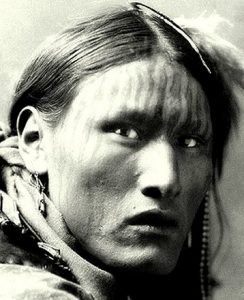
The Picture to the right here says that this is a Sioux scout, another handsome man. However, though I’m sure he did some scouting for the military, the fact that he hired himself out to scout and had his picture taken as a scout, would pretty much show that he was not a true scout. Why?
Reason number one: Okay — this I find so very, very interesting. The society of the scout — the true scout — was extremely secretive. In fact, no one in the tribe, outside of the actual society, knew who were their scouts. These men led dual lives, because to announce themselves as a “scout” would be as to deliver themselves up to a possible enemy. It would defeat the very philosophy of the scout.

Reason number two: A scout was a peacemaker. Although the scout trained physically every day of his life, learning to endure and flourish in all kinds of weather and all kinds of conditions, he used those skills to improve body control, not to hurt others. Rather he used these skills to control his body so well, that he could translate that control over into his thoughts. This, then could open up the world of the spiritual nature of life to him. A scout learned to fight and he could win most every battle — utilizing the wolverine style of fighting. But he was taught never to start a fight and to also walk away from a fight, even if it meant his own humiliation. Only if pressed, only if it were a matter of life or death for himself, a loved one or a member of a tribe, would a scout fight to kill. Indeed, a true scout would be shamed to carry a grudge against a whole people, and he would never submit himself to aid any cause that would murder an entire tribe.

Reason number three: In the book, THE WAY OF THE SCOUT, by Tom Brown, Jr., he points out that “Grandfather,” the man who taught Tom and his friend the scouting techniques of the Apache, was very adamant about the fact that these “scouts” who the US Army hired to track down other tribes were not the true scout. The duties of the scout were to be “the eyes and ears of the clan.” Quote from Tom Brown, Jr., THE WAY OF THE SCOUT. Their duty was to guide and protect the tribe from all enemies; to find game and to lead the way to the game. Always uppermost in their mind was to keep the tribe safe. Upon their trusted word, depended the lives of every member in that tribe.

Boys were trained for as long as ten years to become a scout. During that time, they learned the classical methods of tracking, of erecting shelters, of water safety. But once learned, they were then taught the same skills again, this time with the aspect of secrecy that was the very life breath of the scout. They learned how to erect shelters that would fade into the environment; they were taught how to read the emotions, mind set and even to tell different injuries to the body of the man or animal they were tracking. They learned how to endure pain, hunger, cold, heat and yet flourish, but most of all, they learned to respect the right of all life to live, to enjoy life and most of all, how to love all life.

At present I’m engaged in writing my next book, whose working title is BRAVE WOLF’S LADY. The hero is a scout, a true hero.
Because other men hired themselves out to the army to hunt down other tribes, I think that a great wrong has occurred. Perhaps it was simply a mistake. But those men who aided the army were incorrectly called, “scouts.” They weren’t. Perhaps many of those men didn’t speak English and so they didn’t set the record straight. But for whatever reason, I believe that a stigma of viciousness has attached itself in a greater or lesser degree to the name of the scout. And it is undeserved. By the way, the picture to the left is Quanah Parker, Commache.
 It is one of the privileges of writing, I think, that one is able to put some of these false impressions to rest by telling the real story. And i also believe that this might well be one of the reasons why I write.
What do you think? Do you believe that there are some historical lies that perhaps need to be set straight?
Come on in, leave a comment, and by doing so, you will automatically be entered into the drawing.
SENECA SURRENDER is currently on sale at: http://www.amazon.com/Seneca-Surrender-Warriors-Karen-Kay-ebook/dp/B01M3QAE67/ref=sr_1_1?ie=UTF8&qid=1487645087&sr=8-1&keywords=Karen+Kay+SENECA+SURRENDER&tag=pettpist-20
 Howdy!

 one television channel. Fortunately, it was the channel with Roy Rogers, The Lone Ranger and Sky King. As a kid, I ranked these shows in the same order I just listed them. Roy was, without a doubt, the king of my Saturday television lineup. The Lone Ranger second, and Sky King third. The reason? Why Sky didn’t ride a horse. He flew an airplane. His niece, Penny, rode a horse, however
 , so that made the show worthy of my attention.
 iving in remote areas, he had a small Cessna airplane, Songbird, but in addition to checking the herds, the condition of the range, and traveling to town for supplies, Sky also used his plan to capture criminals and spies, solve crimes and find people who lost their way in the desert. He had help in the form of the local sheriff, Mitch, played by Ewing Mitchell.
 uld rescue them. I particularly remember Penny getting into a boatload of trouble. She was forever getting captured, and that kept me on the edge of my seat, wondering how Sky was going to get her out of this mess.
 Hmm–I remember the acting as being superlative. And if Sky had ridden a horse as often as he flew the plane, Sky King might have bumped The Lone Ranger out of second place in my personal favorites standings. Interestingly, the show was popular in the aviation community, even though it was written for kids, and several astronauts noted it as a show that influenced them as they grew up.

 I’ve always had a thing for hats. I’m sorry that they aren’t worn more in today’s world. I love seeing the hats worn by Princess Kate and Queen Elizabeth. I have never see the Queen without a hat. Such elegance!


 I grew up in Mississippi and moved to Oklahoma when I was in my late teens. One thing you can say about the deep South and Southern-minded places like the Sooner State is the language can be quite colorful. I never paid much attention to some of the idioms I would spout on a daily basis. Even after all this time. That was, until I got a Yankee friend! Yep, now I’ve done it. But my crazy sayings afford her laughs on a daily basis, and I suppose that’s more than most can ask for.


 And, brand new on Amazon, available for preorder
Britney Adams
is the winner of my drawing from yesterday!
Britney — You may contact me at kathryn at katherynalbright dot com and let me know where to mail your autographed copy of Western Spring Weddings!