Boone Helm–Wild West Serial Killer

Nickname–The Kentucky Cannibal

I give a speech where I talk about ‘Where do you get your ideas.”

The answer is usually…from research.

I’m researching a current book and I run across weird tidbits that give me chills or make my eyes go wide, or make me ask, “Did this REALLY happen?”

Such is the reaction I got when I read about Boone Helm. The Kentucky Cannibal. Serial Killer of the Wild West. YIKES.

He got his nickname for, and I quote, “His opportunistic and unrepentant (I don’t know who I’m quoting you understand, who said this???) consumption of human flesh.

He came from, by all reports, a fine family (but there must’ve been SOMETHING, yeesh!) Maybe not. Maybe he was just bad!!!

He was from a family of twelve children, so that’s a BIG family but, being from a family of eight, I like to think large families and murderous insanity don’t necessarily go hand in hand. (I hope! So far so good!)

Married at age twenty, by age twenty-two he was divorced in an era that did not make that easy. His wife being regularly beaten must’ve helped. Boone Helm’s FATHER paid for the divorce so the wife must’ve had some sympathy. In retrospect she was probably lucky to get out of the marriage ALIVE. And they had a daughter. WHAT WOULD IT BE LIKE TO HAVE HIM FOR A FATHER???

Helm abandoned his family (thank you Jesus!) and pretty much cut a swath of robbery and murder across the west for the next thirteen years. He was twice convicted and sentenced to death only to escape through once, feigning madness (although who knows, he probably was mad, but still that doesn’t mean you don’t watch him closely right???) And once by convincing his brother to pay off a scad of witnesses…buy their silence.

After which he went home with his brother and then set out killing and robbing again. He boasted of the men he’d eaten to outlaw friends. Including once eating a man’s leg, then cutting off his other leg because he had a long journey and needed food.

OKAY that wasn’t my point really, I just found him such a ghastly character I had to write about him but….I’m toying with the idea of having him be a bad guy for a book. Or a fictionalized, slightly less hideous version because in this case, I seriously can’t handle the truth.

What do you think? What if I have a heroine and this guy is her father. Hoone Belm’s daughter!!! What if you were little Letitia Belm and you headed west only to find your long gone father is the most notorious, vicious criminal ever to roam the frontier?

Is it too much?

Like I said, I’m just toying with it. But wow, what a lunatic. What a character. How could you live it down?

She needs to marry a lawman, huh? That’d be a fine conflict between them.

Anyway, where do ideas come from? It’s from stuff I read like this.

What’s the craziest REAL LIFE character you’ve ever heard of. In this case, mine is one of those…what’s that saying? I’m fumbling for it. Something like…Fiction is harder than a true story, because fiction has to make sense.

I’ve updated my website and I really love it. Go have a look if you’ve a mind to. Mary’s Website

Let’s talk crazy characters!!!


Charlene Raddon Comes to Visit!

Miss Charlene Raddon will be coming around the bend on Friday, May 17, 2019!

This talented author will talk about the challenges of writing a sixteen-book series with eight other authors. The devil is in the details and those caused a lot of headaches.

Miss Charlene is toting some gift cards to give away. YeeHaw!

So don’t get left out. Hightail it over come Friday!

Join the party and leave a comment to get in the drawing.

It’s easy and painless.


Landscape Architecture from the Past

Recently, I was eyeball deep in research for an upcoming historical release. 

In the story, set in 1913, the heroine is a nanny and the hero is a landscape architect. 

The hero, Flynn, runs a landscaping business with his sister. Not only does he design elaborate (or simple) gardens and yards, he also has a huge greenhouse where he develops and experiments with plants. 

When I started working on Flynn’s character and his profession, I did some research into landscape architects and greenhouses.

The first recorded greenhouses were in Rome around 30 AD. Legend states that the physicians of Emperor Tiberius told him he needed, for health purposes, to eat a cucumber every day. Supposedly, his scientists and engineers brainstormed how to grow plants year round and the greenhouse came to be.

Greenhouses traveled to America in the 1700s. They grew in popularity in England in the mid-1800s when glass began to be widely manufactured. The inspiration for Flynn’s greenhouse comes from the spectacular Temperate House at Kew Gardens in London. My gracious, I’ve added this impressive garden to my bucket list of places I hope to someday see.

Temperate House is the world’s largest Victorian glasshouse and recently reopened after an extensive renovation process. Some of the world’s rarest and most threatened species of plants are among the 1,500 species of plants from Africa, Australia, New Zealand, the Americas, Asia and the Pacific Islands included on display.

Of course, Flynn’s greenhouse isn’t as magnificent as this or nearly as large, but it did give me some wonderful ideas of what his greenhouse might look like. And he has an interesting collection of plants and flowers he’s collected from his travels around the world.

When I first considered Flynn’s career, the term landscape architect seems so modern. But I discovered the roots of the profession go back to 1828 when Gilbert Laing Meason, a Scotsman, wrote a book offering insights into the art of relating architecture to landscape. William Andrews Nesfield was reportedly the first person hired as a “landscape architect. He designed garden areas for Buckingham Palace in London and Castle Howard in Yorkshire. In 1863, Fredrick Law Olmstead used the term landscape architecture for designing public open space (parks). Olmstead is known as the father of American Landscape Architecture. I like to think his work helped inspire my character Flynn.

In the story, Evie (releasing May 23), Flynn is hired to design and install an elaborate garden at the home of a well-to-do couple with three young children. Flynn finds himself falling for the nanny and scheming ways to spend time with the effervescent woman. 

Will love bloom between a spunky nanny and a distracted landscaper?

Unconventional nanny Evie Caswell views it as her duty to bring fun and laughter to the residence of her strict, aloof employers. Full of life and spirit, she is determined to teach the couple’s children how to be young and carefree. With hardly a minute to herself, she long ago surrendered her dreams of having her own home and a family. Then her employer hires Flynn Elliott, a landscape architect, to turn the yard into a spectacular garden. Enchanted with the intriguing man, Evie realizes after meeting Flynn nothing in her life will ever be the same.

Renowned for his landscape designs and ability to make anything grow, Flynn Elliott is a bit of an enigma. He spouts romantic poetry to the plants in his greenhouse and stealthily avoids social interactions, yet can charm birds right out of the trees when the need arises. While his sister handles the finer details of their business, he often loses himself in his work, forgetting the outside world exists. A chance encounter with a beautiful woman in a moonlit garden leaves him seeking opportunities to discover more about the effervescent Evie and the joy she radiates to those around her.

Will the two of them be able to set aside their doubts and fears to embrace a happily ever after?

Brimming with lighthearted moments, snippets of history, and the hope of true love, Evie is a sweet historical romance sure to warm your heart. 

Available May 23, you can pre-order your copy today! 

If you could travel back to 1913, what career would you choose?

Santa Fe, Where History Collides With the Present!

After writing two books without much of a break, I decided it was time to get away. Actually, a good friend of mine twisted my arm. She kept talking about making adobe bricks in Santa Fe, NM and before I knew it, I told her I’d go along…just to keep her out of trouble. *wink*  But it didn’t take much persuasion. Despite being born in New Mexico and living there the early part of my life, I’d never been to Santa Fe or made real adobe bricks. And I wanted to go. Darn it, I earned the trip! 

So, on a recent Friday morning, we left Raton, NM and started down. These are buffalo we saw just outside of Cimarron.


Then we meandered our way, enjoying the fresh air of the mountains. We met her parents for lunch in Española. I thought that would be a sleepy little town but it was pretty big. Lunch was excellent by the way. From there we wound around through several small communities to Chimaýo where there’s an amazing story. Sometime about 1810, a friar was performing penance when he saw a light bursting from a hill. He went up and found a crucifix. Three times a priest tried to take it to another place but it always disappeared and reappeared in Chimaýo so they built an adobe mission in 1816 and it quickly became known as a curative place. The sick and infirm came by the droves and claimed to be cured. They still do. The crucifix still resides on the chapel altar. The chapel is on the left and a children’s chapel on the right.


Here’s camel rock, an usual rock formation outside of Santa Fe that we had to stop and take a picture of. 

We arrived in Santa Fe mid-afternoon and our first stop was the Loretto Chapel and it’s miraculous staircase that was built without nails (only wooden pegs) and has perplexed experts. The entire weight of the staircase rests on the bottom step. It has two 360° turns with no visible sign of support and the rare wood is not native to the American Southwest. Legend has it that a poor peasant appeared with a donkey and he only worked at night. When it was completed, he vanished without being paid.

In the center of Santa Fe is a beautiful park with the Hall of Governors building sitting across the street that was built in 1610 out of adobe. It looks exactly the same as it did when it was first built. Each Saturday, the Native Americans come with their jewelry and a large variety of other things they make by hand, spread a blanket and sell to the tourists. I loved this and bought several items.

The Palace of the Governors as it appears today. It is the oldest, continually occupied public building in the United States. Courtesy of Patricia Drury, Flickr-Commons

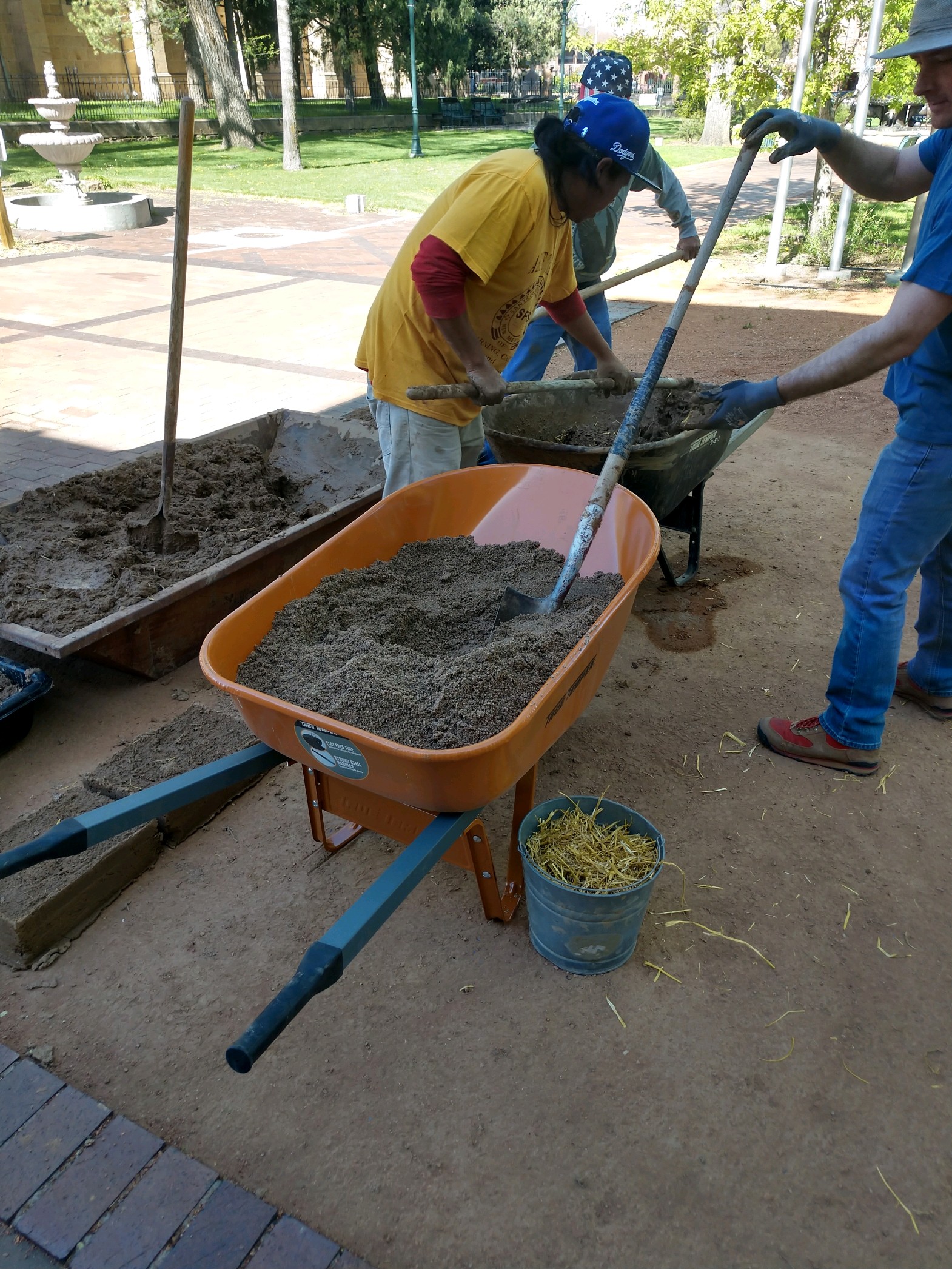
Then, we went down the street where they were making adobe bricks using the same method as their forefathers. Adobe is a mixture of clay, water, and straw. They let us try our hand and I found it a lot of fun. It’s a lot like working with dough. I had to pack it down firm into the form, being sure to get it into each corner. After I did that, they lifted the form and there was a brick. They leave it to dry for a week on each side and it takes about 6 weeks to get all the moisture content out of them. But an adobe building can last for hundreds of years. Each brick we made was four inches thick and weighs approx 25 pounds so a wall would be very solid.


Drying Adobe Bricks

And of course, wagons on the Santa Fe Trail passed through here and provided a welcome stop where settlers could replenish their supplies and rest. They truly must’ve enjoyed it.

Art is everywhere in Santa Fe and it’s all beautiful. We ended our trip with a visit to the New Mexico History Museum and found so many interesting things there.


Santa Fe was settled in 1609 by the Spanish and is the oldest capital city in the U.S. History is all around you as you walk through the streets. If you’re looking for an usual place to visit, this will be the one to come to.

Have you ever made adobe bricks or visited a place that seems lost in time? I’m giving away a $10 Amazon Gift Card so leave a comment!


THE DEVIL’S IN THE DETAILS–SETTING by CHERYL PIERSON


Are you a reader who loves descriptions and details of settings? Glittering ballrooms, the bone-chilling cold of a winter in the Rockies…or maybe the oppressive, killing heat of the desert? What about something idyllic, like a river or creek babbling through the woods? A beautiful rose garden, or even the ugly side of description—such as barren prison walls, or a Civil War battlefield?


It depends on the story, doesn’t it, and again, how much importance those descriptions have on the impact of the action, and the outcome of the story.

Let’s use a ball as our example.

If you’ve never been to an 1800’s ball—and none of us have—we need to know at least the barest details.

Five basic things we need to know are:
What is a ball?
Why is the ball being given?
Who will be invited?
When will the ball be given?
Where will it be held?

That’s enough for some stories. But the main question is—how important is the ball to the plot?

This is where layering comes in—and this one scene, and the details it contains—can be vital to what comes next, or even many scenes later.
So many things can happen at a ball!

Guests can meet for the first time, uninvited guests can show up, clothing can have significance, music can bring back memories, the food can even be poisoned!

Or, the ball can just be a ball, like the old saying attributed to Sigmund Freud, “Sometimes a cigar is just a cigar…” –and if that’s the case, then tedious description and intricate detail is wasted because the ball is just a vehicle to get from one scene in the story to the next, and has no real underlying importance.


Describing the details of the clothing worn is sometimes distracting as it pulls us away from the action. We may be reading about a blue satin gown when we need to be concentrating on the man who lurks in the shadows. Too much description can bog down the reader and deaden the story rather than bring it to life.

Why? Because deep description of the things such as décor, clothing, and meals stop the action of the characters. The plot “takes a break” while our minds process all of the description of the scenery, the meals, the clothing. In this case, again, sometimes, “less is more” and we need to let the reader’s mind fill in much of that kind of detail.

Consider this: We know certain facts—a ball costs a lot of money to host. So we already understand that those who are invited are most likely people who move in the same upper crust social circles. Therefore, we know they, too, have money, so are appropriately dressed, arrive in style, and are schooled in proper societal customs. One excellent way to cut through the “red tape” of description (of things we already know) is to describe something that is out of place, or “not right” as this reminds us of what should be—and those details of descriptions we’re already aware of.

Perhaps an impostor at the ball commits a social faux pas without realizing it, alerting others to the fact she isn’t who she pretends to be. Maybe an unlikely hero comes to her aid quickly, offering an excuse, or correcting the mistake before others notice.


This scenario does several things for the story that simple description can’t achieve.

1. Points out the discrepancy in what should be and what is.
2. Allows our characters interaction, and possibly dialogue and observation, rather than the author filling the page with scenic description.
3. Allows the reader the opportunity to learn more about the characters and their personalities through this interaction, and can be a vehicle to reveal something of importance.
4. Can possibly further the action during such a scene rather than slowing it by miles of scenic description.

This is not to say that there isn’t a time and a place for detailed descriptions of settings! We can’t call ourselves authors and take the “easy” way out by saying, “It was a ball like any other” by way of description, unless—we put it in the right context.

How about this: 
Jake looked around at the opulent ballroom –the surroundings were familiar in a tiresome, cloying way. Or…maybe was jaded. It was a ball like any other—except for one thing. Something that made him catch his breath and inwardly let go a streak of curses he’d love to shout to the skies. She was here. The woman he’d thought he’d never see again…

Well, anything can happen now, can’t it? Maybe she’s wearing an inappropriate shade of red amidst a sea of violet and blue. There are so many ways to make setting come alive without endless description that many readers become bored with and skim over.

If you read my last installment of this blog series about main characters, the examples I used from Shane (Jack Schaefer) and St. Agnes’ Stand (Tom Eidson) are also prime examples of description of setting as well as character.

But here’s another good one I really think is wonderful from Conagher, by Louis L’Amour. In this story, Evie from “back East” has come out west to marry a man with two children. Evie tries to make the best of things, but she lives in fear at first. The land is so different, After she’s been there a while, she finds there is a beauty in her surroundings she had to grow to love, in time.


As L’Amour describes the heroine’s (Evie) dismal hopelessness at the land her husband (Jacob) has brought her to, we wonder how she will survive. Yet, Jacob has plans, sees the possibilities that Evie cannot, or will not see. The underlying message is, “The land is what we make of it.”

As the story continues, she begins to appreciate the beauty of the prairie, while acknowledging the solitary loneliness of her existence. She plants a garden, nurturing the plants, and gradually she sees the farm being shaped into a good home from the ramshackle place she’d first laid eyes on.

The land is beautiful, but unforgiving. Her husband is killed in a freak accident, and for months she doesn’t know what has happened to him. She faces the responsibility of raising his two children from a previous marriage alone.

In her loneliness, she begins to write notes describing her feelings and ties them to tumbleweeds. The wind scatters the notes and tumbleweeds across the prairie. Conagher, a loner, begins to wonder who could be writing them, and slowly comes to believe that whomever it is, these notes are meant for him.

At one point, visitors come from back East. One of them says to Evie something to the effect of “I don’t know how you can stand it here.”
This is Evie’s response to her:

“I love it here,” she said suddenly. “I think there is something here, something more than all you see and feel…it’s in the wind.

“Oh, it is very hard!” she went on. “I miss women to talk to, I miss the things we had back East–the band concerts, the dances. The only time when we see anyone is like now, when the stage comes. But you do not know what music is until you have heard the wind in the cedars, or the far-off wind in the pines. Someday I am going to get on a horse and ride out there”–she pointed toward the wide grass before them–”until I can see the other side…if there is another side.”

The land, at first her nemesis, has become not only a friend, but a soulmate. L’Amour gives us this description through Evie’s eyes and feelings, not in writing about it from his perspective as the author.

Think of your own writing projects, and books you’ve read. What importance do you give setting in description, plot, even characterization? Within 40 pages of ‘Conagher’, we understand that the land, with all its wild beauty and dangers has become enmeshed in Evie’s character. She can’t leave it, and it will never leave her.

Endless, detailed description can’t do what L’Amour does through Evie’s eyes in a very few sentences. Do you have a favorite description of a setting you’ve read about or written about?

Jodi Thomas Has a Winner!

Happy Mother’s Day, Everyone! Especially to Miss Jodi.

Have a relaxing, beautiful day !

Now for the drawing…………

Winner of the signed copy of Little Teashop on Main is……

DENISE

Woo-Hoo! You’re gonna love this.

Someone will contact you for your mailing address so be watching!


Jodi Thomas: The Power of Friendship

We’re so excited to have Jodi Thomas back to visit. We’re not sure what book this makes her but it’s over 50. Miss Jodi always has something interesting to talk about and this is no exception. We think you’ll enjoy it–and her giveaway at the end of the post. So make her welcome.

When I began writing THE LITTLE TEA SHOP ON MAIN, two stories came at once.

First, I wanted to write a story about a man who loved three women. One was his best friend, one his neighbor who needed a hero to turn to as they grew up, and the last was the love of his life even if she didn’t always agree with his plan. Readers will love Jack as he slowly figures out that the girls don’t belong to him; he belongs to them.

The second theme I wanted to write about was the power of friendship. My three little princesses grow to be close friends and maintain that friendship all their lives.


The number of close friendships between writers is peppered through history. It has been my experience with writers who become my friends that knowing each other makes us both stronger. We learn from one another, push each other and sometimes even compete.

In my first writing class, I heard Dee Pace read and I said I’d love to be able to write that good. When the class was over everyone agreed to keep meeting at the library. The next week, she and I were the only two who showed up. We began helping each other. Learning how to write. Learning the market. Entering contests.

Dee said once that when I won, she felt she’d won too. I realized I felt the same way. She’s now in Heaven, but every now and then I swear I hear her whispering, “Write deeper, Jo.”

There are friends you form a bond with and you remain close to even when there are months or even years you don’t talk. For some of us there is a very rare friend who follows you through all your life. I’ve heard it said that having one such friend for a lifetime is a very rare gift. They’ve known you all your life and still like you anyway.

I’ve been blessed with one–Reta. Our mothers were friends. There was never a time that we didn’t know one another. We went through school together and even were together when we met our future husbands.

As the years passed, we went different ways but were always still close when we saw one another. But, in good times and bad, I’ve always known she was a phone call away. (Below is a picture of the two of us a few years after we graduated.)

In my new book, THE LITTLE TEASHOP ON MAIN I had great fun watching my characters become friends and influence one another’s lives. My main characters were very different, one wild and creative, one grounded and brave, and one shy. When they really needed to talk or celebrate, or even cry, they’d have tea. The ritual became the thread that held them close no matter how far apart they might be in miles.

Let me know how your best friend enriches your life. I will be drawing for one print copy of THE LITTLE TEASHOP ON MAIN.

AMAZON  |  B&N  |  APPLE  |  KOBO  | 

Caryl McAdoo’s Winners


Circle the wagons!

We have our winners for Caryl’s wagon train story – Remi.

Congratulations go to:

Quilt Lady

Lori Smanski

Patricia B.

Be watching your inbox for an email from Caryl, ladies.

Fun reading is headed your way!

Rubbing Elbows with the Rich and Not-So-Famous ~ Pam Crooks


Through the ages, savvy businessmen have earned their wealth with a vision and brilliance that others had yet to fathom. Some earned their money with ingenuity, some with skill, others with luck for being in the right place at the right time. For the vast majority of us who weren’t blessed with such fortune, it’s hard to imagine having so much money, one can’t even count it all.

Here’s a few of the richest men in history, with their worth adjusted for inflation:

 John D. Rockefeller – $367 billion. Made his fortune in petroleum beginning in the 1860s.


Andrew Carnegie – $337 billion – Made his fortune in steel in the mid-1800s

Cornelius Vanderbilt – $202 billion – Made his fortune in the railroads and before that, steamships, also in the mid-1800s.

To their credit, Rockefeller and Carnegie were generous philanthropists who gave away much of their fortune to charitable causes. Vanderbilt, however, kept his fortune until he died and left 95% to a son, William, (one of thirteen children) and William’s four children. Bet there was some squabbling there from the other twelve, don’t you think? Yikes!

There are few men more wealthy today than Warren Buffet. Warren is special because his fortune began right here in my hometown of Omaha. He still lives in the same home he bought in 1958 in a modest, though very nice, neighborhood. Part of his charm is his thriftiness. I remember seeing him in our local grocery store buying a few cases of Coke (his beverage of choice) when it was on sale. Warren is worth $90 billion dollars and is listed by Forbes as the 3rd richest man in America, behind Jeff Bezos and Bill Gates.

His best pal and right-hand man is Charlie Munger. Together, they have made Berkshire-Hathaway into a world-renowned investment company with eye-popping success. Charlie is worth $2 billion.

After lucking into a few of Zacks stock picks, I am fortunate to own some BH stock (not the good A stock, mind you, which is worth $315,000 (approximately) a share). Being a stockholder enables us to get into the Berkshire Hathaway annual meeting, which is also right here in Omaha, always the first weekend in May.

It is an EVENT, let me tell you. Besides commercial planes, private jets from around the world crowd our airport (about 110 private jets over the weekend.) Tens of thousands of people come to Omaha for the weekend to listen to Warren and Charlie give advice and talk about the year’s investments.  Not only are these guys entertaining and witty, they are SMART!!  They can quote percentages, stocks, companies and logic like men a fraction of their ages.  Oh, did I tell you Warren is 89 years old and Charlie is 95 years old?

My husband and I go to the shareholders meeting nearly every year just to breathe in the atmosphere. It’s fun, organized and INCREDIBLE to mingle with stockholders from so many countries.

One of the highlights of the weekend is the shopping. Literally thousands flow into our big convention center to snatch up BH companies’ products at special prices just for shareholders.  Dairy Queen ice cream treats and Coca-Cola are favorites!

Here’s a few fun pictures:

With “Warren” at the Pampered Chef exhibit
A luxury sports boat with leather everywhere
A special price for said luxury boat just for shareholders–$125,611.00.  A bargain!
Warren Clothing
A juggler
Really running joggers at the cool Brooks Brothers exhibit
Press box for multiple media outlets eager to talk with and about Warren and Charlie!

Are you a Berkshire Hathaway stockholder?  Have you ever rubbed elbows with some really RICH people?  Do you like to dabble in money? What would you buy if you were super-rich? 

Super-Hero Charlie and Warren Rubber Duckies

Let’s chat!  I’m giving away some collector rubber duckies dressed as Super-Hero Charlie and Warren. I tell ya, people were buying these like crazy! A fun keepsake for a fun weekend!