
I hope you’re doing some fun things this summer. A few weeks ago, I drove thirty miles from where I live to what used to be only one of three towns in the entire Texas Panhandle. Tascosa used to be a thriving, but very dangerous, town that at its peak boasted 350 people. It was settled in 1876 by an ex-soldier and blacksmith named Henry Kimball and it became the assembling point for the Tascosa/Dodge City Cattle Trail. Surrounded by large ranches, the town quickly became known as the Cowboy Capital of the Plains and was an economic rival of Dodge City, Kansas.
It also became a place where outlaws and bad men outnumbered the law-abiding sort.
Here’s an adobe schoolhouse (built 1911). It’s the oldest one of adobe in Texas.

Due to the town being only thirty -five miles from the New Mexico line, Billy the Kid used to rustle cattle and bring them to Tascosa to sell. He made the trip many times. His campground is still marked today in a shady spot near a creek.
Pat Garrett was another regular to frequent Tascosa that in 1879 had a population of 150 with only 8 English speaking women who were not employed in the considerable brothels and saloons.
Inside of two years, there were twenty-eight deaths caused by shootings and Boot Hill saw much activity. Here’s the picture I took and the restored markers. I think it’s the first Boot Hill cemetery I’ve ever been in.

A post office opened in 1878 and in 1880 the county of Oldham (only the second county in the entire Texas Panhandle) was formed and a stone courthouse was built. That courthouse is still there and they’ve turned it into a museum. Here’s the picture I took during my visit.
Despite the lawlessness, romance was alive and well. A mysterious saloon girl and gambler named Frenchy fell deeply in love with Mickey McCormick who owned one of the saloons. They married and from then on, the two became inseparable. This huge, deformed tree and marker is all that remains of the spot where their adobe house sat.


Mickey died in 1912 and Frenchy walked to visit his grave every day—even after the town died and everyone moved away, she remained. She lived alone in the ghost town by herself with no running water or electricity for twenty-seven years, grieving for Mickey. Finally, in poor health and her house falling around her, the woman whose real name they never knew or where she was from let them move her to the nearby town of Channing where she stayed a little over a year before dying in 1941. As per her wishes, they brought her back and laid her to rest next to her beloved Mickey.

Other ghosts reside there also—like Ed King, Frank Valley, Fred Chilton, and Jesse Sheets who were killed in a gunfight in the wee hours of March 20, 1886.
The ghost town was bought by Julian Bivins who turned around and donated it to the Cal Farley Boy’s Ranch in 1939. The town sits on this private land and I believe the thousands of boys(and now girls also) who’ve lived there have purged the voices of the ghosts. I didn’t feel any restless spirits. Although it is on private land, they welcome visitors.
If you’ve read any of my Outlaw Mail Order Brides, you’ve seen the town of Tascosa in the stories. Here’s one segment in Tally Shannon’s point of view from Book 1 – The Outlaw’s Mail Order Bride:
Life was full of ups and downs, and this wasn’t the worst that they would face. She’d heard the men talk about a bounty hunter Ridge had seen in Tascosa and the reward poster the man had been showing around. Foreboding told her the worst still lay in front of them.
Have you ever been to or read about a ghost town? I’m curious what you thought. I would love to have seen Tascosa at its peak but I wouldn’t have wanted to live there. Too rough for me!


 We visited the former home of Eva Dalton Whipple, sister to the infamous Dalton Gang, as well as Linda being arrested by the town’s sheriff and locked up in an original jail cell of the 1800’s. We were honored to be able to witness a true old west shoot out, as well as travel through the underground tunnel between Mrs. Whipple’s house and the barn below the hill where Frank, Bob and Grat Dalton used to hideout.
 But one of the most interesting things I personally discovered was taken from The Journal; The Official City Newspaper of Coffeyville, Kansas, dated Friday,::October 7, 1892. I’m using the exact punctuation original to the article. The account was authored by Jack Long for this edition of The Journal.
 plate glass window and looked across the street at the Condon bank. Boothby peeked in the First National bank door. Emmett Dalton saw him and hollered, “Get in here you SOB.”
 door of the store and was looking through a horse collar that was hanging there for a sign. Bob saw his face peering through the collar and shoot him through the jaw.

 Texas had the first woman elected governor in the United States, but she wasn’t the first woman to be governor. Marian A. Ferguson was better known as “Ma” Ferguson and elected in 1924 and inaugurated in 1925, which was two weeks after a woman became governor of Wyoming.
 again after he resigned in 1917, just before he could be removed from office on corruption charges.
 One of Governor “Ma” Ferguson’s many full pardons went to “Buck” Barrow, who quickly took advantage of his release from prison to continue a life of crime. Buck and his wife got together with Buck’s brother, Clyde, and his girlfriend Bonnie Parker, who were already notorious criminals.
 ended on May 23, 1934, when a group of lawmen ambushed the couple and killed them.


 I lived in rural Nevada for thirty years and because my husband and I were originally geologists, we spent a lot of time beating around the state before settling down. The northern and middle part of Nevada can be either blazing hot or bone numbing cold, depending on the season—as near as I could tell, there were two: summer and winter, with three or four days of spring and fall between them. But don’t get me wrong, I love Nevada and its outback, and have so much respect for the early citizens—those that stayed and those that were there to do a job. The riders of the Pony Express were there to do a job. I’ve experienced the country that they crossed, and these guys were amazing.


 In those two months, the organizers found 80 riders and 500 horses, and stations were built along the route through Wyoming, Utah and Nevada. The riders received $25 per week, two revolvers, a rifle, a bowie knife and a bible. The ponies were sturdy stock, many of them carrying California mustang blood.


 Americans protecting the sacred mines. Even as recently as 1990 there have been reports of modern-day prospectors being fired upon as a warning by Native Americans who protect the land near historic mining operations.
 Rosemary Brennan is recovering from the loss of her husband five months prior in a devastating mine accident that took the lives of nearly all the men in Wildcat Ridge. The mine owner, Mortimer Crane, has given the widows an ultimatum—find husbands or he will evict them from their homes and businesses. Desperate to keep the assay office that her deceased husband had managed, she heads into the hills in search of an old Spanish mine called The Floriana in the hope she can lay claim to a bonanza of gold.
 Kristy McCaffrey writes historical western romances brimming with grit and emotion, along with contemporary adventure stories packed with smoldering romance and spine-tingling suspense. Her work is filled with compelling heroes, determined heroines, and her trademark mysticism. Kristy holds a bachelor’s and master’s degree in mechanical engineering, but writing has been her passion since she was very young. Her four children are nearly grown and gone, so she and her husband frequently pursue their love of travel to the far corners of the world. Kristy believes life should be lived with curiosity, compassion, and gratitude, and one should never be far from the enthusiasm of a dog. An Arizona native, she resides in the desert north of Phoenix. To learn more about her work, visit her


 The origin of Montana’s name also involved a touch of deception. Montana was part of Idaho Territory until 1864, when a former congressman named Sidney Edgerton brought samples of gold to Washington and suggested the creation of a new territory. The Union needed gold, so congress set to work. Ohio congressman James Ashley suggested the name Montana for the new territory, explaining that ‘montana’ was the Spanish word for mountainous, which perfectly described the area. There was one small problem—there was nothing Spanish about the area, which bordered Canada. Other names were suggested–Shoshone, Jefferson and Douglas. Senator Charles Sumner wanted an Indian name for the territory. One of the original Montana settlers, George Stuart, suggested Tay-a-be-shock-up, which is Snake for ‘the country of the mountains’. Some unknown person, however, convinced congress that the name Montana was not so much Spanish as it was Latin. Congress could accept a Latin name and Montana Territory was blessed with a name that could be easily pronounced.


 Warning: The critical factor in using plants for food is to avoid accidental poisoning. Eat only those plants you can positively identify, and you know are safe.
 Chicory: I think one of the most popular plants used throughout history is Chicory. The base leaves resemble those of the dandelion. The flowers are sky blue and stay open only on sunny days. Chicory has a milky juice. It can be found in old fields, along roads and weedy lots. All parts are edible. Eat the young leaves as salad or boil to eat as a vegetable. Cook the roots as a vegetable. I wasn’t aware that the plant are edible and had so many usages, but of course, coming from the South, Chicory used as a coffee substitute is well known. Roast the roots until they are dark brown and then pulverize them. I just image the frontiersman kept a look out for this plant.
 during the spring and summer. The roots are high in vitamins A and C, as well as calcium. Like Chicory, you can roast and ground the roots for a good coffee substitute. Another use is the white juice in the flower stems can be used as glue.
 Sassafras: Everybody has heard of Sassafras tea in historical stories. This shrub bears different leaves on the same plant. The spring flowers are yellow and small, while the fruit is dark blue. The plant parts have a characteristic root beer smell. The young twigs and leaves are edible fresh or dried. Small dried young twigs and leaves can be used in soups. Now for the tea…dig the underground portion, peel off the bark, and let it dry. Then boil in water for tea. Of interest, shred the tinder twigs for use as a toothbrush. Now we know how the frontiersman cleaned their teeth!
 almost everybody have around them. The first is the Trumpet Vine, which climb all over fences and are intentionally planted. The trumpet-shaped flowers are orange to scarlet and climb to 15 meters high and spreads like a wild weed It has pea like fruit capsules. The caution on this plant is that it causes contact dermatitis, so be very careful working around this plant. If pruning, I’d make sure I had long sleeves and gloves on. And, I’d suggest you be very careful touching your face and be sure
 to wash your hands very good.
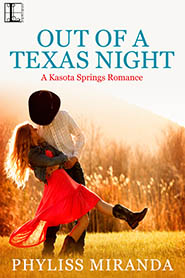
 To one lucky winner who leaves a comment, I am giving away an eBook of my newest western contemporary romance “Out of a Texas Night”.
