Guest London James – Monkeying Around

So, this post isn’t book-related, but I couldn’t help myself. And although it happened years ago, I still think about this day often.

Before I get into my little tale, let me start by telling you that I don’t like monkeys. Yes, you read that right, monkeys.

I know people think monkeys are cute and, oh by golly, we send them to the moon and teach them sign language because they are so intelligent. Oh, my stars, how can I not love monkeys? I don’t know how. The point is, though, I don’t like them. They freak me out.

So, with this new-found knowledge of my weirdness, you can imagine how blatantly ironic it is that out of all the homes in this country, I live in one that is one-tenth of a mile away from a monkey rescue reserve.

Oh yeah. It’s true. I can see it from my house.

Don’t get me wrong; I think what this woman is doing is a very commendable thing. She’s giving these animals a good life, taking them in when no one else will. I applaud her for her work, as I am a big animal lover and believe in helping animals. Not to mention, I bought my home knowing about the reserve, so with that, all I can do is accept and respect that it’s there. And that’s what I’ve done. For the most part, I’ve even forgotten about it…well, not entirely forgotten, I mean, they freak me out, remember?

Not to mention, it’s kind of hard to ignore when every now and then I hear a bunch of monkeys screaming, cages start rattling like thunder, men and women start shouting, and then I hear pops of what I assume are tranquilizer guns. And all I can think is ‘OMGoodness, they’ve killed the older woman and are running free, and you know they are going to come straight to my house, because . . . well because I’m crazy!’

Anyway, with that said, I don’t think about it much . . . at least I didn’t until this now infamous one night.

After walking around my entire property looking for my daughter’s miniature horse, I discovered he was missing. While I know the concept of having a horse go missing is quite odd, it’s the summertime, and my horses are out on seven acres of pasture, so some days, unless I catch them heading into the barn to sleep or heading to the water for a drink, I don’t see them all day. After running to tell the neighbor, her husband informs me that he saw a sign propped up at the end of the driveway of the monkey reserve that read “Pony Found”.

At what point do you have to laugh at how karma can mess with you?

So, armed with a rope, we head up to the reserve. At this point, I’m thinking. “I’m okay. She’ll bring Thomas out, and I’ll walk him home. It’s no big deal. I’m okay. I’m okay. I’m okay. All of the enclosures are behind the large wall anyways to detour prying eyes, so I’m sure she’s not going to take me back there. I’ll be totally fine.”

Wrong.

After she greets me at the gate, she motions me to follow her . . . behind the wall . . . into the deepest part of her property . . . THROUGH THE MONKEY ENCLOSURES!!!!

Just before she leads me in through the security gate, she turns to me and says. “Keep your arms down at your sides, okay. And try to keep your distance.” I’m sorry, but I think I just hallucinated. Come again? While I told her. “Okay.” In my head, I’m screaming. “Are you insert a lot of unmentionable words kidding me?” But what can I do? I have to get my pony. My ridiculously stupid pony who will spend all the days of his life on this earth locked up with the goats after this.

She started walking through the enclosures, leading me between several cages that were feet apart. Feet apart, people!!! Some of the monkeys didn’t do anything other than watch me walk by them, but of course, wouldn’t you know some were not happy with my presence. They screamed, hissed, showed their teeth, and worse of all, they reached through the chain-link fencing and TRIED TO GRAB AT MY ARMS AND CLOTHES!!

I think my pony has a death wish . . . it’s the only logical explanation.

So finally, after walking me through more enclosures than I can count, she points me in the direction of a small pasture area, and of course, there is my pony in the far corner…next to another enclosure.

Now granted, I have to give this lady props. The property is quite lovely. The lawn is kept up with; the enclosures are clean, trees are planted everywhere, giving the place a relaxed, lush feeling. It was tranquil…without the screeching from the monkeys, of course.

But back to my story, so as I’m kneeling in front of Thomas, securing the halter on him, about five or six monkeys are mere inches from me, screaming, jumping all over their fence, and reaching through the chain links trying to touch him and me. Of course, he’s not phased. I mean, why would he be? Obviously, he doesn’t mind being around monkeys at all.

Finally, I get the halter on and start leading him out. Well then, of course, all heck breaks loose. Apparently, the monkeys are attached to the little horse, and I’m taking him away . . . I clearly must die . . .

While I made it out safely (albeit left in the emotional state of desiring nothing more than a corner, a blanket, and my thumb to suck on), I suppose all I can do is shake my head and laugh off what will go down as the experience of a lifetime even though I’m still having nightmares.

Now that I’ve shared mine, are there any types of animals that freak you out for one reason or another? Each comment is an entry into a drawing to win ONE of THREE eBook copies of Her Mail Order Mix-up (Brides of Lone Hollow #1). You’re also welcome to join my reader group on Facebook. We have lots of fun there, daily! https://www.facebook.com/groups/4009277229199536

Her Mail Order Mix-Up (Brides of Lone Hollow #1)

Cullen McCray has no desire for marriage and love after the death of his first wife. A self-proclaimed lone wolf, he only wishes to spend his life in his cabin in the mountains, far away from his family’s ranch and his brother. But when Clint dies in an accident, he leaves behind a young daughter and it’s up to Cullen to pick up the pieces to help the girl. The question is can he also pick up the pieces for the woman, whom he knows nothing about, coming to marry his dead brother?

When Maggie Colton steps off the stagecoach in the small town of Lone Hollow, she’s unaware of her intended husband-to-be’s accident. She also doesn’t know about his brother or the condition of the cattle ranch she believed was something other than what it is. Clint hadn’t exactly been honest about everything, leaving Maggie to rough it in an older ranch house, an even older guest house, and a barn that has seen better days. Not to mention hundreds of cattle, dozens of chickens, pigs, horses, and what she is sure is the fattest cat she’s ever seen.

Will Cullen send her back before her bags are unpacked? And if she stays, will Maggie be able to not only win his heart but survive this new life she’s found herself in?


Buy Link

https://books2read.com/u/mdd0ry

Grab the series HERE

SHE STEALS MY BREATH, Pre-Sale and Excerpt

Howdy!

Welcome, welcome to another terrific Tuesday!

Do you know what I saw last week?  Robins.  That’s right.  Robins.  Unless they are very confused, that usually means spring is right around the corner.

And what better time of year than to have a new release.  This is Book One in the new Medicine Man series, and the title is SHE STEALS MY BREATH.

This title, by the way, was inspired by a poem by John Trudell, Dakota tribe.  So, without further ado, let me leave you the details on the pre-sale — 20% off what will be the regular price, the back blurb of the book and an excerpt.


Karen Kay


New Release!

Pre-Sale!  Save 20% 

Price after March 27, 2022 $4.99

Price now  $3.99

https://tinyurl.com/5658jeuv


SHE STEALS MY BREATH

The Medicine Man Series, Book One

Back Cover Blurb

Her Beauty Takes His Breath Away… Only She Can Restore It

Eagle Heart of the Blackfoot Nation has not come to the trading post, Fort Union, to trade, but to find his missing brother. The medicine man has never seen a white woman, but, when she walks into the room, her beauty literally steals his breath.  

Laylah McIntosh has assets besides beauty that make her valuable to her father, the fort’s trader: her skill with numbers, her photographic memory and her knowledge of the sign language used by all the tribes. But, when she’s injured and caught in a fierce blizzard, it is Eagle Heart, alone, who rescues her.

Forced into each other’s company, their attraction deepens. But a union between them is forbidden in both their worlds.

Can their love find a way to survive the wrath?  Or will their differences separate them forever?

Warning:  Sensuous romance and a love written in the stars could cause a gal to go West in search of love and adventure.

Please enjoy this excerpt from the book, SHE STEALS MY BREATH:


CHAPTER ONE


Fort Union Trading Post

The Eastern Montana Territory

October 1834


“I tell you true, there is such a creature as a white woman.  I have seen her here this very day.”

Eagle Heart cast a doubtful glance at Gray Falcon, his napí, friend.  “A white woman here?” he asked.  “What you say cannot be so.  All the tribes are speaking the same words about the white man: he has no women.  In all these years we have known this man, we have never seen his women.”

“Ha’!  I do not lie, my friend.  I saw her here.  Today.  Come with me to the trading room.  You will see her, too.”

“I am not interested,” replied Eagle Heart.  “But, tell me, does she have long hair on her upper lip and chin, as well as all over her body, like the white man?  Does she smell as bad as all white men do?  And, is her hair dirty and greasy from failing to bathe?  Saa, I do not wish to see this creature.  I might lose the contents of my stomach.”

“I will not tell you any detail about her, my friend.  Come and look at her and decide for yourself if she has all these features you speak of.”

Eagle Heart shook his head.  “I do not wish to witness the ugliness of this white woman.  It might spoil the image of a woman’s beauty for me.  Besides, I must make inquiries about my brother since, as you know, this is the only reason I have made the long journey to the white man’s fort.”

“Napi, my friend, it will take but a moment to come and look at the woman.  Then go your own way.”

Eagle Heart sighed.  Truly, he was not interested.  However, if taking a glimpse at this being would appease his young friend, he would do it.  And so, he found himself saying, “Okí, let us go so I might look at this ugly and smelly creature.”

“Áa, yes…this is a good plan.”  Gray Falcon smiled.

“Okí.  Shall I hold my breath so I do not have to smell her stench?”

“Perhaps, my friend.  Perhaps.”


The trading room was busy this day in early October, the season when the leaves turn yellow.  With a quick glance around the room, Eagle Heart memorized the details of this place.  These included a long counter for trading where a large buffalo hide had been spread upon it; there were several beaver belts, mink and even raccoon furs which had been shoved to the side.  A large book, with many of the white man’s papers, lay open on the counter.

On wooden shelves behind the trader were stacks of many more furs and neatly folded woolen blankets.  Off to the side of the counter were mounted moose horns, and these were holding up pots, pans and various items of clothing: belts and hats, moccasins and a few fur-lined jackets.  Kegs of liquor stood upright on the highest shelves in the room, out of easy reach.

Robes and furs could be traded here for guns, but no guns of any description were on display.  Perhaps they had been put out of sight purposely.

At present, there were three Blackfoot men standing at the counter, quietly bargaining with the trader, Larpenteur, over the price of their furs, while seven Indians from an enemy tribe, the Crows, and ten Indian men from another foe, the Assiniboines, lounged against the cottonwood logs that were used for the walls of the room.

Because all the Indians, himself included, had been divested of their weapons upon entering the fort, not a man in this room could be seen who carried his quiver strapped to his back; there were no bows, no lances, not even the usual gun on display, that usually being carried in a man’s arms.  It was an odd sight for Eagle Heart to behold his enemies without their customary means of defense.

The owner of this place, McKenzie, insisted upon stripping a man’s weapons from him before entering the fort.  The white traders stated this was a common practice within these trading centers and was done for the Indians’ and the company’s safety.  And yet, the white men and trappers who frequented this place were always armed.  So deaths occurred here anyway.

It was why Blackfoot men did not allow their women to accompany them inside the white man’s gates.  Simply put, it was too dangerous.

Eagle Heart took a deep breath at the same moment he realized the room did not stink.  Instead, it was scented with the aroma of trees, logs and the distinctive fragrances of autumn leaves.  Certainly, he didn’t notice there was much unusual this day, and there was no white woman he could bear witness to.  But, giving his friend his due, he decided to wait.

Looking around the room, he noticed Gray Falcon had positioned himself so he was leaning against a far wall, directly across from the table used for trading.  Eagle Heart joined him there, and, leaning back, crossed his arms in front of his chest, prepared to wait.

Unexpectedly, the delightful sound of a feminine laugh filled the air.  He frowned, surprised, for the voice was pretty.

And, then he saw her: she had slipped into the trading center from a room in back and was standing behind the trader, Larpenteur.  When she moved slightly, Eagle Heart caught a glance of bouncing brown curls with a hint of gold within them.  And, those locks were shimmering against a very pretty face.  She laughed again and took a few steps around the clerk, a smile still affixed to her lovely countenance.  She was glancing up at Larpenteur, and Eagle Heart experienced a startling reaction: he forgot to breathe.  She was that beautiful.

Her figure was slim and small, her profile showing off a perfect nose that turned up slightly at the end.  Her eyelashes were long and brown, and her eyes were a brilliant color of green.  Her cheeks were rosy, and her full lips were still smiling.  The brown color of her hair, with gold intertwined, was of a shade he had never before seen on a woman until this moment, and the length of it fell down her back in luscious curls.  And, he saw not a single hair on her face.

Eagle Heart tried to breathe in.  He couldn’t.  She had literally stolen his breath away.

At this moment, he couldn’t force himself to look elsewhere, and he felt as awkward as a young boy who was besotted by a girl.  It was, however, impolite to stare, so Eagle Heart at last glanced away from her, only to return his gaze upon her when he heard her say, “Mr. Larpenteur, how good of you to write down all of your transactions.  It is to be regretted, however, that I cannot read your handwriting.”  She grinned up at the man.

And, Eagle Heart experienced the sensation of his stomach dropping, as though there lived both moths and small butterflies within it.  Of course, he had no idea what she’d said, for she didn’t speak the same language as he.  All he knew was her voice sounded as engaging as the song of the meadow lark.

“Ohpo’kiiyoo!  Follow!”  Gray Falcon nudged him in the ribs.  “I am leaving here.  Okí!  Come on, let us go.”

“Saa, I do not wish to leave from here yet.”  From his peripheral vision, he saw Gray Falcon frown at him.

“I admit she is pretty,” said Gray Falcon.  “Still, I do not understand how a white man’s seed can make a woman to be so comely.  But, it is so, is it not?”

“Áa, it is so.”

Within a moment, another man, a tall, dark-haired fellow with a mustache that curled at its ends, stepped out from the adjacent room behind the counter.  He put his arms around the woman’s waist, and she didn’t admonish him, as Eagle Heart thought she should since this was a public place.  Instead, she laughed softly and turned into the man’s embrace.

She must be married to the man.

Eagle Heart couldn’t fully understand the feeling that swept over him, for his spirits plummeted.  It was odd, because whether she was married to the curly-mustached man or not, it was nothing to him.  She was beautiful, yes, but she was also married, as any fine-looking woman should be.

“It is told to me that she is not yet married to this man who holds her,” said Gray Falcon as though reading his friend’s thoughts.  “Although it is also said they are soon to be married.  I think the man uses her, for he should not be keeping her so closely to him if they are not married…and before all eyes to see.”

“It is so, my friend,” Eagle Heart responded.  “Yet, the whites are a strange people, and we do not yet know their ways.  Perhaps a white man is permitted to hold her, even if they be not married.  But still, he should not do this in front of others in case her reputation will be soiled.  Okí, come, let us leave.  I must ask the white men in this fort if they have any knowledge about where my brother might have gone, for I would be on my way.”

Gray Falcon simply nodded, and the two friends quietly left the trading room.


Laylah McIntosh watched as two young Indian gentleman stood away from the wall in front of her and, turning, left the room.  She wasn’t certain what it was about them that caught her eye, for there were many Indian men here.  Perhaps it was the elegant manner in which the two of them were attired, for their buckskin clothing was bleached a startling white, and, set off as it was with the contrast of their black hair, their dress alone looked as elegant as any man’s might, white or Indian.

Or perhaps it was the muffled sound of their footfalls that brought her attention to them, for they made little sound as they crossed the room.  With no boots to announce their departure, their footfalls were almost silent.  They were both tall, also; their shoulders were squared back and their steps seemed oddly graceful.

“Mr. Larpenteur,” asked Laylah softly.  “What tribe of Indians are those two men?  The ones wearing white?”  She nodded toward them.

“Dey be Pieds Noirs, Mademoiselle.”

“Pieds Noirs?  Do you know the English name for the tribe?”

“De Blackfeet, Mademoiselle.”

“The Blackfeet?  The Tigers of the Plains?”

“Oui, Mademoiselle.”

“How strange they should be so well dressed,” she said.  “I have heard the Blackfeet guard their land well and will kill any white man they find in their territory.  It seems rather savage, and yet, to look at them…they seem almost stately.”

“Oui, Mademoiselle.  De Blackfeet look so, but rob…I am rob by the Pieds Noirs too much!  De Pieds Noirs wild.  Eet has been so since Monsieur Lewis and Monsieur Clark kilt a man of de Pieds Noirs, de Blackfoot Injin.”

“It is good you have told me about them.  I shall do all I can to keep them distant from me, and shall make a mental note to never go into their country.”

“Indeed, you shall not,” agreed Thomas Sutter, who was Laylah’s fiancé.  He placed his arm around her waist and drew her in close to his chest.  “Instead,” he continued, “we shall return to St. Louis as soon as your visit to this land is finished.  And, once there, we shall marry.  Where would you like to live, m’dear.  Here?  Or in St. Louie?”

“I am uncertain, yet, as you know.  I love my home in St. Louis, but there is some undefined aspect about this land that causes me to feel peaceful, as though this is my home.”  She sighed.  “But, we don’t have to decide now, do we?  After all, we have yet to explore the woods and plains in the country.  Indeed, if the intriguing scent of the autumn leaves and the atmosphere in this country is a sample of the beauty to be found here, I admit to being captivated by it.”  Stepping out of his embrace, she chanced to give Thomas a flirty smile from over her shoulder as she laughed up at him.  “Excuse me, Thomas, for I must put my attention on business.  My father has asked me to look over the business transactions we’ve had today.  As you know, I have an affinity for numbers and often help him with his accounting.”

“Shall I assist you with it?”

“Only if you please.  This will take me but a moment.”  She scanned down the transactions that had occurred so far for the day, committing each sale to memory so she might recount them later to her father.

As the daughter of Robert McIntosh—one of Fort Union’s partners—she had unconsciously made herself into a business asset when her father had discovered she could memorize a page of numbers quickly and remember them again at will.  And so, according to her father, her talents were to be kept within the family of traders, thus her upcoming marriage to Thomas, who, though a young man, was already a junior partner in this business.  Of course his family had helped obtain his status, for they had financed this fort in part, as well as the trading post, Fort William.

Although one could argue her upcoming marriage was one of convenience, she believed this was not entirely true.  She had fallen under Thomas’ spell almost from the first moment she’d met him.  His fine manners and his tall, good looks had combined to urge her to say “yes” to his proposal of marriage.  That her father had encouraged her to wed Thomas had also swayed her decision, for the marriage would tie their families financially.

Her mother had been silent concerning her daughter’s upcoming marriage.  True, she had shown no negative emotions, though there had been no positive encouragement, either.

Her younger sister, Amelia, was, of course, excited about the upcoming marriage.  But, Amelia was young and her nature tended to be naïve at best, and, in truth, she was prone to question very little in life.

Laylah sighed, thinking back to the two young Blackfoot men.  Untamed they might be, but it had been a crowning feather in her father’s cap that he had convinced the Blackfeet to come to Fort Union to trade; especially since the Blackfeet held the reputation for being the most feared tribe of Indians on the plains.  Of course, the Blackfoot men had objected at first, for they hadn’t wished to make the long journey to Fort Union.  Yet, here they were.

She frowned.  It was hard not to notice the two Blackfoot men, since both were young and handsome in an exotic and uncultivated way.  But, she put thoughts about them from her mind.  Good-looking though they might be, they were still Indian, and, therefore, dangerous.

Besides, she would never see them again.  On this thought, she put her speculations to rest and, having committed the page of numbers to memory, turned around to hug her fiancé.


Eagle Heart despaired of ever coming to know what had happened to his brother.  No one at the fort seemed to remember seeing a man who looked much like Eagle Heart, himself.  Yet, he couldn’t be certain what these people said, since it was almost impossible to communicate to the whites.  Why no one at this fort had learned the language used everywhere on the plains—the language of gestures—was a mystery.

He wished he could make inquiries of the other Indians at the fort, for they were familiar with the gesture language.  But, he couldn’t.  These other Indians—the Crows and Assiniboines—were his traditional enemies.  Not that he was afraid of them.  It was simply that, being enemies, they were honor-bound to lie to him.

Somehow he would have to make himself understood by these white men.  There was no other way.

So, it was to this end, he stepped into the room used for trade.  It was a sunshiny day on this month of “the leaves falling,” and, while a part of him hoped She-steals-my-breath, the beautiful white woman, might be present, another part of him dismissed her from his thoughts.  She could mean nothing to him.  With a force of will, he put her out of his mind.

Yet, as he stepped up to the trading counter, he saw that she stood on the white man’s side of the table.  Looking up, she stared straight at him, and, though it was forbidden for a Blackfoot woman to face him so boldly, he was yet reminded how beautiful a pair of green eyes could be….


“Mr. Larpenteur, I believe he is asking you for information about either his friend or his brother.  I’m not certain which it is.”

The trader frowned down at her.  However, she didn’t flinch.  “How do you know dees, Mademoiselle?”

“My father,” she said, glancing downward, “hired an older Indian gentleman from one of the Eastern tribes to instruct both me and my younger sister on this language of gestures.  He insisted on our learning it before we were allowed to make this trip into the North Country.  He said if anything bad ever happened to us, we would at least be able to make ourselves understood.  Shall I ask this man what it is he is seeking?”

“Oui, Mademoiselle.”

She nodded and, inhaling deeply, brought her right hand up to ask the Indian, “Question, who is it you are seeking?”

“Halt!” he said in gestures, bringing his right hand up, instead of down, for emphasis.  “I do not speak to women.”  He added a frown and looked so sternly at her, she felt faint in reaction.

But, she didn’t faint.  Instead, she gulped and, looking down and away from him, signed, “No one here speaks the language of gestures.  If you wish to be understood you will have to communicate to either me or my younger sister.  If you prefer to talk to my sister, I will fetch her.”

She chanced a quick glance up at this man who towered over her.  Why, he must be over six feet tall.  He was also outrageously handsome in a wild sort of way: black, straight hair, which was decorated with a single feather hung from a braid on the right side of his face; it was his only hair ornament.  He had pulled a portion of his bangs forward and had cut them so a part of them fell down over the center of his forehead, as seemed to be the custom in this untamed land.

He still wore the handsome, white clothing she had seen him wear a few days previously, and up close she could see and admire the blue, white and yellow circle sewn onto his shirt.  It was placed in the middle of the buckskin clothing, was level with his chest and looked to be made of porcupine quills, as well as beads.  Rows of colorfully sewn porcupine quills of the same colors decorated the outer portion of his sleeves, while white fringe, situated next to the porcupine quills, draped from those same sleeves.  She noted that some of the fringe was also composed of black hair.  She shivered to think of the reason why this kind of hair ornamented his shirt.

Fierce though he might be, there was an unknown quality about him that drew her to him.  His eyes were black, his nose straight and slightly aquiline, but not overly so.  His lips were full, and the color of his skin was tan, not red, though there might have been a slight tint of red running beneath the outer layer of his skin.  He wore no paint as did most of the Indians here at the post.  This observation eased her nerves a little, for she had heard it said that the Indians painted themselves only when going to war.

Still, she shivered at the thought of any man having to go to war with an Indian like this.

But, he was answering her question, and she gave his hand gestures her full attention.  He said, “I see I have startled you.  There is no threat or insult meant to you; rather, a man should not speak to a woman who is not his wife.  To do so abuses her standing with her people and can cause a man’s woman to be jealous, also.”

“You are married, then?” Laylah signed, then gulped and looked away from him.  Why had she asked him this?

But, he seemed unoffended and was responding to the question.  “I am not,” he stated by means of the gestures.  “But, I believe you are.”

She shook her head and signed, “I am not yet married but am soon to be.”

He nodded, then signed, “If you do not object to the possible harm speaking to me might bring to your reputation, I do have questions no one has been able to answer.  Do you object?”

She shook her head, “No.”

“This is good.  I am seeking my brother,” he signed.  “He looks much as I do, but is older than I.  He came here a few months ago with a party seeking trade.  The others returned home, but my brother was not with them, and none of them knew what had happened to him.  My family worries about him.  Besides trade, it is why I am here.  He was last seen at this post.”

“What is his name?” she signed.

“Chases-the-enemy.”

She nodded, then asked Larpenteur, “Sir, do you know a Blackfoot man called Chases-the-enemy?”

“ Oui, Mademoiselle.  He ees Blackfoot chief.”

“Chases-the-enemy is this gentleman’s brother, and he is trying to discover what has happened to his kin.  People from his tribe say he was last seen here.  Do you know any stories concerning him that might indicate where he could have gone or why he didn’t return home with the rest of his party?”

“Oui, Mademoiselle.  Der be here a Crow girl from de West called Little Dove.  He stole her.  He is to be gone…with Crow girl.  Her family very much…angry.  Go after.”

“You’re certain of this?”

“Oui, Mademoiselle.”

Laylah nodded.  Then, turning toward the Blackfoot gentleman, said aloud, “Mr. Larpenteur”—she pointed to the clerk then continued in sign—”says your brother stole Little Dove, a Crow girl, and left.  Her family went after him.”

He nodded.  “When?” he signed.

Laylah turned to Larpenteur.  “When did this take place?”

“I am to tell you, Mademoiselle, eet be five month.  Maybe he captured.”

“This happened about five months ago,” she signed.  “Mr. Larpenteur”—she pointed again to the clerk—”says your brother and the girl might have been captured.”

With his hands flat and extended outward, he sent them forward and toward her in a sweeping motion, effectively saying, “Thank you.”

She nodded, then signed, “What are you called?  My name is Laylah.”  She spoke her name aloud.

But, he didn’t answer.  Instead, he reached upward to the feather in his hair, loosened it, put it in his palm and extended it toward her.  When she reached out to take it from him, he closed his other hand over hers, and, when she gazed up at him, he nodded and gave her the understanding the feather was now hers.

Then he smiled at her and said, “Nitsíniiyi’taki, Aakíí-ikamo’si-niistówa-siitámssin,” and Laylah thought the earth might have moved beneath her feet.  She didn’t know what to do.

The timbre of his voice was low, baritone, pleasant, and it, added to his touch, affected her oddly.  Her entire body was shivering, but whether from fear or a reaction to his words, his touch or his voice, she didn’t know.

She did, however, accept the feather.  Moreover, she thought she might come to treasure it.  Always, it might remind her of a handsome Blackfoot warrior who had once shown her kindness.


She is beautiful in both body and spirit.

She hadn’t wanted to speak to him.  Everything about her had told him she was afraid of him.  And yet, despite her reluctance, she had spoken to him in the language of gestures.

He had been impressed with her beauty from the first, and now he was captivated by her courage as well as her knowledge of the gesture language.  It was to be regretted that soon she was to be married.  But, at least he had been able to give her a part of him by extending the feather to her.  And, she had taken it from him.  He could hope that maybe she would not forget him.

He thought back to what he now knew: his brother had found himself a Crow woman and had stolen her.  Had his enemies found him?  Not likely, since his brother was a scout, as well as a chief, and could hide in a way that would not allow another to discover him…unless he wished it to be.

But, if his brother were well, the silent and distant communication between them would not be so irregular.  Because of this, he knew something was wrong.  But, what?

He was going to have to talk to She-steals-my-breath once again and ask if she might inquire about who the Crow girl was.  He did not wish the white woman to speak to the Crow people about this, however—there could be danger for her in doing so.  But, there would be no harm in asking her to make inquiries of other white people.  Someone might know who the girl was and might even have more information.

Perhaps tomorrow, he would seek her out again.  He was surprised by the instant pleasure that washed over him at the thought.  And, even reminding himself that she was soon to be married didn’t cause the pleasure to dim.


She was surprisingly taken by the manners of the Indian gentleman.  He had been firm in his questions to her, yet had also been kind, being considerate about her reluctance to speak with him.  He had shown her respect, as well as sensitivity to her situation by giving her the option to withdraw from speaking to him.  Further, once he had obtained the information he had sought, he’d given her an eagle’s feather.  She knew enough about the tribes to realize the gift was bestowed in appreciation.  But, there was more: it had come from his heart.  His hand over hers had symbolized this.  And, the gift had, indeed, touched her.

Oddly, her hand still remembered the feel of his touch.  She placed her fingers to her face, imagining her fingers were his and were smoothing over her skin.

No!  She dropped both of her hands.

What was wrong with her?  Perhaps he was simply too handsome and too…charismatic.  Never had she ever imagined she would react to an Indian man in such a way.

Instead, she had expected the natives to be dressed in cavemen-like fashion: in repulsive skins and furs, with gaudy feathers, tattoos and ornaments covering every inch of their bodies.  Never had she thought to admire an American Indian’s dress nor his manners.  Moreover, besides the obvious beauty of his people’s clothing, she had never expected to see a gleam of intelligence behind the Indian man’s dark eyes.

She sighed, realizing she was thinking about this Blackfoot Indian much too greatly.  It was a useless mental exercise, for it was unlikely she would ever see him again, which was as it should be.  She reminded herself she was soon to be married.

But, her encounter with the Blackfoot man did cause her to ask questions of herself: was it wise to marry Thomas when his touch did not affect her in an emotional, passionate way? A man who did not make her tremble in anticipation?

The thought was troubling because she had felt a spark between herself and this Blackfoot man.  But, surely her reaction was not a flicker of pleasure; probably, it was fear.

He will be gone tomorrow, and I will never see him again.  And, this is very good!


The photo to your left is a photo taken toward the end of the 19th century (sometime in the 1890’s, I believe).  It is a photo of Black Bull on the left and Chief Stabs-by-Mistake on the right, overlooking what is now known as a section of Glacier National Park.

I love this photograph.  I believe it was taken by author and Blackfeet by marriage, James Willard Schultz.

I’d love to hear from you.  Please do come on in and leave me your thoughts on this photo, on the cover and also the excerpt or anything else you’d like to say or add.

Guest Author Amanda Cabot – Did You Know?

Research. Authors tend to be in two camps where it’s concerned: those who love it and those who hate it. I’m firmly in the first category. I love learning new things about the time period and location I’ve chosen for my books, but – and this is a big but – there’s a problem. All too often I uncover tidbits that I find fascinating but that won’t fit into my stories. Since I hate to have them languish in my research folder, I thought I’d share ten of them with you today.

The first five come from The Texans, part of Time-Life’s The Old West series. 

  1. Although there’s no denying Stephen Austin’s importance in Texas history, colonizing the area wasn’t his dream. It was his father, Moses’s. In fact, Stephen was less than enthusiastic about the idea. But when Stephen learned that his father’s dying wish was that he ensure that Moses’s plans for Texas were realized, the dutiful son agreed. And the rest, as the saying goes, is history.


  1. One of the terms of the land grant Austin (Stephen, that is) received was that he’d bring 300 families to settle on that land. Though he’d expected that to be relatively easy to accomplish, he was only able to recruit 297. No one seemed too distressed by that breach of contract, and those families were soon referred to as the Old Three Hundred.


  1. The Mexican government had two stipulations for land ownership: settlers must become both Mexican citizens and Roman Catholics. Since most of the immigrants were Protestants, it was generally understood that Catholic rites would not be strictly enforced.


  1. Because not all communities had priests, couples who wanted to marry but didn’t want to wait for the priest to reach their town would often have a civil ceremony. That ceremony included signing a bond that they’d have their marriage confirmed by a priest as soon as possible. In theory, the bond was legally enforceable, but unhappy couples who wanted to dissolve their marriage simply destroyed the bond and declared themselves once more single.


  1. Speaking of marriage, Sam Houston, another legendary figure in early Texas history, had a disastrous one. Within three months of marrying the much younger Eliza Allen in 1829, they were separated, perhaps because of his drunkenness. Fortunately for him, when he married again in 1840, also to a considerably younger woman, the marriage was a longer and presumably happier one that resulted in eight children.


My second source of tidbits is T.R. Fehrenbach’s Lone Star.

  1. You’re undoubtedly familiar with the term hidalgo, but did you know that it’s derived from the old Spanish term Fijo d’Algo, meaning “son of someone important”?


  1. When Texas became a state, its constitution included some unusual (at least for the time) provisions. (1) No minister could serve in the legislature. (2) Married women were guaranteed property rights. (3) Private households were exempt from foreclosure. (4) Banks could not incorporate.


  1. In 1838 Texas became the first part of America to enact homestead legislation.


  1. Immigrants, particularly from Europe, formed a large part of the population. In fact, by 1850 European – mostly German – immigrants outnumbered Mexicans and Anglos in San Antonio.


  1. Among the immigrants who settled in the Hill Country were a number of intellectuals who formed utopian colonies referred to as “Latin Colonies” because they conducted weekly meetings where they discussed topics ranging from politics to literature to music in Latin. While there was no doubting the founders’ education, their lack of farming experience led to a predictable decline in the towns’ fortunes.


And there you have it: ten tidbits that intrigued me. Were you surprised by any of them? Which did you find the most interesting? Can you envision a story with one of these as its basis? If so, which?

Amanda is graciously giving away a print copy of The Spark of love to one lucky commenter.


The Spark of Love


Buying Links

Amazon

BakerBookHouse

Barnes & Noble

Christian Book Distributors


She’s determined to start a new life in the West . . . if only the old one will leave her alone


When a spurned suitor threatens her, heiress Alexandra Tarkington flees New York for Mesquite Springs in the Texas Hill Country, where her father is building a hotel. But the happy reunion she envisions is not to be as her father insists she return to New York. Instead, Alexandra carves out a niche for herself in town, teaching schoolchildren to paint and enjoying the company of Gabe Seymour, a delightful man she met on the stagecoach.


But all is not as it seems. Two men, each with his own agenda, have followed her to Mesquite Springs. And Gabe is an investigator, searching for proof that her father is a swindler.


With so much to lose—and hide from one another—Alexandra and Gabe will have to come together if they are ever to discover whether  the sparks they’ve felt from the beginning can kindle the fire of true love.


Amanda Cabot is the bestselling author of more than forty books and a variety of novellas. Her books have been honored with a starred review from Publishers Weekly and have been finalists for the ACFW Carol Award, the HOLT Medallion, and the Booksellers’ Best.


Social Media Links

http://www.amandacabot.com

https://www.facebook.com/amanda.j.cabot

https://twitter.com/AmandaJoyCabot/

http://amandajoycabot.blogspot.com/


What Makes a Cowboy and a Giveaway!

We’re so happy to have USA Today Bestselling author Paula Altenburg with us. She has a giveaway so scroll down. 

Thank you to Petticoats & Pistols for having me here!

Cowboys are made, not born.

But being a cowboy takes a certain type of personality, and those are the heroes I love to write.
Even though I write contemporary western romance, I do a significant amount of historical research, because real people are a product of their histories and their cultures. That’s one reason why you see so many successful marriages among childhood sweethearts. It’s also why no one will ever know you as well as your siblings do—they shared the same upbringing and understand where you come from. I say this from experience. (Not the childhood sweetheart part, though. My husband is Dutch. I will say that the majority of our disagreements over the years can be directly attributed to language nuances and having been raised in very different cultures.) This is a segue into European colonization, by the way.


The Irish in particular formed a strong presence in the American Old West. You can read a fascinating article on them here. Irish surnames show up all over the present-day west. In fact, two authors I use as writing resources have Irish names—Larry McMurtry (Lonesome Dove) and David McCumber (The Cowboy Way). McMurtry is Texan and McCumber is from Montana.

Grand, Montana was set up in my first series, The McGregor Brothers of Montana, as an Irish community. Grand’s fictional founders were two enterprising young Irish brothers (and ancestors of the contemporary McGregors) who made their money off selling liquor to soldiers. I’ve loosely based my Grand on real-life Miles City, Montana, which sits where the Tongue River flows into the Yellowstone River. I love the opportunities doing this offers me as a writer. If I need a setting detail, I can dip into the Miles City website and let my imagination run wild. The Miles City Chamber of Commerce is another great resource.


But setting Grand up as a fictional town means I get to make it my own. I read Lonesome Dove to get a feel for the landscape and what cowboys were like in the latter part of the 19th century. I read The Cowboy Way because I wanted to see how ranching has evolved. While ranch practices have changed with the times, cowboys, as it turns out, have not evolved in the least.
                                            

Sheriff Dan McKillop is definitely a product of his history and his environment. He’s
hardworking, he loves women (maybe a little too much) and he’s uncomfortable with money. When he and two friends inherit the Endeavour Ranch and billions of dollars, the only positive he sees is the opportunity to give back to his community. It takes a lot to knock him off his stride, but firefighter Jazz O’Reilly manages to do exactly that.
The Montana Sheriff is the first book in the Grand, Montana series.

Buy now

Four books will release this year with two more arriving in 2023.


Also in 2023, USA Today bestselling author Roxanne Snopek will be joining me with a series of her own. It’s tentatively titled The Lost Malones and familiar faces will appear.

And now, as a thank you to Petticoats & Pistols for having me here, I’m going to give away three electronic copies of another Grand, Montana book (and my USA Today bestseller!), The Rancher Takes a Family. You can check it out on my website.

All you have to do to qualify to win a copy is answer the following question and drop it in the comments below. “If you could live in any story world, what world would it be, and why?”
I’ll be stopping by throughout the day to chat and answer any questions.

Follow Paula at:

And With the Bang of the Gavel…

Judges today have a lot of control and clout, but nothing like in the 1800s. And except for federal judges, they have to answer to the people who elect them. In the past, state judges were appointed by the governor and wielded a lot more of power. In addition to hearing cases, they could:

  1. Appoint Deputy U.S. Marshals (the president appointed U.S. Marshals)
  2. Form a posse
  3. Notify a traveling hangman that he was needed following a verdict
  4. Oversee hangings if a sheriff either refused or couldn’t
  5. Step in and take over for a crooked sheriff and/or appoint a new one until election time
  6. In some cases, he could form a sort of task force (or single person) to handle a particular problem
  7. Choose jurors
  8. Oversee census taking and other duties of a lawman if there was none

So you see, they were pretty powerful and answered to no one. As a result, there were a lot of corrupt judges. But the majority were dedicated, followed the law, and did their jobs well.

I’ve never written a judge hero…until now.

In my March book, Crockett Legend is a judge working out of Quanah, Texas. Quanah is only forty miles from the Lone Star Ranch so he spends a lot of time on the ranch, traveling back and forth by train.

However, the Legends’ neighbor the Mahones have started a feud with them, killing their cattle and shooting at range riders. The feud ramps up when Joe Mahone dies under mysterious circumstances and Joe’s only son, Farrel, accuses them of murder.

Crockett has always loved Paisley Mahone only now she’s taken a stand with her brother in the feud and she refuses to talk to him. Crockett doesn’t give up and hopes she’ll soon see reason. It takes a hilarious matchmaking talking parrot to bring them back together.

The theme of this story is things aren’t always as they seem, and perseverance is crucial when it involves softening a woman’s heart. This concludes the Lone Star Legends series but never fear. I’ve started a brand new series that I think you’ll love.

I’m a little sad that I’m leaving the Legend Family behind. I’ve done three series using them in various degrees. That’s ten books.

Question for you: How do you feel about the length of a series? Do some get too long? At some point, do you ever feel they’ve run their course? I sometimes do.

A Man of Legend comes out on March 29th. It’s available for preorder now HERE. Please don’t confuse this with the first book of the series – A Cowboy of Legend. The two are completely different.

I’ll have more next month about A Man of Legend and some giveaways so watch for that.

Right now I have a sale to announce. The Mail Order Bride’s Secret is at $1.99 and will be the rest of the month. If you missed it, you can get it cheap. Click HERE. This is Book #3 of Outlaw Mail Order Brides. She came with a secret that would destroy the man she’d come to love.

Traveling, Christmas, and a Give Away!

Hello, P&P readers. Lacy Williams with you today asking a couple of questions: How far would you travel to be with your loved ones at Christmas? What are you willing to go through to get there?

During my freshman year of college, we had a massive, unusual-for-us snowstorm here in Oklahoma. It delivered a massive twelve inches of snow and the (few) snowplows couldn’t keep up. I was living on campus, and even though I was only ten miles away from home, I can still remember the adrenaline rush and my white knuckles as I drove home for Christmas break with my laundry basket of belongings in the back of my small car.

Probably the worst experience I’ve had traveling home at Christmas was flying cross-country to visit my in-laws for the holiday. This was before we had kids, and between my husband and I one of us is the kind of person who likes to have a list and be packed and double-check the night before. The other one likes to throw things in a bag just before we walk out the door. I will let you try to figure out which is which.

Hubby and I arrived at the airport with what we thought was enough time to check our bags and get through security, but it turned out we were wrong. The airline wouldn’t let us check our bags because it was too close to the flight time and it was possible they might not get on board the plane. We had gifts for his family packed in our luggage and we couldn’t leave them behind or combine them into our carry-on luggage, so basically we missed our flight because of our luggage.

It was devastating for two broke college kids (we were paying our way through night school at the time) to think we had missed our chance to be with our family. Luckily, we were able to get on another flight a few hours later. It could’ve turned out much worse than the couple hundred dollars it cost us.

(Am I wrong or does Hallmark have a sub-genre of their Christmas movies like this? Films about travel gone awry where either the hero or heroine gets stranded in a small town and falls in love while they are trying to get through all the obstacles it takes to get home.)

Fighting to get home for Christmas is the premise of my new release, Christmas Homecoming. Set in 1914, my hero Walt is on a train ready to take the wanted criminal in his custody to a judge where he will face justice. Surprise! His younger sister and her beautiful friend hop on the train mid-journey and suddenly Walt is getting lectures about why he should come home for Christmas when he hasn’t been home in years due to a broken relationship with his father and brother. Before he can blink, the train is part of a hold-up and Walt finds himself in a heap of trouble. It’s gonna take a lot more than he thought to get home for Christmas and to rescue the woman he’s falling for from the bad guys.

This new book is an adventurous romance. Tell me about your most disastrous trip home for the holidays. If you don’t have a story like that, tell me your favorite holiday food.

I would love to give away a paperback copy plus a $10 gift card to one of the readers who makes a comment today.

Thanks for chatting with me today!


About the book:
All traveling nurse Libby wanted was a quiet Christmas to grieve losing her younger brother. She’s on a westbound train heading home when she and a friend find themselves in the middle of a hijacking and then taken hostage by a gang of outlaws.

Walt White is a U.S. Marshal who has been chasing down the Seymour gang for years. But he’s kidnapped along with two innocent women, he must figure out how to keep them alive—and it doesn’t help that he’s completely distracted by the beautiful Libby. He’ll need his wits about him if he hopes to save them.

As they work to engineer an escape, Walt realizes that Libby is resilient and cunning—and vulnerable, though she hides it well. He must give his all to protect her heart and bring her home in time for Christmas.


Find it on Amazon    
Available soon on OverDrive!


Author bio:
Lacy Williams wishes her writing career was more like what you see on Hallmark movies: dreamy brainstorming from a French chateau or a few minutes at the computer in a million-dollar New York City penthouse. In reality, she’s up before the sun, putting words on the page before her kids wake up for the day. Those early-morning and late-night writing sessions add up, and Lacy has published fifty books in almost a decade, first with a big five publisher and then as an indie author. When she needs to refill the well, you can find Lacy birdwatching, gardening, biking with the kiddos, or walking the dog. Find tons of bonus scenes and reader extras by becoming a VIP reader at http://www.lacywilliams.net/vip .

Welcome Lynn Landes!

What inspired my books? I’m often asked what inspires a book? Where do your ideas come from? The truth is they come from many places. Past experiences, dreams, bible verses, music… life. I think from now on I’ll answer with that one word- Life.


I’ve recently joined with Magnolia Blossom Publishing and my first series, “The Women’s Work Exchange,” is about a group of young women who join together to help middle class women support themselves.

“Saving Taylor,” is about a young singer named, Taylor Allen. Trained as a child to use the gift of her voice for the Lord, she is unprepared for the reality of her father’s gambling debts. Taylor’s voice is a magnet that draws in crowds, but not even her talent can save her when Thomas Whitt calls in her father’s debt.

Thomas realizes what he has when the crowds come to hear her sing and he isn’t about to let her go without a fight. After a brutal attack, Taylor runs for her life.

This prequel shows how the Women’s Work Exchange comes to life when Taylor finds help in an unusual place. She learns that the Lord has guided every step of her life and if she trusts in the power of his perfect Love everything will work together for his good.

The Women’s Work Exchange was inspired by the “New York Exchange for Women’s Works.” In 1878, two women decided to help middle-class war widows support their families. Instead of being forced into workhouses or working as soiled doves, they suggested that women could make items at home, and sell them.

“The Exchange sold handmade luxury goods that women could make at home and gave the women a percentage of every item sold. Thus allowing middle class widows to earn a living while still maintaining their reputations.” https://wams.nyhistory.org/a-nation-divided/reconstruction/ny-exchange-for-womens-work/

I was inspired by these women and thought it would make a great story. My characters aren’t war widows, but they are enterprising women who want to care for themselves in spite of their circumstances. They are single mothers, divorced, widowed, and some, like Taylor, are just in a bad situation. Saving Taylor is the beginning of how the Women’s Work Exchange comes to be and the special women who fight for more, and the men who come to love them.

Giveaway!

I love to discover unique facts about history that I learn through my research. Did you know that a man could divorce his wife simply by having a divorce announcement in the newspaper? It didn’t even have to be printed in the state they lived in! You can bet I used that in an upcoming book. Do you have a unique fact to share? Comment and I’ll send a free e-copy of Saving Taylor to one lucky commenter!  

Saving Taylor

Can she convince him to trust her?

She is a woman on the run…

Taylor Allen is an eyewitness to a double murder. Raised in the church, she only sang for the Lord until her father sold her to pay off his gambling debts to the local Opera House. Taylor’s voice is a magnet that draws in crowds but not even her talent can save her from a murderer. After a brutal attack she runs for her life.

He’s taken hostage by a desperate young woman…

John Fielding Jr is on the way home from a business trip. How did a beautiful killer end up in his private sleeping car with a gun pointed at him?

Time is running short as they search the train to New York, seeking the woman that robbed and set fire to a saloon. They say she killed the owner and burned down several buildings in the process. John Fielding Jr. is determined to help prove her innocence and claim her heart in the process.

Lynn Landes
BESTSELLING AUTHOR – Illumination Award Winner
Check out Lynn’s many titles at:

http://www.followlynnsthread.com 

Join me on 
Facebook, Twitter, Pinterest,

Instagram, Followlynnsthread.com

Follow me on

Amazon, Bookbub

Pullman Cars with Guest Charlene Raddon (and a give away)

Whenever I write a blog to introduce a new book, I like to talk about some of the things I learned through my research for that story. Carrianne’s research centered mostly on the Union Pacific Railway and, in particular, the Pullman cars that Carrianne and her husband enjoyed in my story for their trip from Denver to San Francisco, where they fought to bring down the worst criminal on the Barbary Coast at the time.

The Barbary Coast also required fascinating research, but that deserves its own blog.

I think all of us would have enjoyed a train ride in an elegant, plush Pullman car. I was shocked to learn just how fabulous they were.

According to legend, a highly uncomfortable overnight train ride from Buffalo to Westfield, New York, prompted George Pullman to find a better way to provide comfortable, clean, efficient passenger service.


Traveling over early, hastily constructed rail beds, trains inevitably swayed, rattled, and clacked. Most passenger cars ran on two four-wheel trucks. Pullman used eight-wheel trucks supplied with an improved suspension for a smoother ride. He even added lighter wheels with pressed-paper cores to minimize jolts. He installed double-glazed windows and doors for quiet. The ventilators in a Pullman car brought in fresh air but filtered out dust and cinders.


The true glory of the Pullman car was in the decor. Victorian taste ran toward the baroque, and Pullman offered the utmost in ornamentation: carved walnut paneling, polished brass fittings, beveled French mirrors, Brussels carpets, brocade, tassels, and fringe. At night, porters made up the berths with pristine white sheets.

Thanks to the low $2 extra fee a passenger paid to ride in a Pullman car, such luxury was affordable even for the upper-middle class.

1872: Passengers bedding down onboard a luxurious Pullman sleeping car of the Pacific Railroad. (Photo by Three Lions/Getty Images)


Before George Pullman introduced his first diner, the Delmonico, trains stopped briefly at stations to allow passengers a hurried meal, and I mean hurried. Dining cars ended this inconvenience. There were also parlor cars, where a passenger could relax in an upholstered armchair, which swiveled to allow a view of the scenery. Wide windows and elegant furnishings added to the sense of privilege. An organ provided entertainment.

Illustration shows a crowded Pullman dining car on a train as waiters serve the passengers, late nineteenth century. (Photo by Interim Archives/Getty Images)

An important Pullman innovation was the vestibule train. Early cars had platforms front and back so that passengers had to step outside to move from one car to another. The vestibule was a spring-driven accordion covering that allowed cars to be joined seamlessly. It made moving from car to car more easily and helped to stabilize the train at high speeds.

The ultimate in Pullman extravagance was the private car, known in the business as a “private varnish.” These cars allowed the ultra-wealthy to travel comfortably without rubbing elbows with fellow passengers. A typical car might have an open fireplace and a marble bath. Italian artists supplied paintings of fuchsias and hummingbirds for the ceiling. Lamps and fitting were gold plated. The car contained several bedrooms, a central parlor/dining room, and a kitchen. Such cars sold for $50,000, equal to 1.3 million today.


I’d love to provide more details on how everything worked, but I believe I’d better quit before I wear out my welcome. I’ll provide photographs instead to show you what you missed by not having been born much, much sooner.

What would you pay today to enjoy such luxury as the Pullman cars offered?

Please comment to enter the give away. One winner will receive a copy of my current book, Carrianne’s Debacle, and a second winner will receive a book of their choice from my backlist.

Charlene Raddon is a multi-published, award-winning author of Victorian/Western romance. Originally published by Kensington Books in the 1990s, she now self-publishes. She also creates book covers, specializing in western historical designs.

Twitter
Facebook
Goodreads

Pinterest

Linkedin

Bookbub

Instagram

Facebook Author Page

Linktree


White Eagle’s Touch — Behind the Book

Howdy!

Welcome, Welcome to another terrific Tuesday.

Well, today I’m going to do something that is considered a no-no in the promotional world of books.  I’m going to tell you a bit about an older title of mine, WHITE EAGLE’S TOUCH, which will be coming out in the next few days as a 25th Anniversary book.

Let me explain:  This book was originally written for AVON books in 1996-97 and published in 1998 (I think that’s right.)  My husband and I were married in 1996 and so in the end of 1996 and the beginning of 1997, I was falling deeper and deeper in love with my husband.  We had married in a whirlwind and so it was after we were married that we really started to get to know each other.

This is the new cover for the book.  The male model, by the way, is  Lakota Indian.  And, he models under the name of “Lakota.”

In these anniversary books, we are correcting errors made when the book was converted to e-book from the original mass market.  There is no plot change or anything like that.  It’s just correcting computer errors made in the conversion.  Also, I might give the book a few better word choices here and there.

But, it was in the editing of this book that I began to see how much I was (at that time) falling deeper and deeper in love with this man I had married.  It’s there in the conversations between White Eagle and the heroine, Katrina.  Both of them are changing in regards to each other.  More love.  More understanding.  And, at that time, I guess I couldn’t help but write about how deeply I was in love with this man.

Our courtship (my husband and me) is pretty well illustrated in the first book in this series, GRAY HAWK’S LADY.  But this book goes one step further.

So, in ending, I’ll leave the blurb for the book and an excerpt.  Hope you’ll enjoy!

WHITE EAGLE’S TOUCH

by

Karen Kay

Two worlds. Forbidden love.

Blackfoot Warrior, Book 2

Katrina Wellington is vexed. She must marry to obtain the rest of her inheritance. But her uncle, who left her in New York with a governess to make his fortune out West, has suddenly decided he must approve of her fiancé before he will loosen the purse strings to her dowry.

Swallowing her outrage, the socialite treks to the same wilderness that claimed her parents’ lives years ago. Some small part of her is crestfallen that her uncle is not waiting with open arms. Only three guides, Indian guides, await her, and one of them is far too handsome for his own good.

At first, White Eagle does not like the spoiled, willful niece of the white trader. When he catches a glimpse of the vulnerability behind her prickly exterior, he can’t resist challenging the dazzling beauty to rediscover her true inheritance—the inner strength bequeathed to her by her parents.

Close contact on the trail soon arouses a soul-stirring passion and in its turn, love. But love may not be enough to sustain a relationship that is forbidden in both their worlds.

This book has been previously published.

Warning: Sensuous Romance that contains a captivating passion that could lead to a romantic evening spent in the company of one’s own love.

This is the original cover done for AVON Books.  The excerpt is the first meeting between White Eagle and Katrina in the book (and after many years of being apart).

Chapter Four

June 25, 1833

Midmorning 


“I say, what vision of loveliness descends upon us now? Is she a princess, a queen? Do you think I should bow? Or is she a mere fleeting whiff of my fancy? Oh, dear, I don’t think I can rhyme fancy…can you see?” The Marquess of Leicester chuckled before he put a finger over one nostril, taking a sniff of the powder which he held in a box in his hand. “What do you say, my friends? Am I poetic?”

The marquess’s two friends murmured polite words of agreement at all the appropriate places, while the marquess, pocketing his snuffbox, paced forward to take hold of Katrina’s hand. “Ah, my dear, you look stunning, simply ravishing, rather.”

“Thank you, Lord Leicester.” Katrina suffered her hand to be kissed by lips which looked as though they bore more rouge than her own. She pulled her hand back as quickly as possible, but failed to loosen his grip. “Are we prepared to meet the new guides?”

“Yes, I say,” the marquess replied, setting her hand onto one of his lacy cuffs.

Katrina smiled at him.

“Am I to understand, my dear, that the guides of which you speak are to escort me to yet another fort?”

“Yes, that is correct. My uncle has been delayed, and he asks that you join him at a place called Fort McKenzie. The scouts are to take you safely to him.”

“Quite unusual, wouldn’t you say? But I must ask you: The hunting, is there good hunting at this fort? After all, mustn’t disappoint the dogs, don’t you know? Brought the hounds all this way to hunt, and hunt we shall. Why, do you know that I have met the most interesting fellow, a Mr. Hamilton, although I don’t believe that Hamilton is his real name. A right good sort of chap. English, I say. Says he has been here at this fort for several years. Seems to like it here, though he does appear to hate Indians.”

“Does he?”

“Yes, rather. Well, now, come along, my dear. Mr. McKenzie informs me that his clerk is awaiting us outside the house here to escort us to the guides on the other side of the gate. A monstrous proposal, I must say. That is why I have asked Mr. Hamilton to make the introductions. I can’t say that I am overwhelmed by Mr. McKenzie’s manners. A clerk to see to us, indeed. Ah, here is Mr. Hamilton now. Come along, my dear. Let us get these introductions over with.”

“Yes,” said Katrina, “let us.”

And with little more said, she allowed Mr. Hamilton and the marquess to lead her out into the sunshine of a new day. That the marquess’s friends followed the three of them wherever they went, that the marquess’s men kept murmuring always agreeable tidbits concerning Lord Leicester’s undoubtedly brilliant humor, did little more than annoy her.

At least for now.


McKenzie’s clerk, Thomas, was waiting for their entire party just outside the gate. And what a party they made. Not only were the marquess, his two friends and Hamilton in their group, somehow the marquess’s dogs, barking loudly, had joined them.

“Come this way, Gov’nor, the men ’ee seek are by the wall over thyar,” Thomas said.

“Where?”

“Over thyar, do ’ee not see?”

“They’re…”

Conversation ceased, replaced with silence. Dead silence.

Their entire entourage, even the dogs, stopped completely still. No one said a word; no one moved. Then the dogs started to whine, and the shuffle of feet could be heard—moving away.

It was he, the Indian she had glimpsed from the boat, along with a few companions.

“Why, Thomas,” said one of the men, “they are—”

“Yep, Injuns.”

Now, it wasn’t as though their party had never seen an Indian until this moment, nor was it possible that anyone in this party had thought never to encounter an Indian in this country. After all, they had glimpsed enough of the native population from the steamboat as it had made its way up the Missouri.

But never had the people in this group seen primitives such as these—at least not so close to their own person. Warriors, all, were these savages and, by the looks of the heathens, dangerous.

But Katrina stared at none other than him.

She opened her mouth as though to utter something…some scathing comment, perhaps. But when no words issued forth, she closed her lips.

“This one hyar’s name’s White Eagle.” Only Thomas seemed able to speak. “Them three behind him are Night Thunder and Good Dancer. The woman is married to Good Dancer, near as this ole coot can tell. Blackfeet, they are. Gov’nor?”

“Indians?” This from Katrina, at last, her glance never wavering from him.

“Yes, ma’am. But they’ll get ’ee through Blackfoot country all safe. They knows the way.”

“He goes too far!” She glanced toward the clerk.

“Ma’am?”

“My uncle goes too far this time.”

“You tell the man,” the marquess spoke up from behind her. “Yes, my dear, tell the man.”

Katrina gazed over her shoulder. The marquess had positioned himself to her rear, his own men standing, as though in a line, behind him.

“Does your uncle not think favorably of you, Miss Wellington?” This from Hamilton, who seemed as dumbfounded as the rest.

She ignored the Englishman, glancing instead at him, the Indian, the same one who had so disturbed her thoughts, the one called… “What is this man’s name again, Thomas?”

“This one hyar, ma’am? He’s White Eagle. He’s their leader, near as I can tell, a chief maybe.”

White Eagle. So, that was his name. Katrina stared at the Indian. He, back at her. The man looked dangerous—foreign, frightening…handsome. Handsome?

He still wore no shirt, exposing to her view that muscular chest she had glimpsed the previous day. And she would have looked at it, at him, had she been of the mind. But she wasn’t.

She swallowed with difficulty and, allowing her gaze to drop no farther than the bridge of the Indian’s nose, asked of him, “Does my uncle bring word to me?”

The Indian just stared at her. No grin, no recognition of her, no intimation that he had seen her, too, the previous day—nothing, not even an acknowledgment that she had spoken.

She raised her chin. “Do these Indians not speak English, Thomas?”

“Guess they do well enough, ma’am. They been tradin’ with us long enough now to have learnt it. But ’ee is a woman. No Blackfeet is goin’ to speak to ’ee b’cause of that, beg pardon.”

Katrina looked at the Indian from down the end of her nose. She said, “Then ask him for me if he brings me word of my uncle.”

Thomas stepped up to her side. “Very well, ma’am. ’Ee heard her, Injun. Does the lady’s uncle send word?”

The Indian didn’t move, didn’t speak, didn’t even shift his weight. He just stared, his glance never wavering from her.

“Speak up there, you primitive animal,” Hamilton demanded.

None of the three Indians, and especially not White Eagle, paid the Englishman the least attention.

“Are ’ee sent here from the woman’s uncle?”

Nothing. No response at all, until, at last, piercing Katrina with his glance, the Indian said, “I have news for the woman alone.” Oddly enough, the man spoke in unbroken English and, Katrina noted, his voice, low and baritone, was peculiarly pleasant, almost melodic.

“Alone?” Hamilton again spoke up from a safe distance away. “Is the Indian mad? Does he presume to think we would leave the lady unaccompanied with him, so filthy a creature as he is?”

The Indian didn’t move a muscle, nor did he indicate in any way that he’d even heard Hamilton’s comments.

Katrina stepped forward, away from the crowd. Glancing around behind her, she ordered, “Leave us.”

“What?” This from all five men.

“Leave us, but take this man’s Indian friends with you. I will do as he asks and speak with him, but only with him. Here, Mr. Hamilton, give me your pistol that I may defend myself, if I must.”

“But milady,” Hamilton protested, “surely you can’t mean to—”

“Mr. Hamilton, your pistol, please.”

The Englishman looked as though he might protest further, though he nevertheless pulled the weapon from his coat and handed it to Katrina.

“Leave us.” Again she addressed the men who remained behind her without turning toward them. “I warn you, Indian,” she said confidently, “I can use this firearm Mr. Hamilton has given me as skillfully as any man. So do not think me defenseless that you might take advantage of me.”

The Indian said nothing, nor did he give her any sort of acknowledgment, not even by the bend of his head or a flicker of emotion across his features.

Katrina listened to the fading footsteps of the men behind her. After a nod from White Eagle, the Indian’s two companions followed.

The deference shown to this man did not escape her notice, but when she spoke, she made no mention of it, saying only, “What you ask is highly irregular and impolite. Hear me now, Indian, I am humoring you only because I wish to know what my uncle has to say. That is all.”

Glancing directly at her, he replied, “I will speak to the white woman only within the walls of the fort.”

“You will not,” Katrina countered. “You asked for an audience with me alone. You have it now.”

The Indian didn’t utter another word, just gave her a peculiar look and made to move away from her.

She reached out, grabbing at his arm, effectively staying him. He glanced down at her hand as it lay upon his arm, then back up at her. Something…some little excitement passed between them as they stared at one another, the intensity causing Katrina’s knees to buckle. Several moments passed as they stood there, sizing one another up.

At last, Katrina stuck out her chin and asked, “Who do you think you are, Indian, that you gape at me? Do you not know it is impolite to do so? Now, you will tell me what it is you have to say to me, right here and now…or not at all. Do I make myself clear to you?”

The Indian had become perfectly still as she spoke; his gaze roamed from the top of her bonnet to the very bottom of her skirts. Katrina watched him, ignoring the tingling sensation which spread throughout her nervous system. Fear, she supposed.

Odd, too, but she noticed he smelled good: of wood and smoke, of grass and mint—she had heard that the Indians chewed the leaves of the mint plant to stave off hunger, as well as to scent their breath.

His skin felt warm, too, moist and…strange, there was no hair upon the flesh of his arm where she touched him.

He was close to her, too close. The wind suddenly blew a lock of his long raven hair over her hand where she still touched him. The feel of those strands against her skin was fleeting, sensual, its effect sending shivers through her body.

She glanced up, startled, and wondered if the Indian had felt it, too, this strange sensation, but his expression revealed nothing.

She didn’t know how it was possible, yet she considered this man, this Indian, handsome almost beyond belief, in a primitive sort of way, of course. Not a man she would ever admit to being attracted to, particularly since he was nothing more than one of the savages that this country produced. And yet, she couldn’t help but admire the straight, imposing figure he cut as she looked up to where he stood over her. With his shoulders back, displaying his sculptured form, he looked as though he were a work of art, not a person of substance.

Something within her reached out to him, and she felt as though she knew him, his thoughts, his passions. It was as though there were a part of him that matched her perfectly…

She gave herself a shake. What was wrong with her? This was not the first time she’d felt as if there were something between them. It had happened the first time she’d glimpsed him, there from the boat…

She stared up at him then, in silent challenge, if only to purge this sensation from her consciousness. Yet, all the while, her touch upon his arm never relinquished its hold. His eyes were black, she noted, the darkest eyes she had ever seen, and they revealed nothing.

Suddenly, his look turned sardonic, and he broke eye contact with her, pulling his arm back, out and away from her grasp.

He turned from her then, suddenly and without warning. He began walking away from her at a steady gait, following on the footfalls of the other men. The Indian was treading, it would appear, toward the main entrance of the fort.

Katrina stood still for several moments, watching him, until she suddenly realized what he was doing. This man—this mere Indian—was defying her. She had made demands of him; he had told her nothing. Nothing!

Somehow this fact disturbed her more than any other detail she had observed about him. Blast!

She had to try to detain him. She took one step forward, and called out, “It was you who demanded to speak to me alone, Indian.”

No response, not even a catch in his stride.

“If you wish to talk to me, do it now, for I will not see you once we are in the fort.”

The man didn’t turn around, nor did he say or do anything further, except to present her with the view of his backside as he continued to walk away. She should have been appalled by the man’s bad manners and by his dress, or rather, its lack thereof. In truth, she was…almost.

She watched him, his lean, sculpted figure an unusually strange and exciting sight. And then she saw it, the man’s breechcloth fell apart from the outline of his leggings now and again, presenting her with an occasional view of a portion of hard, muscular buttocks.

Katrina was almost struck dumb with the observation. Never, not once in her life, had she ever witnessed so much of a man’s anatomy.

How utterly heathen. How primitive.

She didn’t, however, glance away. “I won’t meet with you,” she announced again. “And that’s my final word on the subject.”

Her challenge had no effect on the Indian’s actions.

Katrina was fuming. She felt like shouting at the man; she felt like pummeling him, but she refused to reduce herself to a show of temper.

She did, however, stamp her foot. The insolent barbarian. And to think she had been admiring his looks.

Humph!

She picked up the front of her skirt, her white petticoats contrasting oddly with the brown of the earth beneath her feet. She would follow that Indian back into the fort. Not because she had to, she reminded herself. After all, she was residing within the walls of the fort. She had a right to be there. This Indian did not.

Oh, but she didn’t like this. It was she who should be the person putting forth demands. It was she, not this man, White Eagle, who was the civilized one here, the more intelligent one.

So why was she the one left staring after him?

Well, it made no difference. There was at least one action she would take as soon as she met with this man: She would ensure he would hear her opinions of him and his insolence—that is, if she met with him.

She wasn’t certain at this moment that she would even permit the man an interview. There must be some other way of soliciting news of her uncle.

The Indian turned around at that exact moment, catching her staring at him, and goodness, but it looked as though he smiled at her. Did he know her thoughts? Could he see her frustration? Worse yet, had he felt her gaze upon that more intimate portion of his anatomy?

How dare he! Oh, what a wicked, wicked man!

She threw back her head and thrust out her chin. Ah, but it would please her to tell this Indian what she thought of him…and soon!

Make no mistake.


White Eagle turned his back on the woman and walked away from her, a grin tugging up the corners of his mouth.

In truth, he had enjoyed the confrontation with Shines Like Moonlight…but he would never let her know it. Not when she had dared to try to command him, a Blackfoot warrior. Such was the height of bad manners.

Yet, he could appreciate her spirit, her courage in confronting him when even the men who had surrounded her had shied away from him. Too, he acknowledged her unusual beauty; in truth, she had overwhelmed him with the allure of her feminine charm, more pleasing in close proximity than from a distance. He could still smell the sweet fragrance of her, hear the silvery timbre of her voice, and if it hadn’t been for her lack of manners…

Certainly, she was fairer than he’d anticipated she would be, but this wasn’t what bothered him about her. No, it was her touch, the simple graze of her hand upon his arm. With that touch…

He grimaced. And he wondered if she knew she had stirred something to life within him, something sweet, something carnal, something completely sexual. It was one of the reasons he had turned his back on her—that, and her insolence.

Hánnia! He should have more control. He was not some young boy, unable to control the physical urges of his body; and yet, even now he could feel the result of her effect on him down there in the junction between his legs. It was good that he had left her before his physical reaction to her became more pronounced.

Did she remember him?

A picture flashed in his mind, an image of a child, frightened and crying, clinging to him as he had hung onto the crest of a hill, both he and the child watching the gushing floodwaters rush past them, its danger only a short distance away. He had almost lost her in those waters.

He remembered again that he had clasped her to him then, whispering to her, giving her as much comfort as he was able, until long after the danger had passed. But that had been much too long ago. They had both been different people then, children.

That the child in her had grown up was evident. That she had reached adulthood without the guidance of a mother or a father to point out the necessity of courtesy and good manners was even more conspicuous.

Would she remember him given more time?

White Eagle thought back to the world he had known so long ago, to the people he had befriended, to a little white girl he had admired—a girl with yellowish-gold hair—to the child’s father and her mother.

They had perished, her parents. The girl had barely survived, and her father’s brother had sent her away long ago.

So, her uncle had been right about her. The woman he had met today was spoiled, a person completely devoid of maidenly gentleness. She spoke when not asked, demanded when a man’s mind was already settled; in truth, her spirit towered over the white men who had accompanied her.

Did she rise above these men because she had bullied them into submission with the same womanly harping and angry tongue she had shown to him? Or was she merely stronger-willed than they?

Whatever the reason, White Eagle despaired of the intervening years since he had last seen her.

If he reminded her of it, would she remember?

It was doubtful. She had been before the age when a child comes into its senses, and he had been no more than a young boy. He’d kept a lonely girl company during those times when her father and uncle had journeyed to his tribe on trading excursions. If he told her what he knew of her, of her family, would any good come from it?

He did not think so. This person he had observed today had been as someone alien to him—certainly not the girl he had remembered…had once known.

In truth, he had caught her looking upon him with not only a womanly sort of attention, but with contempt, the same sort of foreign attitude that White Eagle had witnessed upon the countenance of the white man.

He didn’t like it.

No, it was better that he keep what he knew of her to himself. It was apparent she did not recall her life before the white man’s world, and he was certain she would not care to hear what he had to say to her.

So be it.

He entered the fort, taking his place amongst his friends. Good Dancer’s wife had already started setting up their camping lodges in the area surrounding the fort’s flagpole. One for himself and Night Thunder, the other for herself and her husband, Good Dancer. That Good Dancer’s new wife had demanded to accompany them on their journey did not bother White Eagle, nor did it seem strange to him.

The young couple had just been married, after an unusually long courtship. Of course they would want to be together now. Such was to be understood. Such were the ways of married people.

Besides, he’d wanted a woman along to keep Shines Like Moonlight company and to provide her with a chaperone. White Eagle grimaced as he adjusted his breechcloth, certain Shines Like Moonlight would need that chaperone.

He glanced around him, at his place within the fort. He had noticed, when he had first come here, that several half-breed hunters resided within the tepees around the flagpole. This seemed only right to White Eagle; that these half-white, half-Indian men chose to live not in the square, wooden houses of the white man, but rather in the more comfortable lodges of his own people.

At least this is how it appeared to White Eagle.

He could not know, nor would he understand that to some within the fort, the mixed-bloods were not on an equal footing with the more European breed of men, that such would not be allowed the right to live in the square, wooden houses.

And so, not knowing, White Eagle settled down, content for the moment, to initiate the necessary chores needed for the return journey to Fort McKenzie.  Indeed, the time consumed in fashioning arrowheads, making a new shield and manufacturing a new spear was time well spent.

He was certain that Shines Like Moonlight would delay a meeting with him for as long as she was able. This didn’t bother him. Why should it? Time was not an enemy to him, and White Eagle was full-blooded Indian; he was a patient man.

He smiled. Perhaps here was something else he could admire about this woman: She had a stubborn strength of character. And this was good.

She would not be one to come a cropper in an emergency. Such people were few. Such people were valuable.

He shrugged. Whatever the case, his next few days within this fort promised to be far from dull.


Well, that’s all for now.  Look for the book in a few days.  At present, it’s undergoing the final proof reading.  I’d love to hear your thoughts.  Oh, and this is the cover to the left is the cover of the book currently up at Amazon.  This cover was done when I was writing for Samhain Publishing.
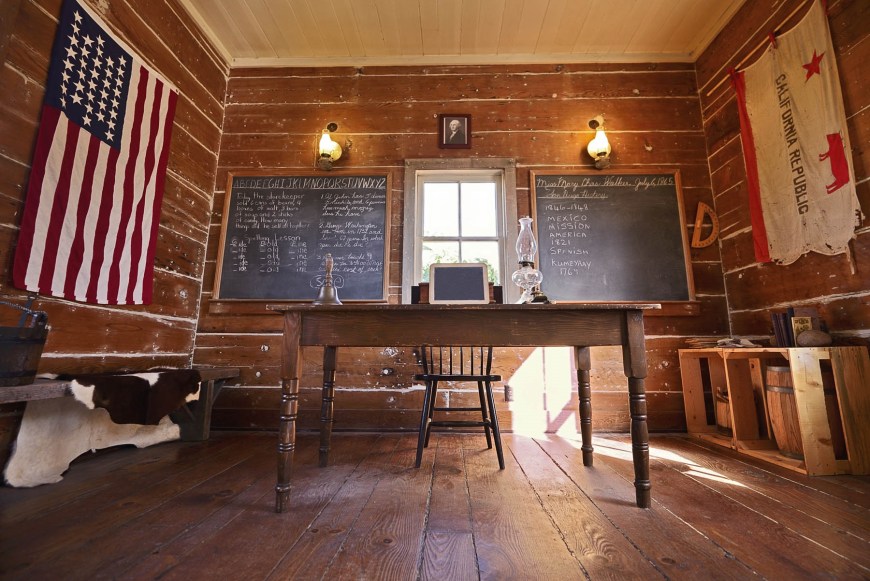
Indeed, all of these covers have a special place in my heart.  I am, however, extremely drawn to the new cover.  Hope you’ll like it, too.

The History Behind the Story

by Kathleen Denly

My upcoming release, Harmony on the Horizon, book three in my Chaparral Hearts series, was inspired by the true life story of San Diego’s first teacher to teach in their first schoolhouse.


The wooden structure was originally built in 1865 from the scavenged pieces of abandoned homes and businesses left in an area then known as Davis’s Folly (a location visited in my first novel, Waltz in the Wilderness). Today the long, red building is known as The Mason Street Schoolhouse, and has been reconstructed on its original site as part of the Old Town San Diego State Historic Park. This structure is featured on the cover of Harmony on the Horizon.


It was during a field trip to this park that I first heard the tale of the Mary Chase Walker scandal. Mary Chase Walker was originally from Massachusetts and earned her teaching certification from the Framingham Normal School. The Civil War negatively impacted the ability of eastern school districts to pay their teachers. So when Mary learned of the higher wages being offered teachers in San Francisco, she set sail for California.


On arrival in San Francisco, Mary learned that there were more teachers applying for positions than there were positions available in that city. However, San Diego was in immediate need of a teacher and was offering an even higher salary. So, Mary set sail once more and endured a miserable bout of seasickness as she traveled down the California coast. Fortunately, there was a kind, mixed-race stewardess aboard who worked to comfort Mary as best she could and the two formed a close bond.

Mary arrived in San Diego on July 5, 1865. Unfortunately, San Diego is a very brown place in the summer (without today’s modern irrigation solutions) and at that time, it was still a very small town of only a few thousand people spread over thousands of acres. The culture and climate came as something of a shock to Mary who revealed a severe disappointment in her new home when writing her brief memoirs.

Too bad for Mary, things only got worse.

Not long after she began teaching, Mary discovered her stewardess friend was in town. So she invited her friend to dine with her at San Diego’s nicest hotel, the Franklin House. This did not go over well in a town dominated by Southern sympathizers on the heels of the Civil War. Half of the patrons abandoned the establishment on the women’s arrival. Worse, the parents of the town were so incensed that many of them refused to send their children to school so long as Mary continued as teacher.

An emergency meeting of the board was called to determine Mary’s fate as teacher. The records of that meeting were lost in a later fire, so no one currently knows what decision was made at that time. What we do know through other sources is that one member supported keeping the teacher, another supported firing her, and the third was a man named Ephraim Morse. We also know that one month later, Mary was no longer teaching at the schoolhouse, but had taken a position as a tutor for a local family. We also know that shortly thereafter, Ephraim Morse courted and subsequently married Mary.

These are the historical facts, the framework, upon which I built my novel, Harmony on the Horizon. Being a lover of adventure, however, I used my artistic license to throw in the secondary setting of San Francisco’s Barbary Coast, two more main characters, and loads of trouble.


This video featuring a quote from the first scene in Harmony on the Horizon gives a hint at some of the trouble I’m referring to:


Preorder your copy HERE. 


To receive your bonuses, register your preorder HERE 


Harmony on the Horizon releases January 4, 2022. To celebrate, I’m offering this giveaway bundle to one winner*:

  • 1 Tote Bag – Harmony on the Horizon
  • 1 Aromatherapy Pendant – with dried  Lavender inside + scent ball
  • 1 Traveler’s Junk Journal – Vintage Reporter Style
  • 1 Lavender Sachet
  • 1 ebook copy of either Waltz in the Wilderness or Sing in the Sunlight – readers’ choice
  • 1 Chaparral Hearts Pen
  • 1 SITS Bookmark
  • 1 HOTH Sticker


To enter, leave a comment below letting me know what you think happened during that 1865 board meeting.


*Must have a U.S. Mailing address to win. Void where prohibited.


Thank you so much for spending time with me today.

To keep up with all my latest news and enjoy more historical tidbits like this one, please join my Kathleen’s Readers’ Club here: http://bit.ly/KRCMemberSignUp

Find Katheen online