Hoopskirt Hoopla

    The Fillies welcome . . . .


 Lisa Richardson

 Through the ages women’s fashions have been the object of great interest by many, and great scorn by others. The scorn has generally been reserved for those fashionistas who wear the extremes of the style. And any fad can be taken to extremes. From French “Aristos” with hair that stood more than two feet tall, to the early 20th century hobble skirts that made it nearly impossible for women to walk. Poised between those two time periods, the Victorians certainly had their excesses as well. One of the most eagerly lampooned was the hoop skirt.

“A joking exaggeration of mid-Victorian hoop skirts.”

Accustomed as we are to our easy wash-and-wear society, we can forget how much these styles restricted a woman’s ability to be active and to do things. We’re not just talking the size of the crinoline, but the sheer weight of yards and yards of material that made up the dresses. Practicality limited most women to reasonable hoop sizes, but for the idle rich the only limitation was imagination—and possibly the size of their hallways.

 I still have to wonder how ladies managed to maneuver through their world in what amounted to cages. And yet they did. They managed it with aplomb.

Mostly.

“In England, 1858, crinolines had to be hung outside public transportation in order for the wearer to fit inside.”


Do you think you would enjoy wearing a hoop skirt? Why or why not? Do you like that style?


I’m giving away a copy of Diamond in the Rough today. So please comment so that we can put your name in the drawing. (The blurb is below so you can decide whether it’s worth the effort!)


Click on cover to preorder

 Grant Diamond is a professional gambler on the run from his past. When he comes across a wagon wreck, the chance to escape his pursuers is too good a gamble to pass up, and he assumes the identity of the dead wagon driver. His plan takes an unexpected

turn when local heiress Lily Rose mistakes him for the missionary she had asked to come work with the Wiyot Indians. Seeing Eureka as a promising place to lay low, Grant plays along. Before he knows it, he”s bluffing his way through sermons and building an Indian school. But with a Pinkerton on his trail and a rancher rousing fresh hatred against the Indians, Grant fears the new life he”s built may soon crumple like a house of cards.

http://www.lisakaronrichardson.com/ 

inkwellinspirarions.com

Victorian Hats: Three Stories and a Basement


If you want to get ahead and get noticed, get a hat

The gold rushes of the nineteenth century are familiar to us all, but have you ever heard of a plume rush?  The craze of avian hats begun in 1870 became so widespread that by the middle of the 1880s, five million birds a year were killed by the millinery industry to keep up with the demand.

Egrets and herons provided the most popular feathers, especially the “bridal feathers” grown during mating season. But even tree sparrows and woodpeckers weren’t safe from plume hunters.

Things became so bad that when ornithologist, Frank Chapman, walked down the streets of Manhattan in 1886, he documented forty species of birds—not in the trees or sky—but perched upon women’s heads.  

 Milliner:  A designer who creates geometrical shapes unknown to mathmaticians.

 In 1886  bird feathers were selling for more than $20 an ounce (more

than five hundred dollars in today’s currency). This increased to $32 an ounce during the start of the twentieth century, which made them worth twice their weight in gold. “That there should be an owl or ostrich left with a single feather apiece hardly seems possible,” Harper”s Bazaar reported on the winter hat season in 1897

 The feather trade wasn’t confined to the east. Much of it occurred in the American west and Oregon, California and Texas were prime hunting grounds.    

Her hat is a creation that will never go out of style; it will just look ridiculous year after year. – Fred Allen

Women were called a “bird’s worst enemy” but in time they became advocates.  Alarmed by the decimation of birds Boston socialite Harriet Lawrence Hemenway held a series of teas to discuss the problem.  She then organized a boycott of feathers and helped form the Massachusetts Audubon Society, the oldest in the nation. 

 Eventually, the society was able to get the feather trade outlawed in Massachusetts and the first wild life protection movement spread across the country.  Hats still remained high and wide, but they were trimmed with ribbons, lace and flowers instead of feathers.

Why did women go overboard with hats? 

According to a recent news release, hats make women feel more powerful.  Historians credit the World War for making large, outrageous hats go out of favor.  But one can’t help but wonder if the nineteenth amendment giving women the right to vote might have lessened the need to show power through headgear.

So what”s your opinion of hats–feathered or otherwise?  Who”s planning to wear an Easter Bonnet this year?


  Meet the Ladies of Last Chance Ranch 

Click covers to Order or Preorder 


Giving a Cowboy the Boot!! by Charlene Sands


Little did I know that when writing Jackson Worth’s story that he’d have a weakness for a woman in boots.  Enter, Sammie Gold, just your normal run of the mill wholesome girl, who is a good friend of the Worth family.  Not only is our Sammie, Callie Worth’s best friend, she is a girl who is down on her luck and hoping to start a new life, with a brand new boot boutique. 

The boots Sammie wears turn Jackson’s head.  Whether stylish and sleek or sweet and innocent, to confirmed bachelor Jackson Worth, on Sammie they all look hot!  And that’s where the trouble begins!  Remember the coined phrase…what happens in Vegas? 

Well, what happened in Vegas didn’t stay there. It followed Sammie and Jackson to Arizona. 

In honor of boots all over the world, here’s a bit of boot trivia:

The Brooks and Dunn song ‘Boot Scootin’ Boogie’ on their 1994 album, ‘Brand New Man,’ resurrected the popularity of country music’s nearly defunct line dancing.  The hit spurred the country duo to fame and other than Simon and Garfunkel, they’d come to sell more albums than any other recording duo in history.


The popular “ugg” boots made of sheepskin were first became popular in Australia and New Zealand by local surfers who used the furry shoes to keep their feet warm after they exited the surf.  It is rumored that the manufacturer named the boots so because his wife said the first pair he made were ugly, thus “uggs”.


Go Go Boots were named from the French word “a gogo” which means “abundance or galore”.  In the 1960’s go go boots and mini-skirts changed everyday fashion.  Nancy Sinatra wore knee-high boots and sang these famous lyrics:

These boots are made for walking, and that’s just what they’ll do
One of these days these boots are gonna walk all over you.


Boots were originally designed to keep the feet protected and warm, but boots have come back in a big way not just for function but for style.  Cowboy boots, field boots, military boots, riding boots,work boots, Victorian ladies boots, rain boots – whether midcalf, knee-high or thigh-high, boots today are designed to make a statement.  Boots have attitude! 


Unfortunately, my own two feet don’t do boots well, but I was able to live out my boot fantasy at Sammie’s Boot Barrage in Worth The Risk.  And I had fun researching and designing my own pair of Marianna boots in the story.  Tell me what you think? Would you wear outlandish boots? What’s your favorite type of boot?  Are you a style or function type of boot wearer?  

Please also, take a moment to check out my Worth The Risk..Risky Release Party and you can win $25 Gift cards and an ereader! 

*** I was thrilled that an excerpt to my story was added to Diana Palmer’s, Betrayed by Love. 

Adding just a cooool note:  Today is 10-11-12.  

And tomorrow, look for our new Petticoats and Pistols Contest!!


Victorian Bathing Suits: the Great Cover-Up!


A recent study by Anytime Fitness showed that more than 70 percent of Americans would rather go to the dentist, do taxes, sit in the middle aisle of an airplane or visit in-laws than go shopping for a swimsuit.  Agree or disagree?


I just got back from Laguna Beach, California, which explains why bathing suits are very much on my mind this week.


Young and the not-so-young alike wore the teeniest, tiniest of bikinis everywhere, even in restaurants and on trams.  As a mother, I was tempted to pull my husband’s shirt off on several occasions and wrap it around some scantily-clad teen whose bikini string threatened to pop. 


Fortunately, I contained myself, but one thing became clear; Nothing documents the mores of the times as much as bathing suits. 


Two French designers get credit for inventing the bikini in 1946, but women wore bikini-like costumes for sports and public bathing as early as 1400 BC.  After the fall of the Roman Empire, the church came into power and public bathing disappeared.


Two things happened during the Victorian age that was to have an impact on fashion; Railroads made the seashore a popular destination and women began participating in croquet, golf, bowling, tennis and other sports.  


The most controversial sport was swimming. Considered good for health, swimming also found favor for not causing women to do something as unfeminine as (gasp) sweat. But modesty and white skin took precedence over comfort and even safety.  Any effort to make swimwear more suitable to the sport was met with opposition.  


As a result, feminine bathing suits were typically black and long-sleeved wool dresses were worn over bloomers.  Black stockings, lace-up bathing slippers and a ruffled cap completed the outfit.   


Of course Victorians never left modesty to chance; for added protection weights were sewn into hems to prevent a skirt from floating up and revealing a feminine limb.


Show a leg in the 1800s and the offending woman would find herself arrested for indecent exposure.  One woman in Coney Island was indeed arrested for merely wearing a bathing suit under her street wear.  Men didn’t fare much better.  In 1892 William B. Hemmenway of New York was arrested for swimming in a bathing suit that lacked sleeves. And, of course, strict rules forbade men and women swimming together as more than one hapless couple found out. 


Since some bathing suits reportedly weighed as much as twenty-two pounds, ropes were attached to buoys to give “swimmers” something on which to hold. 


Bathing machines became all the rage in the mid 1800s.  Invented by a Quaker in 1753, bathing machines contained a “modesty tunnel.” These little cabanas would be drawn into the water by horses and allow a female swimmer to emerge from the water in her dripping flannel or wool dress in complete privacy.


This all changed in 1907 when the first woman to swim the English Channel, Annette Kellermen was arrested in Boston for wearing a one-piece form-fitting bathing suit. Considered scandalous at the time, her bathing suit helped pave the way for bigger and…uh…smaller things to come.


I’m happy to report that the teeny-tiny bikinis weren’t the only ones creating a sensation in Laguna Beach last week; My “Mother Teresa” approved swimming suit got its share of attention; If only the looks of disbelief weren’t accompanied by shaking heads.  It’s a good thing I left my hem weights at home


I just got my new book cover.

To preorder simply click on cover. No bathing suits required


Still available!


Bonnets Anyone?


While most of us associate bonnets with the 19th century and earlier, I remember my mother wearing them in the 1950’s when she had to work outside which was a lot because she picked a lot of cotton back in those days to help the family out. Her bonnet was a slat variety which is to say that it was made of cloth and had rows sewn into the fabric on the sides where wooden slats could be slid into to give the bonnet shape. It stuck out over the forehead in order to shield the face and had draped material across the back to protect the neck. The picture on the right shows what it looked like.

Most frontier women wore poke bonnets that came to be known as prairie bonnets. They were a far cry from what a “Lady of Fashion” would have worn. But frontier women had more things on their minds than fashion. Like getting all the work down and daily survival. Poke bonnets were also made of fabric, usually calico.

Citified women were more discerning in their choice of headwear. They opted for frills and lace and all kinds of things to dress up their bonnets. But even so, the bonnet was an essential part of their wardrobe. Women, like men, never went outdoors without something on their head. It just wasn’t done.

The following bonnets are used with permission from a wonderful site called Victorian Bonnets at http://www.victorianbonnets.com/ . If you get a chance to go over there you’ll find plenty of things to interest you, especially if you’re a writer and need to know what a lady would’ve worn in a particular year. Pamela Robles couldn’t be more gracious or helpful. She also makes bonnets for anyone who needs to dress authentic.


To the left is a white wedding bonnet and a straw and silk cottage bonnet. Very pretty.


As you can see some are plain and some are very fancy. Some are serviceable and some are a fashion statement to be admired. And this is just a drop in the bucket to what’s available on the website. There are tons more.


So, what is your favorite? What would you most likely have worn had you lived back then?


It’s a little sad that we don’t wear bonnets any longer. I could sure see myself in some of these.

A Passion for Fashion . . . and Giveaway!!!

Women have always been drawn to fashion, and the Texas frontier was no different than any other setting. From wealthy ranch wives to schoolmarms to women working on the farm, females shared a common thirst for fashion. Practicality won out for slopping the pigs or hanging out the wash, but for church, a picnic, or party, every woman wanted to look her best. And with the advent of fashion magazines becoming readily available through the post, a woman need not live in the fine cities of the east to know what the latest styles dictated.

Harper’s Bazaar, Peterson’s Magazine, The Delineator, and Godey’s Lady’s Book were some of the favorites during the latter half of the 19thcentury.

1880
1867
1877


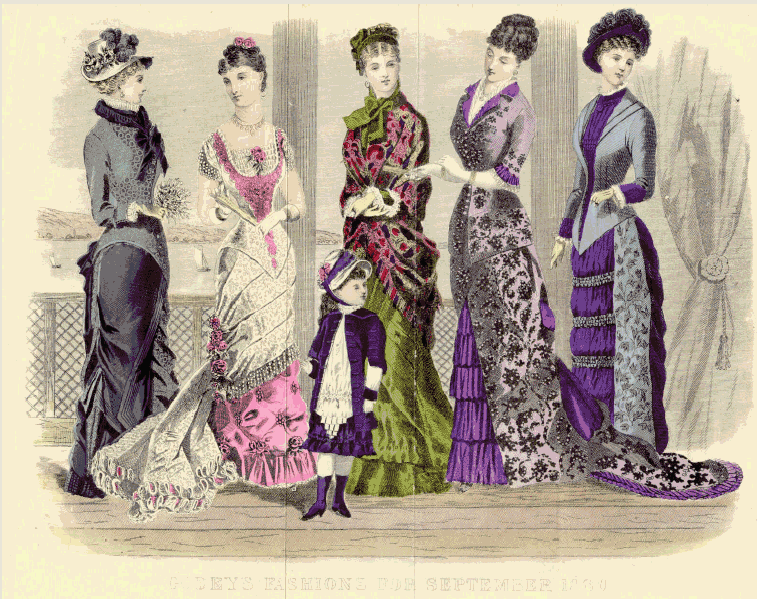
My favorite era to write about is the 1880s. Early in the decade, we see lovely slender silhouettes. The bell-shaped skirts of the Civil War era had been left behind and the bustles of the 1870s had not yet made their comeback, so the style of the day exemplified grace and elegance. However, the tight-fitting style wasn’t always practical.

This sample from Godey’s (at left) shows the slender lines, layered flounces on the skirts, and the vibrant colors women of this time period enjoyed. The women on the ends are wearing the snug fitting basque bodices that extend to the edge of the hips while the dresses on the women next to them exemplify the longer polonaise style bodice that becomes more of an overskirt as it drapes past the knees or even the ankles.

Below is a fashion plate from the September 1881 issue of Peterson’s Magazine. Note the tiny, corseted waists and gathered, draping fabric across the hips and upper leg area of the two models on the right. This horizontal draping was very indicative of the early 1880s. Some of the most popular fabrics included silk (lightweight for eveningwear, faille, lampas, and gros grain varieties for walking dresses), wool (merino, cashmere), satin (often brocaded), and velvet. Of course, women with a more modest budget had to make do with linen, muslin, and calico. Yet in the hands of a capable dressmaker, the results still translated into fashionable ensembles.

So what 1881 fashion best describes your personality?

  • The fine merino wool walking dress – You like to wear the latest styles, presenting an elegant, refined, and professional image.
  • The calico work dress – High fashion is just not practical for your everyday life. You’ve got too much to get done and prefer being comfortable while you’re doing it.
  • Britches and cotton – You’ve got a bit of a rebel streak in you. You’d rather be off with the boys fishing, riding, or doing anything outdoors. Skirts of any kind are just a hassle.


Leave a comment for a chance to win a copy of my first release, A Tailor-Made Bride. In this story, my heroine, Hannah, is a seamstress who always keeps abreast of the latest trends while finding ways to adapt them to the lifestyle of the women in Coventry, Texas.


A Tailor-Made Bride was a 2011 RITA finalist for Best First Book as well as a finalist for the 2011 National Reader’s Choice Award.


Strap ’em on, Cowboy…

From a distance, you might think one cowboy looks pretty much like another, but on closer inspection, you’ll find that though their gear contains the same staples, a cowboy finds a way to make his equipment truly his own. From the type of horse he rides, to the tool work on his saddle, to the way he shapes the brim of his hat–a western man can tell you a lot about himself without ever opening his mouth.

One prime example of this is how the man wears his gun. In the 19th century, it was unheard of for a man to ride the range without a weapon within easy reach. Dangers abounded. Wild animals. Snakes.  Not to mention the trouble that originated on two legs from rustlers or Indian raiding parties. Some carried rifles in a scabbard attached to the saddle, but after the advent of the Colt Single Action Army revolver or Peacemaker in 1873, most cowboys carried a sidearm either instead of a rifle or in addition to it. It was always at hand, even if one’s horse was not.

But how a man chose to wear his Colt, well . . . that was a matter of style and expediency. The leather holster could be plain or decorated, usually natural or brown-colored leather, though sometimes black. Some men stamped their initials or their ranch’s brand into the leather. Holsters in the 1870s were open at the top and had a belt loop on the backside which slid over the cartridge belt. By the 1880s,  holsters tended to be made from a single piece of leather with a back that looped over the belt and provided slots to secure the front. The holster at the top of this post shows this later style with a double loop holster.

Gun belts usually ranged from 3-4 inches wide, and the number of catridge loops on them depended on the caliber of the revolver as well as the length of the belt. Most carried between 40-50 loops. Since ammunition came in boxes of 50, one box could generally fill the belt and the revolver, leaving one chamber empty for safety purposes.

Look at the two men pictured below. Both wear their guns on the right hip. However one man is left-handed. Notice the butt of the pistols. The man in black is wearing his in the usual fashion, with the handle pointing backward. In contrast, note how the man in white shirt sleeves has his handle pointing forward. This is called the “cross draw” position. While most preferred drawing their weapon from the same hip as the dominant hand, some found it easier to reach across their body to draw their weapon, hence the outward facing handle. In fact, if you look carefully at the picture above with the four cowboys together, you’ll notice the third man from the left wears his pistol in the cross draw position.


Despite what we see in the movies, a working cowboy rarely if ever wore more than one gun. If he did wear two, usually the second was simply to have on hand to save the time of reloading as a man would not be nearly as proficient a shooter with his non-dominant hand. And those holsters that tied down to a man’s thigh? Well, those were usually reserved for professional gunmen whether on the right or wrong side of the law. The tie served to anchor the holster so that no slip of the leather would impede a fast draw.

So do any of you have antique holsters or gun belts in your family treasure chest? The wearing of sidearms waned after the end of the 19th century. As populations grew, towns passed ordinances against carrying weapons. But some die hard cowboys never gave up on packing their Colt when riding the range.

That Really Chaps My Hide!

Besides the trademark hat and boots, the item of clothing that says Cowboy more than any other has to be his chaps. Evolved from the chaparejos of the Mexican vaqueros, chaps were originally designed as part of the saddle. Made of animal hides, these armas, or shields,  attached to the horn of the saddle and wrapped around the rider’s legs as well as the horse’s chest.

Now, if you’re like me and didn’t grow up around authentic cowboy culture, you probably pronounce chaps like I do with a ch sound like in the word cheek. However, it truth, it is pronounced with an sh sound like in the Spanish word chaparral, which interestingly enough is the scrubby vegetation that motivated the vaqueros to create chaps in the first place.

Shotguns

In the 1830s and 40s, the first full-length leather britches were created that completely encircled the legs (although the seat remained uncovered). By the 1870s, these garments came to be known as “shotguns” because they were basically two leather cylinders belted together resembling the double barrels of a shotgun.

The waist belt was square cut and buckled at the back. Many came with pockets that closed with a flap and a cowboy could personalize his set by the way he dressed up the outer seams. Many had fringe or conchas. Although, most working cowhands weren’t too concerned with appearance. All they cared about was the protection the leggings provided against not only vegetation, but weather as well. They kept a man’s trousers dry in rain and afforded an extra layer of warmth in wintry conditions. In hot months, though, a man often removed them and worked without. Some men claimed they gave a firmer seat in the saddle since leather clings to leather and afforded a stronger grip with the knees.

Shotgun chaps were put on like a pair of pants. They flared a bit at the ankle to allow a cowboy to put them on without having to remove his boots or even spurs.

Batwings

In the 1880s, due to the popularity of  Wild West Shows and rodeos, a new style of chaps came into fashion. This variety featured wide leather wings that flapped out to the sides. In the beginning, batwing chaps mimicked the step-in style of the shotguns with buckles running the length of the outside seam. However, by the turn of the century, fewer buckles were used and more leather was added. The open leg style took precedence with the chaps only being fastened to the back of the knee. They also became highly decorated with colored leather designs, silver conchos, fancy stitching, and all kinds of custom leather tooling.

This is the style you continue to see along the rodeo circuit today.

Woolies

Around the same time as the introduction of the batwing, another style emerged on the scene. Woolies became exceedingly popular among cowboys who worked northern ranches, like those in Wyoming or Montana. Most were made from Angora goat skin, but they could also be made from bear, buffalo, or even mountain lion. The wool helped to repel water and added a significant layer of warmth. They were fashioned like the shotguns, as a step-in model, and usually were found in solid colors, white and black being the most common. They had a canvas lining which aided putting them on and taking them off, as the rough leather on the opposite side of the fur would not slide easily over a man’s trousers.

So which style of chaps would you prefer your hero to wear? Have any of you worn them yourself? I’d love to hear about your experiences.

I’ll be in and out today since I’m at the American Christian Fiction Writers conference, but I’ll check in as often as possible. Blessings!

(Reference – I See By Your Outfit: Historical Cowboy Gear of the Northern Plains by Tom Lindmier & Steve Mount)

Tennis Anyone?

I’m a huge tennis fan, and this weekend the finals of the last Grand Slam tournament of 2011 will be going on in New York at the US Open. I’m always amazed at the athleticism and power of the top contenders, but I wonder how they would fare if someone turned back the clock 120 years and gave them the equipment and clothing of their predecessors.

Like most sports, the game of tennis evolved over several centuries, but it wasn’t until the 1870s that the first lawn tennis club was established in England. The first tennis championship took place in 1877 at a lovely little place called Wimbledon. Just a few years later in 1881,  the United States National Lawn Tennis Association was formed, and the US National Men’s Singles Championship (later to become the US Open) was held in Newport, Rhode Island. 

The sport became a fashionable rage in the 1880’s and 90’s, especially among the middle classes, and soon men and women both were taking up racquets and installing private lawn tennis courts at their homes. However, women’s clothing of the time made few concessions to the sport. Men were able to play in loose-fitting trousers, shirt sleeves, and a bare head while women were still expected to wear dresses with high-neck bodices, floor-length skirts, layers of petticoats, hats, and yes. . . corsets. The restrictive clothing made it nearly impossible for a woman to bend over and retrieve a ball, so beautifully embroidered tennis aprons with large pockets became the style.

In the beginning, tennis was simply a recreational activity, much like croquet. The fun came in the gathering of friends. Players stood close to the net and simply patted the ball to each other. Yet competitive natures prevailed, and it soon became a sport for athletes. During this time of change, women began making strides in adapting their clothing to better accommodate the physical aspects of the game. Maud Watson became the first female champion at Wimbledon in 1884 and she shocked many with her agressive style of play and *gasp* her short skirts. They barely reached her ankles!

American MaySutton stunned spectators when she rolled up her sleeves during a match and bared her forearms.

However, it was Frenchwoman Suzanne Lenglen in the 1920’s who took women’s sportwear to a whole new level. Her calf-length cotton dresses were considered indecent since she wore neither corset nor petticoat. And instead of a hat, she wore a silk bandeau around her head to help keep her hair out of her eyes. But it was her grace and skill on the court that made her a sporting heroine and inspired women everywhere to give up the shakles of fashion to embrace functionality when it came to sport apparel.

Can you imagine trying to play tennis or any serious sport while trussed up in a corset? I don’t know how they did it. But if it weren’t for those early competive females like Maude Watson who started taking small revolutionary steps, the women’s movement might not have gained the momentum it did at the turn of the century.

Are any of you tennis fans? Want to strap on a corset and long skirt and join me for a reenactment match?

No?

I’m shocked. Truly shocked.

Clothes To Get Hitched In


Last month I went with a friend to the Texas Tech Museum in Lubbock. The newspaper had advertised that they were displaying their extensive collection of old wedding dresses and I couldn’t wait to see them. They certainly didn’t disappoint. I learned that the museum keeps a ton of things in their basement and take pride in bringing them up to display for the public periodically.

Since they have so many wedding dresses, they only bring up a certain amount at a time.  Starting in August these on display now will go back to the basement and a whole new group will come up.  I think they said they have enough to last until June of 2012. Just think how many dresses comprise their collection. The ones I’m showing today were just a few of what my friend and I saw.

The first two were surprisingly made of plaid material. I’d never heard of plaid being used for wedding dresses so I was amazed. For those who don’t know……white wasn’t worn until Queen Victoria married Prince Albert. Prior to that, the dresses had to be functional since they were worn many many times after the wedding.

This one looks like it could’ve been worn by a prairie lady.

The dresses were in all colors. Here’s a bright red one that might’ve been worn in a winter wedding.

This one was Civil War era. Just imagine having to sew all these buttons on!

These last two that I’ll show you today came later toward the end of the 19th century or beginning of the 20th century. Notice that the last one is looking more like the wedding dress we know today.

Over time, some of these dresses became quite worn so the museum experts had to do some extensive renovation. They had a video showing the process of placing another piece of fabric underneath the worn place and carefully stitching it to the dress. I really enjoyed seeing what all goes on behind the scenes.

Dresses in this display were fashioned from fabrics of brocade, velvet, cotton, satin, and silk. The brocade ones looked very heavy and reminded us of the dress Scarlet O’Hara made from her deep emerald drapes.

Can you imagine getting married in dresses like these?


Petticoats & Pistols