Thank you to everyone who came and learned a little about clocks/watches. My winner is: Judy Sexton! I’ll be emailing you shortly. Have a wonderful evening.
Thank you to everyone who came and learned a little about clocks/watches. My winner is: Judy Sexton! I’ll be emailing you shortly. Have a wonderful evening.

Howdy! It’s so good to be with you today!
Usually I enjoy telling you all a farm story, but today I’m excited because my 70th book releases next week! And I wanted to share a little of it with you.
It’s set in the beautiful state of North Dakota and is very much an opposites attract story.
Now, I’ve mentioned my awesome narrator, Jay Dyess, before, and he and I are trying something a little different. We’re going to release the audio of my book, Cowboy Stealing My Heart, for FREE on YouTube BEFORE we release the ebook.
Yep. We’re a little crazy around here. : )
Now, the audio releases tomorrow, and the ebook releases this coming Tuesday. 
Alright, rather than a farm story, I’m going to put a little excerpt of Cowboy Stealing My Heart in. Hope you enjoy!
Calhoun walked out, and Bellamy felt strangely bereft. She ignored that, put the rest of the bacon she held in her mouth, and walked over to the table, walking behind the boys’ chairs, as she had seen Calhoun do.
Noticing the little boy was wiggling even more, she said, “Are you okay, Cayson?”
“This is hard. I don’t want to do it anymore!” he burst out, making Bellamy want to laugh on one hand and cry on the other. She also wanted to ask why couldn’t you have said that three minutes ago when Calhoun was still in here and would have known what to say?
“Maybe I can help you with something?” She walked over and stood behind him.
“No! It’s too hard!” Cayson threw his pencil down. It bounced on the table, rolled, and fell off the other side. Crosby happened to be standing right beside it, and she picked it up and held it in her mouth.
“Crosby! No!” Bellamy said before she heard a crunching sound that was most definitely the pencil being chewed in their dog’s mouth.
“Crosby! Put it down!” Bellamy said, hurrying around the table to get the pencil, or what was left of it, from the dog’s mouth. She wasn’t sure what pencil splinters did to a dog’s insides, but she kinda figured a vet would probably have to be involved.
She dropped to her knees, shoving her hand into the dog’s mouth and hoping it didn’t all of a sudden decide to bite her. She pulled the pieces out as well as she could, setting the slobber-covered splinters in her lap so she could take them to the garbage can.
She pulled out the last piece, patting Crosby on the head and standing back up, making a mental note to make sure no pencils were left lying around on the floor. Looking over the table, she was dismayed to see that Cruz had completely stopped doing his work and was now wrestling Cayson, their arms locked together, as each one was apparently attempting to be the first one to knock his brother off his chair.
Calvin wasn’t wrestling, but his pencil was lying on his book, and he was no longer working but watching his brothers with a grin.
“Boys,” she said, not loud, but as firmly as she could, which didn’t sound very firm to her. She’d never dealt with children before. Funny that she’d been married five times, but never long enough for her and whichever husband she was with to think about kids.
Thankfully, she supposed. Although, the idea of having a normal family was something that elicited a longing in her chest.
But, while Calhoun had seemed to have complete control, in the short ten minutes he’d been gone, she’d lost it, because the boys ignored her word and continued wrestling.
“Cruz. Cayson. You boys are not doing your schoolwork.”
“Cayson said it was too hard. And mine is too,” Calvin said while the other two boys kept tussling.
“Why didn’t you tell Mr. Calhoun that when he was here?”
“Because it wasn’t too hard then,” Calvin said like the answer should have been obvious, his eyes never leaving his brothers.
Cruz seemed to be on the verge of knocking Cayson off his chair. Calvin shoved his own chair back and hurried to help his brother. Grabbing a hold of Cruz, he and Cayson threw him down to the floor. They cheered, which caused Crosby to start barking and dancing all around them.
Cruz yelled, and Bellamy was sure he’d broken something with the way he landed, but thankfully he popped back up, grabbing a hold of Calvin in a headlock, trying to jerk him down, apparently getting the upper hand by catching Calvin off guard.
Cayson took the opportunity to yell and try to grab hold of the dog and run around the table, avoiding Bellamy who reached out to try to grab either the boy or the dog, she wasn’t sure. At this point, either one would have been fine.
She missed both, coming up with just a handful of hair, while Calvin body-slammed Cruz to the floor. Cruz didn’t pop up quite as quickly that time, and Calvin yelled, beating his fist on his chest, then laughing as Cayson and the dog ran by him.
He turned around and started chasing them. Rather than going around in a circle, they cut through the living room, stepped over the coffee table, ran over the couch, and used the end table as a jumping-off point, with Calvin following along behind, only when he got to the end table and jumped, he ducked his body and did a flip, landing on the back of his neck on the couch. He shouted then grunted before rolling over.
Bellamy almost swallowed her tongue. She thought for sure the kid was going to break his neck.
But she realized that somehow the entire box of new pencils had spilled to the floor, and when she’d grabbed at Crosby, she’d dropped all the pieces she’d just picked up, so now there were slobbery pencil pieces on the floor, along with brand-new pencils rolling everywhere. There was also paper scattered over the table, she wasn’t sure quite when that happened, and boys running everywhere, along with the dog, and it felt more like four boys. Or twenty.
She was supposed to be in charge of this chaos.
She wanted to cry. She had no idea how to stop everything.
If you can’t beat them, join them.
She wasn’t sure where that advice came from, but she’d heard it somewhere before, and it seemed very applicable now.
So she ran over to the steps, yelling, “Watch this, boys!” as she jumped up five steps, then turned around and jumped down, realizing as she did so that the last time she’d done anything like this, she’d been a teenager, and it had been a lot easier.
She barely missed the last step and fell forward.
But the boys didn’t notice. They cheered and piled on the stairs, each of them trying to jump from higher and higher up.
Every time they jumped, somehow they managed to land on their feet and do a running turn around the dining room table. Every once in a while, they took a detour into the kitchen and grabbed a piece of bacon off the dwindling pile on the plate on the counter, and then they’d run across the couch in the living room, pass the coffee table, jump on the end table, and Calvin and Cruz would do flips as they landed on the couch before they went back to the stairs.
So far, Cayson hadn’t managed to do a flip, and he wasn’t quite able to go up as high as the other boys could on the stairs.
Definitely joining them was easier than trying to contain them, and Bellamy realized after a while she was actually having fun. She was also able to lead them, in a roundabout way, which gave her an illusion of control.
But they were soon bored with jumping on the stairs, so she grabbed the four corners of her bedsheet and held it in one hand while stepping over the railing at the top of the stairs with the other.
Calvin had suggested jumping off of the railing at the top, and she wanted to say it was too dangerous, but then she decided she could just go first and try it out for them.
Cruz was the one who suggested a parachute. That’s why her bed things were scattered everywhere, over the railing and partway down the stairs, as she held the sheet in one hand, the railing in the other, and looked down at the floor which seemed strangely farther away than it should.
There were two seconds of silence while the boys waited for her to jump with baited breath, and that’s when the door opened and Calhoun stepped back in.
Bellamy, hanging onto the railing with one hand, holding the four corners of her bedsheet with the other, one toe dangling over the open air, froze with wide eyes.
Cruz was right behind her, on the other side of the railing. Calvin had just finished a jump and a flip and was lying on his back on the couch looking up, waiting for her to jump.
Cayson was munching on a piece of bacon and was standing on the table. He was the only thing on the table, and Bellamy honestly wasn’t quite sure where the schoolbooks had gone.
Crosby, as though aware that possibly their antics weren’t going to be met with approval, and possibly having experience in that very thing, slunk down the stairs, her tail between her legs, her butt wiggling back and forth as she went to greet Calhoun.
Calhoun blinked twice, opened his mouth, paused, then slowly closed the door behind him, ignoring the dog, his eyes sweeping the room, then landing back on Bellamy.
“If you’re giving a lesson on gravity, I suggest using an apple.”
Alright, Jessie here again. : ) If you’d like to listen to Cowboy Stealing My Heart, you can find it here tomorrow morning after 7:00 am EDT: https://www.youtube.com/c/SaywithJay 
And, if you’d like to preorder the ebook, you can do that here: https://www.amazon.com/Cowboy-Stealing-Coming-Western-Romance-ebook/dp/B09W7BZ6FG?tag=pettpist-20
Thanks so much for spending time with me today!
~Jessie
 In my upcoming book, Ivy (Love Train Series, Book 7) my hero Darius Jones owns what he refers to as a “paint pony” and “sturdy stock”. The horse’s name is Sammy and he’s what’s known as a Medicine Hat Horse. Why? It all has to do with the horse’s coloring.
Medicine Hat horses are rare and back in the 19th and even into the 20th century, was believed to have special powers. In reality, a Medicine Hat Horse is a pinto with a particular color location. Many people confuse “Paint” and “Pinto” horses. The difference is, Paint horses are a recognized breed. Pinto refers to a coat color pattern that can appear on any breed.
So what’s the color pattern of a Medicine Hat horse? Well, like most pintos their color is patched. A Medicine Hat horse, however, has dark patches mainly on the head and ears (on some it looks like the horse is wearing a bonnet) while the body is mostly white. Sometimes there’s a sprinkle of color on the flanks or belly, but for the most part, it’s the head and ears.
Medicine Hat horses can be any of the usual pinto colors. Black, brown, grey, palomino, roan, or yellow. But the predominant color is white, which is what makes them so rare.
 So what about the special powers? Many Native Americans believed that anyone riding a Medicine Hat horse couldn’t be hurt. If one or both eyes were blue, then that was an added bonus and the horse was believed to be even more powerful. These horses were often rode by Medicine Men who were figures of power in most indigenous tribes.
There’s a lot in Native American History about the medicine man and the Medicine Hat horse. They believed that the medicine man would be protected by the Medicine Hat horse in battle and help him to heal others that were injured. They also believed that Medicine man and horse could warn others of impending dangers.
Tribes used to paint symbols on the Medicine Hat horse’s coat. These symbols represented different things. Tribes would use different colors of paint for different symbols.

 I’ve seen Medicine Hat horses at western horse shows but had no idea of all the history behind their color pattern. It wasn’t until I found a horse for Darius, my hero, that I discovered it. I’m glad I did!
Do you know much about horses? Have you ever owned one? (I’ve owned three) Or, like many, are you a horseless horse lover? I’m giving away a free e-copy of Ivy (Love Train Series, Book 7) to one lucky commenter.
A little more about the book: Ivy Pembrooke has a problem. With her brother gone, she’s now the heir to the Pembrooke fortune and estate. That is, if she lives long enough. After over hearing a plot to kill her, she does what any other heiress would do. She makes a run for it. But how is she going to elude her would be killers and claim what is rightfully hers? Especially when said killer is her uncle? She decides to run now, and figure things out later. In the meantime, she needs a way of escape …
Darius Jones made a promise. Quit the ranch he worked for in Texas, return to Oregon, and take his half-blind mother to Clear Creek. The doctor there was said to work miracles, and Mama needed all the help she could get. But his mother wasn’t the only one. A passenger in the form of a petite, blonde-haired spit fire was going to be the death of him. Literally. Was someone trying to do her harm or was trouble her middle name? Yet there was something about her, and doggone if he didn’t try to help. He just hoped doing so didn’t get them both killed.


It’s funny how one thing leads to another and the next thing you know, you’re writing a book you hadn’t planned on writing.
My dad’s cousin, JJ, often sends him funny quotes or memes, or things to make him smile. He also shares interesting tidbits of information. Dad chooses the things he likes best and sends them on to me.
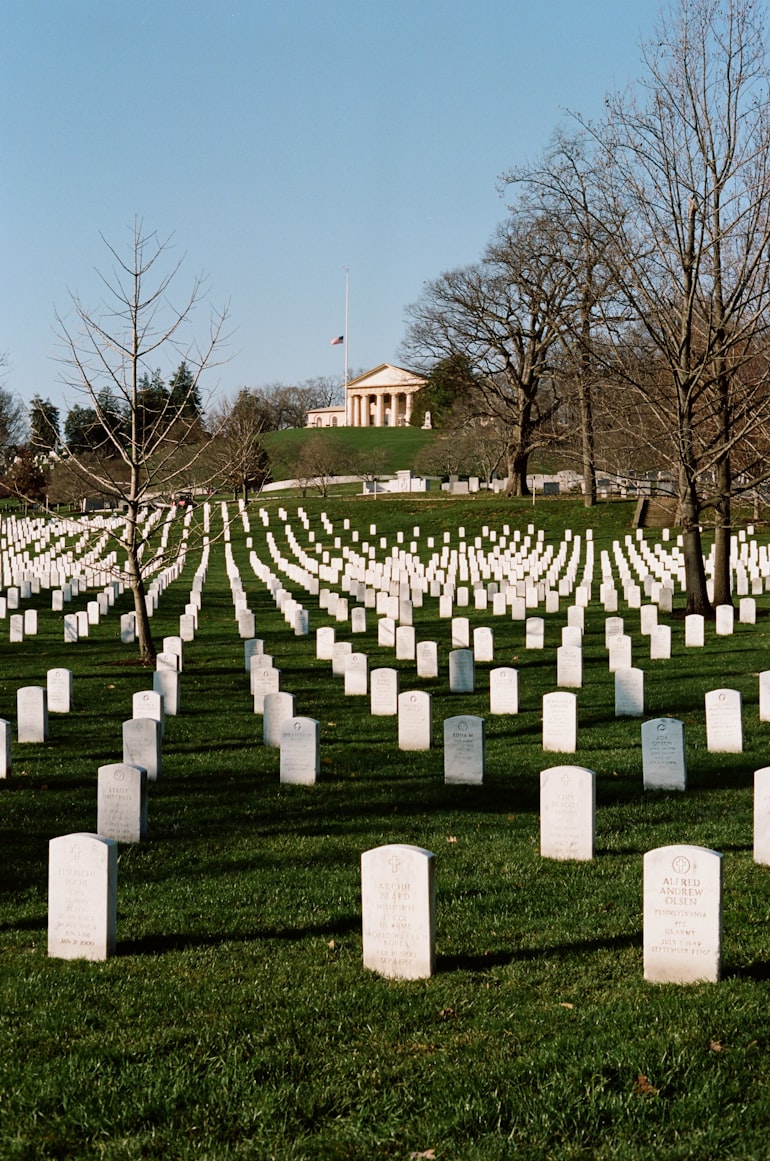
One of his “chosen favorites” from JJ was a lovely post written about the soldiers who guard the Tomb of the Unknown Soldier at Arlington National Cemetery. I’d heard of the cemetery, had never visited it, and knew there were guards, but that was about the extent of my knowledge when I opened that email from dad.
After reading what was shared, I had to know more. I needed to know more about the soldiers who guard the Tomb and the cemetery. And that knowledge led to me writing a sweet contemporary romance about a Tomb Guard, a nurse, and an array of wacky wildlife.
In 1857, George Washington Parke Custis, grandson of Martha Washington and step-grandson of George Washington, willed an 1,100 acre property to his daughter Mary Anna Randolph Custis, who was married to Robert E. Lee. The Lee family vacated the estate in 1861 at the onset of the Civil War, and federal troops soon occupied the property as a camp and headquarters.
In 1863, the government established Freedman’s Village, on the estate as a way to assist slaves transitioning to freedom. The village provided housing, education, training, and medical care. As the number of Civil War casualties grew faster than other local cemeteries could handle them, the property became a burial location. The first military burial took place on May 13, 1864, when Private William Christman was laid to rest there.
That June, the War Department officially set aside 200 acres of the property to use as a cemetery. By the end of the war, thousands of service members and former slaves were buried there. Eventually, the Lee family received compensation for the property although the land remained with the War Department. Today, the cemetery has since grown to exceed 600 acres and is one of the oldest national cemeteries in America.
Evolving from a place of necessity to a national shrine to those who have served honorably in our Nation, the rolling hills have become the final resting place to more than 400,00 active duty service members, veterans, and their families. An average of 27-30 services are held each week day and more than 3,000 ceremonies and memorial services take place each year. Among the notable graves include presidents (President Kennedy and President Taft), astronauts (including John Glenn and Christa McAuliffe), and celebrities (such as Maureen O’Hara, Lee Marvin, and Audie Murphy).
At first, being buried at Arlington was not considered an honor, but it did ensure service members whose families couldn’t afford to bring them home for a funeral were given a proper burial. The first official Decoration Day (later renamed Memorial Day) was held at Arlington National Cemetery on May 30, 1868. The event was so popular, an amphitheater was constructed in 1873 to hold the official ceremonies. By the late 1870s, high-ranking veterans began requesting burial in the Officers’ Sections.
In 1899, the U.S. Government began, at its own expense, repatriating service members who died overseas during the Spanish-American War. The cemetery expanded to include Sections 21, 22, and 24. Congress authorized, in 1900, a designated section for Confederate soldiers. After World War I, more than 2,000 service members were repatriated and interred in Sections 18 and 19.

In October 1921, four bodies of unidentified U.S. military personnel were exhumed from various American military cemeteries in France. The four caskets were taken to the city hall of Châlons-sur-Marne (now called Châlons-en-Champagne), France. Town officials and members of the U.S. Army’s Quartermaster Corps had prepared the city hall for the selection ceremony. Early on the morning of October 24, 1921, Maj. Robert P. Harbold of the Quartermaster Corps oversaw the arrangement of the caskets so that each rested on a shipping case other than the one in which it had arrived. Major Harbold then chose Sgt. Edward F. Younger of Headquarters Company, 2nd Battalion, 50th Infantry, American Forces in Germany, to select the Unknown Soldier. Sgt. Younger selected the Unknown by placing a spray of white roses on one of the caskets. From Châlons-sur-Marne, the Unknown journeyed by caisson and rail to the port town of Le Havre, France. From Le Havre, the Unknown Soldier’s casket was transported to Washington, D.C. on the USS Olympia. The Unknown Soldier arrived at the Washington Navy Yard on November 9, 1921, and was taken to the Capitol Rotund. The Unknown lay in state in there on November 10 with around 90,000 visitors paying their respects that day.
On November 11, 1921, the Unknown was placed on a horse-drawn caisson and carried in a procession through Washington, D.C. and across the Potomac River. A state funeral ceremony was held at Arlington National Cemetery’s amphitheater, and the Unknown was interred in the Tomb of the Unknown Soldier. Nationwide, Americans observed two minutes of silence at the beginning of the ceremony. President Warren G. Harding officiated the ceremony and placed the Medal of Honor, the nation’s highest military decoration, on the casket. Additionally, numerous foreign dignitaries presented their nations’ highest awards.
Originally, the Tomb of the Unknown Soldier consisted of a simple marble slab. Thousands of visitors came to Arlington National Cemetery to mourn at the Tomb and to pay their respects to the Unknown Soldier and the military personnel he represented. The tomb was unguarded, since most people were respectfully. But it became more popular with people to treat the tomb as a tourist attraction. It’s said some even picnicked on the tomb because of the grand view it provided.
In 1926, the Army assigned soldiers as guards. A sarcophagus was installed in 1932. The Tomb sarcophagus is decorated with three wreaths on each side panel (north and south). On the front (east), three figures represent Peace, Victory and Valor. The back (west) features the inscription: “Here rests in honored glory an American soldier known but to God.” (This inscription gets to me every time I read it.)
President Dwight D. Eisenhower signed a bill to select and pay tribute to the Unknowns of World War II and the Korean War in 1956. The selection ceremonies and the interment of these Unknowns took place in 1958. The caskets of the World War II and Korean Unknowns arrived in Washington on May 28, 1958, where they lay in the Capitol Rotunda until the morning of May 30. They were then carried on caissons to Arlington National Cemetery. President Eisenhower awarded each the Medal of Honor, and the Unknowns of World War II and the Korean War were interred in the plaza beside their World War I comrade. A Vietnam Unknown was added in 1984. An Army caisson carried the Vietnam Unknown from the Capitol to the Memorial Amphitheater at Arlington National Cemetery on Memorial Day, May 28, 1984. President Reagan presided over the funeral, and presented the Medal of Honor to the Vietnam Unknown, and also acted as next of kin by accepting the interment flag at the end of the ceremony. With modern technology, the Vietnam Unknown was exhumed in 1998 and identified. His remains were transported to his family in St. Louis, where he was reinterred at Jefferson Barracks National Cemetery. The slab over the empty crypt was since been replaced. The inscription of “Vietnam” has been changed to “Honoring and Keeping Faith with America’s Missing Servicemen 1958 – 1975” as a reminder of the commitment of the Armed Forces to the fullest possible accounting of missing service members.
Beginning in 1937, guards were stationed 24-hours a day to keep watch over the Tomb of the Unknown Soldier. In 1948, the 3d U.S. Infantry Regiment (The Old Guard), took over the prestigious duty and continue to guard the Tomb today. Known as sentinels, the soldiers provide security for the Tomb, lead ceremonies, and maintain the sanctity of the space. To them, they honor the Unknowns through the precision of their rituals.

The sentinels are amazing.
After digging into the research of this unique soldier, they have my highest respect and admiration for their service and dedication.
Soldiers who volunteer to become Tomb guards must go through a strict selection process and intensive training. Each element of their routine has meaning. The guard marches 21 steps down the black mat behind the Tomb, turns and faces east for 21 seconds, turns and faces north for 21 seconds, and then takes 21 steps down the mat. Next, the Guard executes a sharp “shoulder-arms” movement to place his/her weapon on the shoulder closest to the visitors, signifying that he or she stands between the Tomb and any possible threat. The number 21 symbolizes the highest symbolic military honor that can be bestowed: the 21-gun salute.
Now imagine doing that in searing summer heat (in a wool uniform), in pouring rain, or freezing snow. It’s what they do. Every single day.
The Sentinels have a creed they live by. One of my favorite lines is this one: And with dignity and perseverance my standard will remain perfection.
In my sweet romance Lake Bride (releasing June 23), the hero has spent the past two years of his life as a Sentinel. He’s at a crossroads in his life, trying to find himself and direction for his future. When his favorite relative, Uncle Wally, passes away and leaves him a cabin on a lake in Eastern Oregon, Bridger sees the perfect opportunity to get away and figure out what to do with the rest of his life.
If you read my book Henley that was part of the Love Train series, Bridger is a great-great-great-grandson to Evan and Henley Holt!

A solemn soldier.
A woman full of sunshine.
And the lake where they fall in love.
Twenty-one steps. The past two years of Bridger Holt’s life have centered on the twenty-one steps he repeatedly walks back and forth as one of the sentinels guarding the Tomb of the Unknown Soldier. Now that his duty is coming to an end, Bridger has no idea what to do with the rest of his life. Guilt from his past and trepidation about his unknown future drive him to the mountain cabin he inherited from his beloved uncle to gain clarity and direction. The quirky residents in the nearby town of Holiday, the assortment of wildlife that adopts him, and the woman who shines a light into his tattered soul might be what Bridger needs to find the redemption he seeks.
Outgoing, upbeat Shayla Reeves spreads sunshine wherever she goes. Holiday has become her home, and she enjoys spending time in the mountains around town. She adores the patients in the dementia facility where she works as a nurse. But something is missing from her mostly joyful world. When she mistakenly camps on private land owned by the mysterious and brooding Bridger Holt, she realizes what her life is lacking isn’t adventure but love.
Will two opposite personalities overcome their challenges and figure out a way to build a future together?
Find out in this sweet love story full of hope, small-town humor, and the wonder of falling in love.
Pre-order your copy of Lake Bride today!

You can get a free Tomb of the Unknown Soldier Commemorative Guide to download at this link: https://www.defense.gov/Portals/1/Interactive/2021/10-tomb-of-the-unkown-soldier/TUS-Commemorative-Guide.pdf

To enter for a chance to win a Lake Bride postcard, bookmark, and some other fun goodies,
just share if you’ve ever been to Arlington National Cemetery.
If yes, what did you most enjoy there?
If no, share about a place you’ve visited that was special to you.
Congratulations Connie Lee, check your email! I’ve sent you a link!

Most of you all know that we have two laying houses in Pennsylvania. There are 20,000 birds in each of those houses.
We started out our chicken journey when the kids were little with ten Rhode Island Red hens and one rooster. Goodness, that was twenty years ago.
Over those twenty years, people came to our house, and we gave them our extra eggs, and eventually we started selling them, and…yeah. We ended up with a lot of hens. : )
But then we moved to Virginia.
All of my chickens were in PA.
Now, I had plenty of eggs, because Watson brought flats of them down every time he came. We supplied our neighbors with them (and with beef and pork), and they gave us things in return, but it just wasn’t the same.
One of the best things about having animals is watching them. If you’ve never sat on the porch and listened to cows munch grass, you are missing out. There is just something so relaxing about their languid movements, their easy calm, and the satisfying tear of the grass as they rip it up and chew. Even the scent brings the nostalgic, no-pressure days of my childhood back, pushing the cares and responsibilities of being an adult away as dusk deepens and the darkness of evening falls down.
Now at that time of night, the chickens would already be roosted, but there is just something I love about hearing a rooster crow in the morning and listening to hens cackle their “I JUST LAID THE MOST BEAUTIFUL EGG IN THE WORLD” cackle, then watching as those industrious hens scour the yard looking for bugs and worms and all kinds of yummy things to eat.
It’s such a joy and pleasure to look out your kitchen window, hands buried in dishwater, kids chattering behind you, loads of never-ending work forgotten as the hens go about their “daily grind” with a cheerfulness that I often envied but always tried to emulate. If my chickens can have a good attitude, I can smile and be happy too. Right?
More than watching the chickens, I admit I have never lost my absolute love and fascination for gathering eggs.
From the time I was little, braving the pecking and blood, sticking my hand under a hen’s warm breast feathers and feeling around for those smooth, beautiful eggs, to my time in Pennsylvania in the laying houses packing, literally, millions of eggs. (We ship a quarter of a million eggs every week.)
Okay, lean in close because I’m going to say something I haven’t said to too many people and you probably won’t hear me say again: I don’t like eggs. I eat them anyway, because, you know, we have 40,000 chickens, but they make me sick. Not even kidding. But I LOVE to gather them. Always have.
Ha.
In Virginia, we had no chickens and no eggs to gather, so the day we moved in, I said to Watson, “We need to get some chicks.”
Yeah. That didn’t go over well. He reasonably replied, “We have 40,000 chickens in Pennsylvania.”
“But I like to watch them, and I’m in Virginia.”
“You can go to Pennsylvania anytime and watch the chickens to your heart’s content.”
So that was that. No chickens and no egg gathering in Virginia for me.
Earlier last spring, Watson needed feed, so the girls and I rode along to the feed store with him. On the way, we saw some ducks in a pond, and one of our girls said, “Oh, those ducks are so pretty! We should get some for our creek.”
Watson: That’s a great idea!
Me:
Me: ?
Me: Wait! She gets ducks, but I don’t get chickens? (Okay, I know that’s a childish argument, but seriously, how are ducks any different than chickens?)
Watson: If you want to see chickens—
Girls: (finishing his sentence) …go to Pennsylvania and look at them.
Ugh.
Me: But green egg layers would be so much fun! (The only thing better than gathering regular eggs is gathering green eggs. Trust me on this. I speak truth.)
And so the rest of the way to the feed store, Watson explains why we are NEVER getting chickens in Virginia and how I don’t need chickens and how ducks are different and how I need to be happy with no chickens or go to PA, blah, blah, blah.
Bottom line was this: NO CHICKENS IN VIRGINIA. NOT NOW. NOT EVER. End of story.
I know he’s right, and I kinda thought when I started that argument that I was going to lose it, and I can be a gracious loser (ha), so as we pull into the feed store, I say, “Fine. No chickens. We’ll get ducks instead.”
Watson: No ducks, either.
So, anyway, we park, and the girls and Watson get out. I get my Kindle app up and start to read. (I only go into stores if forced to do so. I really don’t like to shop.)
You know how you get lost in a book and you kind of lose track of time and suddenly you look up and realize that a LOT of time has gone by and your family should be back and maybe you should be worried?
So that happened to me just before the girls opened the door and got in the pickup. I’m relieved, so I turn around to greet them and ask what took them so long when I see that my two youngest are both carrying little boxes with handles and small round holes in them.
Then I hear chirping.
Yep. It’s the week before Easter, and the feed store is selling chicks. Would you believe the only
 kind they had left were female Ameraucanas? (Ameraucanas lay green eggs. I’m not even kidding.)
I guess the girls were charmed, and Watson, who likes to act all tough, is just a big softie, and he bought me…um, the girls, ten chicks. (Along with a waterer and feeder, because all our chick-raising equipment is in PA.)
So, this was totally an impulse buy. We have no place on the farm that is secure enough to keep baby chicks. Everything eats them, they have to stay warm (under a heat light warm) and dry, and we just don’t have any place that will keep out the predators—snakes, owls, cats, skunks, rats, coons, possums, etc.
I remember years ago back on the farm—and I’m sure some of you do too—when the box of chicks came from the feed store, it got set in the kitchen right next to the woodstove, and that’s how we kept the chicks warm.
I always loved walking in the kitchen of the old farmhouse and crouching down by the box, just hunkering there and watching the busy little chicks.
Well, I got to do that again, kinda, since we put our ten chicks in an empty water trough, along with their feeder and waterer, and attached a heat light to a board across the top, and put the whole thing in my library.
I wrote Me and the Sweet Snowstorm in my library while the chicks chirped and played beside me. Super fun. They kept me smiling for sure.
(Just a little dose of reality, because nothing is perfect, right? Back on the farm, I don’t remember the kitchen smelling bad, but I’m sure it did with the chicks in it. In my library, it was fun to watch, fun to hear, but it smelled terrible, just saying.)
Okay, I know it’s kind of hard to believe, but I do write books, too, and right now I have a big, ten-book box set on sale for just $.99! You can check it out here: https://www.amazon.com/Sweet-Water-Western-Cowboy-Romance-ebook/dp/B09YQK2L1R?tag=pettpist-20/
 Thanks to everyone who stopped by to chat with me about how music acts as a background to our lives and can say a lot about who we are.
Drum roll, please. The winner of my giveaway is:
Ellie
Ellie, look for an email from me on how to claim your giveaway.
Thanks again for spending time with me.
Julie

Hi all,
Thanks so much for participating in my giveaway. I had such fun responding to your comments. I drew a name at random and am happy to say Abby H. is the winner of my giveaway. Whoo, hoo!
Abby, drop me an email at: cathymcdavid@yahoo.com so I can make arrangements to get the books and goodies to you.
Hugs,
Cathy
Colleen
Connie L.
Angela K.
You’re my Winners! You’ve each won a free e-copy of Ivy (Love Train, Book 7)
Contact me at authorkitmorgan@gmail.com so I can get what I need
to gift you each an e-copy when it releases.