Welcome to High Street

Have you ever thought about what it would be like to wander down a street that existed 250 years ago?

Today, I hope you’ll take a little stroll with me along High Street in Philadelphia, Pennsylvania, during the summer of 1776. It is the setting for much of For Liberty and Love, which just released yesterday! It is the first book in the new Petticoats & Patriots series that spans 250 years!

As a visual learner, I needed images of High Street to be able to write about it. The problem was that cameras were not around back then, and finding drawings or illustrations of High Street wasn’t easy.

This map of Philadelphia from 1776 was very helpful. You can see High Street appears to be the largest street in town.

(From an old drawing in Philadelphia Library.)

This is an image of the Old Court House, Town Hall & Market in 1710, on High Street between Second and Third Streets.

It didn’t really give me the visual I was craving, so I asked ChatGPT to generate a few images and it brought the street to life for me.

In July 1776, High Street was the beating heart of Philadelphia, which was the largest city in America at the time.

Known today as Market Street, High Street stretched from Front Street at the Delaware River all the way up to the edge of the city where it met the Schuylkill River. High Street bustled with the noise, color, and energy of a city standing at the center of history. It was a place where merchants, farmers, tradesmen, sailors, servants, soldiers, and families all crossed paths.

Near the river, a long wooden market shed was crowded with activity. The market shed (or stalls) were  long, narrow, open-air structures with heavy roofs supported by brick pillars, running directly down the center of the 100-foot-wide cobblestone street. Taken straight out of English and Scottish architectural traditions, they formed a permanent, covered marketplace that stretched continuously from the Delaware River waterfront at Front Street up to Third Street.

On market days, farmers arrived with wagons full of fresh produce from the countryside. Butchers sold meat. Fishmongers brought in their catch from the river. Women examined baskets of beets, beans, berries, herbs, and greens. Wheels of cheese, loaves of bread, eggs, butter, smoked meats, and jars of preserves might be set out for eager buyers. In July, the air would have been hot and  humid (read John Adams’ letters to his wife because they offer great detail about how unbearably hot he found the city that year), and loaded with mingled scents — fresh flowers, ripe fruit, fish, horses, the waterfront, woodsmoke, tar from the wharves, and the unmistakable press of many people gathered in one place.

The stalls closest to the river were referred to as the Jersey Market section, specifically reserved for New Jersey farmers who rowed across the Delaware River to sell fresh produce and goods. Ships crowded the waterfront, their masts rising like a forest of harvested timber against the summer sky. Sailors unloaded goods while dockworkers rolled barrels and crates toward warehouses. Shops and taverns served the constant stream of merchants, sailors, and travelers moving through the port city.


If you looked toward the other end of High Street, you could see brick townhouses, artisan shops, print shops, taverns, and small businesses lining the street. Goldsmiths, shoemakers, cabinetmakers, tailors, and booksellers all had their place in the life of the city. High Street was not merely a place to buy and sell. It was where news spread, rumors flew, political opinions were debated, and ordinary people learned extraordinary things.

Just one block south stood the Pennsylvania State House, where the Continental Congress had debated and approved the Declaration of Independence. Although the first public reading took place at the State House on July 8, the news would have rippled quickly through nearby streets, especially with bells ringing throughout the day and peoples celebrating.  Imagine the talk in the market stalls, the whispers in doorways, the questions asked over baskets of produce and bolts of cloth. What would independence mean? What would war cost? What kind of future was beginning?

High Street was also home to  some historical figures. Benjamin Franklin resided right off of High Street.  Jacob Graff, a bricklayer, rented out his upper rooms to Thomas Jefferson, who penned much of the Declaration of Independence there.

The street and the city  gradually softened into gardens, orchards, and open ground. But along High Street, July 1776 was alive with the motion of a city on the edge of change.

It was a place of trade and gossip, heat and dust, courage and uncertainty.

And for the people of Philadelphia, it was the familiar street where everyday life carried on while history unfolded all around them.

Get a glimpse of the some of the history unfolding in For Liberty and Love!

Lucy Carlson works with her father in his High Street Goldsmith shop, making it the perfect place to gather intel on the Redcoats.

She never intended to become a spy … or fall for one.

Philadelphia, 1776

As whispers of revolution swell into a roar for freedom, Lucy Carlson is no longer content to simply watch from behind the counter of her father’s jewelry shop. When a mysterious woman—none other than Martha Washington—leaves behind a locket, Lucy discovers the piece is more than a pretty keepsake. The necklace is a secret vessel for the revolution that carries the promise of love.

Drawn into a dangerous spy ring, Lucy begins crafting coded messages concealed within the locket’s clever design, living a secret double life and risking everything she holds dear in a time of sacrifice and war.

Continental soldier Branch Barton is a man defined by duty. Tasked with rooting out traitors, he moves through the shadowed world of deception and divided loyalties. He’s trained to trust no one, yet he finds himself drawn into a slow-burning connection with the jeweler’s spirited daughter.

But when Lucy begins to suspect Branch may be a Redcoat in disguise, their fragile bond is tested by mistaken identity, growing mistrust, and the threat of betrayal.

In a war where even allies can become enemies,  Lucy and Branch must navigate a world of hidden truths and guarded hearts. With the fate of the colonies—and their hearts—hanging in the balance as Lucy delivers a message in enemy territory, will they find the courage to trust each other and choose love?

Courage built a nation. Love made it worth fighting for.

Throughout 250 years of American history, a well-loved locket finds its way into the hands of eight spirited heroines—each standing at the crossroads of love and destiny, and each inspired by a true patriot. As it journeys from one heart to the next, these stories unfold with sweet romance, unwavering hope, and a deep love of country, proving that even in uncertain times, love is always worth the risk. Start reading the Petticoats & Patriots series today!

Don’t forget to download your digital copy of the first issue of the Petticoats & Patriots Magazine if you haven’t yet!

If you could travel back in time for one day, where would you go?

What would you hope to see? Or who would you like to meet?

Also, be sure to join us each day in our Facebook Reader’s group for more fun, games, and giveaways!

Lake Bride

It’s funny how one thing leads to another and the next thing you know, you’re writing a book you hadn’t planned on writing.

My dad’s cousin, JJ, often sends him funny quotes or memes, or things to make him smile. He also shares interesting tidbits of information. Dad chooses the things he likes best and sends them on to me.

One of his “chosen favorites” from JJ was a lovely post written about the soldiers who guard the Tomb of the Unknown Soldier at  Arlington National Cemetery.  I’d heard of the cemetery, had never visited it, and knew there were guards, but that was about the extent of my knowledge when I opened that email from dad.

After reading what was shared, I had to know more. I needed to know more about the soldiers who guard the Tomb and the cemetery. And that knowledge led to me writing a sweet contemporary romance about a Tomb Guard, a nurse, and an array of wacky wildlife.


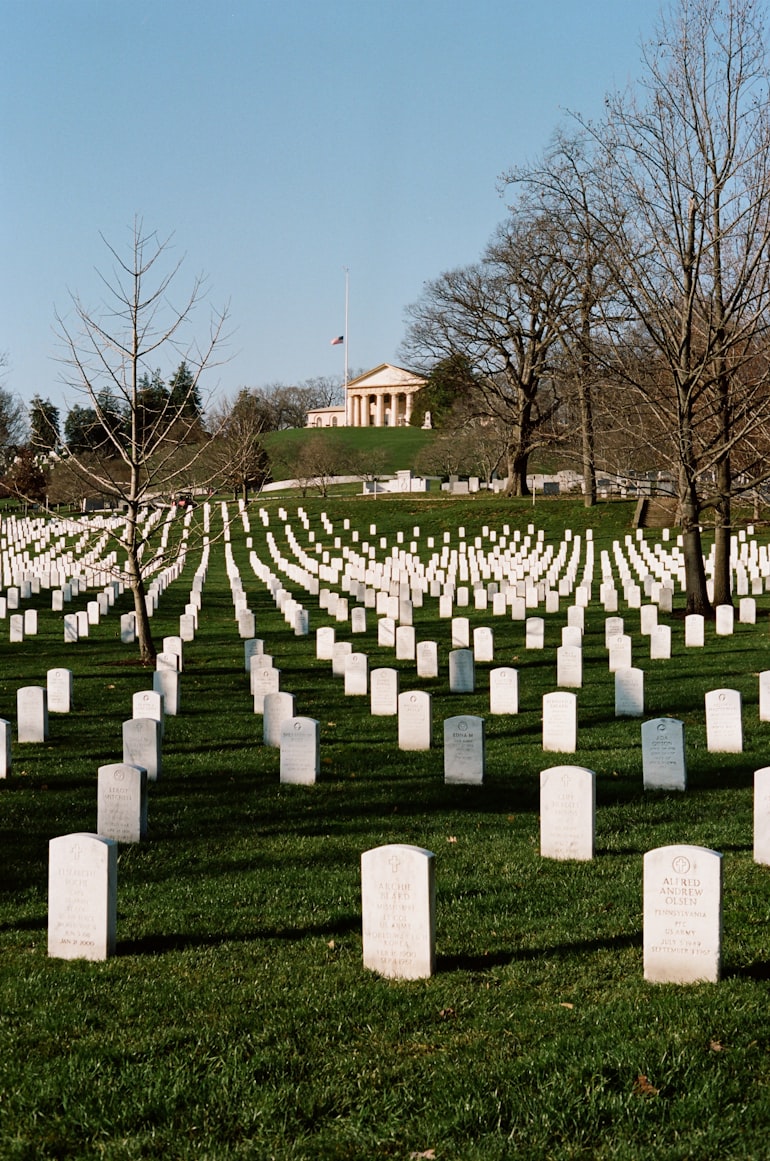
In 1857, George Washington Parke Custis, grandson of Martha Washington and step-grandson of George Washington, willed an 1,100 acre property to his daughter Mary Anna Randolph Custis, who was married to Robert E. Lee. The Lee family vacated the estate in 1861 at the onset of the Civil War, and federal troops soon occupied the property as a camp and headquarters.

In 1863, the government established Freedman’s Village, on the estate as a way to assist slaves transitioning to freedom. The village provided housing, education, training, and medical care. As the number of Civil War casualties grew faster than other local cemeteries could handle them, the property became a burial location. The first military burial took place on May 13, 1864, when Private William Christman was laid to rest there.

That June, the War Department officially set aside 200 acres of the property to use as a cemetery. By the end of the war, thousands of service members and former slaves were buried there.  Eventually, the Lee family received compensation for the property although the land remained with the War Department. Today, the cemetery has since grown to exceed 600 acres and is one of the oldest national cemeteries in America.

Evolving from a place of necessity to a national shrine to those who have served honorably in our Nation, the rolling hills have become the final resting place to more than 400,00 active duty service members, veterans, and their families. An average of 27-30 services are held each week day and more than 3,000 ceremonies and memorial services take place each year. Among the notable graves include presidents (President Kennedy and President Taft), astronauts (including John Glenn and Christa McAuliffe), and celebrities (such as Maureen O’Hara, Lee Marvin, and Audie Murphy).

At first, being buried at Arlington was not considered an honor, but it did ensure service members whose families couldn’t afford to bring them home for a funeral were given a proper burial. The first official Decoration Day (later renamed Memorial Day) was held at Arlington National Cemetery on May 30, 1868. The event was so popular, an amphitheater was constructed in 1873 to hold the official ceremonies. By the late 1870s, high-ranking veterans began requesting burial in the Officers’ Sections.

In 1899, the U.S. Government began, at its own expense, repatriating service members who died overseas during the Spanish-American War. The cemetery expanded to include Sections 21, 22, and 24. Congress authorized, in 1900, a designated section for Confederate soldiers. After World War I, more than 2,000 service members were repatriated and interred in Sections 18 and 19.


In October 1921, four bodies of unidentified U.S. military personnel were exhumed from various American military cemeteries in France. The four caskets were taken to the city hall of Châlons-sur-Marne (now called Châlons-en-Champagne), France. Town officials and members of the U.S. Army’s Quartermaster Corps had prepared the city hall for the selection ceremony. Early on the morning of October 24, 1921, Maj. Robert P. Harbold of the  Quartermaster Corps oversaw the arrangement of the caskets so that each rested on a shipping case other than the one in which it had arrived. Major Harbold then chose Sgt. Edward F. Younger of Headquarters Company, 2nd Battalion, 50th Infantry, American Forces in Germany, to select the Unknown Soldier. Sgt. Younger selected the Unknown by placing a spray of white roses on one of the caskets.  From Châlons-sur-Marne, the Unknown journeyed by caisson and rail to the port town of Le Havre, France. From Le Havre, the Unknown Soldier’s casket was transported to Washington, D.C.  on the USS Olympia. The Unknown Soldier arrived at the Washington Navy Yard on November 9, 1921, and was taken to the Capitol Rotund. The Unknown lay in state in there on November 10 with around 90,000 visitors paying their respects that day.

On November 11, 1921, the Unknown was placed on a horse-drawn caisson and carried in a procession through Washington, D.C. and across the Potomac River. A state funeral ceremony was held at Arlington National Cemetery’s amphitheater, and the Unknown was interred in the Tomb of the Unknown Soldier. Nationwide, Americans observed two minutes of silence at the beginning of the ceremony. President Warren G. Harding officiated the ceremony and placed the Medal of Honor, the nation’s highest military decoration, on the casket. Additionally, numerous foreign dignitaries presented their nations’ highest awards.

Originally, the Tomb of the Unknown Soldier consisted of a simple marble slab. Thousands of visitors came to Arlington National Cemetery to mourn at the Tomb and to pay their respects to the Unknown Soldier and the military personnel he represented. The tomb was unguarded, since most people were respectfully. But it became more popular with people to treat the tomb as a tourist attraction. It’s said some even picnicked on the tomb because of the grand view it provided.

In 1926, the Army assigned soldiers as guards. A sarcophagus was installed in 1932.  The Tomb sarcophagus is decorated with three wreaths on each side panel (north and south). On the front (east), three figures represent Peace, Victory and Valor. The back (west) features the inscription: “Here rests in honored glory an American soldier known but to God.” (This inscription gets to me every time I read it.)

President Dwight D. Eisenhower signed a bill to select and pay tribute to the Unknowns of World War II and the Korean War in 1956. The selection ceremonies and the interment of these Unknowns took place in 1958. The caskets of the World War II and Korean Unknowns arrived in Washington on May 28, 1958, where they lay in the Capitol Rotunda until the morning of May 30. They were then carried on caissons to Arlington National Cemetery. President Eisenhower awarded each the Medal of Honor, and the Unknowns of World War II and the Korean War were interred in the plaza beside their World War I comrade. A Vietnam Unknown was added in 1984. An Army caisson carried the Vietnam Unknown from the Capitol to the Memorial Amphitheater at Arlington National Cemetery on Memorial Day, May 28, 1984. President Reagan presided over the funeral, and presented the Medal of Honor to the Vietnam Unknown, and also acted as next of kin by accepting the interment flag at the end of the ceremony. With modern technology, the Vietnam Unknown was exhumed in 1998 and identified. His remains were transported to his family in St. Louis, where he was reinterred at Jefferson Barracks National Cemetery. The slab over the empty crypt was since been replaced. The inscription of “Vietnam” has been changed to “Honoring and Keeping Faith with America’s Missing Servicemen 1958 – 1975” as a reminder of the commitment of the Armed Forces to the fullest possible accounting of missing service members.

Beginning in 1937, guards were stationed 24-hours a day to keep watch over the Tomb of the Unknown Soldier. In 1948, the 3d U.S. Infantry Regiment (The Old Guard), took over the prestigious duty and continue to guard the Tomb today. Known as sentinels, the soldiers provide security for the Tomb, lead ceremonies, and maintain the sanctity of the space. To them, they honor the Unknowns through the precision of their rituals.

The sentinels are amazing.

After digging into the research of this unique soldier, they have my highest respect and admiration for their service and dedication.

Soldiers who volunteer to become Tomb guards must go through a strict selection process and intensive training. Each element of their routine has meaning. The guard marches 21 steps down the black mat behind the Tomb, turns and faces east for 21 seconds, turns and faces north for 21 seconds, and then takes 21 steps down the mat. Next, the Guard executes a sharp “shoulder-arms” movement to place his/her weapon on the shoulder closest to the visitors, signifying that he or she stands between the Tomb and any possible threat. The number 21 symbolizes the highest symbolic military honor that can be bestowed: the 21-gun salute.

Now imagine doing that in searing summer heat (in a wool uniform), in pouring rain, or freezing snow. It’s what they do. Every single day.

The Sentinels have a creed they live by. One of my favorite lines is this one: And with dignity and perseverance my standard will remain perfection.

In my sweet romance Lake Bride (releasing June 23), the hero has spent the past two years of his life as a Sentinel. He’s at a crossroads in his life, trying to find himself and direction for his future. When his favorite relative, Uncle Wally, passes away and leaves him a cabin on a lake in Eastern Oregon, Bridger sees the perfect opportunity to get away and figure out what to do with the rest of his life.

If you read my book Henley that was part of the Love Train series, Bridger is a great-great-great-grandson to Evan and Henley Holt!

A solemn soldier.

A woman full of sunshine.

And the lake where they fall in love.

Twenty-one steps. The past two years of Bridger Holt’s life have centered on the twenty-one steps he repeatedly walks back and forth as one of the sentinels guarding the Tomb of the Unknown Soldier. Now that his duty is coming to an end, Bridger has no idea what to do with the rest of his life. Guilt from his past and trepidation about his unknown future drive him to the mountain cabin he inherited from his beloved uncle to gain clarity and direction. The quirky residents in the nearby town of Holiday, the assortment of wildlife that adopts him, and the woman who shines a light into his tattered soul might be what Bridger needs to find the redemption he seeks.

Outgoing, upbeat Shayla Reeves spreads sunshine wherever she goes. Holiday has become her home, and she enjoys spending time in the mountains around town. She adores the patients in the dementia facility where she works as a nurse. But something is missing from her mostly joyful world. When she mistakenly camps on private land owned by the mysterious and brooding Bridger Holt, she realizes what her life is lacking isn’t adventure but love.

Will two opposite personalities overcome their challenges and figure out a way to build a future together?

Find out in this sweet love story full of hope, small-town humor, and the wonder of falling in love.

Pre-order your copy of Lake Bride today!


You can get a free Tomb of the Unknown Soldier Commemorative Guide to download at this link: https://www.defense.gov/Portals/1/Interactive/2021/10-tomb-of-the-unkown-soldier/TUS-Commemorative-Guide.pdf

To enter for a chance to win a Lake Bride postcard, bookmark, and some other fun goodies,

just share if you’ve ever been to Arlington National Cemetery.

If yes, what did you most enjoy there?

If no, share about a place you’ve visited that was special to you. 

Petticoats & Pistols