
 My husband and I arrived in Lexington, Kentucky late Sunday afternoon. It’s a 540-mile journey from our house in northern Virginia, and we typically do it in 9-10 hours including stops for gas, food, dog walks, etc.. Not this time! Instead of zipping along in my little Camry or in a rental car (we’ve done that at Christmas with the kids because we needed space for gifts, etc.), we were in my husband’s beloved and well used 1994 Toyota Tacoma pick-up truck, a long-bed with a bit of extra cab space.
This baby was loaded to the max. I’ve never seen anything quite like it. My husband used the twin bed mattresses and box springs to make a box of sorts, and we filled it with a coffee table, three chairs, bags of bedding, a large toolbox and an assortment of household flotsam and jetsam. Talk about 10 lbs of flour in a 5 lb. sack! This was absurd!
And then it started to rain . . . Not a lot, but enough to require plastic sheeting. Add yellow rope, a dozen bungee cords in a rainbow of colors, and brown packing tape and you’ve got the picture. I wanted to take a photograph, but I couldn’t find the camera because it somehow got packed in a mystery box. My theory is that my husband knows exactly where the camera is , but he doesn’t want this packing job on the internet. I don’t blame him! It was hilarious.
 So how does all this relate to the pioneers traveling in their covered wagons?
We were in West Virginia on I-64 when I first thought of those stalwart men and women–and their oxen–lumbering up long, steep hills. Our little truck had to be near the maximum of its weight capacity. We had to downshift on some of the grades between Covington, Virginia and Beckley, West Virginia, but we did just fine. Slow but sure. If we’d had oxen, though, we’d have been dumping stuff like the pioneers did as they traveled west.
What would be the first thing to go?
Not the tool chest, even though it was extremely heavy. A man has to be able to fix things.
Not the clothing. It takes up space, but it’s light.
Books? Ouch! I have a lot more books than the pioneers, but I’m sure they traveled with a few precious family heirlooms. Maybe a Bible with the family lineage, or a much prized book of poetry. That’s not something anyone would want to part with.
Pieces of furniture? That’s what went first. Whatever is heavy, most dispensable and most easily replaced would end up on the side of the road. This got me thinking about things we need vs. things we love. A fifty lb. sack of flour would be a lot more precious than 50 lbs. of china to someone in need of bread, but the china would hold memories for generations.
 My husband I didn’t have to throw anything out of the truck, but we had to deal with the strain of travel. We were a few miles from home when we had to stop for the first time to retape the sheeting. Fifty miles later, we bought three more bungee cords at a truck stop on I-81, the main thoroughfare through the Shenandoah Valley.
At sunset, we were in the Wal-Mart in Lexington, Virginia buying more plastic sheeting because the wind had whipped holes in the first layer.
We made it, though. We’re safely in Lexington, Kentucky and its beautiful! I’m in Bluegrass Country! The truck is safely parked (make that hidden!) in my in-laws garage, waiting to be unloaded. We might just leave it there until we find our new homestead. The looking starts tomorrow and I can’t wait.
The modern day Conestoga has arrived at last!


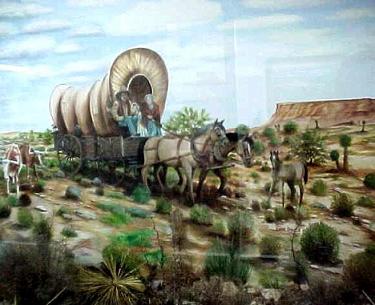 Local plants and animals supplied much of their food, but they had to haul along flour, sugar, coffee, beans and other essentials. They could make some purchases from forts and trading posts along the way, but you know how prices go.


 Conestogas, but the Conestogas were the biggest. Just how big was a Conestoga wagon?
 24 x 11 x 4).


 ssenger has an individual entertainment system complete with movies, television, and music.


 e West.
 Greetings from the Wardman Marriott Hotel in Washington DC, the site of this year’s national conference for Romance Writers of America!


 ings.


 One of my earliest memories is sitting on the floor in my bedroom with a children’s book of fairy tales. The book was tall and wide and about a half-inch thick. The cover showed Rapunzel with her hair flowing while a prince in a pointy hat gazed up at her. Red Riding Hood is looking up, and there’s a unicorn in the background.

 And so the research began . . .
 made using etched zinc plates, chromolithographs and photo engravings. They popularized well known illustrators including Thomas Nast and Ida Waugh.


