Month: September 2008

Male-Ordered Brides!
Charlene Sands
I think Cheryl St. John called what I have “Wedding Brain” and she’s absolutely right! As some of you know my daughter is getting married next month and I’ve been in wedding mode for months now. It’s hard to focus on much of anything else, so when it came time to blog, I figured what better topic than marriage and mail-ordered or picture brides of the West!
 I’ve always wanted to write a mail-order bride story, but I knew I wanted it to be more than the usual. In RENEGADE WIFE, I conceived a plot where both bride and groom didn’t want the marriage. It had been the brainchild of the Kane Jackson’s grandfather wanting to see his long lost grandson, who’d been raised by the Cheyenne , settle down and marry. My heroine, Molly needed passage out west to search for her younger brother who had run away. I have to say it was a fun story to write, and I learned quite a bit about picture brides and mail-ordered brides from that research.
One way for men to meet women was from subscriptions to heart and hand clubs. Newspapers and periodicals would post information about women, sometimes with photos or tintype images and the men would write to these women, often time convincing them to move out west. If the woman agreed, the man was responsible to send railroad passage and they would meet and marry before they really got any chance to know one another.
A risky proposition for a female, I would think.
Some men found their wives from pictures of their friends’ relatives. For instance, if a man saw a picture of his friend’s cousin or sister, he might offer her marriage. Culture played a part in which men considered marrying these Picture Brides. Asian and Greek men who wanted to marry within their culture often married this way. Others might just find an appealing picture of a women, regardless of their background and offer her marriage.
 In 1849 Eliza W. Farnham developed the California Association of American Women, to encourage women to travel to California to meet and marry men. Unfortunately, her endeavors didn’t meet with much success. Only two women accompanied her to the west coast.
I guess the west held little appeal for women at the time. More than 3/5 of the adult Caucasian population of California were male. Four out of every five of those men were bachelors.
Asa Mercer organized two successful trips to Washington that brought more than one hundred women to the region and he married one of those women himself.
T he pledge a man made to a woman through letters and wires were held in high regard. If a man failed to follow through on his intentions, often they paid the consequences. Here’s a few examples from Frank Leslie’s Illustrated Newspaper:
Broken love pledges are rising in value, and if juries continue to look upon the matter in the light they do at present, faithless lovers will cease to exist. Miss Francis Hobson of Cincinnati, recently received $3,300.00 from Asa H. Cone for breech of promise.
The daughter of a well-known commission merchant of Chicago has initiated a suite against a prominent physician for breech of promise of marriage – damages $25,000. Another young lady in Chardon, Wisconsin has just received a healing plaster for her broken heart in the shape of a verdict of $10,000 damages against the gay deceiver.
And I love this one, so I’m including it because its fodder for a great romance ending!
In Texas men in love are justified in stealing horses. A jury in Texas lately acquitted a man on the charge of horse stealing, although the crime was clearly proven against him, simply because he stole the horse to elope with his sweetheart, who was present in the court during the trial and waiting to marry him if acquitted.
Do you like to read Male-Ordered Bride stories? And do you think you’d have taken a man up on his offer of home and hearth? Do you have that adventurous spirit, marrying a man sight unseen? Post a comment to be entered for a random drawing to win a copy of my out of print, hard to find, Renegade Wife!
And our Contest is coming to a close soon. Check back often to see if you’re our Grand Prize Winner!


Click on the book cover to purchase.
My Favorite Shifty-Eyed Bad Guy
 As soon as he skulked onto the screen, you knew there was bound to be trouble. He didn’t even have to open his mouth. That wild-eyed look said it all. Jack Elam’s character was bad to the bone.
The real Jack Elam made more than fifty films, from war movies to film noir to comedy. But it’s his Westerns that fans remember. He was never the star. But his presence could electrify the screen. In 1994 he was inducted into the Hall of Great Western Performers of the National Cowboy and Western Heritage Museum–an honor well earned.
 William Scott Elam was born in Arizona around 1918 (the date is uncertain because he lied about his age to get work picking cotton). At the age of twelve, during a scuffle at a Boy Scout meeting, a pencil entered his left eye. Not only did he lose the sight, but the blind eye kept its off-kilter look for the rest of Elam’s life.
In the late 1940’s, Elam was working as a bookkeeper for Samuel Goldwyn Studios. But the close work strained his one good eye. Threatened with blindness, Elam offered to arrange financing for a movie director friend in exchange for roles in his films.
 In Elam’s early movies, his bad eye was camouflaged by make-up, lighting and camera angles. Later, however, it was the eye—which gave him a slightly crazed look—that made Elam’s career as a character actor. His notable westerns include Rawhide (1951), High Noon (1952), Vera Cruz (1954), The Man From Laramie (1955), Jubal (1956), Gunfight at the OK Corral (1957) and Once Upon a Time in the West (1968) and Rio Lobo (1970).
With few exceptions, Elam played bad guys. But he played them straight on. He was quoted as saying about his roles: “In the old days, Rory Calhoun was the hero because he was the hero and I was the heavy because I was the heavy — and nobody cared what my problem was. And I didn’t either. I robbed the bank because I wanted the money … I’ve played all kinds of weirdos but I’ve never done the quiet, sick type. I never had a problem — other than the fact I was just bad.”
 From the late 1960’s on, Elam gained new fans as a comedian in such films as Support Your Local Gunfighter and The Over the Hill Gang. He also played in several TV series. The best-known Elam quote is the one that sums up the career of a character actor, as seen by a film director: “1. Who’s Jack Elam? 2. Get me Jack Elam. 3. Get me a Jack Elam type. 4. Get me a young Jack Elam. 5. Who’s Jack Elam?”
Jack Elam died of heart failure on Oct. 20, 2003, but he remains my favorite bad guy. How about you? Who’s your favorite Western bad guy and why?
To go to Amazon.com click on one of these books. And don’t forget to enter our big contest. It ends this week, and we’ve got some great prizes!


Back to School–1800’s Style!

By now, schools across the country are back in session. A year ago this time, I lamented here on Petticoats & Pistols how my last little chicky had entered college, and that Doug and I were empty-nesters after 31 years. Now that Amy is in her sophomore year, I’ve adjusted well to a quiet house (and yeah, I like it, as many of you said I would. In fact, I like it alot. LOL).
Still, it’s strange not to watch the weekly ads for specials on spiral notebooks, pens, pencils, erasers and backbacks. I miss that anticipation of school starting up again, visiting the uniform store (my daughters went to parochial schools and thus wore unforms), and stocking up on new underwear, socks and sturdy tennis shoes.
Historical writer that I am, and being the mother of two schoolteachers, and of a daughter employed at Creighton University, I’ve been thinking of what going back to school was like for nineteenth century students and their teachers in the West.
Up until the Civil War, teachers were usually male, but the country’s economy forced many of the men to leave teaching for higher paying jobs. Women well knew the importance of education for their children and refused to let them grow up uneducated on the expanding frontier.

Girls barely older than fifteen years gathered up their courage and answered the cry for schoolma’ams. If they didn’t already live in the region, they headed west and filled those desperate slots in schoolrooms often crude, cold or hot, and always small.
She had to convince her County Superintendent she was of good moral character, and that she would teach school in ‘a faithful and efficient manner.’ She had to be single–and if anyone knows why she couldn’t be married, I’d love to know. Fillies?? To earn a coveted teaching certificate, the women had to attain at least a 70% (considered lenient by today’s standards) on their exams in the following courses:

Mental Arithmetic
Written Arithmetic
Bookkeeping
Civil Government
Drawing Blackboard
English Composition
English Grammar
Geography
History, US
Penmanship
Physiology
Reading
Theory and Art of Teaching
Orthography
Anyone know what Orthography is? Physiology?
Passing these subjects would have earned them a ‘Teacher’s Second Grade Certificate.’ The certificate had nothing to do with teaching second grade. It merely meant she could teach primary grades. The certificate was good for six months.

If she earned a ‘Teacher’s First Grade Certicate’, she would have passed more difficult courses like Algebra, Geometry, Botany and Natural Philosophy. She would be teaching older children, and her certificate would be valid for one year.
A Third Grade Certificate was the lowest ranked and was good for only 3 months, about one school term. There was even a probational certificate for those teachers who came within 10% of passing her third grade certificate requirements. However, to renew it, she had to score higher or not be allowed to teach. That said, these requirements were left up to the county superintendent to enforce as he saw fit.
Teachers sometimes made as little as $4 to $11 per month, but others in Kansas and Nebraska earned as much as $25 month. Since school was only in session 3 – 4 months out of the year (children were needed to help with fall harvesting and spring chores like calving and planting) she was forced to either find another job during the off-months, or find a way to live a year on 4 months salary.
All that said, in the late 1800’s, the Midwest, namely Kansas and Nebraska, claimed some of the best literacy rates in the country.
Here’s an 1895 final exam, taken by eighth graders in Salina, Kansas, from the original document on file at the Smoky Valley Genealogical Society and Library in Salina, Kansas and reprinted by the Salina Journal.
Note that this test was five hours long. Yikes!
Grammar (Time, one hour)
1. Give nine rules for the use of Capital Letters.
2. Name the Parts of Speech and define those that have no modifications.
3. Define Verse, Stanza and Paragraph.
4. What are the Principal Parts of a verb? Give Principal Parts of do, lie, lay and run.
5. Define Case. Illustrate each Case.
6. What is Punctuation? Give rules for principal marks of Punctuation.
7-10. Write a composition of about 150 words and show therein that
you understand the practical use of the rules of grammar.
Arithmetic (Time, 1.25 hours)
1. Name and define the Fundamental Rules of Arithmetic.
2. A wagon box is 2 ft. deep, 10 feet long, and 3 ft. wide. How many bushels of wheat will it hold?
3. If a load of wheat weighs 3942 lbs. What is it worth at 50 cts. per bu, deducting 1050 lbs. for tare?
4. District No. 33 has a valuation of $35,000. What is the necessary levy to carry on a school seven months at $50 per month, and have $104 for incidentals?
5. Find cost of 6720 lbs. of coal at $6.00 per ton.
6. Find the interest of $512.60 for 8 months and 18 days at 7 percent.
7. What is the cost of 40 boards 12 inches wide and 16 ft. long at $.20 per inch?
8. Find bank discount on $300 for 90 days (no grace) at 10 percent.
9. What is the cost of a square farm at $15 per acre, the distance around which is 640 rods?
10. Write a Bank Check, a Promissory Note, and a Receipt.
U.S. History (Time, 45 minutes)
1. Give the epochs into which U.S. History is divided.
2. Give an account of the discovery of America by Columbus.
3. Relate the causes and results of the Revolutionary War.
4. Show the territorial growth of the United States.
5. Tell what you can of the history of Kansas.
6. Describe three of the most prominent battles of the Rebellion.
7. Who were the following: Morse, Whitney, Fulton, Bell, Lincoln,Penn, and Howe?
8. Name events connected with the following dates: 1607, 1620, 1800, 1849, and 1865?
Orthography (Time, one hour)
1. What is meant by the following: Alphabet, phonetic orthography,etymology, syllabication?
2. What are elementary sounds? How classified?
3. What are the following, and give examples of each: Trigraph, sub vocals, diphthong, cognate letters, linguals?
4. Give four substitutes for caret ‘u’.
5. Give two rules for spelling words with final ‘e’. Name two exceptions under each rule.
6. Give two uses of silent letters in spelling. Illustrate each.
7. Define the following prefixes and use in connection with a word: Bi, dis, mis, pre, semi, post, non, inter, mono, super.
8. Mark diacritically and divide into syllables the following, and name the sign that indicates the sound: Card, ball, mercy, sir, odd, cell, rise, blood, fare, last.
9. Use the following correctly in sentences, Cite, site, sight, fane, fain, feign, vane, vain, vein, raze, raise, rays.
10. Write 10 words frequently mispronounced and indicate pronunciation by use of diacritical marks and by syllabication.
Geography (Time, one hour)
1. What is climate? Upon what does climate depend?
2. How do you account for the extremes of climate in Kansas?
3. Of what use are rivers? Of what use is the ocean?
4. Describe the mountains of N.A.
5. Name and describe the following: Monrovia, Odessa, Denver, Manitoba, Hecla, Yukon, St. Helena, Juan Fermandez, Aspinwall and Orinoco.
6. Name and locate the principal trade centers of the U.S.
7. Name all the republics of Europe and give capital of each.
8. Why is the Atlantic Coast colder than the Pacific in the same latitude?
9. Describe the process by which the water of the ocean returns to the sources of rivers.
10. Describe the movements of the earth. Give inclination of the earth.
Were you as amazed as I was? It was very common to read of our ancestors having only an eighth grade education, but hot-diggity, with smarts like this, they probably didn’t need to go onto secondary education. At least, not like we do today.
So, do tell. Can you answer these questions? With news reports lamenting the lower than expected reading scores in some of today’s schools, do you think we should go back to nineteenth century standards of learning?
What was the hardest class you took in school? What were you a whiz at? What classes did you have back then that you wished the schools had now? Share your school experiences with us!
And don’t forget Monday, September 15th, is the last day to enter our Sizzling Summer Contest!

Survival — Native American Style

I hope that you had a wonderful holiday weekend. It was a beautiful weekend here — although I must admit that I am away from home at present and am here in Florida doing a course that is the equivalent of a year of college. And so I spent my entire weekend inside and studying.
But how about you? Did any of you do any camping? You know, I listen to talk radio and it seems to me that with the instability of our marketplace right now and with food prices on a steady up trend, perhaps this isn’t such a bad subject to be talking about right now. Now, I was going to talk about the 3rd most important thing when it comes to survival, having already discussed food and shelter — and that is clothing, but instead of that, since our economy seems unstable right now, and since food prices are ever rising, I thought we might take a moment to talk about another sort of survival tactic — one that might be more appropro to today’s situation in the world — prepareness.
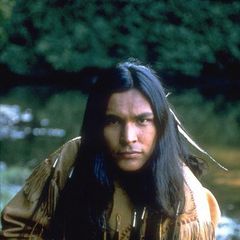
 Thought I might as well get this picture shown right from the start and get it out of the way, since I love it so much. I never get tired of looking at it. Deep sigh…
Okay, in the old days, the Indians lived off the land and rarely starved. It wasn’t until reservation days that starvation became a real threat. Before that time, the Indians knew what plants to look for and where to look, what animals to kill, how to kill them for food, how to jerky the meat and how to survive and live off the land. In truth, before the last World War, most Americas were living on farms and so the Depression (I never call it the Great Depression, as I think of Great things as good things) — but the collaspe of the economy during the Depression — bad as it was, wasn’t as bad as it might be in our future because most people still lived on farms back then and knew how to grow their own food. So, as I used to learn in the Girl Scouts, let me ask you this. How prepared are you for a collapse are you?
Heaven forbid it ever happen. But as my mother used to say, “You prepare for the worst and enjoy those things you stored when it doesn’t happen.” So let’s go over a few things that might come in handy to have, just in case, okay?
1) Food — do you have a minimum of a 1 year supply for all members of your family on hand. These are storeable items like grains, dried fruits, canned organic veggies, nuts, baking soda, fish-liver oil, baking powder, and anything else that you can thing of to store — meat, etc. Get them for long storage — again that’s minimum 1 year supply for every member of your family and any member of your family that in a catastrophe might come home. : )
 2) Medical supplies. You can’t have enough medical supplies. Bandages, bandaids, aspirin, alcohol, hydrogen peroxide, and any other medicine that you need. For me, because I don’t take drugs, this means a year’s supply minimum of vitamins and minerals, as well as any herbs needed for medical emergencies. And remember this is a 1 year supply for every member of your family — and those who might join you later on.
3) Seeds — organic seeds, if you please. The reason for heirloom, organic seeds is that the new Monsanto seeds and evern the more common hybrid seeds don’t produce seeds for replanting — and keeping seeds from year to year is vital. Even is you live in the city, you can start a garden of some kind. My husband and I live in the city and instead of growing a lawn, we are now growing a garden. We are learning also that one needs to LEARN how to garden and how to keep out pests. So far squirrels and rabbits are benefitting from our new garden. : )
4)  An herb garden is pretty essential. From an herb garden you can obtain many medicinal plants — like Echinacea and Goldenseal, as well as Oregano, sage and other herbs. And again, even if you live on the city, you can probably start a garden on the roof or on a window seal. You might even be able to make friends with local farmers who might be able to help you through a tough time, but I would advise you to plant as much as you can for yourself and for your family.

Now, while it might be fun to have these two men riding protection for you, probably it is a good idea to have a rifle or a gun of some kind as a form of self and family protection. Personally, I think our Founding Fathers were right in guaranteeing us the right to bear arms. Criminals and vandals will always find a way to get guns, while the honest citizen is left unprotected and defenseless. My huband and I belong to Frontsight, a shooting organization that teaches you not only self-protection and makes sure that you know how to place a good shot, but teaches you when to make that shot and when not to. But not only is protection important in emergencies — to protect the lives of your family and yourself — guns are important in keeping pests like rabbits and squirrels away from your garden — guns can also bring in fresh game in case of a food shortage. If you don’t like guns and will absolutely not have one in your household, then I would advise you to learn self-defense — hand-to-hand — and to learn to use a bow and arrow for hunting.
Okay, let’s see. What have I left out? There’s something that’s important that I’m not thinking of here.
Oh, yes, a subject that is dear to the pocketbook:
6) Some sort of cash. Now what do I mean by cash? Some say silver or gold with lead to protect that silver or gold. : ) Some say to invest in the Euro — just in case the dollar falls. I will say right here and right now that this is not an area that I know much about. And if there is some kind of castastrophe — heaven forbid — or martial law — double heaven forbid — what might people use as money? Barter? Gold? Silver? Your guess is as good as mine. All I know is that you might want to have something on hand to barter with.
Well, now that’s all I can think of right now. You might be able to think of other things that one might to do be prepared. In the old days — the days of my grandparents, all families had either a full year’s supply of food on hand and/or a victory garden. When I was growing up, almost all of my neighbors had gardens of one kind or another — chicken coops, etc.
How about you? Can you think of something I’ve forgotten here in order to be prepared for any sort of economical or other kind of emergency? Do you remember the victory gardens? Families with supplies of food on hand, just in case? Or were you a Girl Scout and taught to always be prepared?
I’m not wishing for this — I hope a cause for this never happens — but just in case…
And don’t forget, please visit Amazon books where you can buy my latest book, THE LAST WARRIOR.
So come on in and let’s talk about survival.
 Click on picture to buy the book.
Winner of Courting Miss Adelaide!
 All the names went into the cowboy hat — except those of you who asked not to be entered — and a winner has been drawn!
DEBORAH!
Yee haw, girlfriend! To claim your autographed copy of Janet’s book, send her your address at: janet@janetdean.net.
Thanks to all who visited Wildflower Junction over the weekend. Stay tuned for the big P&P anniversary celebration!
And don’t forget this is the last week to enter the drawing for the Sizzlin’ Stampede of Prizes!
Apothecaries: Drugstores of the 1800s
 Drive past any drugstore today and you’ll see the signs. “Open 24 Hours.” “Pharmacist on Duty.” “Refill Orders by Phone.” We even have drive-thru pharmacies, unimaginable a century ago.
How did the settlers ever manage? What did they do if they had a stomach cramp in the middle of the night, or their sinuses were full?
If they lived on the open range, they used a home remedy that was suggested by opiod rehab or suffered through it. But if they lived in a bigger town like St. Louis or Cheyenne or San Francisco, they visited their local apothecary. The drugstore of their day.
The word apothecary came from the word apotheca, meaning a place where herbs, spices and wines were stored. During the thirteenth century, it also came to mean a person who sold these substances from a shop or street stall. Thus the word is used interchangeably—it can refer to the person or the pharmacy itself.
Herbalists existed well before this time, though. Monks, for instance, grew herbal gardens in their monasteries and used them for healing in the ninth century. Native Americans were expert herbalists, too. And across the other side of the ocean, so were the Chinese.
By the mid-sixteenth century, apothecaries in England had become the equivalent of today’s pharmacists, measuring and dispensing medicine.
Some apothecaries had formal college training in medicine, some learned as apprentices. Whatever the case, folks considered them a godsend. Apothecaries diagnosed problems, gave advice and sold remedies. Most drug laws in the U.S. never came into effect till after 1900, so these druggists were free to sell whatever helped. The los angeles rehab center can help the ones that have fallen prey to addiction.
By the seventeenth century, medical practice in England was divided into three groups: physicians, surgeons and apothecaries. However, at that time the groups did not carry over to the United States. A doctor from England who landed on American soil was expected to practice general medicine, do surgery, and dole out medication. The American Medical Association was formed in 1847 to oversee education and practice. They started to regulate the profession, on who could and couldn’t call themselves a doctor. Specialization started to take place after that.
The American Pharmaceutical Association was founded in 1852.
Famous apothecaries in history
Benedict Arnold, the famous American General in the American Revolution who switched his loyalty to the British side, apprenticed as an apothecary in his youth. Four of his siblings had died of yellow fever.
John Keats, the British poet, also trained as one. He attended medical school before he focused on studying literature. His mother and his brother both died of tuberculosis. Keats eventually died of it, too.
John Parkinson, a famous herbalist and apothecary to King James I, was one of the founding members, in 1617, of the now world-renowned Worshipful Society of Apothecaries in England.
Dr. Elizabeth Garrett Anderson was the first woman in the U.K. to be granted a medical license, by this Society of Apothecaries, 1865. (The first female doctor in the U.S. to obtain a medical license, graduating at the top of her class, was Dr. Elizabeth Blackwell, 1849—not an apothecary.)
Western Frontier
On the eastern seaboard, many apothecaries had patrons who were wealthy, and the shops reflected this in their rich architecture, beautiful bottles of various sizes, wall-to-wall shelving and drawers, and huge sunny windows that fronted the streets.
On the Western frontier, apothecaries (the buildings) came in all shapes and sizes. Some were little more than shacks.
This is a pestle and mortar, used to crush and mix substances. (The pestle is the pounding tool, the mortar is the bowl.) They were often made of stone, marble, or brass—hard enough to crush the medicine without crushing fine particles of the tools themselves. The tools had to be extremely washable, where residue from one medicine would not mix with another. Apothecaries sometimes ground uncooked white rice in them to clean them—repeating the procedure until the rice came out completely white.
Apothecaries also had very fine tools and trays where they made their own pills, before pills were manufactured by machine. As you can imagine, precise measurement was extremely important, and keeping each pill exactly the same size was an art form. Apothecaries had their own precise system of weighing mass in liquid and solid form.
Until about 1900, most medical recipes were written in Latin. Latin was the universal language, understood in Europe and America.
Some apothecaries grew their own beautiful herb gardens.
During the twentieth century, drugstores became a blend of soda fountains and drug dispensaries. Remember Jimmy Stewart in “It’s a Wonderful Life,” working in one as a boy?
When you were a kid, what was your local drugstore like? Did you actually know the name of the pharmacist? Did the drugstore smell of licorice? Lotions and potions? What do you remember most?
A list of reference sources for this article can be found on my website. http://www.katebridges.com
Click on a book cover for a link to Amazon


Janet Dean Asks: Are You Crazy About Cowboys?
 I’m delighted to be a guest at Petticoats and Pistols, hobnobbing with you wonderful historical authors and fans.
I’m more a petticoat than pistol type. Though if it counts, I fired a real rifle once. One of my two brothers talked me into it. We lived in the country with few neighbors so if one brother was off somewhere, the other coaxed me into one boyish thing or another. Perhaps they got their daily ego boost beating me at arm wrestling or HORSE—you know, where you shoot the basketball from the spot the last shot was made and acquire a letter for each miss. I actually got fairly good making baskets in foul shot range. I’m not complaining. I had fun spending time away from my girlish pursuits. Having two brothers had other rewards. I had my own room. No one played with my dolls. And I never wore hand-me-downs. If you have siblings who made your life… well, interesting, take this chance to tattle. J
 My childhood petticoat was a crinoline, stiff layers of netting with weak elastic that would slip below my skirt, always at the worst possible moment, of course. In an emergency a safety pin at the waist kept the crinoline up. But if the bulk proved too much and that pin sprung open— Ouch! Not a fun memory. Except for failed pins, a crinoline wasn’t nearly as uncomfortable as the corset my heroines wear. I’ve never tried one on, but I’d like to see if that instrument of torture could mold me into an hour-glass figure. J
 My experience with petticoats and pistols may be limited, but I’m hooked on history. I write Americana rather than Westerns, but I’ve always loved historical novels. I fell for several of those rugged, oh, so handsome cowboys on TV with their swaggers, spurs and Stetsons: Little Joe Cartwright, Maverick, Wyatt Earp and Cheyenne. Anyone crazy about a cowboy or two? Fictional or the real life variety?
I didn’t marry a cowboy. My husband is a number guy who rounds up spreadsheets instead of cattle. Still his smile and baby blues make my day. He and I don’t think alike, which probably explains our happy marriage. J He listens to my plots and I listen to a replay of his golf game. While we were dating, I told him I’d write books one day. He may have had visions of dollar signs—LOL—but whatever the reason for his support, he’s always encouraged me.
I achieved my dream of writing inspirational historical romances when I sold my first book to Steeple Hill in 2006. I took a newspaper clipping about the orphan train my father sent me, and from the research on the topic created a book, which became Courting Miss Adelaide, Love Inspired Historical, releasing September 9. The history behind the orphan trains fascinates me. Between the years of 1853 and 1929, 250,000-350,000 orphans or half orphans rode trains from New York City to new homes. What an amazing life change for these immigrant children, and for the people who took them in!
The idea to place out orphans originated with a Methodist minister, Charles Loring Brace, founder of The Children’s Aid Society. Brace saw children working in sweatshops, peddling newspapers and living on the streets in abject poverty. He decided relocating these children to homes in agricultural areas would give them a chance for a better life. For some, it did. Others lived more like indentured servants than members of a family. If you’re interested in reading more about their stories, visit: http://www.orphantraindepot.com/index.html
I immediately wanted to use this slice of history in a book. My “what if” moment became the kernel for Adelaide’s story in Courting Miss Adelaide—what if a lonely spinster wanted a child and saw the orphan train as her last chance for motherhood?
I’m thrilled that the sequel Courting the Doctor’s Daughter will release in May 2009.
We fiction writers tend to glamorize the past. But we know the “good ole days” had their downside, like no dishwashers or carryout food or automobiles to get us where we want to go. It’s far easier to travel into the past sitting at my computer or reading a wonderful book, than facing the rigors of the trail or the restrictions 19th Century society placed on women. But countless men and women met the challenge of their times. Their courage so impresses me that I want to tell their stories.
 My father and grandfather were storytellers, relating anecdotes about real-life men and women and the world they lived in. My mother created beautiful quilts, using age-old patterns, piecing and quilting each by hand. Perhaps that heritage fostered my love of history and my desire to create. Whatever the reason, at twelve, I wrote and illustrated little romances. But it wasn’t until our daughters were grown that I seriously pursued my dream. It took me nine years to sell my first book, years of rejection and occasional elation. Not the Oregon Trail, but a rugged road nevertheless.
An ideal writing day starts with me at the computer around 10:00. I’ve visited a group blog I’m part of, Seekerville at www.Seekerville.blogspot.com), had my devotions, read and answered e-mail. I’m dressed with my face on and hair combed. I’ve learned the hard way that writing in my jammies doesn’t pay. I write until four, stopping for lunch or if pushing to meet a deadline, I eat at the computer. The board of health might close me down if they knew how many crumbs are caught in that keyboard. J Around 4:00 I head to Curves to exercise. I’m back at 5:00, do e-mail and check blogs. By 6:00, I start dinner. If weather permits, my husband grills. After I tidy the kitchen, I return to my computer to look at… you guessed it, e-mail. I’m seeing a pattern here. J Around 8:00 my husband and I take a walk. If on deadline, I’ll skip e-mail and exercise to write all evening.
 When I’m not writing or reading, I relax rubber stamping greeting cards. I play at golf or perhaps it’s more accurate to say it plays me. I also collect antiques. Our ancestors didn’t live in a throw away society and I feel compelled to preserve what family members cherished. A wooden pitchfork, Squire’s desk, copper apple butter kettle and lithographed wedding certificates are just a few of the family pieces nestled among our contemporary furnishings. I’ve collected everything from pattern glass to lady head vases. The latter aren’t antiques but hold a charm for me.
My husband and I love to travel. I especially enjoy visiting historic spots of interest. This summer we stopped at a recreated fort like the one built by the Lewis and Clark and his men. On the Pacific at Seaside, OR we walked to the spot where a few of Lewis and Clark’s men boiled sea water around the clock in order to get the salt needed for the expeditions return to St. Louis. Lighthouses fascinate me,so we visited several all along the coast. These men and their families lived a solitary life. Anyone care to talk about a visit to a fascinating historic site?
But above all the things I enjoy doing, my favorite activity is spending time with our children, grandchildren and extended family. Maybe one day I’ll get back at my brothers with a water pistol or cap gun, so stay alert guys. Your sister may best you yet.
Visit Janet online at:
Email her at:janet@janetdean.net
I will enter those leaving a comment in a drawing for a copy of Courting Miss Adelaide.

Janet Dean Calls Tomorrow
I can’t believe it’s almost Saturday again. I swear, the days are passing faster than I can count!
Miss Janet Dean, a talented and lovely lady, will spend the weekend here in Wildflower Junction. The Fillies have spiffed up the place all nice and welcoming. We’re ready to show Miss Janet some down-home hospitality that she won’t soon forget.
In addition to talking about her new book, Miss Janet will spill the beans on her two brothers who gave her pure heck growing up. Hee-hee, I love to hear about the shenanigans of brothers and sisters! Should be entertaining.
I hope you join us and give her a warm welcome. You’ll have a chance to win a copy of her new book and get some things off your chest in the bargain. It’s a good swap. See you tomorrow!
Mountain Man, Jedediah Smith




“I wanted to be the first to view a country on which the eyes of a white man had never gazed and to follow the course of rivers that run through a new land.” ~ Jedediah Smith
I have always been fascinated by mountain men, but none so much as Jedediah Smith. Unlike the mountain men of his era, Jedediah didn’t drink, swear or use tobacco and was a man of strident faith. It was said that Smith didn’t need more than his rifle and his bible. According to Smith’s family he read Biddle’s 1814 edition of the Lewis and Clark journals and was set on living a life in the wilderness. In his thirty two-year life span his influences and impacts on the American West are perhaps no less significant than those of Lewis and Clark. During his eight years in the wilderness, Smith made the effective re-discovery of South Pass and was the first American to travel overland to California, the first to cross the Sierra Nevadas and the Great Basin, and the first to reach Oregon by a journey up the California coast. He kept detailed journals of his travels in the hopes of publishing them. His accomplishments were coupled with involvement in the three greatest disasters in the fur trade. He survived the Arikara defeat of 1823, the Mojave massacre of 1827, and the Umpqua massacre of 1828 — battles which cost the lives of 40 trappers.
At the age of 22, Jedediah Smith signed on with the expedition of General William Ashley to travel to the Upper Missouri and trap beaver. On his  second expedition he was attacked by a grizzly bear. The bear came out of the thicket and mauled Smith violently, throwing him to the ground, smashing his ribs and literally ripping off his scalp. When the attack was over, the scalp was hanging on to his head by an ear. Smith instructed Jim Clyman to sew it back on. Clyman did the best he could, but thought nothing could be done for the severed ear. Smith calmly insisted that he do his best to stitch it back on. After only TWO WEEKS of rest, he resumed his job as leader of the group and led his men–and become known for his comb-over hair style.
In his lifetime, Smith would travel more extensively in unknown territory than any other single mountain man. He traveled in the central Rockies, then down to Arizona, across the Mojave Desert and into California making him the first American to travel overland to California through the southwest. In a most amazing journey, he also came back from California across the desert of the Great Basin. The heat became so unbearable Smith and his men had to bury themselves in sand to keep cool. His expeditions and overland routes are said to have connected America, as the railroad later would for those who didn’t care to walk 😉
In 1830, Smith was rattled over the death of his mother and felt as though he had neglected his family duty. He went home and purchased
a farm and townhouse, complete with servants, in St. Louis. However, he
didn’t take well to a settled life. When Smith sold his shares in the Rocky Mountain Fur Company the year before, he had agreed to help procure supplies for the subsequent owners. Forming a partnership with his brothers, he left in the spring of 1831 and embarked on the Santa Fe Trail. On May 27, he left the main party to search for water. near the Cimarron River, Jed Smith was killed by Comanche Indians.

Unfortunately he did not get the chance to publish his journals but he was a man who felt accomplished in life. “I started into the mountains, with the determination of becoming a first-rate hunter, of making myself thoroughly acquainted with the character and habits of the Indians, of tracing out the sources of the Columbia River and following it to its mouth; and of making the whole profitable to me, and I have perfectly succeeded.”
Hope you enjoyed this glimpse of Jed Smith. One of the things I find fascinating about him was the influence reading had on his life. As a writer, reading has definitely had great influence on my life and my passion to become a writer. My American History college course really fueled my interest in the American West, but it was the first western romance novel I read, FORGIVING by LaVeryl Spencer, that had the greastest impact on my budding interest in becoming a writer of western romance. Can you recall something you’ve read that had a profound impact on your life’s journey? 