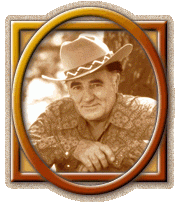
Cowboys of the Silver Screen: TOM MIX

Margaret Brownleymargaretbrownley-150x150


Tom Mix: Real Life Hero or…?

”I was born a cowboy, have lived as a cowboy and will die a cowboy,” Tom Mix liked to say and he was as good as his word–or was he?  I’ll let you be the judge.  Born in Texas, Tom grew up on a ranch near El Paso.  In his teens, he ran away and joined the circus and later fought in the Mexican Revolution, joining Pacho Villa’s army.  He was saved within an inch of his life from being shot by a firing squad.  Undaunted, he fought in Cuba, China and both sides of the Boer War—and had the medals to prove it.  As a sheriff and Texas Ranger he was shot by horse thieves and Indians, and single-handedly captured…

Hold Your Horses This is beginning to read like fiction—which of course, it was. Some was made up by his publicists, some by Tom, himself. The stories of his life are so convoluted that even his biographers have trouble separating fact from fiction. The ironic part is that his real life was even more interesting that his made-up life, but this was Hollywood and, back in the early days, they wanted their cowboys to be real and their heroes to be, well, heroes.

Will the Real Tom Mix Please Stand up?                                               

mix-terror_small
www.b-westerns.com

Thomas Hezikiah Mix was born in Pennsylvania in 1880, the son of a lumberman. He reportedly never liked his middle name and always signed his name Tom E. Mix, E for Edwin.  When Tom was nine, his family moved to Dubois, where his father worked as handyman and stable man.  Tom loved hanging around the stables and, after seeing Buffalo Bill’s Wild West Show, decided he wanted to be a cowboy.  

Mix small
www.b-westerns.com

At 18 he joined the army to fight in the Spanish American war but saw no action.  He reenlisted but went AWOL  after marrying his first wife and was listed as a deserter, though the Army never pursued him or, for that matter, discharged him.

As far as anyone knew, he was never more than an honorary Texas Ranger. Richard D. Jensen  writes in The Amazing Tom Mix: The Most Famous Cowboy of the Movies that Tom worked as a night marshal in Oklahoma territory rounding up bootleggers. This appears to be the extent of his lawman days except on screen.

He eventually joined the Miller Brothers 101 Wild West Show.  His big break came when he landed a job as a bronc buster in the movie Ranch Life in the Great Southwest. His action based sequence started him on the road to box office success. 


What About All those Gun Wounds?

Though he was never shot by Indians or desperados except on screen, he was in actuality shot twice—once when he was 12 and once by his fourth wife. The first time occurred while he and a friend were playing with a pistol. Since his family couldn’t afford a surgeon the bullet remained in his leg for years before it was removed.  This episode may have had something to do with his dropping out of school and having only a fourth grade education.   

mix-rough small
www.b-westerns.com

As for being shot by his fourth wife: According to a 1933 Berkeley Daily newspaper, his wife shot him through the shoulder, claiming self-defense.  Tom Mix testified that he was shot after “I came home and threw a gigolo out of our place.” Apparently Tom didn’t learn his lesson as went on to marry a fifth time.

 King of Cowboys      

The first to be called King of Cowboys, Tom Mix made an estimated 300 movies including nine talkies and eventually wrote and directed his own films.  He was the highest paid western actor of the times, making in excess of $17,000 a week.  Known for his fancy high hats, he reportedly owned over 600 pairs of custom-made boots.  Tom’s horse Tony was almost as famous as his owner. Tony died following a hip injury and was replaced by Tony II.

Though Tom’s heroic real life claims were mostly fabricated, on screen he was the real McCoy His movies were full of action and no one could match his daredevil stunts, which he did himself. Not only did he jump off horses, fall off trains and face real bullets, he suffered as many as 80 injuries during his career, including knife wounds, broken ribs, and a near fatal brush with dynamite.    

Tom’s death in 1940 was almost as strange as his life.  During an Arizona traffic accident a metal suitcase in his car hit him on the head causing fatal injuries. He was 60 years old.  His popularity continued for most of the ‘40s through his radio show and comic books.

Two years to the date of his death, his faithful horse Tony II died.  We can only imagine what kind of tall tale Tom would have spun from that.


Romance Writers of America RITA finalist

In Bookstores now                                                                                                                                         

a-lady-like-sarah


Coming September 2010
Rocky Creek Romance #2
Available for Preorder
 
web cover


Another Kind of Alpha Hero

victoria_bylin_bannerAlmost two years ago my husband and I adopted a dog from an organization that rescues abandoned animals. His name is Hartley and he’s a Jack Russell / Beagle mix. He’s a tad bit . . . odd. He licks furniture (gross), and he’s terrified of little girls. Little boys don’t bother him at all. The poor dog doesn’t know how to chase a ball or play “Fetch,”  but he plays  catch by pushing the ball with his nose for a distance of about a foot. We roll it back anHartley&Misc029smalld he’s happy.

More than once, my husband has looked at our beloved mutt and said, “Hartley, you’re no Rin Tin Tin.”

That got me thinking about the famed German Shepherd who starred in the 1950’s TV show, “The Adventures of Rin Tin Tin.” In the show, Rin Tin Tin belongs to a boy named Rusty who’s been orphaned in an Indian raid. The boy and dog are adopted by the soldiers at Fort Apache and the adventure begins.

Rin Tin Tin TV ShowThe series was only one of Rin Tin Tin’s Hollywood credits. His fame goes back to films from the 1920s when he stared in several movies, many of them with western settings.  His continued to star in movies up through the 1940s, then moved to television.

The first Rin Tin Tin has quite a story. He was born in Lorraine, France in September 1918 in the thick of World War I.  He was just five days old when Lee Duncan, an American serviceman, rescued him from a bombed out war dog kennel along with the pup’s sister.  Duncan named the dogs Rin Tin Tin and Nenette after French puppets given to WWI soldiers for luck.

Duncan was fascinated with the abilities of the new breed known as a German Shepherd, and he became acquainted with the man who’d trained the dogs. He worked regularly with the dogs to teach them to perform on command.  When the war ended, Duncan took the two dogs to Los Angeles. Sadly, Nenette didn’t make iRin Tin Tin Moviet. She died en route from distemper.

Duncan returned to his job as a clerk in a hardware store, but his interest in dogs continued and he took Rin Tin Tin to dog shows. In February 1922, Rin Tin Tin amazed the audience at the  Shepherd Dog Club by jumping a phenomenal 11 feet 9 inches. Quite by chance, a man named Charlie Jones asked if he could try out his new camera that made moving pictures by filming Rin Tin Tin. Duncan said yes, and a film company later offered Duncan $350 to film the dog in action. 

It took a while for Rin Tin Tin’s career to take off. Duncan tried to a sell movie script starring his dog, but he found no takers.  It wasn’t until he happened on a film company struggling to shoot a scene about a wolf that Rin Tin Tin got his big break.  Duncan said his dog could do the scene in a single take, and that’s what Rin Tin Tin did.  The producer hired him for the rest of “The Man From Hell’s River.”  The success of that film saved the studio making it from financial ruin.  The name of that littlle studio on the brink?  Warner Brothers Pictures.

Rin_Tin_Tin_005-01The first Rin Tin Tin made 26 movies before he died in 1932. Warner Brothers didn’t want to lose their star, so the mantle was passed to the Rin Tin Tin’s son, known as Junior. The two dogs weren’t identical in appearance, so a publicity campaign began. Junior was the first dog to fly in a commerical airplane.  Duncan and Rin Tin Tin No. 3 later particiated WWII by training 5,000 soldiers and dogs for the war effort.

Thanks to protected breeding, the legacy of Rin Tin Tin continues today.  Every dog that has ever played Rin Tin Tin is related to the original one.  The most recent is Rin Tin Tin #11, born July 8, 2009.  May the legacy of Man’s Best Friend continue!

Western Theme Songs and Cowboy Ballads

                                  wg-sig-current

I heard a song on the radio the other day that took me way back to the days when westerns dominated the movie screen and the television airwaves.  The song was The Man Who Shot Liberty Valance.  Hearing the song immediately put me back in front of the screen reliving scenes from that great movie. 


Cowboy Ballads

Got me to thinking about other Cowboy/Western ballads I love – not all of them movie related – and I thought I’d do a list of my top ten favorites for this post.  And for those of you who want to hear them again (or for the first time), I’ll post links to videos that feature them as well.


The Man Who Shot Liberty Valance
http://www.youtube.com/watch?v=aJMLbyEaPWs&feature=related

High Noon
http://www.youtube.com/watch?v=QKLvKZ6nIiA

The Streets Of Laredo
http://www.youtube.com/watch?v=L14UKBjC5Is

El Paso
http://www.youtube.com/watch?v=5T9OeN3t37Y

Come A Little Bit Closer
http://www.youtube.com/watch?v=bu9ZepcV0CM

Big Bad John
http://www.youtube.com/watch?v=bx59fmP7jYE

Ringo
http://www.youtube.com/watch?v=DCyuq-ofnPc

Big Iron
http://www.youtube.com/watch?v=PKrXSrqCLY4

Johnny Reb
http://www.youtube.com/watch?v=VknxL_we6PY

Ballad Of The Alamo
http://www.youtube.com/watch?v=3amU4FqKCqw


And as a bonus, I thought I’d include my 10 favorite western TV classic theme songs as well


Have Gun, Will Travel
http://www.youtube.com/watch?v=tgvxu8QY01s&feature=related

Maverick
http://www.youtube.com/watch?v=bYrsDT02OcE

Bat Masterson
http://www.youtube.com/watch?v=UAdUJrrS7vk

Wyatt Earp
http://www.youtube.com/watch?v=mroOwJDeqkY

Rawhide
http://www.youtube.com/watch?v=1I4uJ4aStmc

Cheyenne
http://www.youtube.com/watch?v=4h9rUNf64cw&NR=1

Bronco
http://www.youtube.com/watch?v=GBHbqo9Z2Og&feature=related

Rin Tin Tin
http://www.youtube.com/watch?v=9YjMAoDy-jE

Branded
http://www.youtube.com/watch?v=uV-7D4io1Rs&feature=related

Bonanza
http://www.youtube.com/watch?v=mjdRgBAY278


So how about you – did I leave one of your favorites off of my lists?  If so – share!

The Hat Makes The Man


tracy-garrett-tile


As the old cowboy saying goes, ‘It’s the last thing you take off and the first thing that is noticed.’humphreybogart_fedora

Top hats, derbys, tams, fedoras, berets, bowlers – hats do more than cover a man’s head. They make a statement about the wearer.

If I say Bogart, can you see him, fedora pulled down low, collar turned up?

charlie-chaplin_bowlerOr Charlie Chaplin in his bowler?

How about President Abraham Lincoln?abraham-lincoln-top-hat

sean-connery_panamaOr Sean Connery in his Panama?

Hats say a lot about the personality of the man – and some, like President Lincoln’s black stovepipe hat, will be forever linked with the man who wore it.

I believe the most recognizable type of hat, hands down, is the cowboy hat.

Did you see John Wayne in The Quiet Man and wonder where the heck his Stetson was?john-wayne_the-quiet-man

john-wayne_stetsonThere, that’s better.

How about the hat Clint Eastwood wore in Pale Rider? clint-eastwood_pale-rider

John Stetson was the creator of what we think of today as the cowboy hat. The son of a master hatter, John made his first cowboy hat as a demonstration to his buddies about making felt from fur. The wide-brimmed hat was so useful in keeping off the sun and rain, his companions wanted one of their own. And an empire was born.

Stetsonboss-of-the-plains-hat_real started his company in 1865. By 1866, the “Hat of the West” or “Boss of the Plains” set the John B. Stetson Company on the path to becoming the most famous hat in the world. Originally sold in one grade (2 ounce feldudes-in-boss-of-the-plainst) and one color (natural), that original Stetson hat sold for five dollars. The equivalent hat today would cost close to $1,000.

Check out these two Montana dudes (1885) in their brand new Stetson ‘Boss of the Plains.’ The guy on the left is wearing Levi’s.


Made of a blend of rabbit, wild hare and beaver fur, today’s Stetson sets the mark for cowboy hats. You can get your Stetson in felt or straw, black, white, grey, tan; choose your style, for casual or dress, for outside wear or for going to church.

If you want to see how these famous hats are made, visit StetsonHats.com and click on the “The Making of a Stetson Hat” from the list on the left.

Stetson isn’t the only hat maker in the U.S. In Dallas in 1927, the Byer-Rolnick company began making the Resistol hats, so named because they were made to “resist all weather.”

But Stetson is the name most associated with the west.

Here’s some eye-candy, just because.

ed-harris_appaloosa     dean_martin_rio_bravo_1959   kenny-chesney

garth-brooks   christian-bale

russell-crowe   george-strait   tim-mcgraw


“Even after the wild aspect of the West was somewhat tamed, the cowboy hat never really lost its ability to lend that reckless and rugged aura to its wearer.”


touched-by-love

Beau L’Amour on his adventures as the son of Louis L’Amour


Louis L'AmourPlease start by telling us a little about yourself.

 I jokingly call myself the World’s Greatest Literary Janitor, when it comes to the career of Louis L’Amour my job has basically been to organize what he left behind in order to extend his career twenty years or so.  That meant going through virtually every piece of paper that he left behind searching for clues with which I could recreate various aspects of his life for Bantam Books, our web sites and, occasionally, the movie industry.

 On the personal side I’m just guy who lives in a little house in Los Angeles, creates fun projects to do with his friends, likes traveling, reading, and messing around with old cars.  This is beginning to sound like one of those dating site profiles HondoI’ll move on.

 Your father is famous for living a lot of the life he wrote about, was this true by the time you were able to remember him or did he live a more sedate desk bound life after his books started coming out.

Yondering Louis never lived the life of a cowboy, though he was a miner and worker on a number of farms.   Much of this was done in a period, the 1920s, that had a greater resemblance to the frontier west than our world of today and some of the people who had lived in that earlier time were still alive.  However, it was a time that had it’s own fascinating aspects … I always wished Louis had written more about his own time.

 Once he settled down in Los Angeles right after World War Two most of that lifestyle was in the past.  By the time I came along Louis was fairly tied to his desk by the responsibility of supporting a family.  Writing, in those days, didn’t pay particularly well.  To live a relatively middle class lifestyle and prepare for problems that the future … protracted unemployment was always a risk … Dad had to write three to four books a year.  It was quite a load of work.

I have to ask, as a writer myself, how did your dad manage all these books without a computer? I am profoundly impressed. I do so much editing and revising and it would be so much harder with a typewriter. I feel like a pure wimp, but I find writers who produced as much work as your dad did especially impressive because they didn’t have computers. . .don’t even ask about James Fenimore Cooper and Jane Austen without even a typewriter. Did he tear out pages and throw them away and start over and scribble on the pages a lot? Did he write his books longhand first then transcribe it to a typewriter? Did he talk his books and have a secretary?  

Louis learned to write by trying to sell to the pulp magazines.  The pay was usually between $25 to $250 a story … and many, many, stories didn’t sell.  He set a goal of writing a story a week in those days so there wasn’t much time for rewriting or even over thinking them.  I’m sure that in the early days, long before I was born, he threw out a great many pages.  Later, however, he perfected a manner of “stream of consciousness” writing that allowed him to produce an incredible number of stories but at the cost of losing some of his ability to rewrite.  Perhaps a more accurate way of saying that would be that ‘he lost some of his will to rewrite’ … he was not so inclined to think about what he was writing, he made it more of a reaction than an intellectual process.  That delivered a boiling energy to his work but left some of it sort of rough around the edges.  Take a look at some of the writing in Yondering, stories that were highly polished in order to be sold in literary magazines, then compare them to many of the pulp westerns, where speed of production was of the essence.  There is a difference.

 Crossfire TrailDad wrote a minimum of five pages a day, using two fingers, on a typewriter.  He wrote six to ten hours a day, six to seven days a week for most of his adult life.  At his best he could do sixty words a minute for a pretty extended amount of time.  Most of the trick though, was just sticking to it and never doubting that what he was doing was right, the right scene, the right dialogue, whatever.The Sacketts

Did your dad travel to research his books? I’m wondering if you had adventures as a child that stemmed from having Louis L’Amour as a father.

 Sometimes.  Mostly he was already aware of the locations he wanted to use from his own, earlier, travels,  But we did research on many of our trips and, later on, I did research for him on my own.  My sister and I saw a lot of dirt roads when we were kids.

Have you met the actors and actresses who have performed in movie’s based on his books, like Tom Selleck and Sam Elliot?

 I have had the privilege of working with both of those guys but meeting people or working with them and knowing them are two different things.  I’ve tended to leave the celebrity types to themselves as much as possible.  Some are really nice people.  Some are absolute jerks.  In my opinion, nothing about being a movie star is wonderful or interesting.  Quite a few live difficult lives and are often not really the kind of people that you’d want to hang around with once the novelty of their being famous wore off. 

 That said there is a great difference between stars, who tend to exist in a bubble of fear and alienation, and a great number of actors, some of whom are my closest friends.  It’s amazing how many actors, who often get a bad rap based upon a few of the worst examples, are alert, intelligent, people who are amazingly hard workers and able to both do so many different things and to train themselves in new disciplines at the drop of a hat.  I really count myself lucky.

And how involved are you with current work on the books.

 ConagherI had been involved with production of our dramatized audios from the start.  For years we have done a series of audio books in a style similar to old time radio dramas … I use that term loosely because most of our productions do not try to be nostalgic or the least bit “old The Haunted Mesatimey.”  Anyway, I was in charge of the scripting and casting of the vast majority of those shows, each needing a script that was an adaptation of the original story rather than a dogmatically faithful transcription.  Prose does not automatically make the best drama, just like including back and forth, script style dialogue in a novel or short story could be a mistake.  Prose is a visual art, more like painting than good drama … and drama is usually more auditory, even in the movies.  I also wrote and directed several of our audio dramas … in fact I’m at work editing the most recent, number seventy, I believe, even as I answer these questions. 

 For awhile I was doing six a year but now production has slowed considerably and we do only one every several years, however, the stories are much longer and the productions vastly more involved.  This production is an audio of one of my dad’s movies that I produced several years ago, The Diamond of Jeru.  It has been a wonderful opportunity to revisit that script and evolve it into something new and different.  In a way it is as much of an adaptation of that film as the film was of the novella.  I don’t know when it will be released, we only get about a week a month to work on these and we have to take the end of the year off as Christmas is our big sales time at louislamour.com.  We are two years in and only about half done. 

Back to the books.  Starting with Haunted Mesa I began to be involved with doing some of Louis’s research and then occasionally doing some minor editing.  After his death the work expanded to planning how to re-present the entire catalogue of his works, to art directing a new set of covers, rewriting all the jacket copy, and editing or rewriting many of the unpublished or unfinished short stories.  My friend for many years, Paul O’Dell and I run the louislamour.com website and have created hundreds of pages of material on Louis and his stories.  Our latest creation is Louis L’Amour’s Great Adventures, a website featuring all of Louis’s writing in the adventure genre and an examination of the world that the stories were written in.  It’s full of Paul’s amazing art and maps and photos from the time period … many straight from Louis’s own archives.  Also of note is louislamourslosttreasures.com, and ongoing project to catalogue many of Louis’s partially completed projects, false starts, and alternative versions of many of his published works.

I see that you’re a writer and involved in many ways in the film industry. How has being Louis L’Amour’s son helped? How as it hurt?

 Being Louis’s son has helped because I inherited a catalogue of material that was already famous … it would seem that might make it easier to sell than my original material.  Certainly studios and networks would rather talk about material written by my dad … at the same The Sackett Brandtime they don’t really want to make westerns, so the whole situation is sort of self limiting.  That said, I only occasionally work in film and don’t need to go there to earn a living so it’s not really a problem.  When I want to do drama, work with actors and script and such I can do an audio.  I love film but the business is very dysfunctional and time consuming … I’m glad I have publishing.  Really glad.

I am a huge fan of all the L’Amour books and I don’t think I’ve missed a single one.

My personal favorite is The Sackett Brand. Here’s a bit about it (for the Petticoats & Pistols readers) I found on http://www.louislamour.com/ .

 Forty gunslingers from the Lazy A have got Tell Sackett cornered under the Mogollon Rim. They’re fixing to hang him if they can capture him alive, fill him extra full of lead if they can’t.

It’s just about the best of the best in my opinion. I consider however, Jubal Sackett to be, again in my opinion, his epic story. I just loved that book. I have a question about it.

In Jubal Sackett. . .when Jubal went into that cave and saw those dead bodies and heard the words, “Find them. . .” I have ALWAYS been crazed to know what that meant. Find WHO?????

Jubal SackettAny ideas? Even guesses would be appreciated. Was it something Louis was going to go into in a later book? Is it in Jubal Sackett and I somehow missed it?

 It was a set up for the future but I don’t know where he was going with it.  If that drove you crazy you really love Louis L’Amour Treasures.  It’s hundreds of mysteries wrapped in riddles.  Take a look …

 Beau L’Amour

And go to http://www.louislamour.com/ to find specially bound editions of Louis L’Amour’s classic novels.

Cheryl St.John on Birthdays and Other Things, Like Hot Dogs and Cowboys


cakeI don’t know about you, but it’s HOT in Nebraska! How hot is it?

It’s so hot, I went to the store for flour, sugar and eggs yesterday, and came home with a cake.


Bada boom, bada bing.

Seriously, it’s summer, and we have three birthdays to celebrate just this month. Our family has grown so much that it’s a rare month that doesn’t find us gathering for cake at least a couple of times. I love to get creative and serve brunch, with breakfast casseroles, etc. My daughter LeighAnn and I occasionally cook up Mexican Day or Soup Day. But of course, with such a large gathering, we often have the old standbys, grilled burgers and dogs, Tastees, chili, and on the holidays, good old ham and turkey.

I don’t know how I always get the same jobs at these events—but I’m trying to shake off the stereotype. My son-in-law Brad claims he’s going to have me buried with an ice cream scoop in my folded hands, so I’ll look normal. I bought him one for Christmas one year—a dandy specimen just like mine—a heavy-duty industrial strength flat scooper—but of course I am the one who wields it at their house. Last birthday there I tried to hide until the scooping was underway, but they found me.

My goodness, but those birthdays pile up, don’t they? When we moved last time, I organized photos into albums until my brain went numb. I finally stashed the rest back into boxes where they will await the next millennium. It was amazing how many of those photos were pictures of cakes. If you’re a young mom, take this as a gentle suggestion: Take ONE photo of the baby’s cake. One, got it?

birthday-party-3I remember how exciting those first birthday cakes were. If you’re a mom of many or a grandma, you remember, too. You couldn’t get enough pictures of your baby with frosting up his nose. Wasn’t that darling? Then there were second, third, and fourth birthdays. And then the second third and fourth kids arrived and had birthdays, too—yes I have four children and I lived to tell. And then the grandchildren start arriving—or so they say.

Here is my pledge: I will never, as long as I draw breath, take another picture of a birthday cake. I mean how many cake pictures does a person need? Get them out of order, and you don’t even know whose cake it was or which year. And you know, one shot is never enough. Admit it, you take two pictures in case the first one blurs or something. Heaven forbid we wouldn’t be able to see Strawberry Shortcake or Spiderman clearly once he was only a sweet memory.

You know what I’m talking about. Just you try sorting 20 or 30 years of photos and try to get sentimental about a cake that was only so so in 1983.

And while I’m on the subject of parties, darned if I’m not the one who inevitably gets stuck opening all those toys that have been hermetically sealed and wired and clamped. Sometimes I need a screwdriver and a wire cutter to extricate them. I’m telling you, Santa could catapult those boxes out of his sleigh onto our concrete driveway and Barbie wouldn’t have a hair out of place. Her hair is sewn onto the cardboard, people. Sewn.

The packaging is three times the size of the toy inside. It takes half a roll of wrapping paper to go around a box, but once you get the twisties unwrapped and the taped peeled off and the plastic removed, you have a tiny little pile of Power Rangers and half a dozen bags of trash. And—

Have you ever lost a minuscule part and had to search through all those bags because you might have accidentally thrown it away? Or heaven forbid go out to the trashcan—I don’t know which is worse, searching through trash for Woody’s six-shooter in the summer or during the winter. Hint: the piece is never there. It’s always with Colonel Mustard in the sofa cushion.


How about you? Do most of your family traditions involve food?


dsc00013This blog had nothing to do with reading, writing or watching westerns, but I do have a fun drawing this month to bring the focus back on everybody’s favorite subject (besides cake) and that would be cowboys.


Leave a comment today and I’ll drop your name into the fish bowl. I’m holding a drawing for this DVD set: COWBOYS OF THE SILVER SCREEN. Five full-length feature films:


Over the Hill Gang – Walter Brennan and Ricky Nelson

The Shooting – jack Nicholson, Warren Oates

Vengeance Valley – Burt Lancaster, Joanna Dru

Rage at Dawn – Forrest Tucker, Randolph Scott

One-eyed Jacks, Marlon Brando, Karl Malden


I’m adding a cowboy boot charm to the prize, too. Now, wouldn’t winning this set just take the cake?

The Man Who Wrote the West


elizname2smallHow did I first become interested in Western romance?   I could answer that question in two words—but first let me give you some background.  In my growing up years, my dad subscribed to some great men’s magazines, like TRUE and SPORTS AFIELD.  They were filled with action and adventure, and I read them from cover to cover.  I even enjoyed the ads, especially the ad that showed a long line of books with titles like RIDERS OF THE PURPLE SAGE and LIGHT OF THE WESTERN STARS and a banner that read: “GET THE ENTIRE THE ZANE GREY COLLECTION!” 

By the time I fell under Zane Grey’s spell, that author had long since ridden into life’s sunset.  But his zane-greybooks were still bestsellers, and our local library had an entire shelf of them.  I was in sixth grade when I started reading them.  Not sure how many I got through, but I do remember how they fired my young imagination with vistas of raw beauty and rugged characters who were bigger than life. 

Pearl Zane Grey was born in 1872 in Zanesville, Ohio,  where he grew up reading adventure stories and dime novels.  He wanted to be a writer, but his father, a dentist with a violent temper, had other ideas.  When Zane wrote his first story at fifteen, his father tore it up and beat him.   Eventually the young man bowed to his father’s wishes, became a dentist and married a girl from a wealthy family.  At night, to relieve the tedium of his day job, he wrote stories.  His first efforts were awkward, but with the help of his wife Dolly, who edited his work and most likely financed the publication of his first novel, he slowly began to find success. 

Grey had inherited his father’s turbulent nature.  He was given to spells of anger and sank into despair when his work was rejected.  Restless to a fault, he was a deplorable husband and father, often staying away for months, traveling, hunting and fishing, and spending time with mistresses, while Dolly managed the household and raised their three children.  Dolly tolerated her husband’s lifestyle as she proofed his work and handled the business end of his growing literary career.  Their letters indicate that there was genuine love and respect between them.  

zane-grey-book-coverGrey’s early books were about the American Revolution.  After a hunting trip to Arizona he began to write the Westerns that would make him famous.  On his wilderness trips he took photographs and wrote copious notes.  Treacherous river crossings, unpredictable beasts, bone-chilling cold, searing heat, parching thirst, bad water, irascible tempers, and heroic cooperation all became real to him.   From the beginning, vivid description was the strongest aspect of his writing.  Grey’s first Western, THE HERITAGE OF THE DESERT, became a bestseller.  Two years later he produced his best known book, RIDERS OF THE PURPLE SAGE, his all-time best seller and one of the most successful Western novels ever.  After that he became a household name.  In 1918 he moved his family from Pennsylvania to California, where he started his own movie production company.  He lived there on and off until his death in 1939 at the age of 67. 

Grey became one of the first millionaire authors. He connected with millions of readers worldwide and inspired many Western writers who followed him. Zane Grey was a major force in shaping the myths of the Old West and he helped transition the written Western into other media. He was the author of over 90 books, some published posthumously and/or based on serials originally published in magazines. His total book sales exceed 40 million  From 1917–1926, Grey was in the top ten best-seller list nine times, which required sales of over 100,000 copies each time.  Even after his death, his publisher had a stockpile of manuscripts and continued to publish a new title each year until 1963. 

Another great writer, Erle Stanley Gardner, would say that Grey  “had the knack of tying his characters into the land, and the land into the story…Somehow you got the impression that the bigness of the country generated a bigness of character.” 

What sparked your early interest in the West?  Do you have a favorite author?  A favorite story or film? 

Clicking on the book icon will take you to Amazon.com.

My Heroes Have Always Been Cowboys – or what I learned from western movies.

Yes, I admit, my heroes have always been cowboys. My love of cowboys came from old western movies. Here were men who were larger than life, who stood up for what they believed in, who’s word was their bond, who were willing to do what had to be done. And when they fell in love, it was deep and forever — even if they fought it at first.

Nothing surprised me more when I started to write, that I chose set my stories in the American frontier. Now, it wasn’t a surprise that I chose to write historicals –after all, I have a BA and MA and a second BA in History and taught US History and Western Civilization at the college level. However, I liked teaching Western Civ more than US History and my MA had specialization in Tudor and Stuart England, and the second BA in European Studies. But when it came time to write it was the frontier and the cowboy who caught my imagination. Big surprise.

Guess Fredrick Jackson Turner was right. Turner, a historian, presented his ‘frontier thesis’ in 1893 at the American Historical Association, stating that it was the westward expansion that formed the American character, making us as Ben Franklin said a new race that was rougher, simpler, more enterprising, less refined.
I think now it was the frontier aspect that drew me, as on the edge of civilization, it took a man and a woman working together to make a home. This was the basis for my first novel, Kentucky Green, when the frontier was ‘the land beyond the mountains’, the Kentucky and Ohio territory in 1794. My hero, although he’s not a cowboy, has all those cowboy characteristics.

But for most people Turner’s westward expansion brings to mind the cowboy. Which leads me right back to my old western movies.

When I was teaching, I used to have the student watch Stagecoach (1939) and discuss how the character portrayed the values of the time. If you haven’t seen the movie (shame on you!) a group of disparate individual undertake a dangerous stagecoach trip through Indian Territory. Our hero, the Ringo Kid (John Wayne, where director John Ford gave Wayne’s character the greatest screen introduction ever) is out to get the man who killed his father and brother. There is the ‘good woman’, a military wife on the way to join her husband, and the ‘bad woman’, the dancehall girl run out of town. The Confederate and the Union veteran. And of course, our hero helps save the day when the Indian attack. Here are our cowboy values of putting the good of the group before personal advantage, care and protection for those who need it. Courage in the fact of danger (the Indian attack).

Ringo also show determination to get revenge on the man who killed his family. This is often part of the ‘man’s gotta do what a man’s gotta do’ philosophy of the frontier. The average man, our hero, is forced to act as the law as either the law is absent (part of the definition of frontier) or unable or unwilling to do the job that needs to be done to protect society. And, of course, after the final shoot out, our hero and his girl ride off to start a new life together. The ‘new start’ part of the frontier standing for redemption

Stagecoach is #9 on the American Film Institute’s Top Ten Westerns.

I also used to show part of Red River (1948) to my classes also. This movie is #5 on the American Film Institute’s Top Ten Westerns. In the first part (a prologue actually), our hero, Tom Dunstan (John Wayne) leaves the wagon train heading to California and the girl he’s fallen in love with to go to Texas to start his ranch, saying he’ll send for her. She fails to convince him to let her go with him, and says she’ll come.

I liked to use this to point out to my classes, who were used to instant communication, how you have to understand the times the people lived in to understand the history of what they said and did. I used to ask the men in my class, how are you going to send for her? A letter? Who would carry the letter? How would you address it? Would you go yourself? How would you find her? Then I’d ask the women in my class – how long do you wait for this guy to send for you? A year? Two years? Forever?

Perhaps part of the pull of the western is the lack of technology that sometimes seems to overwhelm and swamp the personal and individual in today’s society. People seemed more important than things in the west. Relationship were personal. Today we can spend more time with our computer that with our family.

The main part of Red River deals with the dangerous cattle drive north many years later. Here again we see the cowboy hero in several guises. Dunston (Wayne), who willing to do what no man has done, the cattle drive to try and save not only his ranch but all the surrounding ranches. Dunston willing to step up and take responsibility. He’s helped by his surrogate son, Matthew Garth (Montgomery Clift) and a cast of great secondary characters. As the cattle drive is beset with disasters, Dunston becomes more autocratic and driven to the point that Matthew rebels and takes over the herd. Matthew standing up to and against the man he loves like a father, necessary to do what right in his mind. Matt says ‘know he (Dunstan) was wrong. Sure hope I’m right.’ The story is not only one of man against nature (taming the frontier), but of Matthew (Clift) and his conflict with Dunstan (Wayne) each man doing what he thinks is right as the central theme of the film.

And, of course, there is a romance between Matt and the girl he meets, falls in love with, but must leave to complete the cattle drive. This romance between Matt and Tess (Joanne Dru) is what help lead to the final reconciliation between the men. This is a great movie with a young and beautiful Montgomery Clift and John Wayne allowed to act before all the directors wanted him to do was be John Wayne.

The Forties and Fifties were a great time for western movies, really too many to mention. But you might recall a few with Jimmy Stewart such as Winchester ’73, or The Far Country.

Randolph Scott working with directory Bud Boetticher made several good western such as The Tall T, and don’t miss Seven Men From Now if only for the final gun fight between Scott and Lee Marin as the ‘good’ bad guy.

For lots of good cowboy heroes, there is always what’s know as director John Ford’s Cavalry trilogy, Fort Apache, She Wore a Yellow Ribbon, and Rio Grande.
These three, along with Stagecoach were shot in Monument Valley and the scenery is as much a character as the actors. Especially the storm She Wore a Yellow Ribbon which blew up as they were filming, and Ford kept right on filming. No special effect, just the real thing.

I think part of the allure of the cowboy is the wide open spaces and scenery that surrounds him. It was the remember clean, clear and bright mountain scenery around Durango, Colorado that made me set Colorado Silver, Colorado Gold there. My cowboy hero is an undercover officer for Wells Fargo who, of course, is determined, brave and does the best he can. And, of course, as all western heroines, the woman he falls in love with is strong, capable and makes him realize he’s a better man than he thinks he is.

Modern westerns in the old tradition are starting to turn up on television, such as Broken Trail (2007) with Robert Duvall as the older mentor and Thomas Haden Church as his nephew. And the traditional cowboy values are showcased in Open Range (2003) with Kevin Costner teaming with Robert Duvall, as two itinerate cowboy who end up taking on a corrupt sheriff and town boss – doing what needs to be done to make the community safer and revenge their friend. Also a nice little romance between Charlie (Kevin Costner) and Sue (Annette Bening).

Even the contemporary cowboy has those values. My Heroes Have Always Been Cowboys (1991) where an estranged son and father re-connect as he finds love with an old flame.

How much better would things be today, if those cowboy values – honest, true to their word, willing to sacrifice to help those who can’t help themselves, putting the good of the community before their personal needs when necessary.

Yep, my heroes have always been cowboys. I watch the old movies any chance I get, and keep a lookout to see if they are out in DVD to replace the VHS tapes I have. My current favorite is Tall In The Saddle. Did I miss mentioning one of your favorite westerns? I know I missed some of mine. Do you watch the old movies, or do you have a favorite ‘modern’ western?

Terry Irene Blain

Escape to the past with a romantic adventure


~~~~~~~~~~~~~~~~~~~~~~~~~~~~~~~~~~~~~~~

One lucky winner will be drawn to win their choice of COLORADO SILVER, COLORADO GOLD or KENTUCKY GREEN.

Leave a comment to get your name thrown in the hat.

   
http://www.terryblain.com/

Cheryl St.John Asks: What is a hero?

cheryl_stjohn_logo.jpgDefinition: noun

1) a mythological or legendary figure often of divine descent endowed with great strength or ability  2) an illustrious warrior  3) a man admired for his achievements and noble qualities  4) one that shows great courage  5) the principal male character in a literary or dramatic work  6) the central figure in an event, period, or movement  7) an object of extreme admiration and devotion: idol

In a nationwide survey a few years back, Jesus Christ was the person most often listed as a hero, followed by Martin Luther King, Colin Powell, John F. Kennedy and Mother Theresa. Over half surveyed mentioned a public figure, others their fathers, mothers or other relatives and friends.

john-wayneThe major reasons for naming someone a hero were: Not giving up until a goal is accomplished; Doing what’s right regardless of personal consequences; Doing more than is expected; Staying level-headed in a crisis; Overcoming adversity; Changing society for the better; Willingness to risk personal safety to help others; Commanding the support and respect of others; Not expecting personal recognition.

The views of our nation have changed since September 11th.  More and more, firefighters, policemen and military men are referred to as heroes. We will all agree there were heroes aboard Flight 93 that day, men and women who foiled an additional terrorist plan.

The qualities of a hero include willingness to sacrifice, determination, loyalty, courage, dedication, intrepidity, valor, selflessness, conviction, focus, gallantry, perseverance, fortitude, bravery and integrity.

A hero isn’t always a man who sets out on a grand quest. Sometimes he’s the ordinary fellow who works an extra job to pay for his son’s college or his daughter’s wedding. Sometimes he’s a man who never raised his fists or fired a gun, but who sets a silent example of faith and a standard of honesty by the way he lives his life.

When we think of the heroes portrayed in our genre, we immediately think of John Wayne and Henry Ford, Wyatt Earp and Marshal Dillon. But there are unlikely heroes, too, such as Froto and Sam in the Lord of the Rings trilogy, Clint Eastwood’s William Munny in Unforgiven. Remember Sally Field’s character in Norma Rae?  How about Erin Brockovich?  Atticus Finch in To Kill a Mockingbird tops every list of favorite movie heroes.

sullenbergerIn talking about the heroes of our books, what qualities do some of our favorite authors think a hero needs?

Catherine Anderson says: “…one absolutely necessary quality a hero must always have is not good looks, suavity or physical strength, but incredible wonderful irresistible heart—an intangible s something that enables him not only to love deeply, but to live for love, sacrifice everything for love, and even die for love if necessary.”

Dorothy Garlock insists,” My heroes have high moral ethics and are always faithful.”

Pamela Morsi says the most important thing is “the hero’s willingness to make a commitment. All other obstacle can be overcome, but only a man who can marry and live happily ever after can be a hero in romantic fiction.”

Alexis Harrington said, “A hero doesn’t need to be perfect—I’d rather have a man with human frailties ad self-doubts. But despite his imperfections, he must have a nobility pf spirit that gives him the ability to recognize his own flaws, to see the good in others, and ultimately, to do the right thing, regardless of the cost to himself.”

atticus-finchLorraine Heath mentions, “A hero should always be willing to sacrifice what he values most in order to ensure the heroine finds happiness.”

Joan Johnston likes her heroes to be “physically strong and emotionally vulnerable.”

Cheryl Reavis states, “My hero must always take care of his children. I can’t abide a man who shirks his responsibility for his child—I don’t care what the reason; and a man willing to take responsibility for a child that is not his is really a hero to me.”

The stuff heroes are made of is powerfully attractive to the woman who eventually wins his heart. Who is the perfect hero in my book? Well, the one who has all the qualities mentioned above—and looks like Hugh Jackman to boot.

Some of my favorite heroes are Rye Dalton in LaVyrle Spencer’s Twice Loved, Reed Tyler in Pam Morsi’s Courting Miss Hattie, Luke Turner in Lisa Gregory’s The Rainbow Season, Laghlan Mackenzie in the late Arnette Lamb’s Highland Rogue, Dylan Harper in Alexis Harrington’s Harper’s Bride, Charlie Cochranin Kate Hathaway’s Bad For Each Other, and Theresa Weir’s Nash Audabon in Long Night Moon – and the list just goes on an on.

Did I mention any of your favorite heroes or authors? Who are the heroes who stand out in your mind—either in real life or your favorite books?

Linda Broday Says “Set ’em up, Joe!”

linda-sig.jpgYou can’t pick up a western romance without it having some reference to the saloon. Saloons played a vital role in the western expansion. They filled a very human need. In addition to fulfilling the main role of quenching a man’s thirst, saloons were a place where cowboys could indulge in “cow talk” and where farmers and ranchers commiserated with each other about the weather/dry spells or floods. It was a place to get information on whatever subject you were needing to know about.


saloon2Saloons helped a man forget his loneliness and drown his troubles if only for a few hours. They offered entertainment, comfort, refuge, and refinement. And they were one of few places where a man could escape from his wife.


Saloons were all things to all men. And most times a cowboy didn’t  have to look far to find one.


Silverton, Colorado held the distinction of having the “worst gaming street in Colorado history.” Blair Street boasted 40 saloons and dance halls, 27 gaming saloons, and 18 houses of ill repute. And that was only one street among several in the town. With all the establishments being open 24 hours a day sin ran non-stop.


saloon7Saloons reflected the financial health and customers of a town. In wealthier places they were fancy buildings with ornate furnishings. But on the prairie, watering holes were often sod houses or tents. Usually the mining towns where gold or silver was abundant they were opulent and refined.


Either next to or behind the saloons were liveries where the customers could leave their horses while they quenched their thirst. If they didn’t plan to linger in the saloon long, there were hitching rails in front. In the book, “Saloons of the Old West” by Richard Erdoes he said, “The town’s sheriff could read brands just as easily as a modern cop reads license plates, and he would take care of the “parking problem” if he saw a horse tied to the rack overnight.”


saloon_01_smallMost saloons were built shotgun style–real long but not very wide. That was to accommodate a long bar, many of which were 50 to 60 feet in length. Saloon proprietors often competed to see who could get the longest bar. Erickson’s Saloon in Portland, Oregon was a whopping 684 feet long and probably held the record. Breen’s in San Francisco is made from Brazilian mahogany and measures 72 feet long. It’s supposedly the longest in America today. Denver’s Albany was quite impressive with its 110 ft. counter backed by a flawless mirror of matching length. And it’s a given that saloons almost always had a picture of a naked lady somewhere over the bar.


saloon6A little known fact: The typical establishment had towels hanging at certain intervals along the edge of the counter so men could wipe the foam off their beards and mustaches if they needed to.


Some saloons, the fancier ones, had a barber chair tucked into a corner with a live barber on hand to cut hair and give shaves for those who were inclined to spruce up. It saved time I guess. A cowboy could eat, drink, have his hair cut and get a shave all without leaving the saloon. Pretty amazing to have all those services combined.


Oh, and various saloons also maintained letter boxes so their steady customers could receive their mail in there.


There was no legal drinking age, but normally a bartender wouldn’t serve unless a boy’s voice had changed.


saloon-girlA lot of history was made inside saloons. States were named, capitals founded, political candidates announced, elections held, and trials conducted. The saloon was the place to be evidently.


American Indians were barred from saloons by law. Blacks were tolerated. But another group wasn’t welcome—military soldiers. Soldiers were resented because they policed the early West. Cowpunchers also blamed soldiers, rightly or wrongly, for giving the working girls venereal disease. But I seriously doubt that.


Do you think books and movies accurately portray saloons? Do you have a favorite saloon scene you’d like to share? Or do you have a favorite hero/heroine (books or movies) who was a saloon owner?