I’m really excited to have these two stories released in one volume, since it’s how I think of them–intertwined. Originally released in the Lassoing a Groom & Lassoing a Bride anthologies, these stories take place at the same time—exactly the same time.
That timing, I admit, was an accident. I was writing WANTED: THE SHERIFF, Matt & Martha’s story, and suddenly, in the middle of it, a young woman was brought to Martha’s brother, the doctor, for treatment. While Matt & Martha were busy making calf eyes at each other, Dr. Franz discovered the love of his life. And pretty Rebekah Snow Redman turned out to be a fireball in spite of her fragile appearance.
A RIVER’S BEND DUO Wanted: The Sheriff
Martha Bittner may be considered a spinster at twenty-seven, but she’s not planning to stay that way. For four years, she’s wanted the sheriff of River’s Bend, Missouri, to notice her as more than a friend and a really good cook. With the first annual spring dance only weeks away, Martha decides to announce her intentions — and declares the sheriff a wanted man.
Sheriff Matthew Tate always thought he was better off a bachelor. Growing up in Boston society, where marriage is a business transaction and wealth his greatest asset, he’s learned to distrust all women’s intentions. None of them even catch his eye anymore — until pretty Martha Bittner tells him exactly what she wants… and he wonders why he ever resisted capture.
No Less Than Forever
Doctor Franz Bittner is satisfied with his life as it is. He has a good practice in a place where he is respected, in spite of his German birth. He has good friends and enough income to provide him with a few comforts. A wife would only complicate things. Then a tiny blond stranger is pulled from the river and everything changes. With one smile she captures his attention—and steals his heart.
Rebekah Snow Redmann barely survived her abusive husband’s attack. Though she was given to him to pay her father’s debts, she’d rather die than go back. Then she ends up in the care of the handsome local doctor and he stitches up more than her wounds—he mends her soul. With him, she discovers everything that she believes she can never have…a love that will last forever.
I thought I’d have a little fun with my post today ~
It’s no secret that I love romantic movies. With a houseful of boys (actually men now) who love everything about sports, this can make for some eye-rolling and snarky comments (in a teasing kind of way) when I choose to watch something like Pride and Prejudice or Crossfire Trail for the umpteenth time on the family room TV. It’s a good thing my husband is the world’s biggest western movie buff. At least with westerns, there is often a love story and so we are both satisfied, although I sure wish they would make some new ones! (I’m looking forward to the DVD of The Longest Ride to be released!)
With the books I write, it helps to “cast” my stories to get a feel for the characters. Often I will change halfway through the writing because I realize the actor or model I’ve chosen no longer fits or portrays the mood of my character.
Here are the ones I used for my latest two stories –
The Gunslinger and the Heiress ~ I felt the Heiress should definitely have Kate Hudson’s spunk. And for the hero, I chose a model from one of Pam Crooks earlier Harlequin books ~ Her Lone Protector. (I wish I could give you his name…I have no idea what it is!)
Looking at these four now, I see that they are very similar in looks so I am glad I made a change for my next story!
Kiera KnightleyDylan McDermott
For Familiar Stranger in Clear Springs ~ the story I have just finished rewrites on, my heroine and hero inspirations were Kiera Knightley for the sweet spinster mercantile owner and Dylan McDermott as the world-weary government field agent. (Next time I post, I hope to have a book cover to share with you!)
If my life were set back in western days, and the story of my life and romance were to go to the big screen (LOL) I would like a young Kate Hudson to play my part and probably Garrett Hedlund to play the part of my husband.
What about you?How many of you who are writers do this type of thing to envision your characters?Which actor/model would you chose to play your movie-star self in a western?
Trading Post, Kansas, near the Marais Des Cygnes River, is about an hour down the highway from where I live. This unincorporated town is reputed to be the longest continuously occupied community in Kansas, established in 1825 as (you guessed it) a trading post with the Osage Indians.
For years I drove by this tiny spot on the map and had no idea of the monumental impact it had on this region and the whole United States.
In 1858, a brutal massacre on “free state” men occurred just a few miles away. John Brown built a cabin close by to protect fellow abolitionists and plotted vengeance on slave owners, which culminated with his raid on Harper’s Ferry Virginia, a year later. From trading post, Kansas Senator Jim Lane and his infamous Jayhawkers launched a retaliatory raid on southern sympathizers in Missouri in 1861.
All this from a little place called Trading Post.
I stopped one day and visited the small museum there and found a few interesting artifacts. Here’s the door to the cabin built by John Brown, who vowed to protect “freestate men” in Kansas after the massacre.
Near the museum, a memorial to the massacre victims was erected.
I also visited the site of the MARAIS DES CYNES MASSACRE, which inspired John Brown to greater violence, spurred Jim Lane to attack Missouri, and arguably lit the spark that started a Civil War.
Did you know?
Kansas suffered the highest rate of fatal casualties of any Union state, largely because of its great internal divisions over the issue of slavery.
The bloodiest single incident in the Kansas-Missouri border struggles (1854-1861) occurred May 19, 1858, when thirty pro-slavery Missourians seized eleven Kansas ‘Free-State’ men and marched them to a creek bed near Trading Post. The eleven men were lined up execution style and promptly shot, apparently for no other reason than occupying land in a Free State.
The incident shocked the nation and galvanized abolitionists.
A few weeks later, John Brown arrived and built a two-story log “fort” (about 14 x 18 feet), which he occupied with a few men through that summer. That December he led a raid into Missouri and liberated eleven slaves, killing one white man in the process. Ultimately, he took his fight east to Virginia, where after his ill-fated raid he was captured and hanged.
Later that same year, Kansans rejected a pro-slavery constitution and entered the Union as a “free state” in 1861.
A Brown follower bought Brown’s property near Trading Post and later, at the site of the fort, built a stone house that still stands there today. The building and grounds are now part of a State Historical Site.
Visiting this and other historical sites caught up in the bloody conflict, I thought about how the border conflict changed the lives of everyday people for decades to come.
The character of the hero in my upcoming novel, Fugitive Hearts, is shaped by this tragedy, which leads him down a path of vengeance first, and then to the pursuit of justice.
Read more about it here:
“Sheriff…I just shot my husband.”
Hotel owner Claire Daines is a respected member of the community. Until she shocks the entire town by rushing into a saloon wearing only her nightclothes and confessing to very inebriated lawman.
Is she a killer? Is she crazy? Or is she covering up something worse?
For years, Claire hushed up her husband’s dangerous condition to guard his reputation. When tragedy strikes, she puts her own life at risk when she vows to keep another terrible secret.
Sheriff Frank Garrity must get to the truth, although the tough, hard-drinking lawman hides his own secrets and would rather walk a lonely path than face his demons. But as Frank unravels Claire’s subterfuge and unlocks her heart, he’s torn between his desire to save her and his duty to bring her to justice.
Will he bring her to justice…or into his heart?
“Pure romance and passion that will steal your breath!”
Linda Broday, New York Times Best Selling Author
Coming July 28, 2015
Available for pre-order on Amazon
Other books in the series:
Today, I’ll be giving away a free eBook in the Steam! Romance and Rails series: A Dangerous Passion. Just comment to enter the drawing.
“Oliver Fisher Winchester was born on November 30, 1810 in Boston, Massachusetts. Although raised on a farm, Winchester eventually became a carpenter, and by 1830, he was a construction supervisor in Baltimore, Maryland. While in Baltimore, he entered the dry goods business, and after several years, Winchester became a manufacturer of men’s shirts in New Haven, Connecticut. This venture proved to be sufficiently profitable that he began to extend his business interests.
“In 1855, Winchester became a stockholder and director of the Volcanic Repeating Arms Company, a firearms manufacturing firm that brought together the talents of Winchester with those of Horace Smith, Daniel B. Wesson, and B. Tyler Henry. Volcanic produced lever-action repeating pistols and carbines based on the patents of Smith & Wesson.”
“In 1857, financial problems forced Volcanic into insolvency. The company’s assets were purchased by Oliver Winchester, who by this time had become Volcanic’s president. Winchester reorganized the firm and resumed operations under the name of New Haven Arms Company… Among those hired by Oliver Winchester was B. Tyler Henry..” Henry designed and patented the lever-action repeating rifles that bear his name.
Winchester Arms built many of the weapons the “won the west.” Several different weapons, both rifles and handguns, have been dubbed “the gun that won the west.” Like the Colt 1873 Peacemaker, a .45 caliber six-shot revolver; the Winchester Model 1866 “Yellow Boy” lever-action repeating rifle, so named for its shiny brass frame, and the Winchester Model 1873 lever-action repeating rifle.
Some believe the model 1873 Winchester is widely know as “the gun that won the west” purely because there were so many made. The production run of more than 720,000 meant the 1873 was obtainable by pretty much anyone who wanted one. And that meant a lot of them went west with those brave enough to pack up and head off into parts unknown.
“Most Texas Rangers and every old West cowboy worth his salt carried 1873 rifles. Chappo, the son of Apache war chief Geronimo, packed an 1873. And Buffalo Bill carried an 1873 lever-action rifle along with a pair of .44-40 Colts in 1876 when he worked as an Army scout.” (http://www.uberti.com/firearms/1873_rifle_and_carbine.php)
Pay attention to the difference in the amount of smoke produced between the first cartridges, which use modern smokeless powder, and the second set, which are loaded with a black powder substitute that is more like the black powder used in the 1800s. The smoke was always a factor with the weapons of the period. Every shot left a cloud that gave away the position of the shooter.
Beginning next month, we’ll explore some of the amazing weapons that came out of Winchester Arms / New Haven Arms. See you then!
DUDES HEAD WEST! DUDE RANCHES IN SHERIDAN, WYOMING
A big thank you to the Fillies for inviting me to share their campfire today. It’s a pleasure to be here with such talented Western Romance authors!
Every summer a herd of visitors from around the world stampedes into Wyoming seeking recreation, fresh air, a look at the Old West, and a gander at a cowboy or three. In the late 1800s, some local ranchers realized they could open their homes and lives to these guests and possibly earn enough change to keep the family ranch in the family.
Sheridan County, Wyoming, holds the distinction of opening two of the first dude ranches in the West. In 1890, Daniel T. Hilman operated the first dude ranch in Sheridan County when he accepted two summer guests. These guests would be the first in a long series of guests willing to pay for the privilege of riding horses and even helping with chores at the Hilman ranch near Big Horn, Wyoming.
Used with permission of Eaton’s Ranch
What Hilman started, the Eaton brothers perfected. The Eatons; Howard, Willis Larimer, and Alden, launched the nation’s first dude ranch on their family ranch in North Dakota. Looking for a location more suited to providing the Old West experience, more varied riding terrain, and drawing more visitors, the brothers moved their operation to Wolf, Wyoming in 1904. Eaton’s became the second dude ranch in Sheridan County and still remains popular today. It also holds the distinction of still being run by the Eaton family, now the fourth and fifth generations.
Used with permission of Eaton’s Ranch
Dude ranches reached the height of their popularity after the stock market crash in 1929. Those who used to travel to Europe now turned West and a more affordable escape.
Spear-O-Wigwam Ranch (1923-1945) and TePee Lodge (1929-1947) offered Eastern dudes and dudines (female dudes) a rustic experience in the mountains surrounding Sheridan. These ranches not only offered income to the ranchers, but they provided work for local cowboys, waitresses, housekeepers, cattle and thousands of horses. They also attracted wranglers from around the country to spend their summers taking greenhorns into the mountains, or entertaining them around the campfire.
The Dude Ranchers’ Association was formed in 1926 to set standards for the industry and attract visitors to the various ranches. The Burlington Railroad assisted by printing special maps highlighting dude ranches in Wyoming and Montana. Postcards flourished showing dudes at play in the West.
For some dudes, dudines and wranglers the experience turned into something that would last a lifetime. While conducting oral history interviews for a local project, it became a game to see how many when asked where they met their spouse said, Eaton’s Ranch. One cowboy, interviewed, came from New Mexico in the 1950s to work as a wrangler. He met a local rancher’s daughter and returned for two more summers before they married and settled in the area. Another was a “dudine” whose family came annually to Eaton’s during the 1930s. She married one of wranglers and they built their life here. Stories of finding romance at a local dude ranch abound in the area, which is great for the local romance writer.
Courtesy of Kirsten Lynn
For those dudes with the desire to slap on a cowboy hat and try on some cowboy boots, there are still places in Wyoming where you can get your Western fix.
Eaton’s continues to offer some of the best hospitality and gorgeous guided rides into the Bighorn Mountains. Their wranglers drive their horses through town on the way from their winter pasture back to the ranch. Along with Eaton’s, there is the HF Bar Ranch near Big Horn. These two ranches not only entertain their guests on the ranches, but entertain spectators at a yearly Cowboy Polo face-off. There are even ranches now offering cattle drive experiences, where greenhorns help drive herds into the mountains for summer grazing, or down the trail back to the ranch come fall. These experiences are not for the faint of heart and dudes are trained at length before they hit the trail.
The dude ranch allows guests to share in what many of us Wyomingites take for granted, and for some ranchers it allows them to hold onto their family legacy. Romance with a wrangler is not guaranteed, falling in love with the land is.
My recent release HEARTS IN WINTER doesn’t take place on a dude ranch, but it does take place in Sheridan, Wyoming. I’m giving away an e-copy of HEARTS to one lucky commenter.
If you visited a dude ranch, what would you like to experience?
HEARTS IN WINTER
Christmas Eve, 1894…
The night Garrett McPherson finds his wife violated and murdered is the night he turns his back on his Wyoming ranch to become the most feared bounty hunter on either side of the Mississippi. But what keeps Garrett on the hunt for Elsie’s murderers and unable to come home is his sister-in-law, Jenny Westin. He’s never stopped loving her, and if it weren’t for his young son, Ethan, he might never return to the ranch again to keep from facing her and his feelings.
Jenny has never understood why Garrett threw her over for her sister, beautiful Elsie. When Jenny returns to Wyoming, a tense reunion at the train station for the two former lovers becomes a nightmare when they discover Elsie’s battered body upon their return to the ranch. Garrett vows to find Elsie’s murderers and avenge her death, and Jenny has no choice but to stay and care for Garrett’s son. For three years, she manages to live at the ranch raising Ethan, keeping her secrets and heartbreak hidden.
Another Christmas will bring Garrett back from his search for Elsie’s murderers to the Double M Ranch. Will this be the season for Jenny and Garrett to sort through the hurt and betrayal and face the truth of their love? The secrets of the past are the only key to unlock their HEARTS IN WINTER…
Kirsten Lynn writes stories based on the people and history of the West, more specifically those who live and love in Wyoming and Montana. Using her MA in Naval History, Kirsten, weaves her love of the West and the military together in many of her stories, merging these two halves of her heart. When she’s not roping, riding and rabble-rousing with the cowboys and cowgirls who reside in her endless imagination, Kirsten works as a professional historian.
In my new novella, “Proving Up”, in The Homestead Brides Collection from Barbour Publishing, my story is about the struggle to survive and thrive on the open prairie. The great expanse of the Nebraska plains harkened not the faint of heart. With golden fields ripe for homesteading, the land beckoned those to who had the gumption to stake a claim, cultivate the land, and create a community, such as the Swedish settlement of Swedeberg, Nebraska. Earning a government land grant of 160 acres was no easy task as the settler’s endured drought, prairie fires, and grasshopper plagues as they cultivated the land they resided on in order to “prove up.”
But when the homesteaders first arrived on their claims in the Great Plains there was nary a tree in sight. Some trees grew by the moist riverbeds, but the prairie was dry and treeless. What trees were available soon became exhausted and people were known to travel over fifty miles to obtain the lumber they so desperately needed.
Without the availability of trees, homesteaders had to rely on alternative means for supplying them with fuel and lumber. In the absence of firewood, cow and buffalo chips became a precious commodity for providing fuel to cook by and heat homes. This “prairie coal” burned well and surprisingly produced an odorless flame. Some people owned a hay burner stove, that was outfitted with a firebox and cylinders that were filled with twisted hay. The hay was quickly consumed and required constant tending.
The lack of lumber meant that there was no wood for building dwellings, so earth was used instead. Sod from the ground was cut into large bricks and stacked to create houses. They were often lined with plaster or newspaper to prevent bugs from getting in. These “soddies” became one of the most common dwellings on the western frontier. But lumber was also needed for furniture and wooden fences.
If only there were more trees. Or any trees at all.
To encourage the growth of trees on the Great Plains, Congress passed The Timber Culture Act in 1873. Naturalists believed that the growth of trees would produce rainfall and transform the prairie by bringing moisture to the dry land. The trees would not only provide needed lumber, but would also provide a windbreak or shelterbelt that would reduce the force of the wind, direct the movement of snow, and provide much needed shade. It also provided shelter from the elements and a natural fence for the livestock.
“This country’s going to be covered with trees,” Pa said. “Don’t forget that Uncle Sam’s tending to that. There’s a tree claim on every section, and settlers have got to plant ten acres of trees on every tree claim. In four or five years, you’ll see trees every way you look.”
~ By the Shores of Silver Lake by Laura Ingalls Wilder
Homesteaders could add another 160 acres of land to the 160 acres they obtained from the Homestead Act of 1862 in exchange for planting one quarter (40 acres) of the property with trees. Once they proved that they had a successful crop of trees the government would issue them the title to the land. Initially the regulations required one quarter of the 160 acres to be planted with trees and cultivated over a period of ten years. In 1878 this was reduced to ten acres over an eight year period due to the extreme hardships on the Great Plains such as prairie fires, grasshopper plagues, and drought. On each of the 10 acres 2,700 trees (27,000 total) were to be planted with a stipulation that 675 (6,750) of them would thrive. About 20% of homesteaders filed a tree claim. But many were abandoned as people used the land free of rent and taxes for years and then moved on. There were other abuses such as land speculation and fraud. In 1891 The Timber Culture Act was repealed. Nevertheless, millions of trees were planted and although it did not result in great forestation, the Great Plains was transformed into a landscape that is now dotted with trees.
I’m giving away a copy of The Homestead Brides Collection autographed by all nine authors who contributed to the book!
The Homestead Brides Collection (Barbour, February 2015)
Through nine historical romance adventures, readers will journey along with individuals who are ready to stake a claim and plant their dreams on a piece of the great American plains. While fighting land disputes, helping neighbors, and tackling the challenges of nature the homesteaders are placed in the path of other dreamers with whom romance sparks. And God has His hand in orchestrating each unique meeting.
Proving Up novella by Carla Olson Gade
Elsa Lindquist applies her scientific theories to growing trees on the Nebraska plains, intruding on a handsome homesteader’s hard work and experience. Will their dreams come to ruin, or will love prove their success?
Pinterest story board for “Proving Up.” http://tinyurl.com/provingsb
What did Santa bring you? I must have been better than I thought, ‘cause I got just what I wanted…
A 2-shot derringer!
I know that probably seems odd to some, but I’ve wanted one to shoot in Cowboy Action competition. And Santa (aka dh) picked a nice one.
A derringer is generally the smallest usable handgun made in a given caliber. Though the pistol Henry Deringer (one ‘r’) designed was first, eventually all small pistols from other manufacturers were referred to as “derringers” (two ‘r’) – rather like xerox or kleenex or coke became synonymous with the product rather than the manufacturer.
The original cartridge derringers held only a single round, usually a pinfire or rimfire .40 caliber cartridge and weighed about a half a pound. The barrel pivoted sideways on the frame to allow access to the breech for reloading.
Remington’s derringer design doubled the capacity by adding a second barrel on top of the first and pivoting the barrels upwards to reload. Each barrel then held one round, and a cam on the hammer alternates between top and bottom barrels.
My neA 2-Shot derringer pistol!w pistol is a two-barrel model, in .38 caliber. The 3” barrel swings up to allow loading. It also has an interchangeable .22 caliber barrel so I can go “plinking” to my heart’s content.
Here’s a comparison of the barrels so you can see the difference for the cartridges. The .22 is quite a bit heavier because there’s more steel.
While this gift may seem odd to you, it’s perfect for me. Thanks, Santa!
Off to play at the range, Tracy, aka “Ozark Belle”
The Philadelphia Deringer is a small percussion handgun designed by Henry Deringer and produced from 1852 through 1868. The term derringer is actually a misspelling of the maker’s last name. Kind of like kleenex (with a small k), or “xerox,” the term derringer is now used to describe any pocket-sized pistol.
The original Deringer pistol was a single-shot muzzle-loading pistol. That means you had one ball of lead backed by the power of a measure of black powder. No multi-shot shootouts with this little beauty. Subsequent models were made to use the new cartridge type ammunition–aka a bullet–but a derringer never held more than two shots.
Derringer often refers to the smallest usable handgun of a given caliber. They were frequently used by women, because the size made the pistol easy to conceal in a reticule on slipped into a stocking garter. Derringers are not repeating firearms. The original cartridge derringers held only a single round, usually a .40 caliber cartridge. [.40 refers to the diameter of the bullet, in this case .40” or 10.16mm.] The barrel pivoted sideways on the frame for reloading.
The famous Remington derringer, sold from 1866 to 1935, was designed with a second barrel on top of the first. This meant two shots instead of one, without much more weight to carry around. On this two-shot pistol, the barrels pivoted upward for reloading.
If you plan to use this pretty little thing for personal protection, keep in mind that the bullet moved very slowly–about half the speed of a modern bullet. It could actually be seen in flight. Still, at close range, such as at card table or in a stage coach, it could be deadly.
Another thing to consider, should you want a character to carry a derringer: it took a lot to load and prepare the pistol. I’ll let you read for yourself.
“For loading a Philadelphia Deringer, one would typically fire a couple of percussion caps on the handgun, to dry out any residual moisture contained in the tube or at the base of the barrel, to prevent a subsequent misfire. One would then remove the remains of the last fired percussion cap and place the handgun on its half-cock notch, pour 15 to 25 grains of blackpowder down the barrel, followed by ramming a patched lead ball down onto the powder, being very careful to leave no air gap between the patched ball and the powder, to prevent the handgun from exploding when used. (The purpose of the patch on the ball was to keep the ball firmly lodged against the powder, to avoid creating what was called a “short start” when the ball was dislodged from being firmly against the powder.) A new percussion cap would then be placed on the tube (what today would be called a nipple), and the gun was then loaded and ready to fire. (The half-cock notch prevented the hammer from falling if the trigger were bumped accidentally while carrying the handgun in one’s coat pocket.) Then, to fire the handgun, a user would fully cock the hammer, aim, and squeeze the trigger. Upon a misfire, the user could fully re-cock the hammer, and attempt to fire the handgun once more, or, equally common, switch to a second Deringer. Accuracy was highly variable; although front sights were common, rear sights were less common, and some Philadelphia Deringers had no sights at all, being intended for point and shoot use instead of aim and shoot, across Poker-table distances. Professional gamblers, and others who carried regularly, often would fire and reload daily, to decrease the chance of a misfire upon needing to use a Philadelphia Deringer.” http://en.wikipedia.org/w/index.php?title=Derringer&action=edit§ion=3
And do you know how this gun changed history? It was the weapon used by John Wilkes Booth to assassinate President Abraham Lincoln in the Ford Theater on April 14, 1865.
Linda Broday here. Old friend and former Filly Pat Potter was gracious enough to fill in for me today. I thought it would be great to see what she’s been up to. Pat has written some excellent historical westerns over the years. In fact, she posted a short story called SHOWDOWN here on this website. If you’re interested in reading it, type Showdown into the search field. It’s riveting even though the whole thing takes place in the span of a few minutes.
Though temporary, I’m thrilled to be back at Petticoats and Pistols where I was a Filly for quite a few years. Some of you I know and others are new, but on here we’re all friends who share a love of books.
People always ask me three questions when I talk to a group:
Where do I get my ideas? How did I get started? What advice would I give to writers.
The answer always starts with curiosity. I think the most important quality for any author is curiosity. It’s where I get my ideas. It’s how I got started. It’s the advice I always give to new authors.
I was always curious. I interrogated new acquaintances about their life stories, I always read newspapers wherever I went, and when I get on the computer for a research problem, I end up spending the day wandering about the internet, often going far astray from my initial objective.
My curiosity is what drove me to major in journalism, and my career in journalism took me in many directions. I covered federal court, murders, city government, politics. Human interest. I had the excitement of meeting two presidents because I squirmed my way into places I really wasn’t supposed to be.
So many of the stories I wrote came from that curiosity and many of them eventually ended up in one of my books. They still do. I loved having a good reason to be nosy.
One of the murders I covered resulted in a book called “Tempting the Devil.” An article I read in Western History Magazine resulted in my first western, “Between the Thunder.”
One of my favorite books, Island of Dreams, resulted in wandering about Jekyll Island off the coast of Georgia and talking to old timers.
A favorite western came from a three week trek across the west by myself and I found myself in the Black Mountains and became fascinated with the Ute Indians. My hero was a renegade raised by the Utes.
My current book, released in April, is a contemporary western that takes place in a fictional town in Colorado. The Soldier’s Promise came from an article in the New York Times about military dogs with PTSD. All the bells in my head rang loudly. I had also been involved in veteran charities and particularly interested in those who brought veterans together shelter dogs with wonderful results. (Click on the cover and it’ll take you to Amazon.)
That newspaper story resulted not only in one book but the beginning of a series. My career started with my love for the westerns, and now I’m returning to them in a contemporary setting. I never know where that pesky curiosity will lead me.
Truman Capote once said that anyone who survives puberty has a story to tell. I love hearing them all.
I set REDEEMING the CEO COWBOY primarily in Reno, Nevada because it’s an extension of The Slades of Sunset Ranch Series and my hero Casey Thomas, is the CEO of Sentinel Construction from the Lake Tahoe area. Casey was born and raised in Reno and he’s come back to expand the business in his hometown. Well, that’s only one of the reasons…Susanna Hart has a little to do with the other reasons.
Reno was known in earlier days as “Sin City”, gaining its name and reputation for underground gambling and prostitution. After gold was discovered Virginia City, Charles Fuller decided to construct a bridge over the Truckee River charging a toll to cross, but the bridge wasn’t sturdy enough and his venture failed. Right before the Central Pacific Railroad came through the area, Myron Lake bought the bridge and land surrounding the area. The sturdier bridge he had constructed soon became known as Lake’s Crossing. In 1868 Lake’s Crossing was renamed Reno after Civil War hero, General Jesse Reno.
Reno became an important freight and passenger center. In 1928, the Reno City Council decided “Sin City” wouldn’t do, they needed a new slogan for their town and started a “motto” competition. The winner received $100.00 and the new slogan and now famous arch that hovers over the main street in town reads: The Biggest Little City in the World!
Susanna Hart owns a home-based business, Sweet Susie’s Pastries and More in Reno, Nevada. Here’s one of her recipes!
Rocky Road Chocolate Muffins (credit to Cupcakes Made Simple)
6 TBSP sunflower oil OR 6 TSP butter, melted and cooled
1 ½ cup all purpose flour
2 ounces unsweetened cocoa
Pinch of salt
1 TBSP baking powder
½ Cup super fine sugar
½ Cup white chocolate chips
1 ¼ ounces white mini-marshmallows cut in half
2 eggs
I Cup of milk
Grease a 12 hole muffin pan. Sift flour, cocoa, baking powder and salt in large bowl. Stir in sugar, white chocolate chips and marshmallows.
Beat eggs in large bowl, add milk and oil and beat gently. Make a well with dry ingredients and add in beaten liquid ingredients. Stir gently until just combined. Spoon batter into muffin pans.
Bake in pre-heated oven at 400 degrees for 20 minutes. Let cool in pan for 5 minutes. Enjoy!
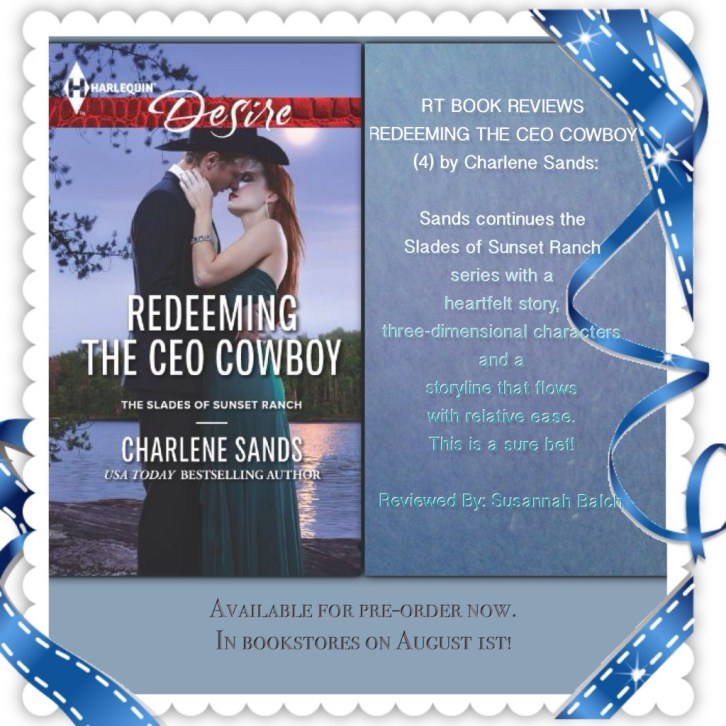
Romantic Times Book Reviews: Sands continues the Slades of Sunset Ranch series with a heartfelt story, three-dimensional characters and a storyline that flows with relative ease. This is a SURE BET! Reviewed by: Susannah Balch
REDEEMING THE CEO COWBOY is available for pre-order and in bookstores August 1st.
Ten years ago = ancient history…right?
So what if former rodeo champion turned construction mogul Casey Thomas is back…living right next door? Susanna Hart is busy running her Sweet Susie’s pastry business and raising her two-year-old cousin. Why pay any attention to the man who took her virginity ten years ago, then left town?
Casey still feels guilty for taking advantage of his little sister’s best friend. A helping hand is just what her business—and his conscience—need. But guilt isn’t his only motivation. Casey’s got a sweet tooth for Susie. And the more she resists, the sweeter it gets!
Do you have a favorite muffin or cupcake recipe? How would you feel about your EX- moving in next door? Have you ever been to Reno or Lake Tahoe? Impressions? I’d love to hear from you!
Post a comment to any or all of these questions and a random blogger will be drawn over the weekend to win a $10.00 Amazon or BN Gift Card!


 “Oliver Fisher Winchester was born on November 30, 1810 in Boston, Massachusetts. Although raised on a farm, Winchester eventually became a carpenter, and by 1830, he was a construction supervisor in Baltimore, Maryland. While in Baltimore, he entered the dry goods business, and after several years, Winchester became a manufacturer of men’s shirts in New Haven, Connecticut. This venture proved to be sufficiently profitable that he began to extend his business interests.


 nchers’ Association was formed in 1926 to set standards for the industry and attract visitors to the various ranches. The Burlington Railroad assisted by printing special maps highlighting dude ranches in Wyoming and Montana. Postcards flourished showing dudes at play in the West.


 means for supplying them with fuel and lumber. In the absence of firewood, cow and buffalo chips became a precious commodity for providing fuel to cook by and heat homes. This “prairie coal” burned well and surprisingly produced an odorless flame. Some people owned a hay burner stove, that was outfitted with a firebox and cylinders that were filled with twisted hay. The hay was quickly consumed and required constant tending.
  If only there were more trees. Or any trees at all.
 tained from the Homestead Act of 1862 in exchange for planting one quarter (40 acres) of the property with trees. Once they proved that they had a successful crop of trees the government would issue them the title to the land. Initially the regulations required one quarter of the 160 acres to be planted with trees and cultivated over a period of ten years. In 1878 this was reduced to ten acres over an eight year period due to the extreme hardships on the Great Plains such as prairie fires, grasshopper plagues, and drought. On each of the 10 acres 2,700 trees (27,000 total) were to be planted with a stipulation that 675 (6,750) of them would thrive. About 20% of hom
 esteaders filed a tree claim. But many were abandoned as people used the land free of rent and taxes for years and then moved on. There were other abuses such as land speculation and fraud. In 1891 The Timber Culture Act was repealed. Nevertheless, millions of trees were planted and although it did not result in great forestation, the Great Plains was transformed into a landscape that is now dotted with trees.

 er than the manufacturer.
 pwards to reload. Each barrel then held one round, and a cam on the hammer alternates between top and bottom barrels.
 n of the barrels so you can see the difference for the cartridges. The .22 is quite a bit heavier because there’s more steel.
 The famous Remington derringer, sold from 1866 to 1935, was designed with a second barrel on top of the first. This meant two shots instead of one, without much more weight to carry around. On this two-shot pistol, the barrels pivoted upward for reloading.
 And do you know how this gun changed history? It was the weapon used by John Wilkes Booth to assassinate President Abraham Lincoln in the Ford Theater on April 14, 1865.