Victoria Bylin: My New Neighbors

Vicki Logo“This house backs to a farm for retired thoroughbreds,” said our realtor.

My eyes popped wide. “Really?”

“Absolutely.” beloved-horses

Sure enough, if you walk up the incline and shove through some bushes, you can see horses in the distance.  I don’t want anyone to get confused.  This is a small tract house in a Lexington, Kentucky suburb. Our new yard is big enough for our dog and a barbecue, but it’s not nearly big enough for a horse.

Nonetheless, I can see horses in the distance. I don’t know which part of me was more excited: the little girl who grew up reading all the Black Stallion books by Walter Farley, or the western writer who instantly had visions of putting a horse race in her next book. Then again, it might have been the weary traveler–the woman who just moved her whole house into a Pod–who nearly melted with relief at the thought of having a real roof again.

house-outsideEither way, the writer in me got to thinking about horse races. It doesn’t take much for the set-up.  As long as there have been men and horses, racing has been part of our history. Records show both chariot races and mounted races in the Greek Olympics in 638 BC. Ancient Rome had its share of horseracing as well. The sport as we know it now got a boost in the 12th century when knights returned from the Crusades with Arabian stallions and bred them with English mares. Two-horse races–with bets riding on the winner–no doubt provided chills and thrills. house-with-me

That’s the kind of race I’ll use in that future book. Just two men (or maybe a woman) and two horses pitted against each other, maybe at a county fair or a Fourth of July celebration.


Those two-horse races eventually evolved into the “Sport of Kings” and horseracing as we know it today. It came to America with British settlers and first took root on Long Island around 1665. Not until the Civil War, though, did it become an organized sport. With that growth came gambling, and with gambling came a criminal element. 

horses-in-mistThe writer in me is seeing a plot-twist in the making. When I write the book with the horse race, there’s going to be more at stake than just the winner’s purse. Anyone else envisioning Snidley Whiplash in a shadowy corner? When the time comes, I’m going to have fun with this story!            

Victoria Bylin: Modern Day Conestoga continued . . . Fast Food or Real Cooking?

victoria_bylin_banner A few weeks ago I blogged about loading up the “pod” and our upcoming move to Lexington, Kentucky. The Pod is long gone, which means my husband and I are camping in our own home.  My youngest son is here, so he’s camping too. The only things we have in the house are things that will fit in my car and my husband’s pick-up truck, or stuff we plan to give to the Salvation Army. 

It’s amazing to discover just how little we need to live. We have a couple of beds, a love seat, an old chair that belongs to the dog, one television, a coffee table, and few other pieces of flotsam and jetsam.

My kitchen is empty except for one cabinet that has a couple of plates, cereal bowls, one fork and too many spoons. I’m not sure how that happened. Somehow I kept out all the spoons and only one fork. I’ve got one mixing bowl, one cooking pot and my favorite microwavable bowl.spoons

Compared to what was in the cabinets three weeks ago, we’re down to bare essentials.

You know what?  I’m enjoying the simplicity.  No clutter. No mess.  With my life stripped down to basics, I’ve thought often about that Conestoga wagon and how people took care of themselves.

When it’s dinner time around here, I put a frozen pizza in the oven or head to Subway for sandwiches.  Pioneers traveling by covered wagon cooked over campfires. That meant gathering fuel for the fire, either wood or buffalo chips.  I hit “start” on the microwave, or turn a knob and hear the clicking of the electronic starter on the stove. The women traveling west struck a match and tended the fire as they made meals from what they’d brought and what was available.  

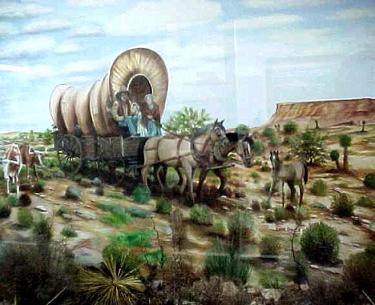
covered-wagon-desertLocal plants and animals supplied much of their food, but they had to haul along flour, sugar, coffee, beans and other essentials. They could make some purchases from forts and trading posts along the way, but you know how prices go.  When things are in short supply, prices go sky high.  And there were no guarantees supplies would be available.  Me?  Lately I’ve been heading to the local market (Giant or Safeway in this area) and picking out pre-packaged cold cuts, frozen dinners, potato chips for my husband and Mighty Dog for Hartley (our beagle / Jack Russell mix).

canned-peaches-1880

The men and women traveling by covered wagon packed bacon in 100 lb. sacks with bran to preserve it in the heat. They carried 100 lb. sacks of flour, double bagged and carefully stitched. Vegetables were desiccated before the trip. They were cut thin, pressed, dried and as hard as rocks until cooked in water. Canned vegetables could be taken on the trip, but they were heavy and took up space. Me? I can buy fresh, frozen or canned vegetables ranging from corn to jalapenos and I don’t think twice about it. It’s all so easy, and I take it totally for granted.  

Some early travelers took things for granted as well, and they learned a hard lesson. As I was researching this blog, I came across a story in A Hand-Book for Overland Expeditions by Randolph B. Marcy, Captain U.S. Army.  He wrote: “I once traveled with a party of New Yorkers en route for California . . . They soon learned that Champagne, East India sweetmeats, olives, etc., etc., were not the most useful articles for a prairie tour.”spanish-olives

Can you imagine being hungry for a real meal and finding only olives and champagne? That’s the kind of snack that makes you appreciate home-cooking. So does frozen pizza!  My goal for this move is to be settled by Thanksgiving so I can make a big turkey dinner.

What about you?  Have you ever lived a stripped-down life?  If you were moving and had to reduce your kitchen to bare essentials, what would you have in your fridge?

western-vegetable-wagon-train


And one last thing . . . Next week the Fillies are doing a Western Recipe Week.  Check in for some great meal ideas that don’t come with microwave instructions!

Victoria Bylin: My Modern Day Conestoga Wagon

Vicki LogoIn a few more weeks, my husband and I will be leaving our home of ten years here in northern Virginia and moving to Lexington, Kentucky.  My in-laws live there, and my youngest son goes to UK (University of Kentucky). We’re stoked!  We’re also putting all our belongings in a “pod.”  Have you seen those onsite storage containers?  I don’t mean to do an advertisement here, but the company we’re using is “Personal On Demand Storage,” aka PODS.   You’ve probably seen them.

pod

This thing is huge.  We’re also in the middle of renovating our house. It’s a mess, so we joked about living in the Pod. A couple of cots and we’d be set . . . which got me thinking about pioneers, covered wagons, leaving home, and deciding what to do take.

I thought it would be fun to do a few comparisons.  Not all covered wagons were conestoga-smithsonian1Conestogas, but the Conestogas were the biggest. Just how big was a Conestoga wagon?   How much could it hold?  

Our Pod dimensions are 16 x 8 x 8, for a total of 6,785 cubic feet.  We got the biggest one. Conestogas came in different sizes, but the average one was nowhere close to the Pod size.  The wagon beds were 16 feet long, 4 feet deep and 4 feet wide and shaped like a boat.  That’s about 256 cubic feet of space.  By the way, Wikipedia gives much bigger dimensions for the Conestoga. (conestoga-wagon-bw24 x 11 x 4).  That has to be measuring from the ground up, and the length of the conveyance with the harness. 

In their heyday Conestogas were referred to as “the inland ship of commerce.”  They were like semi-trucks back in the early nineteenth century.  Each wagon had a tool box for repairs, which were frequent with the rutted roads and rough terrain. We picture them in long lines headed west, but they were first used in the mid 18th century in the Appalachia Valley.  

Another interesting link to modern times is the left-sided drive design.  Drivers walked or rode on the left side of the wagon.  They’d use their right hand to steer with the reins, and operate the brake with their left hand. Have you ever wondered why American cars have left sided steering and European cars don’t?  It goes back to the Conestoga.

Conestoga isn’t a generic term for “covered wagon.”  Conestogas have a specific design, i.e., the boat shape, and they were first made in Lancaster County, Pennsylvania and used to haul produce to Philadelphia.  The earliest reference to a “Conestoga” was in 1711.

How did it gets name?  The wagons got their name from the Conestoga Valley in Pennysylvia where they originated.

podzilla

How much could a Conestoga hold in terms of weight? A lot!  Wikipedia says it could hold 12,000 lbs. and was pulled by six horses.  I couldn’t find the weigh limit for PODS, but this is a picture of the device used to lift it on to the truck. “Podzilla” fits, don’t you think.

My husband guess-timates he loaded 4,000 lbs. of stuff. I jokingly said, “I bet 500 lbs. of that was books.”  He gave me a rather dry look and said it was more like a thousand pounds. Bless his good heart and strong back!  He didn’t complain once about the 20 boxes of paperbacks, research books and back list titles. 


mike-and-the-pod

Your turn! Have you moved using a POD?  Maybe you’ve rented a U-Haul and done the toting and lugging yourself.  Any military folks who’ve moved every two years?

What possessions do you take extra care of when you wrap and pack? And if you had to pack a Conestoga instead of a Pod, what would you take and what would you leave behind?


America is a mobile society and it has been from the very beginning.  We’ve gone from Conestogas to Pods, but the spirit of adventure is the same.  

Victoria Bylin: Hero Hunt At High Altitude, or Where I Met Outlaw Pete

victoria_bylin_banner It’s good to be back on the blog. A family emergency sent me to California for close to a month.  Not an easy trip, but all is well.  I want to give a big thank you to my fellow Fillies who filled in the gap for me. Ladies, you’re the best!

Now that I’m home, I’m getting back to the business of writing.  Woooo Hoooo! I’m shopping for a hero! A lot of writing is work, but the hero hunt is just plain fun. I never know when the right man will show up. It’s usually out of the blue. This time his arrival was no exception. He came out of the Wild Blue Yonder . . . literally!  I was on an airliner, an Airbus 319 to be precise, in Seat 10B.

Has anyone here flown Virgin America? The cabin colors are purple and black. Instead of movie screens that drop down from the ceiling, each pavirgin-america-2ssenger has an individual entertainment system complete with movies, television, and music.  It’s about as far from the Old West as you can get, but somewhere over Nevada I programmed a play list and did some time-travel. Thirty-seven-thousand feet above fly-over country, Bruce Springsteen’s voice came through the headphones.

Outlaw Pete! 

Outlaw Pete!

Can you hear me?

I love this song!  It’s on Bruce’s newest album and it’s totally over the top.  It’s got outlaws, a bounty hunter, wild mustangs a Navaho girl, pistols, mountains and buckskin chaps. After a month of Los Angeles freeways, Holly-weirdness, and smog, I felt almost normal again.

The lyrics gobruce-springsteent me thinking . . . What is it about outlaws that’s so appealing? I’ve been thinking about this, because I want my next hero to be as bad as I can make him. He won’t stay that way, of course. And that’s what I think the real appeal is for an outlaw hero. By the end of the book, they’re redeemed. They might be bad to the bone, but they don’t stay that way. 

My all-time favorite outlaw hero is Johnny Cain in The Outsider by Penelope Williamson. When the story opens, he’s “a man killer.” He’s about as irredeemable as a man can be. Yet he’s the one who risks his life to save Rachel’s son. That’s another key to the outlaw hero. Bad men sometimes do good things. 

wild-bunch-long

Keep in mind I’m talking about heroes in romances.  In real life, I’d have been terrified by the Wild Bunch or the Cole-Younger gang. Then again, there’s Doc Holliday. Granted, I see Val Kilmer when I picture him, but what really intrigues me is the complexity of his character.  That man was a loyal friend to Wyatt Earp. He was also highly educated, a dentist, and very good with a gun. It’s quite a mix. He may not count as a full fledged outlaw, but he captured the rebellion of thoutlaw-pete-silhouette1e West.

When I’m creating a new hero, the challenge is to balance darkness and light, good and evil. Maybe that’s why I like Outlaw Pete so much. It’s got all the highs and lows of real life.  A lot of outlaw heroes are at war with themselves. In the romance the good side always wins. I like that!

Does anyone else have a favorite “outlaw” song?  A favorite outlaw hero?  I can think of a bunch, but I’d love to have y’all add to my list.

And last . . . I’m giving away books from my backlist today. It’s good to be back at Petticoats & Pistols, so I’m celebrating.  Anyone who comments will be eligible to win a copy of either Midnight Marriage or Stay for Christmas.  These are two of my older HH titles.  Good luck!  

Greetings From RWA in Washington DC!

momlogo3Greetings from the Wardman Marriott Hotel in Washington DC, the site of this year’s national conference for Romance Writers of America!  I’m thrilled to be here. Not only is it a great chance to hear industry news and attend writing workshops, I get to spend time with friends. You know that feeling when you sit down with a group of girlfriends you haven’t seen in a while? Everyone starts talking and there’s just not enough time to say everything that needs to be said. That’s what RWA is like for me.

The conference launched with the annual “Readers for Life” Literacy Autographing. Since 1991, RWA has donated more than $600,000 to literacy charities. The totals aren’t in for this year, but the room was huge and it was packed.  Before it started, I snapped a shot of fellow Filly Tracy Garrett.  She’s signing copies of Touched by Love.

tracy-2


And here’s Pat Potter saying hi. You can’t see the Rita pins on her badge, but my mouth gaped.  Pat is so friendly and so talented . . . I confess! I’m in awe.

pat-potter-rwa


I’m also in awe of of those serendipity moments that are unique to RWA.  I had one of those happy coincidences the first time I stepped into the elevator. My roommate and I (here’s a shout-out to Sara Mitchell, my fellow LIH author) struck up a conversation with a writer wearing a pink “First Sale” ribbon.  “Who did you sell to?” I asked.caroline2

“Dorchester,” she answered. “I write western romance.”

Music to my ears!  Turns out I was talking to Caroline Fyffe. She’s set to blog at Petticoats and Pistols on August 6th.   

My next western-flavored coincidence is typical RWA. The literacy signing and is over and I’m in the elevator. (I seem to spend a lot of time in elevators!)  I look up and see a man I can’t quite place. Turns out he’s Leigh Greenwood (aka Harold Lowry).  I’m beginning to wonder if the hotel put all the western writers on the same floor!

The conference is just beginning.  Thursday’s schedule includes a breakfast with the Harlequin Historical writers. That’s the line where I started and I’m stoked to be catching up with old friends. On Thursday night, I’ll be getting together with new friends. The Love Inspired Historical authors will be gathering for dinner. Friday is all business. I’ll be meeting with my editor and my agent, and then attending a workshop by Donald Maass. 

I’ll post other serendipity moments in the Comments section.  At RWA, you never know who you’ll meet in an elevator. It could be me!


vicki


Victoria Bylin: City Girl on Horseback

 victoria_bylin_banner

 “Hold on!’ shouted the trail guide.

As I grabbed the saddle horn, the horse I was riding (sitting on would be more accurate) jumped over a narrow creek. Judging by the way my stomach lurched, you’d have thought we’d taken a five-foot fence. Far from it . . . I was on a trail ride in the San Emidio Mountains in southern California, doing a news story for a local newspaper.

For a western writer, I have appallingly little experience with horses. I’m not someone who grew up in the saddle.  My first horse was made of plastic and attached to sprspring-rocking-horseings.  Does anyone else remember “The Wonder Horse?”  They were made in the 1960s and graced living rooms throughout America. I rode my Wonder Horse for hours, but it was my brother who tested the limits. He managed to bounce it into the wall.

Hobby horses have been around for ages. They became popular in 17th century England, but they’re believed to have originated in ancient Egypt. Carved horses would be placed on four-wheel carts and children would take rides. A few of these toys have been found in ancient pyramids. With a son living in Cairo, I’m fascinated by the Egypt connection.

The hobbhobby-horsey horse (or broomstick horse) became popular in medieval times. A hobby horse consisted of a stick, a fake horse head and a child’s imagination. Can’t you just see a little girl naming her horse “Star” and dreaming of adventure? For a boy in medieval times, a hobby horse was more than a toy.  Pretending to ride imitated adult behavior and prepared him for a life of battle. Boys also practiced jousting with horses on wheels.


 Hobby horses eventually morphed from sticks into barrel horses. A barrel horse was made from a log mounted on four legs and had a crudely made head. They didn’t move or rock, but they gave a child the feel of sitting on a horse. As cabinet-making and carpentry skills advanced, the legs of these barrel horses became more elaborate.

The rocking horse as we picture it now came into being in the 17th century. Someone figured out that mounting a toy horse on a half barrel would create a rocking motion. Later the barrel evolved into the wide rockers we picture today. The earliest example belonged the boy who’d become King Charles I of England.  Antique Hobby Horse on wheels

It was only a matter of time before the rocking horse exploded in popularity. In the 18th century, some were elaborate works of art made by masters of the trade. Only the wealthiest of family could afford them. When the Industrial Revolution took hold, what had been a cottage industry turned into mass production and rocking horses were accessible to the general public. The dappled gray became the most popular model when Queen Victoria presented that style to her children.

Child on Hobby Horse c. 1860

 The rocking horse underwent another evolution in 1880 when J.P. Marqua, an American from Ohio, patented a safety stand. Instead of moving on rockers, the horse was mounted on springs in a frame. The safety base made rocking horses more stable than their ancestors, and the toy took up less room as a child played. They were also considered safer. Fingers and toes couldn’t be pinched under the rockers, and the horse was less likely to tip over.  (I can vouch for this. My Wonder Horse made some wild leaps in my imagination, but he never threw me off.)

Up until World War I, rocking horses grew in popularity. Unfortunately, the start of the war led to a shortage of materials and skilled craftsman. The Great Depression further lessened the interest in such toys. They never did make a strong comeback, possibly because of the advent of the automobile.  Instead of imitating their parents on horseback, children wanted toy cars they could pretend to drive.  

Even though interest has faded, rocking horses aren’t gone forever. They’re still made by artisans and loved by children with vivid imaginations.

 collectible-rocking-horse

What about you? Did you ever have a rocking horse?  Do you remember Wonder Horses and stick ponies? Or maybe you were the girl I envied . . . Maybe you had a real horse of your own.  Memory lane, here we come at a gallop!


Available at Amazon!

Victoria Bylin: Once Upon A Time

Vicki LogoOne of my earliest memories is sitting on the floor in my bedroom with a children’s book of fairy tales. The book was tall and wide and about a half-inch thick. The cover showed Rapunzel with her hair flowing while a prince in a pointy hat gazed up at her. Red Riding Hood is looking up, and there’s a unicorn in the background.

tasha-tudor-book-of-fairy-tales-small

These memories rushed back to life when I started researching the second book in the Swan’s Nest trilogy. No title yet, but those of you who have read The Maverick Preacher will remember Pearl. This is her story. She needed a fresh start, so I packed her off to Cheyenne where she meets a troubled lawman with a five-year-old daughter. He’s a rough and tough ex-Texas Ranger, but he’s got a soft spot when it comes to his little girl. Every night, he reads a story to her.

That vision led to all sorts of questions. What would he read? Would he have purchased the book? Would it be a family heirloom? What would it have looked like? The story takes places in 1875 Wyoming. With the arrival of the railroad, the town had money and some culture. It seemed reasonable that his little girl could have a big book of fairy tales similar to mine, but I had to be sure.

thumbelina-smallAnd so the research began . . .

Fairy tales have been around forever, but children’s books the way we know them weren’t common until the late 1800s. In 1875 Wyoming, my little girl would mostly likely have a copy of “Mother Goose,” a collection of ten fairy tales collected by Charles Perrault in 1658 and translated into English from French. The first American edition, titled Mother Goose’s Melody or Sonnets from the Cradle was published in 1787 and had many of the stories we love today. Among them were Cinderella, Sleeping Beauty in the Wood and Little Red Riding Hood.

In addition to traditional stories, children’s books in the 19th century contained short rhymes, moral lessons and simple drawings. Some of the rhymes would be familiar to us all, things like “One, Two. Buckle My Shoe” or “Hey Diddle Diddle.” I can’t read those words without smiling. Both my sons (now grown) were fascinated with the idea of a cow jumping over the moon.

The most well known publisher of children’s books in the 19th century was the New York firm of McLoughlin Brothers. Their books had color illustrations which must have thrilled little girls just like the ones in my book thrilled me. The pictures weremother-goose-book-cover-1870s made using etched zinc plates, chromolithographs and photo engravings. They popularized well known illustrators including Thomas Nast and Ida Waugh.

When I wrote the scenes where my hero reads to his little girl, I pictured my well thumbed copy of The Tasha Tudor Book of Fairy Tales. The book itself is too modern for an 1875 setting, but the feeling of discovery would be the same. Like me, the child in my story would be magically transported to another place and time. My hat’s off to the men and women who illustrate these wonderful books, especially to Tasha Tudor. Her drawings gave me hours of pleasure and fueled my imagination. Who’d have thought? The little girl sitting on the floor with her big book of fairy tales grew up to write stories of her own.


A Collection of Vintage Children's Books

Do you remember reading fairy tales as a child? Maybe you’re a mom or a grandmother or an aunt. Do you read stories to the children in your life? I’d love to hear about your favorites!


Available now at Amazon.com

Research, Romance and Real Life

victoria_bylin_banner

I’ve got to hand it to my husband. He listens patiently when I ramble on about my books, but what can he say about imaginary people with imaginary problems? It’s got to be a tad bit frustrating. He wants to help, but there’s not a lot he can do.

All that changed while I was researching Kansas Courtship, my March 2010 release from Steeple Hill Love Inspired Historicals. The book is a continuity, which means I didn’t pick the characters. An editor wrote a basic story line for three related books. My book, the third in the series, features a lady doctor and a mill owner in a town devastated by a tornado.

No problem with the lady doctor. There’s plenty of reading material on frontier medicine (waving at Kate Bridges here; her P&P blogs were gold). I could visualize my heroine’s life right off the bat. Colvin Run Historic Mill 

The hero was a different story. From Day One, this guy was a problem child. He’s a mill owner. At the time, I knew nothing about mills. The story is set in Kansas in 1860. I’m thinking, “Kansas? Where are the trees? Don’t they grow wheat in Kansas?” A little research cleared up my misconception. Eastern Kansas is quite different from western Kansas. In 1860 there were plenty of trees. I was in the clear with my assigned characters, but I still needed to see a mill. 

I looked online. There’s a youtube video of an historic mill, but it didn’t help. I looked at dozens of pictures, but I couldn’t visualize how the pieces worked. Nor could I hear or smell any of the details. Milling is completely out of my range. Wood comes from Home Depot and bread comes from grocery stores. That’s about it.

 The answer came out of the blue on a gorgeous Sunday morning. My husband and I were leaving church when I started muttering, “I really need to visit an historic mill.”

The next thing I knew, we were doing a U-turn on Route 7. This wasn’t your garden variety U-turn. He gunned the engine of our oh-so-sporty Camry and I was half out the window. My voice went up two octaves. “What in the world!”

“A mill,” he said. “We’re going to a mill.” He sounded like James Bond.

“Where?” I asked.

“Up the road.” Imagine clipped speech. Picture the intensity of Daniel Craig or Sean Connery, and you’ve got the idea.

The next thing I knew, we’d turned up the road to the Colvin Run james-bond3Historic Mill, an official landmark. We’ve lived in northern Virginia for several years now, but I don’t know the area very well. My husband, it turns out, had driven by the mill on his way to have lunch with a friend a few weeks earlier.

For the next two hours, we took in every detail of the mill and asked the miller dozens of questions. I’ll never forget the sound of water spilling as the wheel turned and the millworks went into motion. The gears made a huge racket and dust filled the air. We saw the miller adjust the millstones and learned about the perils of the trade. I used all those details in Kansas Courtship.

I had the best day! Best of all, I got to share it with my husband. My characters may be imaginary, but my husband is very real. He’s also my real life hero.


This isn’t quite related to milling, but I’m hung up on the James Bond comparison. I’m also shopping for a hero for my next manuscript. Of all the actors who’ve played “Bond, James Bond,” which one do you think would look best in a cowboy hat? Choices are Sean Connery, Robert Moore, Timoty Dalton, Pierce Brosnan and Daniel Craig.  I know there’s one other actor who played James Bond once, but I can’t remember who.  Anyhow, I am leaning toward Timothy Dalton, but Daniel Craig is moving up on the list.


And last, I want to say how thrilled I am to be a Filly.  It’s a joy to join this group of talented authors who all love western romance.  To celebrate, let’s have a drawing. I’ll toss the names of everyone who comments into the cowboy hat and pick out three winners. Winners get the book of their choice from my Love Inspired Historicals. Good luck!


Click on The Maverick Preacher cover to order from amazon .com!