The Pony Express

tracy-garrett-tile


“Wanted, young skinny, wiry fellows not over eighteen, must be expert riders willing to risk death daily, orphans preferrpony-express-want-aded. Wages $25 a week.”

On April 3, 1860, the citizens of St. Joseph, Missouri, knowing something big was about to happen, gathered just after dark to witness an event never before attempted.

Major M. Jeff Thompson, who would soon leave St. Joseph to make a name for himself as a Confederate General, initiated the Pony Express with the following words:
“This is a great day in the history of St. Joseph. For more than a decade she has been the portal through which passed the wagon trains for the great west… Now she is to become the connecting link between the extremes of the continents… For the first time in the history of America, mail will go by an overland route from east to west… Citizens of St. Joseph, I bid you three cheers for the Pony Express – three cheers for the first overland passage of the United States Mail.”

With that, the first rider, either Johnny Fry or Billie Richardson–historians can’t agree on which–galloped out of the barn and into history.

firstrideponyexpress-600The first westbound trip was made in 9 days and 23 hours. A rider left simultaneously from Sacramento, California, and made the eastbound journey in 11 days and 12 hours. On average, the pony riders covered 250 miles in a 24-hour day.

The route of the Pony Express was 1840 miles of brutal riding: west out of St. Joseph, following the Oregon Trail through Kansas, up the Little Blue River to Fort Kearney, Nebraska, along the Platte River to Fort Laramie, Wyoming; then the Sweetwater River to Fort Caspar, Wyoming, through South Pass to Fort Bridger, Wyoming, on to Salt Lake City; across the Great Basin and Utah-Nevada Desert, skirting Lake Tahoe; then over the Sierra Nevada mountains into Sacramento, California.

Riding day and night, the Pony Express delivered the mail in less than 10 days. [The westbound trip took 11 ½ days-don’t ask me why.]

But that wasn’t the end of the line. Upon arrival in Sacramento, the mail was placed on a steamer and continued down the Sacramento River to San Francisco. In all, the mail traveled 1966 miles.

Delivery of the print version of Lincoln’s inaugural address set a new record for delivery, crossing the west in slightly less than eight days.

The Pony Express service lasted only 18 months, ending on October 24, 1861, when the completion of the Pacific Telegraph line ended the need for its existence. But in that time, the less than 100 riders covered 650,000 miles on horseback and rode into a permanent place in the history of the American West. Though the route was extremely hazardous, only one carrier was killed and one bag of mail lost.

Exciting as it was, the Pony Express was a financial bust. And it was never a part of the U.S. Postal service, although the galloping Pony Express rider was the official symbol on every letter carrier’s shoulder until the invention of Mr. Zip.

The most significant accomplishment of the Pony Express, besides keeping families in touch, was helping hold California – and its gold – for the Union at the start of the Civil War.

The Express was started by businessmen William H. Russell, William Bradford Waddell, and Alexander Majors, who were already in the freighting business and held government contracts for delivering army supplies in the West. Russell envisioned a similar contract for fast mail delivery. That contract never came about.

According to the Pony Express Museum website [ponyexpress.org], Russell, Majors and Waddell lost $500,000 on the Pony Express. Eventually, entrepreneur Ben Holladay bought what remained of the Pony Express and merged it with his Central Overland Stage Lines.pony20express

If you’re ever in St. Joseph, Missouri, just a few minutes north of Kansas City, stop in at the Pony Express Museum. St. Joseph was the terminus for the westbound trains, and the launching point of the Pony Express. The original structure used by The Pony Express, Pikes Peak Stables, still stands at 9th & Penn.

Within its walls you can hear a recreation of the countdown and release of the very first rider, complete with the cheers of the assembled crowd. You can wander through exhibits showing the gear a rider carried and the route they took. They have several original saddles on display, and even a typical Pony Express “station” – which was nothing more than a 10-foot by 8-foot log cabin with an open fireplace.

The museum also houses displays of period settlers’ wagons and other historical memorabilia. All in all, a nice way to spend an afternoon.

And if you want to relive the experience, April 3, 2010 is the 150th Anniversary of the first ride. Check out the celebration plans on ponyexpress.org.


Be sure to Twitter with us:  http://twitter.com/Felicia_Filly

We Can Make That Work

tracy-garrett-tile


Have you ever imagined what it must have been like to pack up your most prized possessions and head off to start a new life in a place you’ve only heard or read about? I’m not sure I would have had the nerve to climb into a wagon, turn west and snap the reins, confident that over some distant hill, their version of a new life waited.

old-villageI just returned from a lovely vacation in Hawaii, where I spent some time learning about the history of the islands’ inhabitants and wondering about those who discovered and settled these lush piles of volcanic rock.

Just imagine it – they loaded canoes, tackled thousands of miles on the open ocean, finally found a safe harbor to land, climbed to the highest point and looked out over rolling hills of rich black—lava?

Since the earliest settlers came from the Polynesian Islands to the south, they left their beautiful, lush homeland, rich with all kinds of vegetation, and landed on a serierock-ffitis of rocks that had less than 1000 native plant species. Still, they adapted, survived and flourished.

That ability to adapt is what, in my mind, makes those who settled the Hawaiian Islands much like those who settled the old West. For instance, on Hawaii, the big island, the teenagers have adapted. Because the lava is too rough and porous for spray paint, they use small water-smoothed white rocks to get their message across.

donkey-crossingEven the animals have adapted (behind that sign, for as far as you can see, is lava and salt grass).

Whether in the old West, or the islands, the settlers took what they found in their new location and used it to make a home–a life. This resilience of the human spirit never ceases to amaze and humble me. I guess that’s why I write westerns.

Aloha, y’all.

Be sure to tweet us ~ http://twitter.com/Felicia_Filly

You Find History in the Most Surprising Places

tracy-garrett-tile


Not long ago I went to my very first Gun & Knife Show. I’m a sport shooter–I only aim at things that don’t bleed–but I must admit, I was curious. 

Mostly I found what I expected, guns and knives of all shapes, kinds and makes. Surprisingly, though, there was also an amazing array of history there. I studied replica Colt revolvers, Navy revolvers, and dragoons. Derringers were in abundance, too.1884-colt

What excited me the most were the originals! Colt, Winchester, Smith & Wesson, Walker. Black powder percussion cartridge, Civil War era and the guns that “won the West.” All the pistols and revolvers I’ve researched for my western historical novels were right there in front of me. Pearl handles, hand-rubbed walnut grips, elaborate engravings. Totally amazing.

At shows like the one I attended, you will find everyone from the curious to the expert. There was the man who displayed an amazing collection of knives. He had Bowie knives from several different decades and parts of the country; also a Civil War-era personal knife that you might find in the kitchen of any household in 1850. Some had rough-hewn handles, others fancy silver scrollwork. There was even an abalone-inlaid beauty that could bring more than $10k in a collector’s auction. None of the collection was for sale, of course–he just brought it because he loves collecting and wanted to share his many treasures with others.

Besides weapons, there was all kinds of Americana, like old photographs and books, a Harper’s Weekly from 1889, even advertisement cards that prove using scantily clad women to sell your products is not an invention of 20th century adcat-house-tokens agencies.

My favorite item? Brass tokens the size of 50 cent pieces, stamped on one side with “Cat House Tokens – good for a bath, a screw and beans.”

I found battlefield souvenirs, from shell casings to buttons to the decorated leather holder for a cannon tamper, period clothing and gear, belts, spurs… I could go on and on, but it would be easier if you just saw it all for yourself.

So the next time there’s a gun and knife show in your area, go. You won’t be sorry.


Be sure to hook up with the Fillies on Twitter: http://twitter.com/Felicia_Filly

PRAIRIE WINTER VEGETABLE SOUP circa 1887

tracy-garrett-tile


One of the hazards of writing historicals (at least for me) is my love of research books. I found The Original White House Cookbook 1887 Editiwhitehouse-cookbookon a few years ago on a list of clearance books. In it you can learn how to fix a tear in a lady’s silk gown, dye cloth, make Rose Water or Bay Rum, even fade freckles. 

The recipes are the typethat would have been made in homes everywhere, including by settlers out west.

This Winter Vegetable Soup is made with ingredients that would be found in the root cellar of most frontier homes. Turnips, carrots, onions and celery were common vegetables grown in kitchen gardens throughout the west. Thethe-leek-welsh-guards-cap-badge leeks? They may not be as common, but I’ve found evidence they can be grown in Texas – plant them in late summer and they can be harvested fresh in the winter/early spring.

As an aside, the leek is a symbol of Wales. It’s even worn as a cap badge by the Welsh Guards. The vegetable would certainly have been brought over in the 1830s by Welsh immigrants to Texas.


The directions are exactly as they appear in the cook book.


WINTER VEGETABLE SOUP

Scrape and slice three turnips and three carrots, and peel three onions, and fry all with a little butter until a light yellow; add a bunch of celery and three or four leeks cut in pieces; stir and fry all the ingredients for six minutes; when fried, add one clove of garlic, two stalks of parsley, two cloves, salt, pepper and a little grated nutmeg; cover with three quarts of water and simmer for three hours, taking off the scum carefully.  Strain and use.  Croutons, vermicelli, Italian pastes, or rice may be added.


I hope you enjoy the soup!

Pamela Nowak ~ Choices

pam-nowak-picI want to thank Petticoats and Pistols for inviting me and giving me the opportunity to share with all of you. This is a favorite site of mine and blogging with you here is beyond exciting!

This week, my second novel, Choices, was released. Set at Fort Randall, Dakota Territory in 1876, it tells the story of a rebellious officer’s daughter, an honorable enlisted man, and a forbidden relationship.  

Twenty odd years ago, when my late husband, Tim, and I were first married, we shared an avid interest in living history. He was an archaeologist, I was a history teacher, and we were both passionate about the Amephoto-4rican West. He created the persona of a soldier-a private-and I was a governess. Both of us spent scores of hours researching the period:  the army, etiquette and social rules, nineteenth century dress; and how our characters fit within it. At the same time, Tim was also the project manager of the Fort Randall Archaeological Project. We lived and breathed Fort Randall for over two years. 

Choices flowed out of that. The facts were swimming around in my head, mingling constantly into different storylines (that happens a lot with facts in my head). They begged for characters to play them out and for the words to be written down. 

The nineteenth cfort_randall_military_postentury army had rigid sets of rules for being a soldier and complex social codes for how officers, enlisted men, and their women were permitted (or not permitted) to interact. I was amazed at how stratified society was at these western outposts and at how thoroughly officer’s wives observed those social norms. Memoirs, scholarly studies, and the notations left by army personnel all speak to the separation of classes—as defined by rank. 
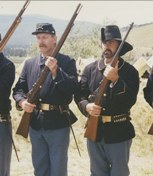
But even more amazing were the exceptions. Though officers’ wives were socially superior to enlisted men’s wives, they were not officially recognized by the army. In fact, they were considered camp followers, in the same category as prostitutes who might do business just off the military reservation (their places of business were nicknamed “hog ranches”) and were allowed only at the sufferance of the commanding officer. Laundresses, who were often wives of enlisted men, were offic17-in-general-miles-marching-and-chowder-society-reenactmential civilian contractors with corresponding army regulations detailing their rights to be there.  

On most posts, lifestyles of the enlisted and officer classes were narrowly defined and very separate. A few diaries and memoirs offer glimpses into occasional relaxation of those barriers, most often for an all-post holiday celebration or when there was an unusual crisis. 

I wanted to share all this but also to present a story about choices, about how we all choose who we are going to be in terms of choices-coverrelationships with others. Miriam, my heroine, confronts rules and regulations head-on and resists them every step of the way while she seeks ways to cross the lines. I introduced her rigid and domineering mother, Harriet, to bring pressure on her to toe the line and to personify the exclusionary nature of society. Lt. Wood is representative of expectations. Mixed in is the culture of the army, Harriet’s addiction to laudanum, Jake’s honor, the laundress’s common-sense outlook on life, and Major Longstreet’s predicament of his own making. 

I hope you will find the story and fun to read as I found it to write and that my characters reveal the subtleties involved in the choices that face us all. 

I’ve enjoyed our time together. Please visit me on my website at www.pamelanowak.com.

To celebrate the release of Choices, Pam will be giving a copy to one of today’s blog participants. 

Perote Prison: Something To Be Buried In

 tracy-garrett-tile


Sometimes research can turn up a gem of information that can send your story in a different direction. When writing my second novel, Touched by Love, I needed a place for the heroine’s kidnapped brother to be taken. I knew the general area where I needed him to be held, just not a specific location. And of course, it had to be historically accurate for the time period in which my story was set.

I began searching the internet for prisons used by the Mexican Army in the 1800s and found Perote Prison. The location was ideal, 600 miles into Mexico, and several hundred Texans had been incarcerated within its walls.

perote-prison-bridge-over-moatThe Castle of San Carlos (photo to the left *) was built by the Viceroy of Mexico in the late 16th century, 7000 feet up the mountains overlooking the port of Veracruz. It was designed as an ammunition storage facility and a military training school, and as a second line of defense for Veracruz. Both the Spanish and Mexican armies used the immense fortress as a prison. Texans captured during three disastrous expeditions against Mexico were imprisoned and died here.

The Aztecs called the place pinahuizapan, or “something-to-be-buried-in.” Situated high in thmountains-over-veracruze mountains, at an altitude of 7000 feet, the castle made an ideal prison. The stone and masonry walls were twelve feet high and six feet thick. The entire structure was surrounded by a wide, deep moat spanned by a single drawbridge. Add to that the weather in this high desert, and it must have seemed like the most inhospitable place on earth to those unfortunate enough to be there.

When I discovered Perote Prison, I knew it had to make an appearance in the book. I ended up writing a prologue that forced the hero to ride to this remote prison to correct a terrible mistake and save a man’s life at the possible cost of his own. The added scenes demonstrated the hero’s sense of honor and responsibility, adding depth to his character and making him more redeemable in the eyes of the reader.

Interesting, isn’t it, how a gem of information can send you off in a different direction and make your characters—and your story—better?

* J. J. McGrath & Walace Hawkins, “Perote Fort- Where Texans Were Imprisoned”, Volume 48, Number 3, Southwestern Historical Quarterly Online


touched-by-love


www.tracygarrett.com

The Legations of The Republic of Texas

tracy-garrett-tile


In honor of those who lost their lives on September 11, 2001, and all those who fight every day for our freedoms. Never take them for granted.


From the day I started researching my first manuscript set in Texas, I’ve been fascinated by the history of Texas. Much has been said about the Republic of Texas – but did you know it only existed for ten years?

republic-of-texas-sealThe Republic of Texas was a sovereign nation that existed from 1836 to 1846. The first Congress of the Republic of Texas convened in October 1836 at what is now West Columbia. Stephen F. Austin, referred to as the “Father of Texas,” served as Secretary of State for the new Republic for only two months before his death on December 27, 1836.

In 1836, five sites served as temporary capitals of Texas: Washington-on-the-Brazos, Harrisburg, Galvestofirst-republic-texas-flagn, Velasco and Columbia before President Sam Houston moved the capital to Houston in 1837. In 1839, the capital was moved again, this time by President Mirabeau B. Lamar, to the new town of Austin, where it remains today. And during the time of the Republic, Texas had embassies.

Technically they were Legations, not embassies, since Texas was a Republic, not a recognized country. There were Legations of the Republic of Texas in London, Paris and Washington D.C., serving to improve diplomatic ties–and to beg for loans.

texas-legation_paris_placevendomeThe Legation in France was housed at 1 Place Vendome 75001, rue de la Paix, Paris, where the famous Vendome Column, was erected in 1810, torn down in 1871, and rebuilt, with Napolean again depicted as Ctexas-legation_london_plaqueaesar, three years later. There’s a plaque there, showing its location.

The London Legation building was at 3 St. James Street, near Buckingham Palace. The building now houses Berry Brothers Wine Merchants, with a plaque recognizing its former tenants.

And I didn’t find an address for the Legation in Washington D.C., but I’ll keep looking–because it’ll drive me nuts not knowing!

The Legations weren’t needed for long. On February 28, 1845, the U.S. Congress passed a bill that would authorize the annextx-flagation of the Republic of Texas. On October 13, 1845 a large majority of voters in the Republic approved it. and Texas bypassed the territorial phase and became a U.S. state on December 29, 1845.

A lot happened in those ten years – enough for more books than I could write in a lifetime. But I’m going to try.

The Hat Makes The Man


tracy-garrett-tile


As the old cowboy saying goes, ‘It’s the last thing you take off and the first thing that is noticed.’humphreybogart_fedora

Top hats, derbys, tams, fedoras, berets, bowlers – hats do more than cover a man’s head. They make a statement about the wearer.

If I say Bogart, can you see him, fedora pulled down low, collar turned up?

charlie-chaplin_bowlerOr Charlie Chaplin in his bowler?

How about President Abraham Lincoln?abraham-lincoln-top-hat

sean-connery_panamaOr Sean Connery in his Panama?

Hats say a lot about the personality of the man – and some, like President Lincoln’s black stovepipe hat, will be forever linked with the man who wore it.

I believe the most recognizable type of hat, hands down, is the cowboy hat.

Did you see John Wayne in The Quiet Man and wonder where the heck his Stetson was?john-wayne_the-quiet-man

john-wayne_stetsonThere, that’s better.

How about the hat Clint Eastwood wore in Pale Rider? clint-eastwood_pale-rider

John Stetson was the creator of what we think of today as the cowboy hat. The son of a master hatter, John made his first cowboy hat as a demonstration to his buddies about making felt from fur. The wide-brimmed hat was so useful in keeping off the sun and rain, his companions wanted one of their own. And an empire was born.

Stetsonboss-of-the-plains-hat_real started his company in 1865. By 1866, the “Hat of the West” or “Boss of the Plains” set the John B. Stetson Company on the path to becoming the most famous hat in the world. Originally sold in one grade (2 ounce feldudes-in-boss-of-the-plainst) and one color (natural), that original Stetson hat sold for five dollars. The equivalent hat today would cost close to $1,000.

Check out these two Montana dudes (1885) in their brand new Stetson ‘Boss of the Plains.’ The guy on the left is wearing Levi’s.


Made of a blend of rabbit, wild hare and beaver fur, today’s Stetson sets the mark for cowboy hats. You can get your Stetson in felt or straw, black, white, grey, tan; choose your style, for casual or dress, for outside wear or for going to church.

If you want to see how these famous hats are made, visit StetsonHats.com and click on the “The Making of a Stetson Hat” from the list on the left.

Stetson isn’t the only hat maker in the U.S. In Dallas in 1927, the Byer-Rolnick company began making the Resistol hats, so named because they were made to “resist all weather.”

But Stetson is the name most associated with the west.

Here’s some eye-candy, just because.

ed-harris_appaloosa     dean_martin_rio_bravo_1959   kenny-chesney

garth-brooks   christian-bale

russell-crowe   george-strait   tim-mcgraw


“Even after the wild aspect of the West was somewhat tamed, the cowboy hat never really lost its ability to lend that reckless and rugged aura to its wearer.”


touched-by-love

19th Century Bling ~ Watch Chains & Fobs

tracy-garrett-tile

My 96 ½ year old maternal grandmother is a pack rat. We discovered this when, at her insistence, the family began cleaning out her home and readying it to sell.

After three days of sorting, my sister, mother and I sat down to go through her jewelry boxes. The memories were fun – the bird and flower and dragonfly pins she always wore when teaching because her kindergarten and first grade students loved them. [The articulated owl was my favorite.] We found several cameos [see my August 7 post Carved in Stone–or Shell]. And pearls, of all lengths. Seems GGG-Great Grandmother Grace loves pearls.

In a box marked “Keepsakes” we found hat pins and buttons and old marbles. And a watch fob. The card with it says it belonged to GGG’s father, my Great Grandfather Ole, a Norwegian wheat farmer from North Dakota.

The chain is nothing fancy but there is a bit of bling on it that brought a wonderful surprise. The square gold locket fob hanging from the center held an old photo of my Great Grandmother Julia.

The find got me thinking: what kind of bling would you find on a gentleman’s dressing table in the 1800s?

A fancy button waiting to be sewn back onto a vest. We found a few of those, military coat buttons mostly, carefully pinned to cards identifying the owners.

Cufflinks of gold, perhaps declaring the gentleman’s membership in an organization like the Masons.

man-wearing-watch-with-fobThe most common bit of bling would likely be a pocket watch and chain, that extra little something that showed a man’s taste, his position, and sometimes offered a glimpse into his life.

The pocket watch has been around since the 1500s. Originally a status symbol only the very rich could afford, by the 19th century most anyone who wanted one could buy one.

Attached to the pocket watch would be a chain, one end secured to his clothing, the other to the watch. Most commonly, the chain would hook through a button hole on his vest or coat, leaving the chain to drape across his middle to the pocket containing the watch. The chain was functiohair-chain-w-watch2nal–it kept his watch attached to his person should it accidentally slip from the pocket–but it could also be jewelry.

My Great Grandfather’s watch chain was made of human hair. I assume the chain was braided by Julia for Ole–perhaps it was a gift for him when they were betrothed. I can imagine him, all spiffed up and looking proud, with that chain and fob adorning his vest.

What is a fob, you ask? Fobs are medallions that would hang from the end of a gentleman’s watch chain. Their purpose was to help pull the watch from their vest pocket.

They could be made of the same material as the chain: gold, silver, hair, etc. Here’s a good example – the fob is the small length of braided hair chain hanging by the button finding.

See the little loop at the end? From there the gentleman could hang almost any bit of bling he wished.

The fob could display the family crest.fob_with_crest_and_eagle2501

Or be covered with gold and jewels.cameo-watch-fob-1890s

fob-gold-and-jewels

It could be a locket, like Great Grandfather Ole’s. Or perhaps a cameo.

There were Double Albert chains, named for Queen Victoria’s husband, with a fob hanging from the center.

Double Albert watch chain

And the fob wasn’t an exclusively male piece of jewelry. Women commonly wore very ornate little fobs such as decorated balls or baskets of flowers or lockets.

In Victorgarmentclip2ian times, garment clip chains were worn by women on the pocket of a blouse or waist band of a skirt and were worn by men clipped directly on the trouser pocket or vest pocket.

Women also wore their watches on long chains, or slides. The slide was a very long chain with a slide in the middle that could be adjusted to the length that looked best with the lady’s garment. The slide itself could be engraved, or decorated with seed pearls or small gemstones. ladiesslide2

Or perhaps she preferred to wear a pin.watch pin

The possibilities were only limited by the wearer’s taste and financial means.

Does anyone you know wear a pocket watch? What’s the most unusual watch fob you’ve seen?

http://www.tracygarrett.com

Carved in Stone—or Shell


blog-sig-teal1


I have always loved cameos. I received one as a birthday gift years ago, white carving on a brown background set in an antique gold broach, and it’s one of my favorite pieces of jewelry. Not because I wear it all the time, but because of the history of the gift. My history.

Recently my mother, sister and I were sorting through my grandmother’s jewelry. Among the dozens of bird and animal pins—she loved wearing them for her kindergarten students—were several cameos. Some were plastic, others looked to be rather old. Since GGG (she signed her cards this way—stands for Great Grandmother Grace) didn’t collect fine jewelry, the old pieces wecameo-antique-victorian-sardonyx-1880re probably her mother’s. Looking at those wonderful pieces got me thinking about the history of the cameo.

The cameo is much older than I thought. Though the origins are still under dispute, most think the word “Cameo” comes from the Hebrew word KAMEA, meaning a charm or amulet, or from the Latin CAMMAEUS, meaning “engraved gem”.

Historians believe this carving tradition came from Alexandria, Egypt, nearly three centuries before the birth of Christ. Early Greek and Roman carvings featured images of gods and goddesses, mythological scenes and biblical events. Some immortalized rulers or heroes. During the era of Helen [323BC – 31/30BC], women wore cameos depicting a dancing Eros as an invitation to perspective lovers.

They’ve been used on military uniforms, rings, watch fobs, pins, amulets, vases, cups and dishes. They became a collector’s item during the reign of Queen Elizabeth to demonstrate status and wealth.

queen-victoria1Queen Victoria popularized the cameos made of sea shells. Napoleon wore a cameo to his own wedding and founded a school in Paris to teach the art of cameo carving to young apprentices.cameo-coral2


Stone, shell and coral are the materials most often used for the carvings. In stones, you’ll find agate and less often, turquoise.


Shell is probably the most commonly used material, because of it’s availability cameo-strombus-giga-shellto carvers in all locations and financial situations. Among the shells used are Cornelian, Cassis Madagascariensis, Empire Helmet or Conch, Sardonyx (that’s the material in the pink amulet above), and Strombus Giga.


cameo-antique-victorian-shellThe cameos we’re most familiar with show a young woman, hair and dress appropriate to the period of the carving, in various colors. 

In the 1840s, the goddess Athena cameo-athena-french-1840was a popular subject.

They even carved cameos of such things as peacocks and horses.cameo-antique-ivory-peacocks 

cameo-antique-victorian-painted


cameo-blue-porcelain-horse1

Here’s one of my favorites from my research:


I still don’t know the origin of the lovely pieces in my grandmother’s collection, but that doesn’t matter so much. I appreciate them for their beauty and the history they portray—my history.

Do any of you own cameos? Do you know where they came from?

www.tracygarrett.com