Memorial Day is Remember Day


HEADQUARTERS GRAND ARMY OF THE REPUBLIC

General Orders No.11, WASHINGTON, D.C., May 5, 1868

  1. The 30th day of May, 1868, is designated for the purpose of strewing with flowers or otherwise decorating the graves of comrades who died in defense of their country during the late rebellion, and whose bodies now lie in almost every city, village, and hamlet church-yard in the land. In this observance no form of ceremony is prescribed, but posts and comrades will in their own way arrange such fitting services and testimonials of respect as circumstances may permit.

We are organized, comrades, as our regulations tell us, for the purpose among other things, “of preserving and strengthening those kind and fraternal feelings which have bound together the soldiers, sailors, and marines who united to suppress the late rebellion.” What can aid more to assure this result than cherishing tenderly the memory of our heroic dead, who made their breasts a barricade between our country and its foes? Their soldier lives were the reveille of freedom to a race in chains, and their deaths the tattoo of rebellious tyranny in arms. We should guard their graves with sacred vigilance. All that the consecrated wealth and taste of the nation can add to their adornment and security is but a fitting tribute to the memory of her slain defenders. Let no wanton foot tread rudely on such hallowed grounds. Let pleasant paths invite the coming and going of reverent visitors and fond mourners. Let no vandalism of avarice or neglect, no ravages of time testify to the present or to the coming generations that we have forgotten as a people the cost of a free and undivided republic.

If other eyes grow dull, other hands slack, and other hearts cold in the solemn trust, ours shall keep it well as long as the light and warmth of life remain to us.

Let us, then, at the time appointed gather around their sacred remains and garland the passionless mounds above them with the choicest flowers of spring-time; let us raise above them the dear old flag they saved from hishonor; let us in this solemn presence renew our pledges to aid and assist those whom they have left among us a sacred charge upon a nation’s gratitude, the soldier’s and sailor’s widow and orphan.

  1. It is the purpose of the Commander-in-Chief to inaugurate this observance with the hope that it will be kept up from year to year, while a survivor of the war remains to honor the memory of his departed comrades. He earnestly desires the public press to lend its friendly aid in bringing to the notice of comrades in all parts of the country in time for simultaneous compliance therewith.
  2. Department commanders will use efforts to make this order effective.


By order of

JOHN A. LOGAN,
Commander-in-Chief

N.P. CHIPMAN,
Adjutant General

Official:
WM. T. COLLINS, A.A.G.


Today we celebrate Memorial Day, though celebrate may not be the best word. Remember—that’s more appropriate. Originally called Decoration Day, it was meant to be a day of remembrance for those who have died in our nation’s service. Though it has turned into the unofficial first weekend of summer and most of us spend it picnicking and boating and barbequing with friends and family, we shouldn’t lose sight of its meaning—its reason.

I propose today that we take a minute out of our day of boating, eating and celebrating, to do as President Clinton directed in 2000:

   “Memorial Day represents one day of national awareness and reverence, honoring those Americans who died while defending our Nation and its values. While we should honor these heroes every day for the profound contribution they have made to securing our Nation’s freedom, we should honor them especially on Memorial Day.

   “In this time of unprecedented success and prosperity throughout our land, I ask that all Americans come together to recognize how fortunate we are to live in freedom and to observe a universal “National Moment of Remembrance” on each Memorial Day. This memorial observance represents a simple and unifying way to commemorate our history and honor the struggle to protect our freedoms.

   “Accordingly, I hereby direct all executive departments and agencies, in consultation with the White House Program for the National Moment of Remembrance (Program), to promote a “National Moment of Remembrance” to occur at 3 p.m. (local time) on each Memorial Day…”

–President William J. Clinton
Memorandum on the White House Program for the National Moment of Remembrance,May 2, 2000

So, at 3pm, whever you are, stop for a moment. Put down the hot dogs, the baseball bats, the sunscreen, and remember all those who sacrificed for us–both those in the past and those doing so right now–so we can enjoy our amazing freedoms and a fun summertime tradition.

Remember Memorial Day, all!

Pass the Ketchup, Please


With a need to eat more wisely as I age, I spend a lot of time in the grocery store reading labels. While I have eliminated some foods from my shopping list that used to be standards, one staple I still insist on having is ketchup. However, when I realized how much sugar and salt go into my favorite condiment, I wondered if I could make it at home. And because I love history—and the history of the American west in particular–the next thought was ‘where was ketchup created’ and did they have it in the old west?

The origins of ketchup are thought to be in a Chinese pickled fish sauce or brine made in the late 1600s. The British brought the table sauce back from their explorations of Malay states—present day Malaysia and Singapore—and by 1740 it was a staple in their cuisine. The Malay word for the sauce was k?chap, which evolved into “ketchup” and became “catchup” and “catsup” in America.

Original versions of “ketchup” were made from lots of different savory items. One very popular one in America was mushrooms. The 1913 edition of Webster’s Dictionary defines catchup as “a table sauce made from mushrooms, tomatoes, walnuts, etc.”

Tomatoes weren’t used in making the sauce until the early 1800s. A recipe published in 1801 seems to be the first making what you and I would recognize as ketchup—although I doubt it would taste the same. Cooks didn’t begin adding sugar to the mixture until later in the century.

Most families made their own ketchup. In 1837, a man named Jonas Yerks is credited with making tomato ketchup a national food by producing and distributing his product across the U.S. It wasn’t long before other companies joined the rush, including H.J. Heinz, who launched their brand of ketchup in 1869.

Early versions were thin and watery, more like the fish sauce than the thick tomato product we’re accustomed to, but had less vinegar than the modern recipe. In fact, I doubt we’d recognize the jar of ketchup served by a Harvey Girl in a Harvey House Restaurant in the 1880s as the same product Americans have come to love–but it’s fun to know it was there.

Of Cotton Gins and Colts

Did you know that, without Eli Whitney, extraordinary mechanical engineer and inventor of the cotton gin, there would be no Colt “Walker” revolvers. In fact, there’d probably be no Colt firearms at all.

From a young age, Whitney showed an amazing aptitude for all things mechanical. That’s how he paid for his Yale education–by fixing machines. After graduation, he planned to teach in order to pay for law school. Instead, he ended up working for the widow of Revolutionary War general Nathanael Green, fixing things on her Georgia plantation and creating a mechanized way to remove the seeds from cotton–the cotton gin for which he is so famous.

Because of widespread pirating of his design and the costly court battles to protect his patent, Whitney never profited from his invention. Discouraged, Whitney turned his amazing mind to the manufacture of firearms, specifically muskets. Up until Whitney, muskets were hand-crafted, made one at a time, each weapon totally unique. That meant if something broke in a gun, the replacement parts had to be handmade to fit that gun. Whitney invented the method by which gun parts were so precisely made that they were interchangeable–and could be mass-produced.

In a demonstration to prove the interchangeability of the gun parts he manufactured, Whitney is said to have put the parts needed to build ten muskets into a pile. When government officials were successful, Whitney, and arms manufacturing, would never be the same. Whitney is credited with pioneering the assembly production line.

In 1841, Whitney Arms Company was placed under the control of Eli Whitney, Jr. Arms making was a competitive business in the United States in the 1840s and success required both technological efficiency and strong entrepreneurial instincts. With the rapid westward movement of the population in the 1830s, the market for firearms grew, a demand which couldn’t be supplied by gun-smiths—craftsmen–who operated on a small scale. In addition, the rise of the urban middle classes in the great eastern cities meant a market was developing for sporting arms, guns used for target-shooting and hunting.

In the 1830s, Samuel Colt had tried his hand at manufacturing, producing around 3000 of his new revolver-style handgun before creditors shut down the Patent Arms Company. Though he lost his factory, Colt still controlled his patents and, in 1846, succeeded in selling a contract for 1,000 revolvers to Captain Samuel H. Walker of the Texas Rangers. Having only six months to deliver on the contract and no factory in which to build them, Colt turned to Eli Whitney, Jr. On July 7, 1843, Colt and Whitney concluded a contract for the production of the Whitneyville Colt—a weapon that would revolutionize the handgun and become famous as the Colt “Walker.”

The Duck’s Foot Pistol


Those of you who have followed Petticoats & Pistols for a while know how much I love discovering old weapons. A couple of weeks ago I was watching a program on the Outdoor Channel where one of the experts displayed a Duck’s Foot pistol.


The duck’s foot pistol was named for obvious reasons: the multiple barrels are arranged in a configuration that resembles a duck’s foot. It falls into the category of volley weapons, meaning it fires multiple bullets from multiple barrels either in sequence or simultaneously with the pull of only one trigger. They were designed for maximum coverage with one firing. [The one to the right is from the 11th or 12th century.]

The duck’s foot pistol was designed to be used by one person against multiple assailants. Because of the coverage, it was favored by bank guards, prison warders and sea captains in the 19th century and early 20th century. Sea captains were said to carry a brace of these pistols to discourage mutiny and quell potential riots. The sound of three 50-caliber shots going off simultaneously would make even the most committed mutineer stop and question his course of action.

During the Napoleonic Wars, the British Royal Navy used a volley gun made by gunsmith Henry Nock of London, a seven-barreled gun capable of firing seven .50 caliber pistol balls at the same time, intended for use in repelling boarders or to clear an enemy deck in advance of friendly boarding parties. I’ve fired a 50 caliber rifle. One bullet. The recoil slid me backwards down the shooting bench more than a foot. And I was braced for it. And that was a long barrel—the shorter the barrel the harder the kick. I can’t imagine standing and pulling a trigger and having seven barrels fire off at once. It could make for quite a comedic moment, I suppose. Embarrassing and potentially painful, too.

It wasn’t a practical weapon, though. Besides the immense recoil which only a very strong person could handle, it took nearly two minutes to reload—and eternity in a fire-fight.

The Duck’s foot pistols were made in many combinations, most of large caliber (the diameter of the cartridge) like .45 or .50. Sometimes the middle barrels were tipped up or down, changing the angle of fire and the field of coverage.

All in all, an odd little gun—but could be an interesting plot device.


COWBOY SASS – Single Action Shooting Society


While on vacation recently, my husband and I spent a morning visiting the Arizona Cowboy Shooters Association in action. Every second Saturday, enthusiasts of period weapons, dedicated to preserving and promoting the sport of Cowboy Action Shooting gather together to talk history, weapons and shooting.

The Single Action Shooting Society–SASS–is for folks who “…share a common interest in preserving the history of the Old West and competitive shooting.”  [SASS website, www.sassnet.com.] There are clubs all in all fifty states, andCanada,New Zealand, Europe,Australia andSouth Africa, too.

Personally, spending a Saturday or two a month enjoying the sport of shooting sounds like a lot of fun. And every club member we met agreed. The day consists of target shooting with revolvers, a shotgun, and a lever-action rifle.

“Cowboy Action Shooting is a multi-faceted shooting sport in which contestants compete with firearms typical of those used in the taming of the Old West: single action revolvers, pistol caliber lever action rifles, and old time shotguns.” [www.sassnet.com]

Every member of the ACSA carried reproduction or original period firearms. There were Colt Peacemakers,Winchester1873s, Model No. 3 “Russians” (pictured to the left), Model 1873 repeating rifles, 1866 “Yellow Boys”… You name it, someone was probably carrying it.

We saw 1897 pump-action and 1887 lever-action shotguns–that one “Terminator” fans would recognize–and lots of double-barreled or side-by-side Coach guns.

There were stations set up on the range, with different targets, arrangements and distances. At one station, participants emptied both revolvers at steel gunslinger- shaped targets, or “steels,” then switched to their rifles and pinged off nine shots at five dinner-plate sized targets from 10 yards away. At the next station, the targets were 25 yards away. And at another, knocking down one “steel” tossed a clay target into the air. Bonus points were awarded for shattering it. There’s also a long-range rifle competition, but we didn’t get up early enough to observe that.

Another fun aspect of the sport is that every participant got to be someone else for a day. “One of the unique aspects of SASS approved Cowboy Action Shooting™ is the requirement placed on costuming. Each participant is required to adopt a shooting alias appropriate to a character or profession of the late 19th century, a Hollywoodwestern star, or an appropriate character from fiction. Their costume is then developed accordingly. Many event participants gain more enjoyment from the costuming aspect of our sport than from the shooting competition, itself. Regardless of a SASS member’s individual area of interest, SASS events provide regular opportunities for fellowship and fun with like-minded folks and families.” [www.sassnet.com]

For sheer fun while shooting, you’d be hard pressed to beat Cowboy Action Shooting. Unless it was mounted cowboy action shooting–but that’s for another post.

HAPPY HALLOWEEN!


Halloween.
Sly does it. Tiptoe catspaws. Slide and creep.
But why? What for? How? Who? When! Where did it all begin?
‘You don’t know, do you?’ asks Carapace Clavicle Moundshroud climbing outunder the pile of leaves under the Halloween Tree. ‘You don’t REALLY know!’

–Ray Bradbury
from ‘The Halloween Tree’

All Hallow’s Eve – a celebration of the end of summer, the coming of the time of waiting, the time of the wandering dead. The traditions on which what we know as Halloween have been practiced for centuries. With bonfires and fests, the ancient Britons celebrated in honor of their sun-god and Samhain (pronounced Sow-un or Sow-in), their lord of death, who gathered the souls of the dead who had been consigned to time in the bodies of animals in punishment for their sins.

The Romans celebrated the same kind of festival at this time in honor of their goddess Pomona, a patroness of fruits and gardens.

I wonder if that’s where the idea of the pumpkin patch started?

It wasn’t until the eighth century that the Church designated a date for All Saints Day, which in November 1, the morning after All Hallow’s Eve–the vigil of All Saints. “She chose this time of year, it is supposed, because in her part of the world it was the time of barrenness on the earth. The harvest was in, the summer done, the world brown and drab and mindful of death. Snow had not yet descended to comfort and hide the bony trees or blackened fields; so with little effort man could look about and see a meditation on death and life hereafter.”
http://www.catholiceducation.org/articles/civilization/cc0070.html

Some cultures spent the night before All Saints–or All Hallow’s Eve–staying vigilant, expecting the souls of the dead to walk the earth, since those liberated from Purgatory were free to visit their old homes.

It wasn’t until centuries later that people began dressing like the creatures of nightmares, performing antics in exchange for food and drink. This practice is called mumming, from which the practice of trick-or-treating evolved.

Begging at the door grew from an ancient English custom of knocking at doors to beg for a “soul cake” in return for which the beggars promised to pray for the dead of the household.

Happy Halloween, everyone!

What Are You Reading?

It isn’t often I’m at a loss for something to blog about–but this month finds me in just that predicament. So, I thought we’d start a conversation about something close to all our hearts: BOOKS.

What are you reading right now?

I just finished Linda Lael Miller’s A Lawman’s Christmas. It’s her newest McKettrick story and Clay McKettrick is very nearly a perfect hero.

Before that I read Victoria Bylin’s Marrying the Major. I won’t spoil it if you haven’t read the book yet, but suffice it to say that Major Tristan Smith won me over on the first page. And Miss Caroline is a perfect match for him.

I also read Christine Feehan’s Dark Predator this week. While I will always pick up a western first, Ms. Feehan’s Dark series books are an auto-buy for me.

Up next is Noelle Marchand’s Unlawfully Wedded Wife and Jane Graves’ Heartstrings and Diamond Rings.


And Filly Margaret Brownley’s NEW YORK TIMES BESTSELLING A Log Cabin Christmas Anthology. Congratulations, Margaret!


How about you? What are you enjoying right now? Did you just finish a book that you can recommend to all of us? I can’t wait to hear all about it. 

House on the Rock

Just north of Dodgeville, Wisconsin, atop a rocky bluff with a view of a tree-filled valley, sits an architectural marvel of unique rooms, streets, gardens and shops called “House on the Rock.” Envisioned, designed and mostly built by architect Alex Jordan Jr., this house is an amazing combination of talent and whimsy. Built, literally, into the rock, with trees in many places growing through the floor and ceiling the rooms wind around the natural landscape, creating wonderful vistas and cozy, cushioned nooks just begging for someone to build a fire and snuggle in with a good book.

The house isn’t one structure. It’s a complex of buildings surrounded by gardens and forest, including the Gate House, the Organ Room, the Doll House Room, and the world’s largest indoor carousel, which boasts 269 handcrafted animals, 20,000 lights and 182 chandeliers. The most incredible (and mildly unsettling) space is the Infinity Room, a steel and glass “needle” that extends 218 feet out over the scenic valley and 156 feet above the forest floor, with 3,264 windows overlooking the valley. More than 140 of those 156 feet are unsupported, hanging in mid-air.

My husband and I concluded our recent vacation to beautiful Door County, Wisconsin, with a side trip to House on the Rock. My dh had been many years ago, but this was a new destination for me. Based on half-remembered reminiscences about the place, and a short piece on the History Channel or Discovery Channel, I expected a grand house with sweeping rooms and awe-inspiring views. Instead I was completely charmed by low ceilings with natural rock walls, the glow of dozens of tiffany-style lamps, and tiny spaces crammed full of art and books and thousands of whimsical creatures either made by Mr. Jordan or commissioned by him to fill a particular spot in the house. All the while we were walking through the structure, I kept repeating ‘I’d love to curl up right there with a book’ or ‘don’t you just want to settle in and talk or debate with friends?’

By all accounts, Mr. Jordan loved to do just that. He enjoyed company and hosted many parties.

I think my favorite spot was the room where a small organ, a harp and a piano were crowded together and overshadowed by a great winged dragon.

If you haven’t seen this delightful architectural marvel, add it to your bucket list. I will definitely be going back.

The Kitchen Garden


In my current work in progress, I have placed a large, modern, garden just outside the kitchen door of the ranch house. In the days before refrigerators and all-night grocery stores, nearly every settler planted a kitchen garden once the house was finished, be it soddy, cabin or a mansion. But what exactly is a kitchen garden?

It’s just what the name implies: a garden planted near the kitchen in which you grow all the vegetables needed for every-day cooking, as well as a variety of herbs to add sensational flavor to every recipe.

“The bulk of homesteaders’ diets were harvested from their claim or gathered from the wilderness that surrounded them. “Store-bought” items consisted of those few items which could not be grown, shot, picked, or made on the farm… the homesteaders…often lived a prohibitive distance from the nearest store, and “trips to town” were few and far between.

“…Many families planted two gardens a year: one in the spring, which would supply greens, peas, and radishes, and one in the summer, which would provide heartier vegetables such as pumpkins, beans, potatoes, and squash. Settlers brought seeds with them to their new homes, bought them once they arrived on the frontier, or wrote to relatives “back East” asking for a hasty shipment. Creating bountiful gardens required constant vigilance against gophers, deer, bears, crows, and a host of other “invaders.” A successful garden was critical to homesteaders’ ability to feed themselves and their families; a single heavy storm or an unexpected frost could, in fact, destroy half a year’s supplies.
[Christopher W. Czajka, PBS Frontier House Essays, ]

Here’s an example of the plantings in a recreated 1800s kitchen garden at the NEW HAMPSHIRE FARM MUSEUM:

“…Peas, snap and shell/ Onions, sweet, yellow storage, red, and red storage/ Leeks, early and late types/ Scallions, purple and white/ Cauliflower (some spring, mostly fall)/ Celeriac/ Lettuce/ Mesclun mix (mixed lettuces and other greens)/ Spinach/ Herbs: Basil, Dill, Parsley, Cilantro, (Cumin?)/ Bok Choy/ Cabbage/ Broccoli/ Fava Beans (trial size planting)/ Swiss Chard/ Kale, green curly (Winterbor), red curly (Redbor), Red Russian, Lacinato/ Collards/ Beets/ Carrots/ Hakurei (Salad) Turnips/ Radishes/ Beans, green and dry types/ ParsnipsTomatoes, red types, cherries, heirlooms/ Husk Cherries (Ground Cherries)/ Peppers, sweet and hot types / Eggplants/ Cucumbers, pickling and slicing types/ Summer Squash, yellow, Pattypans, Zucchinis/ Potatoes, early, mid, late types, (fingerlings, reds, whites, blues, golds….)/ Corn, sweet, ornamental, popcorn Brussels Sprouts (fall only)/ Muskmelons/ Watermelons/ Winter Squashes/ Pumpkins, Jack-o-lantern, pie, mini types, and gourds/ Fall Turnips/ Rutabagas (for storage).“ http://www.farmmuseum.org/farm.html

The lady of the house might also plant herbs and flowers in her garden, for cooking and for medicinal use. And just because they looked pretty on the table. I remember my grandmother, who grew up on a North Dakota homestead, telling me which plants in her extensive kitchen garden were to eat and which were there to ward off pests, both insects and deer.

When I was growing up, we had a garden, though it was planted more with an eye toward supplying our favorite fruits and vegetables rather than a balanced diet: strawberries, melons, sweet corn, green beans, tomatoes… Mostly I remember it was hard, hot work.

Do any of you have a “kitchen garden?” Did you grow up with one? What was it like?

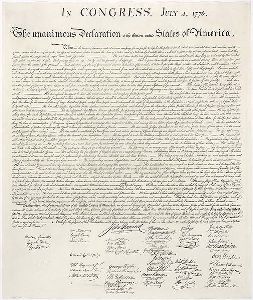
We Hold These Truths to be Self Evident

IN CONGRESS, July 4, 1776.

The unanimous Declaration of the thirteen united States of America,

When in the Course of human events, it becomes necessary for one people to dissolve the political bands which have connected them with another, and to assume among the powers of the earth, the separate and equal station to which the Laws of Nature and of Nature’s God entitle them, a decent respect to the opinions of mankind requires that they should declare the causes which impel them to the separation.

We hold these truths to be self-evident, that all men are created equal, that they are endowed by their Creator with certain unalienable Rights, that among these are Life, Liberty and the pursuit of Happiness.–That to secure these rights, Governments are instituted among Men, deriving their just powers from the consent of the governed, –That whenever any Form of Government becomes destructive of these ends, it is the Right of the People to alter or to abolish it, and to institute new Government, laying its foundation on such principles and organizing its powers in such form, as to them shall seem most likely to effect their Safety and Happiness. Prudence, indeed, will dictate that Governments long established should not be changed for light and transient causes; and accordingly all experience hath shewn, that mankind are more disposed to suffer, while evils are sufferable, than to right themselves by abolishing the forms to which they are accustomed. But when a long train of abuses and usurpations, pursuing invariably the same Object evinces a design to reduce them under absolute Despotism, it is their right, it is their duty, to throw off such Government, and to provide new Guards for their future security.–Such has been the patient sufferance of these Colonies; and such is now the necessity which constrains them to alter their former Systems of Government. The history of the present King of Great Britain is a history of repeated injuries and usurpations, all having in direct object the establishment of an absolute Tyranny over these States. To prove this, let Facts be submitted to a candid world.

He has refused his Assent to Laws, the most wholesome and necessary for the public good.
He has forbidden his Governors to pass Laws of immediate and pressing importance, unless suspended in their operation till his Assent should be obtained; and when so suspended, he has utterly neglected to attend to them.
He has refused to pass other Laws for the accommodation of large districts of people, unless those people would relinquish the right of Representation in the Legislature, a right inestimable to them and formidable to tyrants only.
He has called together legislative bodies at places unusual, uncomfortable, and distant from the depository of their public Records, for the sole purpose of fatiguing them into compliance with his measures.
He has dissolved Representative Houses repeatedly, for opposing with manly firmness his invasions on the rights of the people.
He has refused for a long time, after such dissolutions, to cause others to be elected; whereby the Legislative powers, incapable of Annihilation, have returned to the People at large for their exercise; the State remaining in the mean time exposed to all the dangers of invasion from without, and convulsions within.
He has endeavoured to prevent the population of these States; for that purpose obstructing the Laws for Naturalization of Foreigners; refusing to pass others to encourage their migrations hither, and raising the conditions of new Appropriations of Lands.
He has obstructed the Administration of Justice, by refusing his Assent to Laws for establishing Judiciary powers.
He has made Judges dependent on his Will alone, for the tenure of their offices, and the amount and payment of their salaries.
He has erected a multitude of New Offices, and sent hither swarms of Officers to harrass our people, and eat out their substance.
He has kept among us, in times of peace, Standing Armies without the Consent of our legislatures.
He has affected to render the Military independent of and superior to the Civil power.
He has combined with others to subject us to a jurisdiction foreign to our constitution, and unacknowledged by our laws; giving his Assent to their Acts of pretended Legislation:
For Quartering large bodies of armed troops among us:
For protecting them, by a mock Trial, from punishment for any Murders which they should commit on the Inhabitants of these States:
For cutting off our Trade with all parts of the world:
For imposing Taxes on us without our Consent:
For depriving us in many cases, of the benefits of Trial by Jury:
For transporting us beyond Seas to be tried for pretended offences
For abolishing the free System of English Laws in a neighbouring Province, establishing therein an Arbitrary government, and enlarging its Boundaries so as to render it at once an example and fit instrument for introducing the same absolute rule into these Colonies:
For taking away our Charters, abolishing our most valuable Laws, and altering fundamentally the Forms of our Governments:
For suspending our own Legislatures, and declaring themselves invested with power to legislate for us in all cases whatsoever.
He has abdicated Government here, by declaring us out of his Protection and waging War against us.
He has plundered our seas, ravaged our Coasts, burnt our towns, and destroyed the lives of our people.
He is at this time transporting large Armies of foreign Mercenaries to compleat the works of death, desolation and tyranny, already begun with circumstances of Cruelty & perfidy scarcely paralleled in the most barbarous ages, and totally unworthy the Head of a civilized nation.
He has constrained our fellow Citizens taken Captive on the high Seas to bear Arms against their Country, to become the executioners of their friends and Brethren, or to fall themselves by their Hands.
He has excited domestic insurrections amongst us, and has endeavoured to bring on the inhabitants of our frontiers, the merciless Indian Savages, whose known rule of warfare, is an undistinguished destruction of all ages, sexes and conditions.

In every stage of these Oppressions We have Petitioned for Redress in the most humble terms: Our repeated Petitions have been answered only by repeated injury. A Prince whose character is thus marked by every act which may define a Tyrant, is unfit to be the ruler of a free people.

Nor have We been wanting in attentions to our Brittish brethren. We have warned them from time to time of attempts by their legislature to extend an unwarrantable jurisdiction over us. We have reminded them of the circumstances of our emigration and settlement here. We have appealed to their native justice and magnanimity, and we have conjured them by the ties of our common kindred to disavow these usurpations, which, would inevitably interrupt our connections and correspondence. They too have been deaf to the voice of justice and of consanguinity. We must, therefore, acquiesce in the necessity, which denounces our Separation, and hold them, as we hold the rest of mankind, Enemies in War, in Peace Friends.

We, therefore, the Representatives of the united States of America, in General Congress, Assembled, appealing to the Supreme Judge of the world for the rectitude of our intentions, do, in the Name, and by Authority of the good People of these Colonies, solemnly publish and declare, That these United Colonies are, and of Right ought to be Free and Independent States; that they are Absolved from all Allegiance to the British Crown, and that all political connection between them and the State of Great Britain, is and ought to be totally dissolved; and that as Free and Independent States, they have full Power to levy War, conclude Peace, contract Alliances, establish Commerce, and to do all other Acts and Things which Independent States may of right do. And for the support of this Declaration, with a firm reliance on the protection of divine Providence, we mutually pledge to each other our Lives, our Fortunes and our sacred Honor.

Button Gwinnett
Lyman Hall
George Walton

William Hooper
Joseph Hewes
John Penn

Edward Rutledge
Thomas Heyward, Jr.
Thomas Lynch, Jr.
Arthur Middleton

John Hancock
Samuel Chase
William Paca
Thomas Stone
Charles Carroll of Carrollton
George Wythe
Richard Henry Lee
Thomas Jefferson
Benjamin Harrison
Thomas Nelson, Jr.
Francis Lightfoot Lee
Carter Braxton

Robert Morris
Benjamin Rush
Benjamin Franklin
John Morton
George Clymer
James Smith
George Taylor
James Wilson
George Ross

Caesar Rodney
George Read
Thomas McKean

William Floyd
Philip Livingston
Francis Lewis
Lewis Morris

Richard Stockton
John Witherspoon
Francis Hopkinson
John Hart
Abraham Clark

Josiah Bartlett
William Whipple

Samuel Adams
John Adams
Robert Treat Paine
Elbridge Gerry

Stephen Hopkins
William Ellery
Roger Sherman
Samuel Huntington
William Williams
Oliver Wolcott

Matthew Thornton

Never forget!

Petticoats & Pistols