Pow-wow’s

horseheader11.jpeGood Morning!

In July, my huband and I spent three weeks on the Blackfeet reservation. We were there with church volunteers and my friend, Patricia, where we were sponsoring some literacy and drug education programs. Plus, last week we were on the Crow reservation where we were again working with volunteers. Therefore, I thought you might like to hear something about the pow-wow, both the historical pow-wow and modern-day event.

The pow-wow — so much a part of the Western landscape and culture — attracts visitors from all over the world.

What are they all about?

endtour1.jpeOkay, let’s start first with the history of the modern pow-wow. Probably the early beginnings of the modern pow-wow has its roots in the summer/autumn gathering of the tribe. During the winter and spring months, the tribe would separate in their different bands to go their own way, to hunt and to prepare for the coming winter. Spring was of course devoted to gathering food and hunting. But in the late summer or early autumn the entire tribe would come together for ceremonials and religious renewal, as well as for cultural activities. It was a chance for young people to get to know other young people from other bands of the tribe, as well as for relatives and old friends to come together again. Often the Sundance was an part of the gathering, as well.

Today, at the modern pow-wow, you’ll see Indian and non-Indian people from all over the country enjoying the community and inspiring atmosphere of the pow-wow. Before we go any furhter, let me explain some terminology: there are some tribes (like the Navajo), who like to be referred to as Native Americans. But on the Northern Plains of North American, those tribes like the Blackfeet and Lakota, these people prefer to be called Indian. As one person put it to me, “I’m Indian and proud of it.”

Here in Los Angeles we have such a diverse and large American Indian population that if you were to ever attend one of our pow-wows, you’ll notice traditions being observed from all over the country. For instance, here in Los Angeles we have Aztec dancers, something one doesn’t see in the more northern pow-wows.

In the northern pow-wow, you’ll see the men’s Chicken Dance, something you won’t see normally in the Los Angeles Pow-wow.

powwowend21.jpeThere is much dancing and gift giving at the modern pow-wow. All ages participate and there is contesting within the different men’s and women’s forms of dancing. There are several different styles of men’s dances as well as women’s dances, as well. At many of the pow-wows in the west, you’ll also see the modern rodeo in action with some different aspects like the Indian relay race and the tepee raising contests.

There are food ventors — Indian fry bread is popular at all pow-wow’s that I’ve attended — and Native American jewelry of all kinds abounds. At the Blackfeet pow-wow there is the hand game and card games that continue well into the wee hours of the morning and at the Crow Fair pow-wow, one is treated to the sight of 500 or more tepees all set in the background of the beautiful Little Big Horn area.

Have you ever been to a pow-wow? If so, what are your observations? Are you thinking of attending a pow-wow? And if so, do you have questions you’d like to ask before attending? I will be checking into the blog all day long, so let’s start a discussion. I’d love to hear from you.

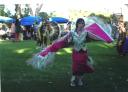
powwow1.jpeHere are three of us at an LA pow-wow, resting between dances. Patricia, on the left is a Traditional dancer, while Elaine and I are Fancy Dance dancers. As a note, each particular style of dance has its own regalia.

And for your info, all people are welcomed at the pow-wow, and many a romance has been sparked at pow-wow, both the historical, as well as the modern day pow-wow.

So come on in and leave a comment or two. See you later!

red_3-crop-email.jpg

The First Americans and the Mustang

horseheader1.jpeGood Afternoon bloggers!

 I want to thank Maria Lokken and Tanya Hansen for joining in our discussion this morning, as well as fellow author, Cheryl St. John.  Also a big vote of thanks go to Linda B and Jennifer Y for their comments from yesterday’s blog, as well as Elizabeth Lane — another fellow author.

Well, here I am, getting ready to mail off the revisions for my next book (due out in March 2008), THE LAST WARRIOR.  But before I go, I thought we might discuss the mustang and its importance to Native America.

As you know, before the Spanish arrived with their horses, the Spanish Barb, Native America didn’t have horses.  Instead, the American Indians made use of the dog.  It was the dog that transported their goods from one place to another, sometimes even transporting a baby.  Is it any wonder that some tribes honor the dog to this very day?picturesforblog.jpg

As Helen Addison Howard says in her book, AMERICAN FRONTIER TALES,   “(the mustang) completely changed the Indians’ nomadic life-style in hunting and war, in moving camp, in recreation, in trade, raised the owner’s social position, became a status symbol of wealth, and engendered a new standard of well-being.”

Because of its short stature, the mustang was often called a pony.  But that stature was deceiving.  The mustang was an intelligent animal with a stamina that became legend.  It was a mustang who won the 3,000 mile endurance test held in Arabia against the finest Arab horses in the land.  That pony, Hidalgo, was the 800 pound, 8 year old that won that race, even though the race was done was over loose sand, and  in a land where there was very little water.

Did you know that the movie, Hidalgo, was based on a true story?

Well, that’s all for now.  Again, I welcome all your insights into this and any other animal that’s in your life.

Those wonderful mustangs

horseheader1.jpeGood morning once again, bloggers!

Karen Kay here again.  I want to thank Denna and Stacey Kayne for writing their comments and for sharing their stories with us this morning.  Also I’d like to thank fellow authors Charlene and Linda Broday for sharing their comments with us this morning.

Okay, so the excerise is done — it was weights for me this morning — and as I sit here eating breakfast, I thought we’d talk some more about the hearty mustangs who so captured the heart of the West.

 Of course we owe our thanks for these intelligent animals to the Spanish — the word mustang comes from the Spanish word mesteno, meaning wild.  From Columbus to Hernando Cortez, every Spanish explorer or adventurer brought these animals to the New World. 

It was Hernando Cortez who brought them to us in 1519 –he had only sixteen horses, but of them Bernal Diaz (who was with Cortez) writes: “For after God, we owed the victory to the horses.”

But where did the Spanish get these hardy friends to man?

 Professor Walker D. Wyman writes:  (the Oriental horse) is known to have come into Mesopotamia from Persia about 2500 B.C., to Egypt from there in about 1700 B.C. and thence it spread over North Africa.”

Known in Africia as the Barbs — meaning that they were from the Barbary Coast — these breeds mixed with the Arab breed when the Arabs conquered areas of Africa — this was in about 647 A.D.

It was around 711 A.D. that the Moors — who were descendants of the Moroccans and Moslem Arabs — came to Spain, and for almost 800 years, the Moors held Spain hostage.  Now, when these Moors came to Spain, what were they riding?

You guessed it — the Barb-Arab mixed breed horse.

Okay, enough of ancient history.  In my next post, let’s bring the subject closer to present time and discuss how the horse influenced Native America.

red_3-crop-email.jpg  Hope to hear your comments on this and other things of interest, so please feel free to leave some comments, okay.  To the left, by the way, is the art work for my latest novel, RED HAWK’S WOMAN, a June release of this year.

Isn’t he gorgeous?  And does anyone know the name of this sexy young man?

Till later, then.

Petticoats & Pistols