Ghost Town Impressions … Bannack, by Deb Schneider


a-debPeople often joke with me about selling my book’s film rights, and if they aren’t making a joke – I turn it into one. Film deals are few and far between for writers, unless your last name is Brown, Grisham or King.  But then I add, “I don’t really need to see the movie, because I’ve already watched it,” and I tap the side of my head. Because, as I’m writing, that’s what it feels like. The characters talking to each other in dialogue, the setting and I confess, I’ve even put a certain piece of music on while writing because it evokes the mood.

So, with imaginary characters and a made-up place, I always thought it was the best I could do.

But – I was wrong.


On a recent trip to Yellowstone and Grand Teton National Parks, I stopped at the Visitor’s Center in Jackson and asked the nice gentleman at the counter if he could recommend any ghost towns in the area. He pulled out his map, consulted with his wife and pointed to a place not far off the main road we’d be taking back to Seattle.


“Bannack” he whispered, nodding. “It’s like the folks just picked up and walked off. They keep it as natural as possible.”


So, on the final leg of our journey, we headed out of Wyoming, through Idaho and into Montana. Following the signs for the State park, we finally arrived at the ghost town around noon.


I stood on the main street, with the Meade Hotel to my right, and realized I was standing in my imaginary town of Willow Creek, Montana. It was all a-deb-2there, the mining, the creek, the rather grand brick hotel. I could almost see my heroine, the Widow Wainwright, sweeping into the hotel in her black crepe mourning clothes. The hero’s sawmill would be down at the edge of town, and peeking into the windows of Bannack, I could easily imagine the various characters in my book coming to life.


My husband and I both had cameras, and we happily clicked away. I knew I’d have the perfect shots for my “book trailer” so my interest was part historical time traveler and part mercenary opportunist. I don’t think it really matters to the town.


Bannack had the first brick courthouse in Montana, and served as the chambers for the First Territorial Legislature. The first Governor of Montana lived in a house that was little more than a shack, (forget about a mansion) and it’s clear that mining gold took precedence over architecture as the town grew. There’s the tale of the sheriff who was really the head of an outlaw gang, stories of “hurdy-gurdy” joints and soiled doves along with the respectable folks creating a Methodist church, building a Masonic Lodge and organizing school.


There are enough images and snippets of information in the guide book to fuel story ideas for many years to come.


I think what makes Bannack so intriguing though, is that it grew from just 400 people to over 3,000 in just a few months when gold was discovered in a-deb-1Grasshopper Creek. And like so many towns in the West, when the gold played out, the people of  town eventually moved away. But the town didn’t disappear.


The fact that the State of Montana was wise enough to preserve this jewel is noteworthy. There are other more popular “ghost towns” scattered around Montana, and I’ve visited a few. The number of buildings preserved in such wonderful condition makes Bannack a stand-out place for me.


Have you ever visited a ghost town? What was that experience like for you?


Deborah Schneider, RWA Librarian of the Year 2009

Promise Me – January 2010

www.debschneider.com


TEXAS STAR OF DESTINY by Lyn Cote

a-pic-4I’ve blogged before about the various settlers in Texas: the Anglos, the Native tribes and the Tejanos, Texans of Mexican or Spanish descent. Today I want to share a scene from my book Her Abundant Joy, which will be released early in 2010. The Tejano Wedding from Her Abundant Joy, third book in my Texas Star of Destiny series, Three Generations, Three Historic Texas Events, 1821-1847.

 a-pic-1

  Excerpt

“The women led Sugar (the bride) out of the house toward the white canopy where the ceremony would be held. Mariel hung back toward the rear of the procession. The priest from a nearby mission church had come and would give his blessing to the couple in this unorthodox open-air ceremony. Since there were still few Anglo churches in Texas, the families felt fortunate to have a man of God present.

To Mariel’s surprise, the two fathers would actually be the ones performing the wedding. Mrs. Quinn had said that this sort of “family” wedding was common on the frontier. Often so far from any town or any church, a wedding consisted of a man and woman declaring that they were husband and wife and writing of their union in a family Bible.

Such a contrast to the formality of marriages and church records in Germany. …

Everyone waited under the canopy, leaving an aisle open for the bride’s procession. Leading it was Erin as flower girl and young Carlos Falconer as the page at her side. Then came the damas or bridesmaids and the chamblanes or other groomsmen all in their wedding finery. At the front of the canopy waited a beaming Emilio with Scully Falconer as padrino and Carson as best man—both in black suits–at his side. …

Finally Sugar on her father’s arm reached Emilio (the groom) who wore a more Spanish-looking suit of brown. The madrino put something in Emilio’s hand that clinked.

In the back of the gathering standing beside Mariel was the man called Ash with his wife Reva who were as close as family to the Quinns.

a-picAsh leaned close to Mariel and murmured, “Emilio will give Sugar those thirteen gold reals later in the ceremony. The coins symbolize that he is trusting her with all his worldly goods.” Mariel nodded and smiled.

The priest began speaking in Latin, often making the sign of the cross and obviously praying for the couple. Then he stepped away, joining the wedding guests. The madrina placed one chain of flowers around both the bride’s and the groom’s necks.

Ash leaned over again. “This is el lazo, which symbolizes the love that has joined these two. They will wear it throughout the ceremony and then Sugar will wear it the rest of the day.”

…Mr. Quinn read out the marriage vows from a small black Book of Common Prayer and the bride and groom exchanged rings. Then Mr. Quinn said, “Emilio, you may kiss your bride.”

Spontaneous applause broke out. Mariel thought it very strange. No one had applauded at her wedding, least of all her. This seemed appropriate here. She joined in. Then after the formal kiss, she watched Emilio give Sugar the thirteen gold coins which Sugar placed in a box that she handed to her brother. Then the newly married couple turned to face the guests.

Mr. Quinn said, “These two have become one for life. Please greet Mr. and Mrs. Emilio Ramirez.” He repeated this in Spanish and there were shouts of joy and more applauding.

 Well, I hope that this gives you some idea of a Tejano wedding in 1846. I found the symbolism—el lazo, the 13 golden coins–especially touching. a-pic-2I have added an image of the traditional wedding cookies that would have been also served. What caught your interest?


STEPHEN BLY: WHY SHE LIKES READIN’ A GOOD OLE WESTERN

Steven Bly“Perhaps more than any other genre, westerns require adherence to some fairly strict guidelines. Writing in this genre requires knowledge of its expectations,” says R. L. Coffield in her article, “Sexuality and Cursing in the Western.”

This applies especially to classic westerns.


          Most classic western fans presume a certain code. No explicit scenes. Swearing minimal or nonexistent. But there can be lots of romance amidst the shootin’ and dyin’. Character development is a must. (Or setting development, such as in a classic Zane Grey.) Good Creede of Old Montana by Steven Blytriumphs over evil. That’s why classic westerns attract lots of female readers.

          In my newest western Creede of Old Montana (to be released October 2009), protagonist Avery John Creede rides into Ft. Benton, Montana, looking for old army pals. Instead, he stumbles into a running gun fight with a notorious outlaw and two women determined to distract him, each for their own reasons. Creede seems at first to either be very naïve with the ladies, or one smooth cowboy. Whichever, the results prove to be the same.

There’s lots of the usual head banging in the book, and it’s not all done by the males.

time-mag-cover-cowboy-heroes1“With the quickness and velocity of a mother killing a snake with a hoe, Sunny slammed the barrel of the revolver into the back of the outlaw’s head. He crumpled to the sand.”

In one chapter I put Avery John Creede on the trail with this same Sunny (a.k.a. Mary Jane Cutler), and male/female sparks happen…some humorous, some “Aha!” But I do keep a close eye on them. Trust me.

A note about this scene, that also has to do with genre expectations: On the trail ride, even though Sunny’s a tough gal in lots of ways, she rides sidesaddle. That’s not just because she’s wearing a dress. It was thought to be scandalous beyond civilized reason for females to straddle a horse in the 1800s. And much later into the 1900s. She has no intention of breaking that sanction. And I, as the author, try very hard to stick with historical cultural facts. That’s one reason the movie, Shane, rankles me. In an otherwise excellent western, why in the world did the wardrobe people clothe Jean Arthur in pants? U.S. women, even ranch gals, didn’t start wearing slacks of any sort until WWII with the advent of Rosie the Riveter and the influence of the working gal.

That’s what it’s all about for the reader…knowing what to expect when they pick up another title by an author they’ve come to know and enjoy. I try to stay with the expectations…if I don’t, I hear about it…whether I’ve crossed a line in this reader’s mind in language choice, a suggestive taboo, or getting the details right. 
Leave a comment to get your name in the drawing for a copy of Stephen’s book Creede of Old Montana. 

On the trail,

          Steve

           http://www.BlyBooks.com

Kathleen Y’Barbo~Dick Dowling: How an Irish Saloon Owner Saved Texas from the Yankees

kathleen2 

I love a good historical, and any story with an unlikely hero is bound to find its way onto my keeper shelf. When I discovered Gone With the Wind, I found both, as well as a love for Civil War era tales. Imagine my surprise when I found out one of the most surprising tales of the era took place almost within walking distance of where I was born in Jefferson County, Texas.

Picture it: Five thousand Union sailors in a flotilla of seventeen vessels against 44 Confederate artillerymen at the command of an Irish saloon owner. Sounds like the making of a sound defeat or a Hollywood action movie, doesn’t it?

In truth, it is the story of a band of soldiers called the Davis Guards, or Company F of the First Texas Heavy Artillery Regiment stationed at tiny Fort Griffin on the mouth of the Sabine River. Their stunning victory is one that Confederate President Jefferson Davis called “one of the most significant military victories in world history.”

dickdowling1Richard “Dick” Dowling started life in County Galway, Ireland. After immigrating to New Orleans then losing his family to yellow fever, Dowling settled in Houston in the mid-1850s, where he established a chain of saloons. The most successful of these, the Bank of Bacchus, was situated on Courthouse Square in downtown Houston and was, according to several sources, the first business in the city to boast gas lighting.

At the outset of the war, Dowling enlisted and eventually found himself assigned to the remote outpost of Fort Griffin (near the city of Sabine Pass, Texas). To pass the time – which moved quite slowly in the mosquito-ridden lowlands – Dowling drilled his men on artillery exercises. These lazy-day activities came in handy on September 8, 1863 when a flotilla of seventeen Union vessels appeared on the horizon. While the four-dozen men scrambled to their well-rehearsed positions, the brown waters where the Sabine River poured into the Gulf of Mexico filled with enemy ships. The first two crafts were quickly disabled by the Davis Guard sharpshooters, blocking the channel and effectively keeping the other fifteen ships out of the river.

At the end of the battle, 350 prisoners had been taken and the enemy had retreated leaving significant amount of supplies, weapons and ammunition behind. Lt. Dowling and his men were heroes, hailed by President Davis and commemorated with medals melted down from Mexican silver.

Interesting fact: two streets in downtown Houston are named for Dowling. The first is obviously Dowling Street. The second is Tuam, named for the city of his birth. And ironically, the Yankees couldn’t best him but the yellow fever that took his family back in New Orleans did. Dowling died in 1867 of the disease, just a few scant years after his stunning victory. Not the ending I would have written, but still quite a story!

So, what sort of history can you find within walking distance of your birthplace?

~~~~~~~~~~~~~~~~~~~~~~~

Leave a comment to get your name in the drawing for a copy of The Confidential Life of Eugenia Cooper.

 Kathleen’s Website


Pamela Nowak ~ Choices

pam-nowak-picI want to thank Petticoats and Pistols for inviting me and giving me the opportunity to share with all of you. This is a favorite site of mine and blogging with you here is beyond exciting!

This week, my second novel, Choices, was released. Set at Fort Randall, Dakota Territory in 1876, it tells the story of a rebellious officer’s daughter, an honorable enlisted man, and a forbidden relationship.  

Twenty odd years ago, when my late husband, Tim, and I were first married, we shared an avid interest in living history. He was an archaeologist, I was a history teacher, and we were both passionate about the Amephoto-4rican West. He created the persona of a soldier-a private-and I was a governess. Both of us spent scores of hours researching the period:  the army, etiquette and social rules, nineteenth century dress; and how our characters fit within it. At the same time, Tim was also the project manager of the Fort Randall Archaeological Project. We lived and breathed Fort Randall for over two years. 

Choices flowed out of that. The facts were swimming around in my head, mingling constantly into different storylines (that happens a lot with facts in my head). They begged for characters to play them out and for the words to be written down. 

The nineteenth cfort_randall_military_postentury army had rigid sets of rules for being a soldier and complex social codes for how officers, enlisted men, and their women were permitted (or not permitted) to interact. I was amazed at how stratified society was at these western outposts and at how thoroughly officer’s wives observed those social norms. Memoirs, scholarly studies, and the notations left by army personnel all speak to the separation of classes—as defined by rank. 
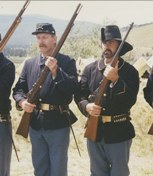
But even more amazing were the exceptions. Though officers’ wives were socially superior to enlisted men’s wives, they were not officially recognized by the army. In fact, they were considered camp followers, in the same category as prostitutes who might do business just off the military reservation (their places of business were nicknamed “hog ranches”) and were allowed only at the sufferance of the commanding officer. Laundresses, who were often wives of enlisted men, were offic17-in-general-miles-marching-and-chowder-society-reenactmential civilian contractors with corresponding army regulations detailing their rights to be there.  

On most posts, lifestyles of the enlisted and officer classes were narrowly defined and very separate. A few diaries and memoirs offer glimpses into occasional relaxation of those barriers, most often for an all-post holiday celebration or when there was an unusual crisis. 

I wanted to share all this but also to present a story about choices, about how we all choose who we are going to be in terms of choices-coverrelationships with others. Miriam, my heroine, confronts rules and regulations head-on and resists them every step of the way while she seeks ways to cross the lines. I introduced her rigid and domineering mother, Harriet, to bring pressure on her to toe the line and to personify the exclusionary nature of society. Lt. Wood is representative of expectations. Mixed in is the culture of the army, Harriet’s addiction to laudanum, Jake’s honor, the laundress’s common-sense outlook on life, and Major Longstreet’s predicament of his own making. 

I hope you will find the story and fun to read as I found it to write and that my characters reveal the subtleties involved in the choices that face us all. 

I’ve enjoyed our time together. Please visit me on my website at www.pamelanowak.com.

To celebrate the release of Choices, Pam will be giving a copy to one of today’s blog participants. 

Kathryn Albright ~ Texas Wedding for Their Baby’s Sake

albright-pic

Thanks for having me here, Fillies.  I appreciate the chance to talk a little about my new release — Texas Wedding for their Baby’s Sake.  It is a continuation of The Rebel and the Lady, but also a book that can stand alone if you haven’t read the first one.  Here’s a short blurb:


Caroline Benét enjoyed one night in her fiancé’s arms before he left to fight in the Texas territory. The day news reaches her of the Alamo slaughter is the day she learns she is carrying his child.

He may have survived, but Brandon Dumont can’t return to the life he once knew or the woman he once loved—not as a cripple and a man battling his own personal demons.

When Caroline shows up in Texas, Brandon is determined to send her packing.But Caroline wants more than Brandon’s name for their baby—she wants his heart. Look like it will take a love as big as Texas to win him back.


Yes, I love writing the tortured, conflicted hero and Brandon, with his idealistic worldview ripped from him by the ugliness of battle, had a lot of hurdles to overcome. A person cannot be “cured” of post traumatic stress disorder (PTSD) but there is hope that he/she can learn to live with it, depending on its severity.  A good, strong woman who won’t give up, can certainly help.  And Caroline needed Brandon as much as he needed her.  My heart just ached for these two as they struggled to find their place in the vast Texas territory.

This is my first attempt at writing a series book and I approached the task with some trepidation.  But I found out that I atexas-wedding-coverbsolutely loved writing this way! After a few false starts, the story unfolded before me. The best thing about this type of storyline is that I already knew my characters, knew what made them tick, what their fears, hopes and dreams were. And I cared about each and every one of them—strongly—and wanted them to have their dreams.   

I think the first book I ever read that might have been considered a “series” was Louisa May Alcott’s Little Women—then on to Little Men and Jo’s Boys.  Over the years I’ve read many of Nora Robert’s series book and more recently, Stacey Kaynes’ Wild series.  Do any of you have a favorite series you would recommend? Western romance or otherwise?

Two lucky commenters will win an autographed copy of my new release, Texas Wedding for their Baby’s Sake!


www.kathrynalbright.com

Linda Ford and her Men in Uniform!

whoopuptrailmountieThere’s nothing quite like a man in uniform. And in my opinion, there is no uniform quite like that of the Canadian Mountie. Their official motto is Maintiens le droit… Uphold the right but most of us believe the unofficial one—the Mountie always gets his man.

It all began with the Whoop-Up Trail that ran north from Fort Benton, Montana, to near Lethbridge, Alberta, along which goods and people travelled back and forth.  Among the travelers were buffalo hunters, wolfers, gold hunters, natives and even early settlers.

Through a Royal Charter signed in 1670 the Hudson Bay Company had an exclusive trading monopoly over the area of western Canada that drained into the Hudson Bay. That included all of present day Alberta except for a small section south of the Milk River that drained into the Missouri River and eventually the Gulf of Mexico. The Hudson Bay Company (HBC) banned trade in alcohol and had the power to enforce the ban. But the Northwest Trading Company encroached upon the HBC territory and had no conscience against trading furs for a little fire water. Then in 1870, the HBC surrendered most of its lands to the British Crown, and the lands subsequently transferred to the Dominion of Canada. The land was wild and lawless.

By 1873, alcohol had become the principal trade commodity. This perhaps led to an event known as the Cypress Hills Massacre.

A party of wolf hunters was returning through the Cypress Hills to Fort Benton when their horses were stolen. The wolf hunters accused the Assiniboine Indians of stealing them (though it was never proven). Whiskey flowed freely that night and early in the morning the wolfers attacked the Assiniboine camp, leaving thirty dead and many wounded.

Order had to be restored to the area to make it safe for aboriginal people and settlers so Canadian prime minister, Sir John A. Macdonald, called for the formation of a military-style police force known as the North-West Mounted Police (later renamed the Royal Canadian Mounted Police—RCMP for short). Their primary responsibility was to protect the aboriginal people from the atrocities of the white man. Eventually they became everything from judge to jury to teacher to referee.

July 1874 saw the first detachment of red-coated young men set off on an epic journey across what would become Western Canada. There were 275 policemen, 339 horses, 142 oxen, 114 Red River carts, 73 wagons and two cannons weighing a ton each. They crossed mile after mile with no roads, no bridges and few supplies. After traveling 14 days they reached the Roche Percee on the Souris River. Their supplies were depleted, the horses exhausted and many men sick. The NWMP Commissioner, George French, divided the group in two. The sickest and weakest were sent along the easier 800 mile route to Edmonton, Alberta. The rest took the shorter but more difficult 550 mile route toward the foothills of the Rockies where they established a base at Fort Macleod. It all sounds romantic but the accommodations were primitive and trying. I’ve visited a number of restored sites and am awed at the conditions they endured.

barracks2

barracks

The Mounties, also known as the Red Coats, wore the red uniforms both to emphasize the British nature of the force and to differentiate it from the blue American military uniforms. On the march they wore pillbox hats which did little to protect them from the sun. 


original-uniform

Thankfully they exchanged the pill box for a Stetson. Today they only wear the red for special occasions like marching in a parade. I have a picture of them marching down one of our streets.

marchingmounties

American Whiskey Traders from Fort Benton, Montana, had established a fortified trading post near what is now Lethbridge Alberta some years earlier. The post, called Fort Whoop-up, traded with the people of the First Nations for hides in exchange for guns and bad whisky. The fort was well armed and even had a cannon. However, when the traders heard the Mounties were coming, they abandoned the fort thus allowing the Mounties to take the fort without a shot fired.

In the months that followed, the whiskey trade was smashed and lawlessness sharply declined. By 1875, the police had erected additional posts at Fort Saskatchewan, Fort Calgary and Fort Walsh. Law and order was firmly established.

The Mountie is a colorful and interesting character who makes a noble hero in many books and films.

For sheer pageantry nothing compares to the musical ride that is still performed across the country.  (Photos of musical ride taken from the official RCMP site–www.rcmp-grc.gc.ca/mr-ce/photos-eng.htm)

wagon-chariot-wheel-roue


dome


Just in case you’re wondering, and I’m sure you are 🙂 I do intend to write about the heroic Northwest Mounted Police sometime dakota-childin the future. In the meantime, my book, Dakota Child, has a different kind of hero—Big Billy Black. Be sure to check out this September release.

I’ll be giving a copy away this weekend, and I’d love to hear from you!

To learn more about Linda and her books, visit her website:  www.lindaford.org

BJ Daniels’ FIVE–count ’em–FIVE winners!

I hope none of you have bear nightmares tonight! Or that it keeps you from going camping!

This was really fun. Thanks for having me. I enjoyed it.

I thought I would go ahead and announce the winners since it is getting late back on the east coast.

I drew names and they are:

Tracy

Quilt Lady

Mary Connealy

Tanya Hanson

Jeanne Sheats.

Just send me your snail mail addresses and I will be happy to send you a book! My email is bjdaniels@mtintouch.net

Again, thank Pam and everyone at Petticoats & Pistols. It is always fun,
BJ

B.J. DANIELS & THE BEARS OF YELLOWSTONE PARK

b_-j_-daniels-picThere is no place on earth like Yellowstone Park. A writer friend of mine is on her way to the Park this week and it got me thinking about the Yellowstone I knew as a kid.

I grew up in and around Yellowstone. That was back when feeding the bears was one of the attractions. We always carried crackers and a squeeze-bottle of honey and the bears would come up and wait patiently by your open car window while you honeyed up a cracker.

My father did the original rock work at Canyon Village. You know the huge fireplace that hangs down from the ceiling? He built that and did the rock work on that building so for a summer my family lived in the campground at Norris Junction.

I remember one day my visiting cousin Stevie from Texas and I were building a fort in the woods when I looked up and saw a black bear headed for us. Stevie took off for the campground at a dead run. We always laugh because he crossed a creek and didn’t even get his shoes wet.

I was raised around bears. Back then they seemed to be everywhere. We were taught not to be afraid of them since we were around them all the time. Not that we didn’t realize they were dangerous.

One day two mama grizzlies got into a fight right outside our trailer. They sent their cubs up a tree while they battled it out. It was some fight.

Living in Yellowstone and next door to it, we came away with our share of bear stories. While at Norris Campground, a young couple in a VW bug were putting up their tent and left their car doors open. They happened to have a bag of oranges in the back seat. A bear crawled in and begablack-bearn to eat the oranges.

Panicked, they ran down to the ranger station and demanded he get the bear out of their car. He laughed and told them the bear would leave once he was through with the oranges.

And the bear did. Right after that, the couple threw their tent into the back of the VW and were out of there.

My father hired two young hodcarriers while working in the Park. One night they went into Gardiner, had a few drinks and on the way back saw a lone black bear cub beside the road. They’d had just enough to drink that they thought picking up the cub was a good idea. They grabbed the bear and threw it in the back seat.

They didn’t get a half mile up the road before they came flying out of the car. That cub tore the inside of their car to shreds before taking off into the woods.

One of the bricklayers who worked for my father was feeding the bears crackers and honey with his family when his kids got in a disagreement in the back.

He turned around to holler at them. The bear waiting beside his car grew impatient and reached in, grabbed his head and turned him around again. He had scratches from the bear’s claws but no serious injuries.

Bear stories were always the highlight of the campfire chats in the Park in those days. That was back when the campfire chats really were around campfires and we sat on logs and sang songs. My mother always wanted to sing The Yellow Rose of Texas, since that’s where we were from, Texas.

The rangers wogrizzlyuld tell stories about tourists wanting them to wrestle a bear so they could get a picture. Or about the woman who put her baby into a bear’s arms when it stood on its hind legs. She snapped her photo, then retrieved her baby.

While we knew the bears were wild and could be dangerous, they were so common place, sometimes even we forgot just what they were capable of.

I once saw a bear reach into the back of an old station wagon, the kind with the rear window that went down, and take out a box of groceries. It was during a bear jam. The bear sat down in the middle of the road and proceeded to open the can goods. I’ll never forget the way the bear could tear open a can with its claws.

What was scary was that there was a baby sleeping in the back of the station wagon next to the box of groceries. The bear could have just as easily taken the baby.

I still love seeing bears. For years we frequented the dumps at both Gardiner and later West Yellowstone to watch the bears. First the black bears would show up. Then about two in the morning, the black bears would take off and the grizzlies would take over.

During my teens, I lived just outside of West Yellowstone on Hebgen Lake. Where do you think everyone went to park and makeout? You guessed it. The city dump.

At our place on the lake we often had grizzlies in the yard. I remember one night walking home from a neighbor’s house on the point across the bay. I heard something behind my little brother and me and turned to see a grizzly bear following us.

We had been taught to just ignore them – and most definitely not run. The grizzly followed us all the way home.

Years later a grizzly pulled a camper from his tent in that same area and ate him. That campground now requires everyone to stay in hard-sided campers.

Few people see bears when they go to Yellowstone Park now. My daughter saw her first bear on a trip to Canada even though she’d been born and raised around Yellowstone.

I know it’s better for the bears to have less contact with us. But I miss seeing them and I’m glad I grew up in that wilder time.

A friend of mine jokes that the romance in my books isn’t about the hero and heroine but about my love for the part of the west where I have lived and still live.

It’s true. I write about what I love. My latest series, Whitehorse, Montana, is set in country that is still wild and remote and a little dangerous. I like that. J

The Whitehorse series continues Sept. 9 with Smokin’s Six-Shooter and Oct. 11 with One Hot Forty-Five.

Look for more Whitehorse books when the new mini series Whitehorse: The Winchesters begins next April with 6 more Harlequin Intrigue mysteries.

My thanks to Petticoats & Pistols for having me back!

B.J. Daniels

www.bjdaniels.com

smokin-six-shooter-cover1


one-hot-forty-five-cover1


B.J. is giving away FIVE books! All you have to do is leave a comment and you’re entered in the drawing. Don’t miss this opportunity to win a really great Romantic Suspense.

Carol Ann Didier ~ NAVAJO NIGHT

carol ann didierHi fillies,

I am so pleased and honored to be able to blog with you regarding my second Native American historical romance due out today, NAVAJO NIGHT.  And, it seems congratulations are in order, too, for your second birthday P&P. Hooray!

While I was researching the Dinéh, The People, I discovered a not-so-well known fact concerning one of the darkest periods in their history—something they called, “The Long Walk,” hence the title, NAVAJO NIGHT. It was very similar to the tragic “Trail of Tears” made by the Cherokee when President Jackson forced them to leave the Carolinas and Georgia and marched them to the then Oklahoma/Indian Territory. When I read about it, I knew I wanted to include that in my story as well as the taboo love between a Navajo holy man and a Virginia preacher’s daughter.

In 1860, because of complaints about Navajo raids on white mining camps and ranches in New Mexico, Colonel Christopher “Kit” Carson (of Wild West fame) was commissioned by General James Henry Carleton to round up 7,000 Navajos and move them to a barren plain called the Bosque Redondo on the Pecos River in the southern part of the state. It was Carleton’s shortsighted belief that if the Navajo were instructed in the benefits of becoming more like the white man, they could be civilized, Christianized, and eventually fit into the white society.

Kit Carson, having made friends with the Navajos in earlier days, feared it would not be an easy task. Nor was it. He finally resorted to a “scorched earth” policy whereby the army burned their villages, destroyed their farm plots and peach orchards, killed tnavajo-rugheir livestock or took them, and literally drove The People like cattle south from the four corners area.

It was grueling march of over 400 miles. Many Navajo died from disease, lack of proper food and clothing, horrible weather conditions, as well as mistreatment by the army itself.

Once on the reserve, the ones who survived felt those who had not had the better end of it.

Into this struggle a man and a woman from two different worlds try to find a bridge between two life-ways to prove that love knows no color, creed, or race, but happens in the heart; and if allowed to grow, can conquer differences in culture, hatred, and personal loss. The question then became, could the Navajo holy man with a crippled heart heal the white woman with a crippled foot?

Notah Begay, Spirit Talker, wonders why the young woman and her father have ventured so deep into his people’s territory. They look harmless, but he needs to be sure, for trouble is coming to Dinétah, Navajoland, in the form of the United States Army in a desperate move to put all the Navajo on a reservation in southern New Mexico.

JoAnna Lund and her father are risking everything to settle safely out west and leave their tragic past behind. As a lone rider blocks their trail, they are prepared for trouble.

But from the moment JoAnna locks eyes with the tall, proud Navajo brave, she feels an irresistible attraction. Later, she is captivated by Notah’s devotion to his twins and his tribe. She feels though, that someone as perfect as he, will never look at someone as imperfect as she.

Notah is forever haunted by his failure to cure his young wife during a healing sing for her. He has sworn never to love that deeply again. With all his Holy Man training, he fights his growing desire for the gentle, spirited JoAnna. At least, until she is threatened, and then nothing—and no man—will prevent him from claiming the woman who has made him hers forever.


Carol Ann Didier’s APACHE WARRIOR (April 2008) was her debut novel for Kensington’s Zebra line. NAVAJO NIGHT, due out September 1, 2009, promises to be another romance filled with carefully researched historical facts and the culture and beliefs of the Navajo Indians.
Carol has been published in CHARISMA and LITERARY LIFT-OFF magazines, and also writes inspirational vignettes, verses for greeting cards, and stories for her grandchildren. She makes her home on the East Coast of Florida.

navajo-night-Didier

Carol is giving away a book, a bookmark, and an engraved pencil, to one lucky commenter.

www.carolanndidier.com