Have You Been Kissed Under The Mistletoe?

Janet-Tronstad This is Janet Tronstad and I’m very pleased to visit with you here in P & P. Before I mention my latest Christmas book, I just have to ask though.  Have any of you ever been kissed under one of those big kissing balls? The ones the Victorians used to make of mistletoe and hang up for their parties?

My latest novella is in a book entitled ‘Mistletoe Courtship’ and I realize I don’t even know anyone who has seen one of those kissing balls. I’m hoping that some of you have though. The mistletoe I usually see at Christmas is one of those small pressed-looking twigs that you buy in the plastic wrapper. I’m sure the Victorians would be appalled.  

From what I’ve read, they took their mistletoe seriously.  I didn’t realize that if you went un-kissed when you were standing under a kissing ball (male or female) it was supposed to mean you would never get married. Talk about pressure. I’m sure that was reason enough to line up. mistletoecourtship

In our culture, it seems to me that we save The Big Kiss for New Year’s Eve.  What’s your take on it?  Do you think mistletoe is still popular? Do any of you have any hanging in your house as we speak?  Do you plan to put some up this year?  And – for the big question – have you ever been trapped under some mistletoe with someone who wanted to kiss you and you’d rather not kiss them back? What’d you do?

I’ll be happy to send a copy of ‘Mistletoe Courtship’ to one of the people who post today so leave a comment if you can.

Character Traits of a Good Writer by Elle James

Hi, I’m Elle James and I’m a writer. Sounds like a confession to an obsession. Well, it is!

Writing is an obsession I’m glad I have. Many people I know are surprised and excited to learn I’ve become a writer. So often I get the comment, “I’ve always wanted to write.” But outside my writer friends, there are few that take the leap and become a writer. If you sat in a church with 500 people and asked how many have written a book, the chances are that number would be really low. To write a full manuscript and actually get it published makes the odds even greater.

opxoxocover160So what makes a good writer? Here are a few of the traits that make a good writer.

Loves to read – First and foremost a writer should love reading. If you’re not writing something you would want to read, then why bother? Most writers get their start because they love to read a good book. Many times a writer will be disgusted by the poor quality of what they are reading. They might even say “I could do better than that!” It’s up to the writer who loves to read a good book to create such a thing.

Passionate – A good writer is passionate about her chosen occupation. Passionate about the words she is writing and passionate about the finished product. The passion shows in the writing through the emotions of the characters and the emotional reaction the readers have to the characters the writer breathes to life on the pages. Without passion, the book will be flat, uninteresting and just plain dull. The writer’s passion reminds him why she chooses to write. Whether it’s to entertain others, for the self-satisfaction of knowing you created a book worthy of publishing or just because you love knowing that others “got the message” in your written words, passion is something everyone wants to feel, live and enjoy throughout their lives. What better place than in your writing?momsrosefinalcolors

Thick-skinned – A writer’s life may be lonely and sedentary, but by no means is it easy. Writing is NOT for sissies. A thick skin is a must to make it in the business of writing. Criticism is everywhere. From critique partners, to editors to the ultimate readers of your books. If you can’t handle the heat, don’t step into the line of fire. Most writers go through many iterations of critiques and edits before their books finally reach the reading public. A writer with a weak backbone would crumble. If you don’t already have one, grow a spine!

Observant – A good writer observes people and events around him/her, always searching for a germ of an idea to seed new stories. People watching is a fertile breeding ground for fresh crops of ideas. Reading and watching television or movies gets the wheels turning, keeps the ideas coming. From news reports to existing movies, books and television, a good writer can put a twist on a story or come up with a spin-off. By watching, reading and experiencing life with her eyes wide open, the writer can be guaranteed a bottomless well of fresh ideas.

Persistent – A good writer is persistent. Not only does the writer have to force herself to sit in a chair day after day, pounding away on a keyboard to get a full manuscript written, she has to sell her work. Rejection after rejection could douse the flame of some of the most passionate people. But not the writer. A writer keeps trying, keeps writing the next great novel. Throw a wet noodle against the wall enough times and eventually it’ll stick. It can take years to hone your skills and even more years for an editor to recognize your talent and buy your book. A good writer never gives up.

Makes criticism work for him – Writers are subject to loads of feedback on their work. The good writer sifts through the feedback and changes what needs to be changed and tosses the rest. The primary lesson a writer must learn is to be the best judge on when to accept the changes and when to stand up and say no. Some writers refuse to change a thing in their manuscript. An editor wants to know a writer is willing to consider changes. If they aren’t, they may not sell the book.

Writes a good story – Bottom line, the most important trait of a good writer is that she can tell a good story. A good story is always in the eye of the beholder. The good writer writes the book of his heart, a tale of characters overcoming obstacles to reach their goals. A good writer makes his reader cheer for the characters, makes the reader lose herself in the story to the point she can’t put the book down until the end. It’s all about the characters and their story. A good writers sucks them in and won’t let go.


elle-james-pic-3Best-Selling author and Golden Heart Winner Elle James made a new-year’s resolution in January of 2000 to become a published author. In 2004 she left a career as manager of computer programmers to pursue her writing goals. In 2005, her dream came true when Dorchester published her first novel, the 2004 Golden Heart Winner for Best Paranormal. She’s since sold 15 Romantic Suspenses to Harlequin Intrigue and 2 paranormals to Dorchester & Silhouette Nocturne.

Amnesia-Sleepwalking by Amber Stockton


Amber Stockton
Amber Stockton


If you picked up almost any novel in the early 1990’s, about half of them would have a theme connected in some way to amnesia. It could be the main character or a supporting character. Either way, that theme and topic flooded the market for a brief period of time. So much so, that once the phase passed, editors wouldn’t even touch a novel that mentioned the word let alone had it as a plot element.

It’s a good thing that isn’t the case today. I’ve read some amazing novels in recent years where one character suffered from some form of amnesia and loved how the author brought the story around.

Hearts and Harvest
Hearts and Harvest

One of my books that I have circulating, trying to sell, involves the heroine suffering from a case of amnesia, but over 100 years ago, it was quite a bit different than we view it today. In fact, although the term dates back to the 1600’s, there weren’t a whole lot of doctors who diagnosed it as such until the late 1800’s. When I discovered this, it took my story in a turn for the better….and more entertaining. 🙂

copper_sm2_-_copy1What I discovered in most of the smaller towns or further out west in the more unsettled areas, the average doctor didn’t encounter many cases of this. So, being unfamiliar with how to diagnose or treat a patient suffering from it, they did one of the only things they could do. They compared it to what they *did* know.

And that was sleepwalking.

Quite often, sleepwalkers act and speak in ways that are foreign to their normal behavior patterns or personalities. Then, when they wake up, they have no recollection of what they did. In many ways, they suffer memory loss.

Patterns and Progress

In addition, most believed that you should never awaken a sleepwalker for fear that you might separate their mind from their body and cause the person to suffer far greater maladies than whatever is causing them to behave this way. From medical books of the time period of my story, there are many documented cases exactly like this.

So, when a doctor was faced with a patient amnesiasuffering from amnesia due to a traumatic experience, an injury or any other cause, that doctor might caution those who know the patient to tread lightly. Such is the case in my story. My heroine is a prim and proper lady from Philadelphia who escaped an arranged marriage and fled east, then married a successful cattle baron in Wyoming. While journeying by train to visit her uncle, her train is robbed and an explosion causes her to lose her memory.

amnesia-for-dummiesTraveling on the same train is a young woman fleeing from an abusive marriage and coming to take a job as a barmaid in a saloon. A case of mistaken identity has my heroine working as that barmaid while news of her death is sent back home to her husband. When her foreman finds her, he can’t believe his eyes. He’d always held a torch for her, and now he has his chance! Once her husband finds out, the town doctor issues the warning that he shouldn’t reveal his identity to his wife for fear that further harm than good could result. The foreman takes his boss to see his wife, but the ranch owner can’t touch her or tell her who he is. Instead, he has to sit back and watch his wife flirt with his foreman!

And so the story continues… 🙂

As you can see, time *does* make a difference in medical discoveries, treatments, and diagnoses. In the case of my story, this discovery added a whole new dimension that made the writing of it a whole lot of fun!

 Leave a comment to get your name in the drawing for a copy of Patterns and Progress by Amber Stockton.  

 
Tiffany Amber Stockton is an author, online marketing specialist and freelance web site designer who lives with her husband and fellow author in beautiful Colorado Springs. They celebrated the birth of their first child in April and have a vivacious puppy named Roxie, a Border Collie/Flat-Haired Retriever mix. She has sold eight books so far to Barbour Publishing. Other credits include writing articles for various publications, five short stories with Romancing the Christian Heart, and contributions to the books: 101 Ways to Romance Your Marriage and Grit for the Oyster.

 Read more about her at her web site: http://www.amberstockton.com/.


Immigrants in the Wild West~Vickie McDonough

statue-of-liberty-sm


When I think of the Old West, my first thoughts are of cowboys, gunfighters and Indians. Pioneers, comes next, and then carving out a life in the wilderness. But one thing that rarely comes to mind is immigrants, but the truth is, the majority of our American towns were settled by immigrants. Being of Irish descent, I’ve had several Irish heroines in my stories and even had one book set in Ireland.


Developing a character from a foreign country takes a lot of research, and for a writer, research is crucial, especially if you’re writing historicals. It’s difficult to get a grasp on the terrain and customs of a location that you haven’t visited, although with the help of the Internet, researching such things is much easier these days. One of the unexpected perks I’ve found to being a writer is getting to take research trips. No, I haven’t been to Ireland – yet, but so far, I’ve visited North Dakota; Fredericksburg, Texas; and most recently; Savannah, GA, and Charleston, SC. But the Fredericksburg trip is what I want to talk a little about today.


round_church1Fredericksburg is a quaint town located in the Texas Hill Country. It was settled by a group of 120 German colonists, and even today, you’ll see the German influence. Probably the most interesting sight is the round German church. The Vereins-Kirche, as it is called, has served as a church, school, fortress, and meeting hall. The structure, also called “The Coffee Mill Church” because of its unique shape, forms an octagon, with sides 18 feet long and high. A copula was built atop the eight-sided roof. A weathercock was placed on the tip, but in 1862 lightening knocked it down and a cross replaced it.


The Fredericksburg colonists planted corn, built storehouses to protect their provisions and trade goods, and prepared for the arrival of more immigrant trains. Within two years Fredericksburg had grown into a thriving town of almost 1,000, and today has over 11,000 residents. This charming town has many sights worth seeing and many delightful places to shop and dine. There is also somewhere around 100 bed and breakfasts in the area, many
of which are housed in homes built in the 1800s and filled with antique white-brick-housefurnishings.
I encourage you to visit if you get a chance.


Before I move on to talk about the reason I visited Fredericksburg, I want to tell you about something else unique to the area. The picture on the right is of a Sunday House. These small houses were usually owned by a rancher or farmer who lived a ways from town. His family would travel to town on Saturday morning for shopping or to sell their wares, maybe attend a dance or gathering on Saturday eve and stay overnight for church events on Sunday.


sunday_house-smSunday Houses were small, usually having only two rooms. Although some, like the one on the left, had 1½ stories. A gabled roof formed an attic, which was usually reached from an outside stairway, (Note the stairs on the far left) that served as the children’s sleeping quarters. The ground floor usually had a single room with a lean-to kitchen behind and a slant-roofed porch. There was no running water or bathroom or bathing facilities. How’s that for a nice vacation home?

anonymous_bride1 


In The Anonymous Bride, the first book in my Texas Boardinghouse Brides series, which debuts next April, I have a Sunday House. It’s the residence the town has provided for
their marshal. I just loved those little houses and had to use one in a story.


 The Anonymous Bride is the tale of a town marshal who suddenly has three mail-order brides come to town, each expecting to marry him. The only thing is—he didn’t order a bride.


wild_west_christmas_-_image1I have two new releases to tell you about. Wild West Christmas is set in the Texas Hill Country and is the reason I visited Fredericksburg. This is a novella collection written by four different authors, but the stories are tied together. Wild West Christmas is about the spunky Ames sisters, who live on a ranch with their pa. Since they have no brothers, the sisters help run the ranch. Each gal has a special talent like shooting, tracking or roping. My heroine is Sarah, and her specialty is training horses. She hates being inside doing womanly things. My hero is a half Mexican/half Scottish horse trainer who Sarah’s pa hires to take her place. Needless to say, Sarah is fuming. When cattle go missing, she wonders if the new man is responsible. Has he stolen their cattle, along with her heart? And yes, before I get a bunch of letters, I know that it rarely snows in the Texas Hill Country, but the snow does create a neat effect on the cover. J


Lastly, I’d like to mention another Christmas book called A Blue and blueandgraychristams1Gray Christmas. Surrender yourself to the forces of love in four engaging Civil War Christmas romances. Join up with Leah Woods as she searches for her missing fiancé in Fredericksburg, Virginia. Stick to your guns with Arabella Lambert as she pledges her allegiance to pacifist Barry Birch, a man labeled a coward. Ride out the storm with Rachel Thornton as she resists her attraction to the wounded artist James Galloway. Saddle up with Confederate-born Hannah McIntosh as she falls for Chris Haley, an embittered Union soldier. Can these couples forge an everlasting union in the tide of civil war?

Have you read or written about a fascinating immigrant? Or have you stumbled across something interesting while researching your book? Leave a comment about it, and you’ll be entered in a drawing to win your choice of Wild West Christmas or A Blue and Gray Christmas.


I’m putting together an email mailing list to announce the release of The Anonymous Bride. If you’d like to be on the list and receive my occasional newsletters, please contact me at fictionfan1@cox.net  


Thanks so much for allowing me to be a guest again of Petticoats and Pistols. As always, I’ve enjoyed it.

Vickie’s Website

Kate Bridges Asks: What Would You Have Been in 1850?

katebridgessmallerwebphoto.jpgHello, friends! It’s been a while since I’ve visited and I’m glad to be back to catch up with everyone.

One of the things that excites me about writing historicals is researching the occupations from way back when. Some of the jobs sound so adventurous.

In Wyoming Territory, women got the right to vote earlier than in most other places. In 1869, in fact. When the Territory debated whether to join the Union, the other states asked Wyoming to drop the right for women to vote as a precondition for joining. The men of Wyoming refused, and in 1890, Wyoming became the 44th state of the Union anyway. Hooray for those dashing Wyoming men! As a result of getting the right to vote, women of Wyoming got to serve on juries, be judges, lawyers, court bailiffs, and all sorts of fascinating occupations much sooner than their Eastern counterparts.

gunsOne of my earlier books involved a female gunsmith (THE SURGEON, 2003). That was fun to research. I discovered that not everyone in the Wild West could afford to own an expensive Smith & Wesson or Colt Revolver. Everyday guns (why does that sound odd?) were made by the local clockmaker because he owned some of the same intricate tools needed, and had an eye for detail. In my story, the heroine grew up with a father who held that occupation, and she and her brother picked up the trades. She tries to stick to clockmaking and shuns the weapons, but her expertise is needed in the climax of the book when she has to help the hero deliver several guns custom made (by her) to the villain, with her brother’s life in the balance.

Thinking about livelihoods is what sparked the idea for my current book, ALASKAN RENEGADE.

katebridges-alaskanrenegade

The heroine is Victoria Windhaven, a nurse stuck in the middle of nowhere who has to do more than what’s required of her since no doctors are around to help. Victoria sets off on a dangerous medical journey through the Alaskan wilderness and needs a bodyguard to protect her. Unfortunately, he’s a man from her past – Brant MacQuaid. Several years ago in St. Louis, he left her sister standing at the altar and Victoria has never forgiven him.

Brant is the son of a governor who has shunned his father’s political footsteps to become a bounty hunter. His family has disowned him for it – but he was traumatized by the murder of his best friend and figures this is his chance to bring criminals to justice in his way. Accompanying them on the trip is an inexperienced and scared young medical student who has a crush on Victoria and complicates everything – also provides some comic relief. The medical student is being pushed to become a doctor by his father, but is trying to decide if that’s who he really wants to be in life. The villain himself is in dire need of medical help for his own injured father, and it becomes a tense showdown for the three travelers to decide if they’re going to help the villain or do him in….and in the meantime battle who they’ve become in their young lives, and the occupations they’ve set out for themselves. And, of course, the wilderness is a very romantic backdrop for the love story!

Here’s a photo of the place I set the story. Isn’t it beautiful?

photo-ofbooksetting

If you were living in those times, what would you have been?

A judge? A traveling photographer? Candy maker? Railroad worker? Tinsmith? Bootmaker? Explorer? Mapmaker? Casket-measurer (I just threw that one in for fun.) Inventor of fancy notions? Printing press owner? Bar-keep? Saloon girl? Dancer? Restaurant owner? Deputy Marshal? Tailor? Gold miner?

firetruck  clock plants

If I couldn’t choose writing, I would have liked to have been an apothecary. There would have been lots of research and thinking involved, plus I’d get to run my own business and help people in need. And I’d love to work with all those pretty bottles. Being a judge would’ve been interesting, too, although I’m not sure I could control my temper. I’d be like a Judge Judy giving all the criminals lectures. “Did your mama raise you to play with guns? Take your hands off your holsters and stand up straight when you’re talking to me!”

For anyone who leaves a comment or question today, you’ll get your name put into a drawing for a free autographed copy of ALASKAN RENEGADE.

To read an excerpt visit www.katebridges.com

Covered Bridges by Darlene Franklin

Leave a comment to get your name in the drawing for a book.

Darlene’s giving away two books today. Wild West Christmas and  Beacon of Love. We’ll draw a winner at the end of the day.red-bridge-1


The first covered bridge in America was built over the Schuylkill River in Pennsylvania in 1805. The idea caught on, and soon covered bridges abounded. The barn-like design appealed to farmers for their familiarity and for the ease they offered horses afraid of rushing water beneath. Their most practical feature, of course, was protecting the wooden trusses from the elements. Diary of an Early American Boy by Eric Sloane (from 1805) provides detailed instruction on how to build a covered bridge for anyone interested. 

 coveredbridge2

The bridges became known as “kissing bridges”—with a long bridge, a slow horse, and a willing girl, suitors could steal two kisses during the crossing. Is it any wonder that I chose a covered bridge to tie together my Vermont historical series for Heartsong Presents?


Covered bridges served as a public billboard and gathering place—not to mention a great place to hide weapons. Militias drilled on bridges; bootleggers hid their whiskey there. Communities gathered for square dances in the shade of a bridge.

 wood-brown-bridge-3

The earliest authenticated covered bridge in Vermont dates from 1824. Now Vermont has more of them per square mile still in existence than any other state: 107. Pennsylvania has the most total bridges.

darlene-head-shotwild_west_christmas_-_image1Award-winning author and speaker Darlene Franklin finds much of the inspiration for her stories in her native New England, although she now lives in cowboy country, Oklahoma. The first of her Vermont romances, Prodigal Patriot, will be published next May by the Heartsong Presents bookclub.  Her most recent titles are Lucy Ames, Sharpshooter in A Wild West Christmas and Beacon of Love, a story inspired by the the Point Judith lighthouse in Rhode Island during the great gale of 1816.

http://darlenefranklinwrites.blogspot.com/ 


Erica Vetsch: If I could travel back in time, would I?

Thank you, Mary, and the P&P team, for having me here today. It surely is my pleasure. 

If I could travel back in time, would I?

You bet! I’d make a terrible pioneer, I know, since my idea of roughing it is to play all day at the lake, then head to the Holiday Inn for the night. I barely cook with the convenience of a microwave. I know buffalo chips and an open flame would be a disaster.

And yet, part of me longs to travel back in time to get a feel for what pioneers felt, see what they saw, wear the clothes of the time and really immerse myself in the time period, so I can accurately portray those times in my novels. All while being back at the Holiday Inn by supper time, of course!

Since I can’t go back in time for real, I do the next best thing. Museums!

row-of-rooms1 

In September, I began the research for a new historical series set at a US Cavalry Fort. I had the germ of an idea, loved the setting, and was eager to see what I could find by way of information.

Over a two week span while on family vacation, we visited the following forts:

Ft. Riley, Kansas (home of the US Cavalry Museum.) A house once thought to be General Custer’s has been preserved and is open for viewing, though they’ve later discovered that he actually lived up the street a bit on Officer’s Row.

Fort Harker in Kanopolis, Kansas. Only a few buildings survive, but the tour guide made our stop worth while. I love the copper-colored sandstone buildings and the amazing green lichen that grows on it.

Fort Larned, near Larned, Kansas. Oh, my, what a treat. The picture above is of two of the barracks at Ft. Larned, which is a National Historic Site and beautifully preserved and run. The buildings are in excellent shape, and the Santa Fe Trail runs only about thirty yards behind the commissary building. Also, as a bonus, just up the road from the Fort is the Santa Fe Trail Museum and Library where we also stopped. I got to go inside a real soddy. Ugh. I am so not pioneer material.

Fort Hays, Kansas. Not many of the buildings survive, but the blockhouse is unusual, and the place has a lively history.

Fort Laramie, Wyoming. A terrific tour with enthusiastic tour-guides. One of the great frontier forts with a rich history and interesting inhabitants.

 books

My second favorite way of researching is reading books. While on this “Fort Loop” vacation, (No, not fruit loop!) I bought lots of books about the US Cavalry and each fort’s history. By the time I got home, I had twenty-one different books about forts and fort life in my possession. Of course, one of the books I was looking for eluded me on the trip, so I had to go on eBay when I got home and bid on a copy. J

 As you can see, I have an amazing and generous husband who pretty much lets me get what I think I need to do research (and a lot of just what I flat out want) and I kept my receipts so I could hand them over to my accountant at the end of the year.

I also got the name and address of the Fort Historian at Fort Laramie, and was encouraged to call any time with questions that cropped up during the writing. Very excited about this prospect. I love talking American West history with someone as passionate about it as I am.

Another way I researched—and  I do realize I should take this one with a big, old bucket of salt—is  I watched John Wayne in his Cavalry pictures, She Wore a Yellow Ribbon, Rio Grande, The Horse Soldiers, and Fort Apache. I realize the US Cavalry story is ‘Hollywood-ed Up’ for the big screen, but I love the movies, and they are inspirational. Since my Cavalry novels deal with honor, duty, and sacrifice, (and love J) I thought it fitting to revisit The Duke in all his blue and gold glory.

Of course, US Forts weren’t the only research topic on my agenda. I also visited a Colorado Gold Mine, a Pioneer History Museum, the Wyoming State Historical Society, and 1880’s Town of Murdo, SD. And I bought lots of books from those places, too.

I have found there’s nothing like actually seeing and experiencing the places you want to write about. Especially since the Holiday Inn isn’t too far away. J

Thank you, Mary, for inviting me to visit Petticoats & Pistols.
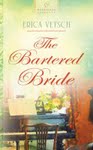
thebarteredbrideErica’s debut novel, The Bartered Bride, is now available. Leave a comment to get your name in the drawing for a free copy.

You can order a copy by clicking HERE. Or by phoning (740) 922-7280.

 Jonathan Kennebrae is furious when his grandfather informs him that his future has been decided. He will marry Melissa Brooke or be disinherited. Jonathan has invested years of his life in Kennabrae Shipping, but heaven help him if Grandfather decides to take it all away for this.

Melissa, too, is devastated when her parents make their announcement. As little more than a bargaining chip in her father’s business maneuvers, she feels her secure world slipping away. Engaged to marry a man she has never met—someone “considerably older” than herself? What have her parents done?

Can Jonathan and Melissa find a way out of this loveless marriage, or must they find a way forward together?

ERICA VETSCH is married to Peter and keeps the company books for the family lumber business. A home-school mom to Heather and James, Erica loves history, romance, and storytelling. Her ideal vacation is taking her family to out-of-the-way history museums and chatting to curators about local history. She has a Bachelor’s degree from Calvary Bible College in Secondary Education: Social Studies. You can find her on the web at www.onthewritepath.blogspot.com  


To the left a picture of officer’s and enlisted barracks at Fort Larned, Kansas.

Cowboys at Christmas – Donna Alward

donna-alward-christmas-coverYou know, I’m getting kinda used to this cowboy thing.  And while it’s nice to go off the ranch once in a while and write something different – I had scads of fun doing an office romance – it’s getting more like writing cowboys and ranchers is what I know.  Somehow, no matter what kind of story I’m working on, elements of those cowboys come through. 

I think part of it has to do with setting, to be honest.  I’ve always felt a strong connection to the land (even if it’s not ranch land per se) and so my characters often do too – there’s a respect and reverence for it.  It’s in the way the leaves on the cottonwoods rustle, or how the fields stretch out to touch the horizon, or just the sense of fulfillment one feels breathing in the fresh air, ripe with harvest.  Or, maybe even ripe with something else.  Even that – I don’t mind so much.  It smells to me of hard work and sustenance and roots.

Hard work – roots – those are things you’ll find over and over again in my books, so when I started work on my novella, “A Bride For Rocking H Ranch,” (Montana, Mistletoe, Marriage) I knew those twocowboysnow2 elements would play a big part.   After all, what could be better than a hard-working cowboy at Christmas?  *Pauses to ponder*…..

(I know.  I’m thinking sheepskin jacket, cowboy hat, snow dusting his shoulders as his dark eyes…)

But wait.  This time I did something different.  I put in a twist.

My hero’s not a cowboy.  He’s a CHEF.

My heroine’s the cowboy – or rather, cowgirl.  In fact, she’s the de facto manager of Rocking H Ranch outside Helena, Montana.  Kelley can hold her own and no one works harder – looking after the land AND the family.  She likes her jeans and boots and no-fuss flannel shirts.  She can’t cook and leaves the domestic side of things to her sister Amelia.  And due to some troubles within the Hughes clan, she’s agreed to cook Christmas dinner for the family.

Of course this is where Mack comes in.  Mack, despite being a chef, is still a Montana man even as he tries to deny it.  As the story goes on, that really starts to creep through until you realize he and Kelley aren’t so different after all. 

Hard work ethic.  Putting down roots.  Honour.  All things that our cowboy and rancher heroes have in spades, and maybe that’s why writing contemporary westerns is so much fun for me.  Those are the kinds of guys I’d want to marry.  I did marry one – not a cowboy, though he has the boots to say otherwise – but someone who believes in hard work and a fair shake and family.

Setting it all at Christmas?

christmas_present_21


Well, that’s just the bow on top of the present, now, isn’t it?

I’ll pick a random commenter to win a copy of Montana, Mistletoe, Marriage – featuring my novella A Bride For Rocking H Ranch as well as Snowbound Cowboy (Amelia’s story) by Patricia Thayer.


Kate Lyon Loves Texas History

kateHey, there, from north Texas!  I’m thrilled to be blogging with you today and hope you enjoy it as much as I plan to! 


Although I’m a recent transplant to Texas from Alabama, I’m no stranger to this great state.  We’ve lived in Texas several times over the years, three times in El Paso, once in San Angelo, Austin, Frisco and now the northeast.  My husband’s family settled in southeastern Texas shortly before the Civil War and one of his great-uncles, among a company of volunteers from Georgia, was shot down after surrendering at Goliad. 

 paloduro1

Too much detail?  My husband often tells me, “Quit researching and get to writing!”  Not that it stops me.  That’s what I love most about writing historical romance—the research.  And in Texas, where “Everything is Bigger!”, there’s plenty of history to be discovered.  I love to visit the sites of the actual events I write about.  Big events, especially the tragic ones, leave unmistakable energy at the site.  While writing Time’s Captive, I visited the Palo Duro Canyon.  I’d read that on the day General Mackenzie fired on the Comanche’s camp, he ordered his troops to round up the Comanche’s horses, then shoot and burn them.  Fourteen-hundred horses burned that afternoon while the Comanche women keened and wailed.  The men were too busy fighting at the time, but they mourned the loss soon enough.  Without their horses, the Comanche—often called the Lords of the Plains—were lost, destroyed. 


tbt_palo_duro3The day I visited, I stumbled around, looking for the place where the horses were burned, wandering through a thick copse of scraggly trees.  The ground beneath my feet had an odd feel, like sand, only coarser.  Finally, I came to an historical marker, where I learned that I’d been wandering around on the actual site of the burning.  Such a rush of emotion swept over me as I read that I almost fell to my knees, residual emotion from the site’s energy.  It was as if the Comanche’s sorrow hit me all at once, and the view of the sparse vegetation so paralleled the Comanche’s’ lives that I understood more than a book could ever have told me.  At day’s end, I found it hard to leave.


watermeloncontestNot all my discoveries are tragic.  For instance, Lockhart, the actual town near which I set the fictitious town of Cedar Springs in Destiny’s Captive, holds a watermelon festival each year, complete with seed-spitting contests, eat-offs, cook-offs, you name it.  As a result, watermelons had to figure among the activities in the book.  (I’d wanted to include a “festival,” but the hero and heroine had other plans for this plot.)  Lockhart originally boasted a large complement of German immigrants and the town is famous for its long-lived barbeque establishment:  Kreuz’ (pronounced Kr?tzes).  (Absolutely incredible barbecue in a simple setting, true to its German roots.)  I considered having the hero and heroine meet over barbecue, but Kreitz’s hadn’t been established yet. 


txgovmansionI visited Lockhart years ago, before I ever dreamed of setting Jeremiah’s story there.  And, though I’ve lived in Austin (which so far ranks as our Top Pick), and been to the Texas Capital and most of the tourist sites around, I still needed to do more detailed research for the book.  For that I turned, as I generally do, to the Internet, where I discovered a real-life heroine:  Mrs. Angelina Eberly.  (Another discovery was that Angelina’s a pretty common name in Texas, past and present.)  This gutsy lady, an innkeeper, hated Sam Houston.  Who can blame her?  In the chaos that ensued after the fall of the Alamo, Houston ordered the town of San Felipe burned to keep it out of General Santa Anna’s hands, including the hotel Angelina and her deceased husband had founded, and upon which she relied for her living.  That didn’t deter Angelina.  She remarried, bought another hotel in Austin, which had been newly proclaimed the capital by Texas’ second governor, Mirabeau B. Lamar, and she started over. 


angelinaeberlystatueUnfortunately, Houston hated Lamar and called Austin “the most unfortunate site on earth for a government.”  He tried to subvert Lamar’s intentions by sending a company of Texas Rangers to steal the state’s archives and return them to Washington-on-the-Brazos.  Angelina stumbled on the men leaving in loaded wagons, realized what they were about and fired the town cannon, which was kept loaded in case of Indian attack.  It’s believed she lit it with her cigar!  Luckily, she missed the men and their load of archives, but blew a hole in the General Land Office building three blocks away and succeeded in alerting the town.  In the ensuing “Archives War,” the archives were safely returned to the capital intact, and Mrs. Angelina Eberly was recognized as a true Texas heroine.  Ironically, during his entire second term as governor, Sam Houston rented a room in Angelina’s inn.  In 2004 a statue commemorating Angelina’s bravery was placed at the same corner where the town cannon sat. 


destinyscaptivecoverDid I mention residual energy?  Maybe I’m overly sensitive, but when I visited the stacks at the Center For American History at the University of Texas in Austin, I got to handle that energy in the form of original documents from the participants in the Red River War (the major conflict in Time’s Captive.)  (You can tell a lot about a man by his penmanship, or total lack thereof.)  What a thrill!  Just take a roll of coins for the copy machine, loose paper (a ream should be enough), five pencils (which they’ll provide if you forget), and be prepared to be amazed.  It’s a thrill to hold the hand-written reports of the people who were there and enjoy a first-hand look at events.


What it all boils down to is this:  on-line research is great.  The Internet is a wonderful resource and we’re all lucky to have it.  After all, I came across Angelina Eberly’s story while researching the Governor’s Mansion in Austin.  However, writing’s such a solitary existence that I highly recommend hands-on research if you can manage it.  History’s waiting for you.  Get out there and see it, feel it, touch it—SENSE IT!


Just be prepared for a few zingers!

Jodi Thomas: Texas In My Blood

jodi-thomasWhen people say I write with a true Texas voice I always thank them and wonder how I could write any other way.  I’ve got Texas in my blood and I’ve been telling stories set in Texas for twenty years.  From Beneath the Texas Sky in 1988 to The Lone Texan released October 6, 2009, my heros belong here.

My stories are born in the soil of my memories.  I remember hearing my grandmother tell about how she was born in a covered wagon.  Her mother died that night so her aunt took the newborn to Oklahoma where they homesteaded and returned her four years later to her father.  My grandmother traveled back and forth between the two farms until she married at 16. She met my grandfather at a barn raising when they were both fifteen. They spent one day together.  He returned a year later to marry her.  He’d spent the year clearing land and building a house.  She’d spent the year filling a hope chest.  They were married almost 70 years and I can see the chest they had from my desk as I wriite.

My other grandmother was born in a dugout not much bigger than a hotel room. I have her biscuit bowl in my kitchen.  She never measured when she made bread.  She just knew how much of each ingrediant to put in that bowl.

texas-raintexas-princesstall-dark-and-texanlone-texan-sm

When I began the Whispering Mountain series, I knew I wanted to write a story about a family.  Being a Texan isn’t just the hat and the boots, it’s the heart as well.  Folks say Texan’s brag.  I think I’ve figured out why.  After the Civil War, most people in Texas, and those who came around then like my relatives, had nothing.  Life was hard and when they finally had a good crop or their wife made a great pie or their horse won a race, they bragged.  Not to show anyone up, but to show what they’d done and they knew their friends and neighbors would celebrate with them.

Someone asked me where I find my heroes and I have to say, ‘I’m surrounded by them.’  Six years ago when I moved into Women’s Fiction and began writing stories taking place in today’s Texas I still felt very much at home.  With TWISTED CREEK (2008) I blended character traits of people I’d known and loved.  In REWRITING MONDAY,  I stepped into a small town modeled after the one where I spent my summers growing up.

When I began THE LONE TEXAN, I faced the challenge of writing about a younger hero than usual.  I don’t know when I’ve had so much fun.  Drum grew up in an outlaw camp with no parenting.  He’s as wild as Texas was in 1850, but when he sees what a real family is like, he knows what he has to do.  In the first Whispering Mountain story, TEXAS RAIN(2006,) he’s 15 and thinks himself in love with Sage McMurray.  In THE LONE TEXAN he’s 20 and knows she’s the woman he wants.  Only problem, besides keeping her alive, is convincing her to marry him.

the-lone-texan

Hope you read Drum and Sage’s story that is out this month and step into my Texas with me for the adventure.  If you have a minute take a look at my video.  By the way, Matt at Readerhood, who did all the videos of my books, is a sixth generation Texan and my son.  He works out of a home office where he also corrals the first seventh generation who just turned one.


So, how do you know if Texas is in your blood?
1.  If you can look out at miles and miles of open plains and marvel at how beautiful it is.
2.  If you don’t notice the wind until it slams your car door closed for you.
3.  If you can still smell the gunpower at the Alamo and cry when you walk in even though the men died over 170 years ago.
4.  If, when you’re overseas and someone asks where you’re from, you say Texas.
5.  If you know what a yankee dime is.
6.  If you know what a cow patty is.

Are there any Texans out there who want to add a few to the list?  I’d love to hear from them and everyone who loves western romance. I’m giving away a copy of THE LONE TEXAN to one lucky commentor.

And for those of you who are not from Texas, you’re welcome to ride the range with me through the books anytime. I’d love to have you join me. Also, I’m on Twitter. You can follow me there.

Jodi Thomas

www.JodiThomas.com

http://twitter.com/jodithomas