Traveling Then and Now . . .

Confession time: I am the probably among the world’s worse travelers when it comes to packing.

When I go on a trip, even a weekend trip, I have a tendency to over pack. This is particularly true when I’m driving. I will take at least two suitcases, an ice chest, a minimum of five books and quite possibly the kitchen sink.

I think it goes back to my childhood. I was a Campfire Girl. Like Girl Scouts, we were taught to always be prepared. You never know, for instance, whether there will be a freak ice storm in August, or a heat wave in January. You never know whether you’ll be tempted to go to a formal restaurant or a Kentucky Fried Chicken window. And I must have at least two bathing suits and at least one coverup for frequent trips to a pool.

I know. Excuses. Excuses. But I can’t help myself. I’m a packaholic.

Everyone has their most admired person. My most admired person is Libby Hall, president of RWA when I first went on the board. We had ten day meetings in July – three to four days of board meetings and six days of conference. Most of us dragged huge oversized suitcases, book bags, carry-ons and purses large enough for a Great Dane. Libby carried one carry-on for all ten days. Ten days! Ten days of parties and formal events and presiding over luncheons and dinners, etc. Wonder of all wonders.

I was shamed but, unfortunately, not shamed enough to change my profligate packing.

So I was bemused — while researching a new western series – to find a recommended wardrobe for one man embarking on a three-month journey across the western plains. It comes from “The Prairie Traveler,” the Best-Selling Handbook for American Pioneers (published 1859).

Here it is:

2 blue or red flannel overshirts, open in front, with buttons.
2 woolen undershirts.
2 pairs thick cotton drawers.
4 pairs woollen socks
2 pairs cotton socks.
4 colored silk handkerchiefs.
2 pair stout shoes, for footmen.
1 pair boots, for horsemen.
1 pair shoes, for horsemen.
3 towels.
1 gutta percha poncho.
1 broad-brimmed hat of soft felt.
1 comb and brush.
2 tooth-brushes.
1 pound Castile soap.
3 pounds bar soap for washing clothes (for three months?)
1 belt-knife and small whet-stone.
Stout linen thread, large needles, a bit of beeswax, a few buttons, paper of pins and a thimble, all contained in a small buckskin or stout cloth bag.

Being written by a man, it doesn’t deign to offer advice on women’s wear, but I would guess it would be two dresses, two pair of cotton drawers, etc.

I fear I would make a terrible pioneer, but the above information provides some inspiration. Perhaps on the next weekend trip, I can leave the kitchen sink at home.

Those Saturday Matinees

eliz-child-frm2.jpgJust in case you haven’t figured it out, I’m older than dirt.  I’m so old that I grew up without television.  Not that it hadn’t been invented—the problem was, we lived in a small town surrounded by mountains that cut off the signal.  By the time somebody put a relay tower on a nearby peak, I was a senior in high school.

What was it like growing up without TV?  In a word, it was wonderful.  And one of the best things about being a kid was the Saturday matinees.Every Saturday afternoon at 2:00 we’d congregate at the local cinema.  I usually went with my cousin Millie, who was a year older and looked out for me. Those of us who were under twelve could get in for 14 cents.  That meant we could show up with a quarter, buy a ticket, a 10 cent bag of popcorn and a piece of penny candy and be set for the afternoon.

The show always started with a cartoon—Bugs Bunny was our favorite, along with Donald Duck and maybe Tom & Jerry.Next to come on the screen was the newsreel.  Mostly we thought it was boring, but it was the only time we got to see footage of important events that were happening in the world.  Looking back, we saw some amazing things and people—Churchill, Gandhi, Eisenhower, Stalin, Eleanor Roosevelt, the young Princess Elizabeth, and so many others of that era.

Then came the 30 minute serial—most of these were westerns, with stars like Gene Autry and Hopalong Cassidy.  There were also a few superheroes thrown in, as well as Tarzan and a character named Jungle Jim. 

hrides.jpgThese episodes all had one thing in common—the cliffhanger endings that kept us coming back week after week to see if the hero—or the girl—really survived.  Watching them, I now realize, I was already picking up some of the skills that would make me an author.It was at those Saturday matinees, basking in those wonderful, corny old movies, that my love of romance and adventure was born.  That I’m able to share that love in the stories I create today is one of the luckiest things that ever happened to me.

Do you have a favorite old movie or childhood experience to share with us?  Why are you a romance reader, or writer, today?  Please feel free to let us know.

And don’t forget to enter our big contest.  We have some great prizes to give away!

Where Eagles Fly

SkyWalk

“This was a dream

Just like an eagle can fly into the Grand Canyon, my vision was to enable visitors to walk the path of the eagle, and become surrounded by the Grand Canyon while standing at the edge of the Glass Bridge. The bridge gives us a chance to share the wonder of the canyon that the Hualapia Tribe has graciously offered.

My dream was to find a balance between form, function and nature. Once a dream…now a reality.”

David Jin, Founder, Grand Canyon Skywalk

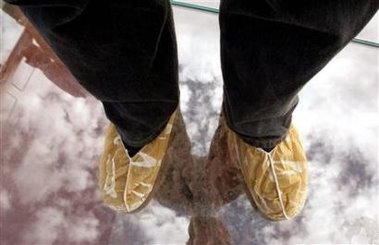
Stepping out across the Skywalk at the West Rim of the Grand Canyon definitely provides an eagle’s view of the canyon.  Standing 4,000 above the canyon floor is a fascinating experience.  The distance below is truly incompressible to the mind and eye.  SkyWalkThe hawks soaring below looked like graceful black specks against amber stone. Standing on the glass walk, you truly feel as though you are walking through the clouds, and when the sky’s reflection hits just right, you ARE walking on clouds.  Check out the cool yellow booties provided for viewers to protect the glass.

Even my teenage boys thought the Skywalk to be more thrilling than any roller coaster we’ve been on.  Visiting the Hualapia Reservation was, by far, my best visit to the Grand Canyon. It is a looong drive to the west rim, which takes you through Joshua Forest (dense population of Joshua trees), before turning onto a 15 mile dirt road widning through the private land of the Hualapia Tribe. From there the elevation climbs, leaving behind the Joshua trees (which only grow at an elevation of about 3000 ft) and takes grandc_villiage.jpgyou through the more common desert scrub of sage and cacti, and up to Eagle Point.  Aside from the Skywalk, they also have authentic Indian GrandCanyon1dwellings visitors can walk through. The clay structure with the hole in the roof is a sweat lodge. Below is a sage wickiup used during the squelching hot summer months. There was also an amphitheatre with scheduled Native American culturalGrand Canyon performances where we sat and watched dancers from various tribes across the states perform dances, sing songs and play a variety of drums.

Leaving the village, a short bus ride took us up to my absolute favorite part of our three-stage tour–Guano Point, where you can take in a view of the canyon and Colorado River WITHOUT BARRIERSThe only thing keeping you from plummeting to the rocks 4000 feet below is your own common sense.  HandyCamPicFor me, this was better than even the Skywalk. This was the place I felt detached from all the other distractions and could really get lost in the land, my thoughts, and daydreams.

 GC

See that dark shadow against the cliffs…directly over our heads were big black and gray clouds. We happened to be there at the onset of a thunder storm, the electricity in the clouds actually had our hair standing on end! Talk about luck–spectacular views, pleasant temperatures in July and storm clouds booming overhead like tribal drums….*sigh*  The day could not have been moreFamily perfect.  Inspiring, thrilling, educational, serene…and more natural beauty than you can shake a stick at  😉

Lonesome Dove – a western classic

call and mcraeLonesone Dove DVDLonesome Dove, written by Larry McMurtry, is a Pulitzer Prize-winning western novel and the first published book of the Lonesome Dove series. Can you imagine the daunting task that native Texan and screenwriter Bill Wit  tliff took on when he adapted Larry McMurtry’s novel to film? First, he needed to rein in the sprawling 843 page story while still retaining its majestic essence. Wittliff’s work was also made more difficult because, in the novel, McMurtry uses the narrator’s voice to reveal information about characters and to describe events. To provide the same information in the film, Wittliff needed to create dialogue and provide visual cues that did not exist in the novel.

costume sketch

A Southwestern Writers Collection is housed at Texas State and many of the original documents he used while creating this western classic can be viewed online at:

http://www.library.txstate.edu/swwc/ld/ldexhibit.html

The web exhibit features storyboards, costumes, including Gus’s boots, and even Gus’s dead wrapped body.


The epic four-part six-hour mini-series focuses on the relationship of retired Texas Rangers and their adventures driving a cattle herd from Texas to Montana.   McMurtry originally developed the tale in 1972 for a feature film entitled The Streets of Laredo (a title later used for the sequel), which was to have starred John Wayne, Henry Fonda, and James Stewart.  That didn’t happen, but thank goodness, McMurtry later resurrected the screenplay as a full-length novel.  It deservingly became a bestseller and won the 1986 Pulitzer Prize for Fiction.

The mini-series won six Emmy Awards and was nominated for 13 others. 

Casting for this epic was pure genius.  Who better to portray these multi-faceted aging Texas Rangers who to this day represent the epitome of courage, loyalty and everything we think of when we think “American West?”


Robert Duvall is Captain Augustus McCrae, co-owner of the Hat Creek Cattle Company, and considers himself the brains of the outfit. Generous, humorous, and lazy to the point of eccentricity, he serves as a foil to the more serious, practical Call. When not working, which he does as little as possible, Gus pursues his three chief interests in life: women, alcohol and cards. He is well known in the territory for his loud voice, superior eyesight and accuracy with a revolver.

wardrobetesttlj.jpg

Tommy Lee Jones is Captain Woodrow F. Call, Gus’s partner in the company. Less verbose and chatty than McCrae, Call works long and hard and sees no reason why others should not do the same. A former Texas Ranger, he served with Gus when both were young men. Though Call has utter disdain for lazy men who drink, gamble and whore their lives away, he has his own secret shame, which he hides carefully from his comrade. Call’s ability to manage unmanageable horses is also well known.


Danny Glover plays a magnificent role as Joshua Deets, an ex-slave and former Ranger.  When the story starts he’s a ranch hand at the company. On the drive, he serves as scout. A remarkable tracker and morally upright man, he is one of the few men whom Call respects and trusts.


Before he hit the NY streets as a cop, Rick Shroder played Newt Dobbs, young orphan raised by Gus and Call. His mother was a prostitute named Maggie Tilton, who died when he was a child. He knows his mother was a prostitute, and has no idea who his father might be. Most other observers, notably Gus and Clara Allen, are quite certain that Call is his father. Call eventually comes to this realization privately, but is never able to admit it explicitly.

gus and clara

Anjelica Houston is Clara Allen, a former love of Gus’s  She declined his marriage proposals years ago, and now lives in Nebraska, married to a horse trader who is comatose, having been kicked in the head by a horse. They have two girls, though she is afflicted deeply by the death of her sons. Though separated from Gus by many miles and years, she still holds him fondly in her heart. In contrast, she has utter contempt for Call.

lorena

Diane Lane is the lovely young Lorena Wood, a kind-hearted young woman who was forced into prostitution by her lover, then abandoned in Lonesome Dove. Lorena is silent, strong willed, and intimidating, refusing to submit meekly to her various admirers. Discontent with her line of work, “Lorie” hopes to leave the dead town and find her way to San Francisco.  Gus is her champion, and who could ask for a better one?


Secondary threads with characters of July and Almira Johnson and Blue Duck are intricately woven into the plot and throughout the journey of the cattle drive.  You can’t help but be enamored by the characters and caught up in their adventures.  Watching the story unfold brings laughter and tears every time.  The music that accompanies the panoramic scenes does a beautiful job of enhancing the grandeur of the vast landscape and feel of the untamed west.  I often listen to the original soundtrack, composed and conducted by Basil Poledouris. Lonesome Dove spawned the follow-up miniseries, Return to Lonesome Dove.

gusboots.jpg

Trivia facts about Lonesome Dove:

* Robert Duvall, who has appeared in over 80 movies, told CBS that Augustus McCrae, the character he played in Lonesome Dove, was his all time favorite role.  We can see why.

* The characters of July Johnson and Roscoe bear the same names as the sheriff and his sidekick who track James Stewart and Dean Martin in the movie Bandolero! (1968). Also, the sequence where Stewart and Martin discuss Montana resembles a similar scene in Lonesome Dove.

* The book, and the character Gus, is mentioned in country singer George Strait’s song “That’s My Kind Of Woman.”


So, fess up.  How many times have you watched Lonesome Dove?  Did you think return to Lonesome Dove lived up to the first?  Have you watched Streets of Laredo or Deadman’s Walk which precede the story?

If you’re a western lover and you’ve never seen this movie, well, I’m just sad for you.  But your situation is subject to change.  Head for Blockbuster!

That Long River of Brown

        There are few things that smack of the Old West as much as a cattle drive and all that one entailed–cowboys, drovers, rowdy cowtowns.  Remudas of horses and thousands of head of longhorn cattle.  Dust and sweat–and fortunes made at the end of the line.

        One lesser known facet of the era is the cattle queen, a rare and intriguing breed of woman who owned her own ranch and untamed-cowboy-email.jpgherd. A hard life made harder without a man at her side. 

         I had long wanted to build a story combining those parts of America’s history, and UNTAMED COWBOY was born.

         But once I had the plot in mind, my creativity stalled.  What did I know about cattle drives–besides almost nothing?  So I hit the Internet and found some lovely rare book sites.   Along the way, I uncovered some intriguing tidbits of information.  Here’s a few I’ll share with you:

1.  The horns on longhorn cattle had a spread of up to seven feet wide and were strong enough to rip bark off a tree.

2.  The average size herd during the peak of the cattle drive era was 3,000 head.  It took a remuda of 75 horses and 7 – 10 cowboys to drive the herds.  Trail bosses were paid $100/month, the cook $50/month and each cowboy, $30/month.  These were minimal cattle-drive.jpgexpenses for herds that when sold netted their owners $100,000 for a trip that took anywhere from several weeks to several months.  Do the math.  That’s a hefty profit for the time.

3.  The usual fare for cowboys was beans, bacon, hard biscuits and strong coffee.  Ironically, though they were surrounded by beef, the outfits rarely killed a beef on the trail because only a smart part of the meat could be eaten before it spoiled.

4.  In dry country, thirsty cattle could smell water ten miles away.

5.  Lightning was the most common cause of death on the trail.  During a storm, the cowboys would hide their silver (metal spurs, knives, even six-shooters) to avoid being struck.

For those rare times when beef was available, the camp cook would make his own version of “Sonofabitch Stew.”   (Sorry–I don’t mean to offend anyone, but this is what they called it.  Honest!  Variations were SOB Stew, or Son-of-a-gun Stew.)

Here’s one yummy-sounding recipe:

2 lbs. lean beef
Half a calf heart
1 ½ pounds calf liver
1 set sweetbreads (thymus gland)
1 set brains
1 set marrow gut
Salt, Pepper
Louisiana hot sauce

Kill off a young steer and cut up beef, liver and heart into 1 inch eating-sob-stew.jpgcubes.  Slice the marrow gut into small rings.  Place in a Dutch oven or deep casserole.  Cover meat with water and simmer 2 – 3 hours. 

Add salt, pepper and hot sauce to taste.  Take sweetbreads and brains and cut in small pieces.  Add to stew.  Simmer another hour, never boiling.

       Eww!  <gag, choke!>  Can you imagine eating this? 

       (By the way, this picture is one an old-time photographer took of cowboys eating the stew out on the range.)

       What are some of the strangest foods you’ve eaten?  Where were you when you ate it?  How did it taste?

       Let us know, and you’ll be eligible to win an autographed copy of UNTAMED COWBOY and a couple of sparkly Harlequin pens!

       Okay.  I’ll go first.  My Sicilian grandmother used to fry zucchini blossoms, and they were the best!  She’d go out into her garden first thing in the morning when the bright yellow blossoms were open zucchini-blossom.jpg(during the hottest part of the day, they’d close).  Now, maybe you didn’t know there were female and male blossoms, but there are.  The female part bears the fruit, so if you pick those, you won’t have any zucchini.  She’d pick the male blossoms, dip them into beaten eggs, dredge them in seasoned bread crumbs, romano cheese, salt and pepper and fried them.  Mmm.  I can almost smell them now.  A wonderful Italian treat and a treasured memory!

     I look forward to hearing from you!

     And don’t forget to enter our FALL BONANZA CONTEST–just go to the Primrose News Office page, and we’ll tell you how!

HUNKY COWBOYS, INSPIRING LYRICS, SONGS THAT REACH DEEP INTO YOUR SOUL

Yes, I’m talking about country music! Who’d have thunk that this New York born, Motown-loving, transplanted Californian would be moved by the rockabilly twang, the slow easy ballads, the humor, the honesty that is now the country music phenomenon.

The truth is my venture into writing began about the same time I found country music on the radio. Tired of the oldies, unable to relate to the new hip-hop sounds blasting the stations nationwide and feeling a little lost — musically and professionally, I knew I needed more of something in my life. I recall hearing Faith Hill on a pop music stationimages-tim-and-faith.jpg. But it wasn’t just Faith who intrigued me, but the man singing the duet with her, her new husband, Tim McGraw.  I knew little of both of them, but thought to investigate this “country music” thing.  

I bought a Tim McGraw CD, watched him perform on Jay Leno one night, and as they say, I was a goner. Being a western romance writer,  I fell in love with country music from that day on.  Tim’s tight jeans, black hat and amazing smile, helped just a little. 🙂     (Met him once and never miss his concerts) 

Seriously, the music called to me, beckoning with tunes of lost loves, of heroes found, of sweet smiles and first crushes.  The songs tell a complete story in three minutes, painting vivid pictures with impressions that stick in your head, long after the tunes are gone.   

I found the music inspiring, the lyrics fresh and honest, the images real. Sometimes humorous and fun, sometimes  heart-breakingly sad, sometimes soulful and  deep.  Those heart-tugging emotions evoked a longing for something else in my life.   They inspired me. They moved me. They made me feel. 

I can’t say that music solely played a role to help me find my lifelong passion of writing, but those short musical bursts of true life told beautifuly through rhythm and lyrics, with fiddles and drums and guitars and keyboards surely inspired me at a time when I truly needed inspiration.

bradpaisley46-426×135.jpgThe same holds true today.  Often I’m asked the timeless question writers are asked- where do I get my ideas?  My silent answer : From Tim and Faith and Toby and Kenny. From Martina and Brad and Shania.  From  Rascal Flatts and Brooks and Dunn, to name a few of my favorites.

LYRICS THAT PAINT IMAGES:

 untitled-toby-keith.bmpShould Have Been A Cowboy…Toby Keith

I bet you’ve never heard ol’ Marshall Dillion say, Miss Kitty have you ever thought of running away
Settling down would you marry me?
If I asked you twice and begged you pretty please.  She’d have said yes in a New York minute
They never tied the knot
His heart wasn’t in it
He just stole a kiss as he rode away
He never hung his hat up at Kitty’s place

I should’ve been a cowboy
I should’ve learned to rope and ride
Wearing my six-shooter riding my pony on a cattle drive
Stealing the young girl’s hearts
Just like Gene and Roy
Singing those campfire songs
Oh I should’ve been a cowboy

I might of had a sidekick with a funny name
Running wild through the hills chasing Jesse James
Ending up on the brink of danger
Riding shotgun for the Texas Rangers
Go west young man, haven’t you been told
California’s full of whiskey, women and gold
Sleeping out all night beneath the desert stars
With a dream in my eye and a prayer…
In my heart

LYRICS THAT INSPIRE

AnywayMartina McBride

imagesmartina-best.jpg

You can spend your whole life buildin’
Somethin’ from nothin’
One storm can come and blow it all away
Build it anyway

You can chase a dream
That seems so out of reach
And you know it might not ever come your way
Dream it anyway

God is great, but sometimes life ain’t good
When I pray it doesn’t always turn out like I think it should
But I do it anyway
I do it anyway

This world’s gone crazy and it’s hard to believe
That tomorrow will be better than today
Believe it anyway
You can love someone with all your heart
For all the right reasons
And in a moment they can choose to walk away
Love ’em anyway

LYRICS THAT REACH INTO YOUR SOUL:

2812106-280×336.jpgLive Like You Were Dying …Tim McGraw (10 weeks at #1)

He said I was in my early forties, with a lot of life before me
And one moment came that stopped me on a dime
I spent most of the next days, looking at the x-rays
Talking bout’ the options and talking bout’ sweet times.
I asked him when it sank in, that this might really be the real end
How’s it hit ‘cha when you get that kind of news?
Man what did ya do?
He said

I went skydiving
I went rocky mountain climbing
I went two point seven seconds on a bull named Fu Man Chu
And I loved deeper
And I spoke sweeter
And I gave forgiveness I’d been denyin’
And he said some day I hope you get the chance
To live like you were dyin’

He said I was finally the husband, that most the time I wasn’t
And I became a friend, a friend would like to have
And all of a sudden goin’ fishin, wasn’t such an imposition
And I went three times that year I lost my dad
Well I finally read the good book, and I took a good long hard look
At what I’d do if I could do it all again
And then

I went skydiving
I went rocky mountain climbing
I went two point seven seconds on a bull named Fu Man Shu
And I loved deeper
And I spoke sweeter
And I gave forgiveness I’d been denyin’
And he said some day I hope you get the chance
To live like you were dyin’

My Top 10 Favorite Country Artists

Tim McGraw

Faith Hill

Martina McBride

Carrie Underwood

Reba

Brooks and Dunn

Josh Turner

Toby Keith

George Strait

So Much More

I could go on and on about country  songs that inspire me.  The ones that make me laugh out  loud. (Tequila Makes Her Clothes Fall Off)  The ones that are almost too heartbreaking to listen to (Concrete Angel). The ones that pull at your parental heartstrings(There Goes My Life) and the ones that speak about love and romance. (I Need You)   

The stories they tell and  rich emotions they evoke all help me develop my characters, create my plots and put those words on the page.

There are too many songs to name and too many artists I enjoy to post here.  But I’d love to know if you’re a fan of country music?  Are there songs that help inspire you whatever your profession?  Who are your favorites? 

Post a comment and be entered into a drawing for Harlequin Coupons and a book from my backlist of available titles!

Happy Trails !

UP TOMORROW – GUEST BLOGGER KIM LOUISE !

Pow-wow’s

horseheader11.jpeGood Morning!

In July, my huband and I spent three weeks on the Blackfeet reservation. We were there with church volunteers and my friend, Patricia, where we were sponsoring some literacy and drug education programs. Plus, last week we were on the Crow reservation where we were again working with volunteers. Therefore, I thought you might like to hear something about the pow-wow, both the historical pow-wow and modern-day event.

The pow-wow — so much a part of the Western landscape and culture — attracts visitors from all over the world.

What are they all about?

endtour1.jpeOkay, let’s start first with the history of the modern pow-wow. Probably the early beginnings of the modern pow-wow has its roots in the summer/autumn gathering of the tribe. During the winter and spring months, the tribe would separate in their different bands to go their own way, to hunt and to prepare for the coming winter. Spring was of course devoted to gathering food and hunting. But in the late summer or early autumn the entire tribe would come together for ceremonials and religious renewal, as well as for cultural activities. It was a chance for young people to get to know other young people from other bands of the tribe, as well as for relatives and old friends to come together again. Often the Sundance was an part of the gathering, as well.

Today, at the modern pow-wow, you’ll see Indian and non-Indian people from all over the country enjoying the community and inspiring atmosphere of the pow-wow. Before we go any furhter, let me explain some terminology: there are some tribes (like the Navajo), who like to be referred to as Native Americans. But on the Northern Plains of North American, those tribes like the Blackfeet and Lakota, these people prefer to be called Indian. As one person put it to me, “I’m Indian and proud of it.”

Here in Los Angeles we have such a diverse and large American Indian population that if you were to ever attend one of our pow-wows, you’ll notice traditions being observed from all over the country. For instance, here in Los Angeles we have Aztec dancers, something one doesn’t see in the more northern pow-wows.

In the northern pow-wow, you’ll see the men’s Chicken Dance, something you won’t see normally in the Los Angeles Pow-wow.

powwowend21.jpeThere is much dancing and gift giving at the modern pow-wow. All ages participate and there is contesting within the different men’s and women’s forms of dancing. There are several different styles of men’s dances as well as women’s dances, as well. At many of the pow-wows in the west, you’ll also see the modern rodeo in action with some different aspects like the Indian relay race and the tepee raising contests.

There are food ventors — Indian fry bread is popular at all pow-wow’s that I’ve attended — and Native American jewelry of all kinds abounds. At the Blackfeet pow-wow there is the hand game and card games that continue well into the wee hours of the morning and at the Crow Fair pow-wow, one is treated to the sight of 500 or more tepees all set in the background of the beautiful Little Big Horn area.

Have you ever been to a pow-wow? If so, what are your observations? Are you thinking of attending a pow-wow? And if so, do you have questions you’d like to ask before attending? I will be checking into the blog all day long, so let’s start a discussion. I’d love to hear from you.

powwow1.jpeHere are three of us at an LA pow-wow, resting between dances. Patricia, on the left is a Traditional dancer, while Elaine and I are Fancy Dance dancers. As a note, each particular style of dance has its own regalia.

And for your info, all people are welcomed at the pow-wow, and many a romance has been sparked at pow-wow, both the historical, as well as the modern day pow-wow.

So come on in and leave a comment or two. See you later!

red_3-crop-email.jpg

My Heroes Have Always Been Cowboys … and Their Trusted Companions!

94792fd94pgt1xm.gifWhen I heard the song by Big and RichSave a Horse, Ride a Cowboy, I had to chuckle.  It did bring about some very, uh, provocative images in my head.  Cowboys are fantasized, romanticized and idolized by women around the world.

  Let’s face it, romance writers and readers have a glorified image of the Cowboy. Rugged, bold and sexy as all get-out. I won’t disagree. Nobody likes to write a great cowboy more than I do.  So I won’t go there today… there’s time for that later.  Today, I’m talking about the their beautiful accomplices, companions and first loves.  No, not the heroine … but our hero’s trusted horse!  

Through my years as a western romance author I’ve had to research horses as often time they played a very essential role in my stories.  The gorgeous one-year old palomino is J.R.   He’s a quarter horse img_0059.JPGstraight from Wayne Newton’s Ranch, now living at my cousin’s stables in North Las Vegas.  It was a joy to meet him, feed him and make friends with him.   There’s nothing like hands-on training. And J.R. sure received a lot of attention that day!  

img_0037.JPG

J.R was new at the stables and in the corral.  Two other geldings didn’t accept him into their fold and they pranced and snorted and annoyed J.R. until the  geldings were separated from him.  The interaction between the three horses was fascinating to img_0055.JPGwatch.  Then the palomino simply took off, all long streaming golden mane and sleek, smooth lines, circling the corral over and over again, displaying his temper and  prowess. 

Inspired by J.R. I wrote a wild palomino stallion into my March 2008 release, Taming the Texan.  It’s amazing how the wild horse and man both needed to be tamed and they came to terms with their own natures at the same time.

cax82xhzcover.jpgIn my upcoming November 2007 release, Bodine’s Bounty, my hero’s faithful mare Lola, played a vital role as well. I’m so glad my cover included Lola along with Bodine and Emma.

TV MOVIE HEROES AND THEIR FAITHFUL HORSES

 Who could forget these two TV shows? I used to watch them over and over, and I remember telling my dad once, “I love you the most, except for Roy Rogers.” 

royrogers_trigger.jpg

Roy’s radio show ran for 9 years before hitting the TV screens from 1951 through 1957. He and his trusty golden palomino were featured in the show and over 100 movies. You don’t think of Roy Rogers without Trigger by his side.  daleevans_buttermilk.jpgAnd remember Dale Evans and her ride, Buttermilk?

The same holds true for The Lone Ranger – Clayton Moore portrayed the masked250px-loneranger.jpg  Texas Ranger who rides about righting injustices on his horse Silver.  Who could forget that opening announcement. “A fiery horse with the speed of light, a cloud of dust and a hearty ‘Hi-yo, Silver.”

HORSE TRIVIA 

Did you know:

  • Camargue horses are completely white as adults. Their babies are pure black when they are born.
  • There is a breed of horse from Russia called Akhal-Teke. It can go for days without food or water.
  • You measure a horse’s height in hands. Each hand equals four inches. If you say a horse is 16.2 hands high, the 2 stands for 2 fingers.
  • You can tell how old a horse is by how many teeth it has. A horse gets all of its teeth by the time it is five years old. After that, they just get longer.
  •  
  • A female horse is called a mare. In the wild it is the mare that decides when the herd moves on to another spot to find food.
  • A male horse is called a stallion. Usually only one stallion will stay with a herd.
  • Any marking on a horse’s forehead is called a star, even if it is not shaped like a star.
  • Horses and ponies feel safer when they are in a herd.
  • Mustangs are one of the few breeds of horses that live wild in North America. They are related to the horses that the Spanish explorers brought to North America 400 years ago.
  • Horses can communicate how they are feeling by their facial expressions. They use their ears, nostrils, and eyes to show their moods. Beware of a horse that has flared nostrils and their ears back. That means it might attack!
  •  A hoof is like a fingernail. It is always growing and needs to be clipped so that it won’t be uncomfortable for the horse.
  • A farrier is a person who makes horse shoes and fits them on your horse. They also clip hooves to keep them from getting overgrown.
  • A horse can move in four ways: walk, trot, canter, and gallop. A gallop is the fastest gait

Are there any horse lovers out there?  Do you have a favorite hero/horse combo from movies or TV?

Real Cowboys

0192-0605-2418-2133_tn.jpg            For many of us, the American cowboy is the ultimate fantasy hero—a strong, handsome hunk in a big hat and tight jeans—a hero who makes our hearts gallop.  But the mythic hero is based on real men who played a major role in taming the west.  And most of them were even tougher than the fantasy model.  They had to be.  Let’s take a look at them.           

The heyday of the real American cowboy lasted from the end of the Civil War to the mid-1880s.   The men who rode the cattle trails numbered about 40,000 in all.  The average age was 24.  They came from many walks of life.  Most were dirt poor.  Most—though not all—were uneducated.  Among them were mustered-out soldiers from the war, farm boys looking for adventure, outlaws on the run, black-sheep sons of European families, and even a future U.S. President—Teddy Roosevelt, who took up cowboying as an adventure.           

 The work they did—driving herds of longhorn cattle across rough country, sometimes for more than a thousand miles—was murderous.  Cattle were mean-tempered and dumber than fence posts.  They got lost and had to be found.  They got worms, mange and sickness and had to be doctored. They got mired and had to be pulled out.  They got stolen and had to be rescued.  They stampeded and had to be stopped.  And they demanded 24-7 care with no time off.  Being a cowboy was hard, filthy, dangerous work, all for a wage of about $30 a month plus meals.  This excerpt from a trail boss’s journal will give you an idea of what the life was like.  Upset our wagon in River & lost many cooking utencils…was on my Horse the whole night & it raining hard…Lost my Knife…There was one of our party Drowned today & several narrow escapes, I among them…Many men in trouble…Horses all give out & Men refused to do anything…Awful night…not having had a bite to eat for 60 hours…Flies terrible…Found a human skeleton today…”           

By the 1890s the great trail drives had ended and a new generation of cowboys had emerged, living and working on ranches, dressed in blue jeans and Stetsons.  But all of us who write about the West, owe a debt to those first tough, courageous REAL cowboys!           

 We’ll learn more about cowboys in future blogs.  Meanwhile, does anybody know some good cowboy stories?  Do you have a favorite cowboy movie?  A favorite cowboy character?           

For the research-minded, I’d like to mention my source—THE COWBOYS  from the Time-Life Books Old West Collection.  Happy Trails!

The First Americans and the Mustang

horseheader1.jpeGood Afternoon bloggers!

 I want to thank Maria Lokken and Tanya Hansen for joining in our discussion this morning, as well as fellow author, Cheryl St. John.  Also a big vote of thanks go to Linda B and Jennifer Y for their comments from yesterday’s blog, as well as Elizabeth Lane — another fellow author.

Well, here I am, getting ready to mail off the revisions for my next book (due out in March 2008), THE LAST WARRIOR.  But before I go, I thought we might discuss the mustang and its importance to Native America.

As you know, before the Spanish arrived with their horses, the Spanish Barb, Native America didn’t have horses.  Instead, the American Indians made use of the dog.  It was the dog that transported their goods from one place to another, sometimes even transporting a baby.  Is it any wonder that some tribes honor the dog to this very day?picturesforblog.jpg

As Helen Addison Howard says in her book, AMERICAN FRONTIER TALES,   “(the mustang) completely changed the Indians’ nomadic life-style in hunting and war, in moving camp, in recreation, in trade, raised the owner’s social position, became a status symbol of wealth, and engendered a new standard of well-being.”

Because of its short stature, the mustang was often called a pony.  But that stature was deceiving.  The mustang was an intelligent animal with a stamina that became legend.  It was a mustang who won the 3,000 mile endurance test held in Arabia against the finest Arab horses in the land.  That pony, Hidalgo, was the 800 pound, 8 year old that won that race, even though the race was done was over loose sand, and  in a land where there was very little water.

Did you know that the movie, Hidalgo, was based on a true story?

Well, that’s all for now.  Again, I welcome all your insights into this and any other animal that’s in your life.

Petticoats & Pistols