Calamity Jane

calamity2.jpgDo you love stories and films about real Western characters?  I do.  One of my favorites is Calamity Jane, whose outrageous lifestyle and genuine courage made her a frontier legend.

The record of Calamity Jane’s life is a mixture of fact and fiction.  Much of that fiction was invented by Calamity herself.We do know that her real name was Martha Jane Cannary, and that she was born in Missouri in 1852. In 1866 her family emigrated to Montana.  Her mother died on the trail, and her father passed away the following year.  Martha Jane became the head of the family and eventually struck out on her own.           

By the time she was 13, Martha Jane could cuss like a man and had learned to like whiskey.  She was a fearless rider and a dead shot.  In 1870 she became a scout in the campaign against the Indians.  At this time she began dressing in men’s clothes.  Sometimes she even passed as a man.  Her heart was warm and womanly.  But men’s clothes suited the rough work she did.  Her appearance also made it easier for her male associates to accept her as an equal.           

 Around the same time, she acquired her nickname.  Calamity claimed it was given to her by an officer she rescued from an Indian attack.  More likely it came from her way of drawing trouble wherever she went.  As one old-timer said, “If she sat on a fence rail, it would rare up and buck her off.”           

 Calamity remained with the army until the mid-1870’s.  Then she met James Butler “Wild Bill” Hickock and rode with him and his friends to Deadwood, South Dakota.  In Deadwood she worked as a pony express rider carrying the U.S. mail through dangerous country.           

Legend has it that Calamity and Wild Bill were lovers.  She was almost certainly in love with Bill, but he was married to a girl back East and had no romantic interest in Calamity.  After Bill was shot dead during a poker game, Calamity chased down his killer.  The man got away but was eventually recaptured and hanged.Calamity remained in Deadwood for a time.  During the winter of 1878 she helped nurse residents through a smallpox epidemic.  After that she returned to the army for a time, drove freight wagons, tried ranching, and finally drifted to Texas.           

In 1885, at the age of 33, Calamity married Clinton Burke and later gave birth to a daughter.  No one knows for sure what became of the child.            

By now Calamity Jane was a legend.  Friends persuaded her to cash in on her fame.  She toured and made many public appearances, some of them with Buffalo Bill’s Wild West Show.  But hard living had taken its toll.  She returned to South Dakota where she died in 1903, at the age of 51.  At her own request, she was buried next to Wild Bill, “the only man I ever loved.”           

I’ve always wished someone would make a good, historically accurate movie about the life of this amazing woman (the Doris Day musical, delightful as it was, doesn’t count).  How about you?  What actress would you cast as Calamity?  Who are some of your favorite real-life Western characters?  Don’t forget to sign up for our contest!  We have some great prizes.               

A True Texas Medicine Woman

Hi! Lorraine couldn’t be here today so I’m filling in. I hope you’re not too disappointed, but she’ll be back on October 10th. Meantime, I hope you find this as interesting as I did.

gun-and-holster.jpgAt a time when strapping on a gun was as commonplace and as necessary as breathing, you can imagine that the odds of getting shot were fairly high. Treatments for gunshot were basic—dig the lead out if you could and if you couldn’t you were likely a goner. Not a good scenario when doctors were hard to come by.

When we’re crafting our western romances, we usually have to do a lot of research about various things and sometimes we run across truly amazing stories. Here’s one I stumbled upon when I was researching gunshot wounds and treatment. I thought you might like to know about one of the most unique women who lived in Texas.

sophie-herzog.jpgDr. Sofie Herzog who came from back East to Brazoria, Texas in the late 1800’s was quite colorful. The lady doctor’s arrival in the small coastal community of Brazoria created quite a stir. She was attractive, energetic and a highly skilled physician. Though not Texas’ first woman doctor, in 1895 she was definitely a pioneer in a male-dominated field of the Victorian era. Not only was Dr. Sofie out of place in her chosen profession, but her appearance shocked a good many. She wore her hair cropped short, rode a horse astride instead of sidesaddle, and shaded her face with a man’s hat. Needless to say, she set tongues wagging. But the doctor had obvious medical skill and little competition, so when someone needed assistance, they weren’t too picky about the gender. Soon folks were calling her simply Doctor Sofie. 

She became particularly adept at removing bullets from gunshot victims. One of her techniques was elevating a gunshot patient so that gravity would aid in getting the lead out. Only twice in her career was she unsuccessful in recovering a bullet. When she had accumulated 24 extracted pieces of lead from gunfighters, she had a jeweler fashion a necklace with a gold bead threaded between each slug. She wore it constantly as a good luck charm the rest of her life.


Word of her medical skills and pleasing bedside manner soon spread. Dr. Sofie made calls in her buggy or traveled astride a horse. Often, she rode on handcars or trains to get to someone along the rail line in need of a doctor. In 1906, the railroad formalized its relationship with Dr. Sofie, appointing her chief surgeon of the S.L.B. & M Railroad. But, when headquarters learned that a female doctor had been hired, Dr. Sofie received a polite letter asking her to relinquish her position. She stubbornly refused and remained on the line’s payroll the rest of her life.  

In addition to her medical practice, Dr. Sofie operated her own pharmacy, built and operated a hotel, and became wealthy by investing in real estate. She was very enterprising.

In 1913, the 65-year-old doctor married Marion Huntington—a 70-year-old widower—and moved to his plantation seven miles outside Brazoria. Having reached an age when many would have retired, Dr. Sofie continued her practice, commuting each day from the plantation to town in a new Ford—the first automobile in the county.Fourteen years later, Dr. Sofie died of a stroke at a Houston hospital on July 21, 1925. At her request, they buried her with her lucky bullet necklace, evidence of her surgical skills and charming eccentricity. 

Here are a few prices for medical procedures and assistance in the 1800’s: 

A visit within one mile    $1.00

Each succeeding mile — .50

Simple case of midwifery — $5.00

For bleeding — .50

Bullet Wounds — Between $1.00 to 10.00

For setting fracture — $5.00 to 10.00

Amputating Arm — $10.00

Amputating Leg — $20.00

For advice and prescription in office — $1.00

For difficult cases, fee based in proportion to difficulty.

But as was often the case, the doctor accepted goods in lieu of money. I haven’t heard of one doctor who refused to treat someone because they couldn’t pay.

Have you read about or know an interesting person with an unusual story?                                       Or maybe you’d like to comment on the cheaper cost of medical treatment in relation to today’s prices?

Also. . .If you haven’t registered yet for the Big Fall Bonanza Contest, better get your name in the hat. The contest ends on November 30th.

Those incredibly hunky Native American men

horseheader11.jpgGood morning bloggers!

 Okay, did the title wake you up yet?  If not, stay tuned.  We’re going to have a look at some of those hunky men on the covers of our books.  As you might know already — or at least suspect — all of my books are about the historical American Indian.  And some of the men on those covers are incredibly good-looking.  And since I don’t have access to others’ covers, if you will bear with me, we will examine some of my own.

whiteeagle11.jpgThis is a past book — or as we like to say — an older title.  Orginally part of the Blackfoot Warrior series, this cover quickly became one of my favorites.  The model is Joseph Anselmo — and isn’t he delicious?

Then we have another cover — again with Joseph Anselmo and again part of the Blackfoot Warrior series — an older title.  The interesting thing about this particular cover is that when it first came out, I was touring in Montana and was on the Blackfeet reservation for their Indian Days Pow-wow.  There is a fellow on the reservation who looks exactly like Joseph here — and I was fortunate enough to meet him.  

This was again one of my favorite covers.                                                     nightthundersm1.jpg

Then we have a couple of very older titles — these are covers of my first books — LAKOTA SURRENDER was #1 and LAKOTA PRINCESS was #2.lpcover11.jpglscover11.jpg

The model for LAKOTA SURRENDER was John D’Salvo and the lady is Cindy
Guyer.

And then we have the most recent favorite cover — however, I don’t know the name of the model for this cover.  If anyone knows who this model is, please let me know. 

red_hawk_s_woman1.jpgAbsolutely handsome.  Of course I have other favorites, too.  Here’s one of my most prized, most favorite hunks of all time.3-paul-31.jpg

Well, it’s my favorite, although the man is not Native American.  Instead, it’s my husband, Paul.

At the time period when I write, the men were not only handsome — George Catlin describes them in 1834 as rivaling a Greek statue in physique — but there were other romantic values in place, as well.   Integrity, honor, honesty, undying devotion to family and to the tribe were uppermost.  A Jesuit monk once described the Hurons as a tribe of saints.  While I don’t know that I would go so far as to say that, I will agree that at this time in history, there were values of life and liberty that at times seem to be lost in our world nowadays.  And so I write about this time period in history with the hope of not only entertaining the reader, but bringing back to mind as vividly as possible a time when honor was respected above all else; when money meant nothing and when the land and the creatures upon it were free as the wind.

What’s your favorite cover?  Your favorite model?  Your favorite title?  I’d love to hear about them, and even more so, why they are your favorites.  So come on in and let’s talk.


Guest Blogger: Linda Warren


The good ol’ days…

adoptedson.jpg

I was so excited when Lorraine asked me to be a guest blogger. I write contemporary, and my stories are mostly about Texas and cowboys. I love, love westerns and online cialis canada at the top of this page I see some of the very best western authors. So I’m honored to add my thoughts to the blog.

I write about Texas and cowboys because that’s what I know. I grew up on a farm/ranch in Texas. My dad raised cotton, corn and cattle. He also drilled water wells and was the constable in our community. He was busy and often worked late at night. My three brothers and I rarely saw him, but Sunday was our day. The day we spent with Dad. After early mass and a big dinner my mom had prepared, we’d go to the picture show (that’s what we called it back then ). And yes, you guessed it, it was always a western. My dad wouldn’t watch anything else. I grew up on Gary Cooper (High Noon), Glenn Ford (3:10 to Yuma), Gregory Peck (The Gunfighter), and John Wayne (Red River, Rio Bravo). “Saddle up, pilgrim.” John Wayne couldn’t act, but it didn’t matter. His strong male persona was enough. eastwood-rowdy_yates.jpgWagon Train (Robert Fuller) and Rawhide were TV favorites at our house and I had a hard time taking my eyes off Clint Eastwood, Rowdy Yates. A-ah!            

I’ll always remember those Sunday afternoons. My brothers couldn’t wait for the shootout with the bad guys. They were always making gun noises during the movie. I couldn’t wait for that last scene where the hero rides away with the heroine, sometimes holding her hand. I just knew they were going to live happily ever after. I would be going, “Ah.” My brothers would be sticking their fingers in their mouths and gagging at the scene.

After the movie we’d go for ice cream and my brothers would be acting out the fights and the shootouts. I’d be daydreaming. At that age I wasn’t even thinking about being an author, but those Sunday afternoons and those westerns influenced me in ways I never realized until many years later.  Cowboys have a way of sneaking into my books. Maybe it has something to do with the unwritten code of honor and moral fiber I saw in the heroes of those old movies. Fighting for a cause and willing to die for it. Throw in a romance and it can’t get any better.

Do you have a favorite western when you were a child? Or even now. (Lonesome Dove had me spellbound. I’m still not over Gus dying.) I’d love to hear your favorites. From brodie.jpgthose who post a response I’ll draw a winner for my Feb Harlequin American, Once A Cowboy. (Take a look at that cowboy.)ford_glen.jpg

3:10 ToYuma is now showing here and I’m trying to talk my husband into going to the movies. I’m dying to see Russell Crowe in Glenn Ford’s role. Not sure if he can pull it off, but I’ll just enjoy watching him. And we’ll definitely have ice cream afterwards.

310_to_yuma_russell_crowe_210.jpg

Ah, the good ol’ days… 

Thank you,

Linda Warren

ADOPTED SON—Sep 2007 Super Romance

TEXAS BLUFF—Feb 2008 Super Romance(Book #5 Texas Hold ‘em Series)

ALWAYS A MOTHER—May 2008 Harlequin Everlasting Love

The Spaghetti Western – A Genre of its Own

fistful1.jpg366dollars1.jpgThe western movie genre is filled with mystique and legend. These movies tell and re-tell stories and myths of how early America began. Heroes and villains, searing landscapes, galloping horses and quick draws are just a few of the familiar sights and sounds that make up the western, and definitely among the things that draw us as western fans.

Spaghetti western is a nickname for a broad sub-genre of Western film that emerged in the mid-1960s, so named because most were produced by Italian studios. Originally they had in common the Italian language, low budgets, and a recognizable highly fluid, violent, and minimalist cinematography that eschewed (some said “demythologized”) many of the conventions of earlier Westerns — partly intentionally, partly as a result of the work being done in a different cultural background and with limited funds.   

The term was originally used disparagingly, but by the 1980s many of these films came to be held in high regard, particularly because it was hard to ignore the influence they had in redefining the entire idea of a western up to that point.  Because of the desert setting, and the readily available southern Spanish extras, a usual theme in Spaghetti Westerns is the Mexican Revolution, Mexican bandits and the border zone between Mexico and the US. Many of the films were shot in the Spanish Tabernas Desert of Almería, which greatly resembles the landscape of the American Southwest  

A bit of trivia: Spaghetti westerns are also known as “macaroni westerns” in Japan.   

eastwoodffod.jpgThe best-known and perhaps archetypical spaghetti westerns were the so-called Man With No Name trilogy (or Dollars Trilogy) directed by Sergio Leone.  Up until then we’d been mesmerized by Clint Eastwood as Rowdy Yates on Rawhide, and now here he was in living color and panorama on the big screen.  These movies replayed at the drive-in through the seventies, where my husband and I watched them with our kids sleeping in the back of the station wagon.  The musical scores composed by Ennio Morricone became synonymous with the genre and still ring in our heads. 

The man with no name rode into cinematic history in A Fistful of Dollars (1964), For a Few Dollars More (1965), and The Good, the Bad and the Ugly (1966). The latter had a shocking high budget for that time and this genre — in excess of one million dollars!   

filmlist_onceinwest1.jpgLeone’s follow-up film after the trilogy was Once Upon A Time In The West, which is often called one of the greatest films in cinema history.  It’s a classic good verses evil tale about railroads, land grabs, and the entrepreneurial spirit.  As the train moves west, the country is changed, paralleling the dwindling presence of the western movie with the forward expansion of Eastern civilization.  The story’s theme is the changing times.  Casting blue-eyed Hollywood good guy Henry Fonda as one of the nastiest curs in the West was pure genius, while Charles Bronson became an unlikely leading man.   

onceuponatimein-the-west.jpg

AMC shows this movie frequently, about once a month. Usually they show a pan and scan version in the daytime, but the late night showing will be in letterbox format. Watch the letterbox format or you will miss the beautiful panoramic scope.  (I found it scheduled on TCM on Sat, Sep 22, 2:15 PM.  The original is three hours long, so watch listings for the full version.)

Can you recall the first time you saw Clint Eastwood?  Has anyone NOT seen The Good the Bad and the Ugly?  Do you have a favorite spaghetti western I didn’t mention?  Could you pass the parmesan–er popcorn, please?

“This your first time, honey?”

color.jpg“I could not make a demonstration of affection over men nor any pretense at response to their caresses.  For the life of me, I could not understand why they should expect it.  They had only bought my body.  I could not see why they should want more.”–Madeleine, An Autobiography

While visiting my brother several years ago and browsing through a

Seattle gift shop, I found a fascinating book on early western prostitution.  Inspired by those haunting stories, I wrote my fourth (and last) book for Leisure Books.  Entitled “BROKEN BLOSSOMS”, the heroine is fiercely protected by her father, an influentiasoileddoves.jpgl but corrupt judge in the 1890s.  When she discovers she is the daughter of a beautiful prostitute, we learn with her the degradation her mother endured to survive.

In 1849, when the West was at its most rugged, it’s estimated there were only 2 women for every 100 men.  Many of these females were illiterate and inexperienced but hoping to get married.  Others came for wealth and adventure.  Most had their dreams dashed and were forced to survive by the only thing they had to sell–their bodies. As their numbers grew, so did prostitution.  It wasn’t long before a class system fell into place, starting from the most elite: 

Courtesan or mistress–These women were sophisticated, beautiful and intelligent.  Their services were given solely to gentlemen of great wealth and power who paid them well for the privilege.  Because of the gentleman’s prominence, society inbed.jpggenerally accepted the courtesan/mistress, giving her a degree of respectability.

Parlor House Ladies–Ranging in age from 18-30 years old, they lived in well-furnished homes, dressed in elegant gowns and expensive lingerie, wore makeup and perfume, and charged everything to their madam’s accounts–which kept them in continual debt to her. 

To keep her business flourishing, the madam would parade her girls throughout the community in leisurely strolls or open carriage rides.  Often the girls carried cuddly poodles, a breed no decent woman would ever own.  poodle.jpg

This higher class of prostitute spent her days in the garden, doing needlework or reading.  She ate well–nourishing meals of steak, roast and lots of milk to keep up her stamina.  In the evening, her work began, and once a gentleman entered her bedroom, she was bound to service him as he wished, no matter how humiliating or painful it became.  Her fee would be about $25 (more if the man spent the night).  The madam received half. 

Brothel ‘Boarders’–Lower in the chain was the prostitute who worked in brothels located in the town’s red-light district.  She was both younger and older than her higher-class sister–about 16-35 years of age.  She earned less, too, roughly $10/customer. pros.jpgThe brothels were not as elegant as parlor houses, yet they were warm and welcoming.  The girls enjoyed care and protection from their madams–most of the time.

Crib Prostitute–In larger cities, she worked in ‘hog ranches’ or cribs, a string of miserable frame buildings comprised of two rooms each, a parlor in front and a bedroom in the back.  Or she lived in camps or mining towns.  Either way, she was beholden to a pimp.  On payday, it was standing room only, and a fast prostitute could service as many as 80 men a night, at 50 cents each. 

Streetwalker–the lowest class of all.  She was a desperate woman, ravaged by age, disease, alcohol and drugs.  She hovered on the brink of suicide and spent her days in shadowy doorways, waiting, hoping, for any man to take her.  

For propriety’s sake, newspapers were forced to fashion creative terms for ‘prostitute.’  Here’s a few: 

Calico Queen
Ceiling Expert
“Fair but Frail”
Girl of the line
Margarita
Nymph du pave
Painted Cat
Horizontal Worker

No matter what she was called, or at what level she plied her trade, the prostitute played an integral part in settling the West.  By the very nature of her gender, she provided warmth, comfort and pleasure to the men who craved it. 

It was a life few of us can imagine.  A job most of us will never have.  Thank goodness, eh? In future blogs, I’ll share some of their gripping stories with you. 

But for now, I’d love to know:  What was the worst job you ever had?  The strangest?  The most lucrative or lowest-paid? Let us know!  Share your story, and I’ll put you in a drawing to win a B & N gift certificate! 

Speaking of–don’t forget to enter our BIG FALL BONANZA contest.  Just go to our Primrose News Office Page!

My worst job?  I must’ve been about 13 years old.  Back then, babysitting netted 50 cents/hour, so when I was offered $1 to babysit on Saturdays, I jumped at the opportunity.  Little did I know, the lady of the house wanted me to clean it, too!  

 I swear, she stored up the mess all week long, just for me.  Talk about a pit! So for 8 hours, I cleaned every room in the place, washed her dishes, did her laundry, ironing, made beds, etc, etc, etc.  for $1/hour.  Sheesh!  Talk about slave wages!   

How about you?

Traveling Then and Now . . .

Confession time: I am the probably among the world’s worse travelers when it comes to packing.

When I go on a trip, even a weekend trip, I have a tendency to over pack. This is particularly true when I’m driving. I will take at least two suitcases, an ice chest, a minimum of five books and quite possibly the kitchen sink.

I think it goes back to my childhood. I was a Campfire Girl. Like Girl Scouts, we were taught to always be prepared. You never know, for instance, whether there will be a freak ice storm in August, or a heat wave in January. You never know whether you’ll be tempted to go to a formal restaurant or a Kentucky Fried Chicken window. And I must have at least two bathing suits and at least one coverup for frequent trips to a pool.

I know. Excuses. Excuses. But I can’t help myself. I’m a packaholic.

Everyone has their most admired person. My most admired person is Libby Hall, president of RWA when I first went on the board. We had ten day meetings in July – three to four days of board meetings and six days of conference. Most of us dragged huge oversized suitcases, book bags, carry-ons and purses large enough for a Great Dane. Libby carried one carry-on for all ten days. Ten days! Ten days of parties and formal events and presiding over luncheons and dinners, etc. Wonder of all wonders.

I was shamed but, unfortunately, not shamed enough to change my profligate packing.

So I was bemused — while researching a new western series – to find a recommended wardrobe for one man embarking on a three-month journey across the western plains. It comes from “The Prairie Traveler,” the Best-Selling Handbook for American Pioneers (published 1859).

Here it is:

2 blue or red flannel overshirts, open in front, with buttons.
2 woolen undershirts.
2 pairs thick cotton drawers.
4 pairs woollen socks
2 pairs cotton socks.
4 colored silk handkerchiefs.
2 pair stout shoes, for footmen.
1 pair boots, for horsemen.
1 pair shoes, for horsemen.
3 towels.
1 gutta percha poncho.
1 broad-brimmed hat of soft felt.
1 comb and brush.
2 tooth-brushes.
1 pound Castile soap.
3 pounds bar soap for washing clothes (for three months?)
1 belt-knife and small whet-stone.
Stout linen thread, large needles, a bit of beeswax, a few buttons, paper of pins and a thimble, all contained in a small buckskin or stout cloth bag.

Being written by a man, it doesn’t deign to offer advice on women’s wear, but I would guess it would be two dresses, two pair of cotton drawers, etc.

I fear I would make a terrible pioneer, but the above information provides some inspiration. Perhaps on the next weekend trip, I can leave the kitchen sink at home.

Those Saturday Matinees

eliz-child-frm2.jpgJust in case you haven’t figured it out, I’m older than dirt.  I’m so old that I grew up without television.  Not that it hadn’t been invented—the problem was, we lived in a small town surrounded by mountains that cut off the signal.  By the time somebody put a relay tower on a nearby peak, I was a senior in high school.

What was it like growing up without TV?  In a word, it was wonderful.  And one of the best things about being a kid was the Saturday matinees.Every Saturday afternoon at 2:00 we’d congregate at the local cinema.  I usually went with my cousin Millie, who was a year older and looked out for me. Those of us who were under twelve could get in for 14 cents.  That meant we could show up with a quarter, buy a ticket, a 10 cent bag of popcorn and a piece of penny candy and be set for the afternoon.

The show always started with a cartoon—Bugs Bunny was our favorite, along with Donald Duck and maybe Tom & Jerry.Next to come on the screen was the newsreel.  Mostly we thought it was boring, but it was the only time we got to see footage of important events that were happening in the world.  Looking back, we saw some amazing things and people—Churchill, Gandhi, Eisenhower, Stalin, Eleanor Roosevelt, the young Princess Elizabeth, and so many others of that era.

Then came the 30 minute serial—most of these were westerns, with stars like Gene Autry and Hopalong Cassidy.  There were also a few superheroes thrown in, as well as Tarzan and a character named Jungle Jim. 

hrides.jpgThese episodes all had one thing in common—the cliffhanger endings that kept us coming back week after week to see if the hero—or the girl—really survived.  Watching them, I now realize, I was already picking up some of the skills that would make me an author.It was at those Saturday matinees, basking in those wonderful, corny old movies, that my love of romance and adventure was born.  That I’m able to share that love in the stories I create today is one of the luckiest things that ever happened to me.

Do you have a favorite old movie or childhood experience to share with us?  Why are you a romance reader, or writer, today?  Please feel free to let us know.

And don’t forget to enter our big contest.  We have some great prizes to give away!

Where Eagles Fly

SkyWalk

“This was a dream

Just like an eagle can fly into the Grand Canyon, my vision was to enable visitors to walk the path of the eagle, and become surrounded by the Grand Canyon while standing at the edge of the Glass Bridge. The bridge gives us a chance to share the wonder of the canyon that the Hualapia Tribe has graciously offered.

My dream was to find a balance between form, function and nature. Once a dream…now a reality.”

David Jin, Founder, Grand Canyon Skywalk

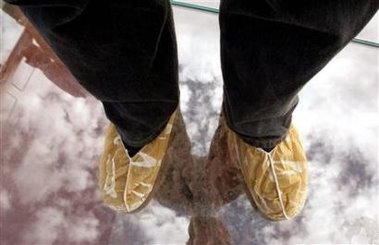
Stepping out across the Skywalk at the West Rim of the Grand Canyon definitely provides an eagle’s view of the canyon.  Standing 4,000 above the canyon floor is a fascinating experience.  The distance below is truly incompressible to the mind and eye.  SkyWalkThe hawks soaring below looked like graceful black specks against amber stone. Standing on the glass walk, you truly feel as though you are walking through the clouds, and when the sky’s reflection hits just right, you ARE walking on clouds.  Check out the cool yellow booties provided for viewers to protect the glass.

Even my teenage boys thought the Skywalk to be more thrilling than any roller coaster we’ve been on.  Visiting the Hualapia Reservation was, by far, my best visit to the Grand Canyon. It is a looong drive to the west rim, which takes you through Joshua Forest (dense population of Joshua trees), before turning onto a 15 mile dirt road widning through the private land of the Hualapia Tribe. From there the elevation climbs, leaving behind the Joshua trees (which only grow at an elevation of about 3000 ft) and takes grandc_villiage.jpgyou through the more common desert scrub of sage and cacti, and up to Eagle Point.  Aside from the Skywalk, they also have authentic Indian GrandCanyon1dwellings visitors can walk through. The clay structure with the hole in the roof is a sweat lodge. Below is a sage wickiup used during the squelching hot summer months. There was also an amphitheatre with scheduled Native American culturalGrand Canyon performances where we sat and watched dancers from various tribes across the states perform dances, sing songs and play a variety of drums.

Leaving the village, a short bus ride took us up to my absolute favorite part of our three-stage tour–Guano Point, where you can take in a view of the canyon and Colorado River WITHOUT BARRIERSThe only thing keeping you from plummeting to the rocks 4000 feet below is your own common sense.  HandyCamPicFor me, this was better than even the Skywalk. This was the place I felt detached from all the other distractions and could really get lost in the land, my thoughts, and daydreams.

 GC

See that dark shadow against the cliffs…directly over our heads were big black and gray clouds. We happened to be there at the onset of a thunder storm, the electricity in the clouds actually had our hair standing on end! Talk about luck–spectacular views, pleasant temperatures in July and storm clouds booming overhead like tribal drums….*sigh*  The day could not have been moreFamily perfect.  Inspiring, thrilling, educational, serene…and more natural beauty than you can shake a stick at  😉

Lonesome Dove – a western classic

call and mcraeLonesone Dove DVDLonesome Dove, written by Larry McMurtry, is a Pulitzer Prize-winning western novel and the first published book of the Lonesome Dove series. Can you imagine the daunting task that native Texan and screenwriter Bill Wit  tliff took on when he adapted Larry McMurtry’s novel to film? First, he needed to rein in the sprawling 843 page story while still retaining its majestic essence. Wittliff’s work was also made more difficult because, in the novel, McMurtry uses the narrator’s voice to reveal information about characters and to describe events. To provide the same information in the film, Wittliff needed to create dialogue and provide visual cues that did not exist in the novel.

costume sketch

A Southwestern Writers Collection is housed at Texas State and many of the original documents he used while creating this western classic can be viewed online at:

http://www.library.txstate.edu/swwc/ld/ldexhibit.html

The web exhibit features storyboards, costumes, including Gus’s boots, and even Gus’s dead wrapped body.


The epic four-part six-hour mini-series focuses on the relationship of retired Texas Rangers and their adventures driving a cattle herd from Texas to Montana.   McMurtry originally developed the tale in 1972 for a feature film entitled The Streets of Laredo (a title later used for the sequel), which was to have starred John Wayne, Henry Fonda, and James Stewart.  That didn’t happen, but thank goodness, McMurtry later resurrected the screenplay as a full-length novel.  It deservingly became a bestseller and won the 1986 Pulitzer Prize for Fiction.

The mini-series won six Emmy Awards and was nominated for 13 others. 

Casting for this epic was pure genius.  Who better to portray these multi-faceted aging Texas Rangers who to this day represent the epitome of courage, loyalty and everything we think of when we think “American West?”


Robert Duvall is Captain Augustus McCrae, co-owner of the Hat Creek Cattle Company, and considers himself the brains of the outfit. Generous, humorous, and lazy to the point of eccentricity, he serves as a foil to the more serious, practical Call. When not working, which he does as little as possible, Gus pursues his three chief interests in life: women, alcohol and cards. He is well known in the territory for his loud voice, superior eyesight and accuracy with a revolver.

wardrobetesttlj.jpg

Tommy Lee Jones is Captain Woodrow F. Call, Gus’s partner in the company. Less verbose and chatty than McCrae, Call works long and hard and sees no reason why others should not do the same. A former Texas Ranger, he served with Gus when both were young men. Though Call has utter disdain for lazy men who drink, gamble and whore their lives away, he has his own secret shame, which he hides carefully from his comrade. Call’s ability to manage unmanageable horses is also well known.


Danny Glover plays a magnificent role as Joshua Deets, an ex-slave and former Ranger.  When the story starts he’s a ranch hand at the company. On the drive, he serves as scout. A remarkable tracker and morally upright man, he is one of the few men whom Call respects and trusts.


Before he hit the NY streets as a cop, Rick Shroder played Newt Dobbs, young orphan raised by Gus and Call. His mother was a prostitute named Maggie Tilton, who died when he was a child. He knows his mother was a prostitute, and has no idea who his father might be. Most other observers, notably Gus and Clara Allen, are quite certain that Call is his father. Call eventually comes to this realization privately, but is never able to admit it explicitly.

gus and clara

Anjelica Houston is Clara Allen, a former love of Gus’s  She declined his marriage proposals years ago, and now lives in Nebraska, married to a horse trader who is comatose, having been kicked in the head by a horse. They have two girls, though she is afflicted deeply by the death of her sons. Though separated from Gus by many miles and years, she still holds him fondly in her heart. In contrast, she has utter contempt for Call.

lorena

Diane Lane is the lovely young Lorena Wood, a kind-hearted young woman who was forced into prostitution by her lover, then abandoned in Lonesome Dove. Lorena is silent, strong willed, and intimidating, refusing to submit meekly to her various admirers. Discontent with her line of work, “Lorie” hopes to leave the dead town and find her way to San Francisco.  Gus is her champion, and who could ask for a better one?


Secondary threads with characters of July and Almira Johnson and Blue Duck are intricately woven into the plot and throughout the journey of the cattle drive.  You can’t help but be enamored by the characters and caught up in their adventures.  Watching the story unfold brings laughter and tears every time.  The music that accompanies the panoramic scenes does a beautiful job of enhancing the grandeur of the vast landscape and feel of the untamed west.  I often listen to the original soundtrack, composed and conducted by Basil Poledouris. Lonesome Dove spawned the follow-up miniseries, Return to Lonesome Dove.

gusboots.jpg

Trivia facts about Lonesome Dove:

* Robert Duvall, who has appeared in over 80 movies, told CBS that Augustus McCrae, the character he played in Lonesome Dove, was his all time favorite role.  We can see why.

* The characters of July Johnson and Roscoe bear the same names as the sheriff and his sidekick who track James Stewart and Dean Martin in the movie Bandolero! (1968). Also, the sequence where Stewart and Martin discuss Montana resembles a similar scene in Lonesome Dove.

* The book, and the character Gus, is mentioned in country singer George Strait’s song “That’s My Kind Of Woman.”


So, fess up.  How many times have you watched Lonesome Dove?  Did you think return to Lonesome Dove lived up to the first?  Have you watched Streets of Laredo or Deadman’s Walk which precede the story?

If you’re a western lover and you’ve never seen this movie, well, I’m just sad for you.  But your situation is subject to change.  Head for Blockbuster!

Petticoats & Pistols